
-
Key Takeaways
-
What Is a Coordinated Turn?
- Adverse Yaw
-
Slip vs. Skid: What Is the Difference?
- Coordinated Turns Without Instruments
-
Which Way Does the Ball Move in a Slip vs. a Skid?
- Keeping the Ball Centered
-
Why Is a Skidding Turn More Dangerous Than a Slipping Turn?
- Why the Inside Wing Stalls First
- Slip to Spin
-
How Does a Skid Turn Into a Spin?
- In the Thick of the Spin
-
The Base-to-Final Stall and Spin
- Accident Review: Caldwell, Texas
- Concerning Statistics
-
Why Turning Raises Your Stall Speed
-
When Is a Slip the Right Move?
- Can You Slip With Flaps Down?
- Why Your Airspeed Reads Wrong in a Slip
-
Frequently Asked Questions
- What Is the Difference Between a Slip and a Skid?
- Why Is a Skidding Turn More Dangerous Than a Slipping Turn?
- What Does "Step on the Ball" Mean?
- Can You Spin an Airplane Without Stalling It?
- Is It Safe to Slip an Airplane With the Flaps Down?
- What Should You Do if You Overshoot the Turn to Final?
-
Conclusion
A slip and a skid are both uncoordinated turns. In one, you have too much bank and not enough yaw. In the other, you have too much yaw and not enough bank.
And while a slip is a genuinely useful tool, a skid low to the ground is the notorious setup for a fatal stall and spin.
Let’s say you’re flying a normal traffic pattern, and it’s a windy afternoon. You turn left base, and the tailwind pushes your groundspeed up more than you expected.
By the time you start the turn to final, you are going to blow straight through the centerline. Then, almost without thinking, your foot presses the left rudder to swing the nose back toward the runway.
That rudder input, right there, is what we’ll have to talk about.
Let’s break down the difference so you can tell what outcome your feet are about to create.
Key Takeaways
- A coordinated turn keeps the ball centered, with the nose pointed straight into the relative wind.
- A spin requires both a stall and yaw, so preventing the stall prevents the spin.
- To fix an uncoordinated turn, step on the ball until it slides back to center.
- If you overshoot final, go around instead of forcing the nose around with rudder.
What Is a Coordinated Turn?
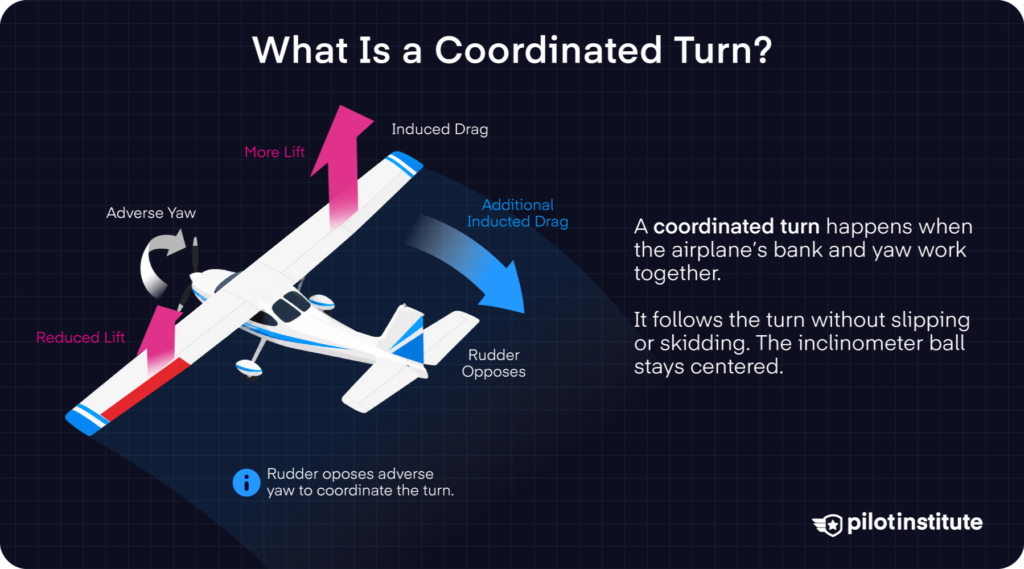
We can describe a turn as coordinated when your airplane’s nose points directly into the relative wind and the ball in the slip/skid indicator sits dead center.
In an uncoordinated turn, the relative wind is hitting the side of the fuselage.
The nose points directly into the relative wind. That little ball in the inclinometer stays parked in the middle.
But as many pilots are well aware, coordinated turns don’t happen naturally. It’s something you actively manage.
You’re constantly correcting for the yaw that creeps in from engine and propeller effects, aileron inputs, the way your airplane behaves as it turns, and how the airframe is rigged.
Staying coordinated, in other words, is a full-time job.
Adverse Yaw
An airplane does not steer like a boat or a car. To turn, you have to use coordinated bank and yaw. The FAA is blunt about this. The horizontal component of lift, with coordinated yaw, turns the airplane, not the rudder.
So why does the rudder belong in a turn at all? Blame adverse yaw.
You’re rolling into a bank. The aileron on the rising wing swings downward to push that wing up.
The outside wing makes more lift, and with it, more induced drag. It tugs the nose in the opposite direction of the turn, and away from where you’re trying to point it.
Left alone, your nose could swing the wrong way as you’re starting to turn. So you need rudder to cancel that tendency and keep the ball centered.
If you want the full mechanics behind why it happens, we break adverse yaw down in detail.
Slip vs. Skid: What Is the Difference?
Slip vs. Skid: What Is the Difference?
Both are uncoordinated turns. They work in opposite directions. A slip has too little rudder into the turn. A skid has too much.
They’re both uncoordinated turns, but they work in opposite ways.
According to the Pilot’s Handbook of Aeronautical Knowledge, in a slipping turn, your airplane is banked too much for its rate of turn. The nose ends up yawed outside of the turn.
With the extra bank, the horizontal component of your lift wins out over the centrifugal force. The aircraft then slides, or slips, toward the low wing.
A skidding turn is the inverse. Here, the rate of turn is too great for the bank you’re holding.
Centrifugal force overpowers the horizontal lift component and drags the aircraft toward the outside of the turn.
Put simply, a slip doesn’t have enough rudder pressure in the direction of the turn. A skid has too much.
Coordinated Turns Without Instruments
You can even feel the difference without glancing at your instruments.
In a skid, centrifugal force throws you and your passengers toward the outside of the turn.
It’s the same unpleasant force you get when a car takes a corner too fast on a flat road, and everyone slides toward the door.
A slip feels like the opposite. With the aircraft banked more steeply than the turn calls for, you lean toward the low wing, down into the turn.
And even without the help of instruments, you’ll know you’re in a coordinated turn when you feel forced straight down into your seat during the turn.
Which Way Does the Ball Move in a Slip vs. a Skid?
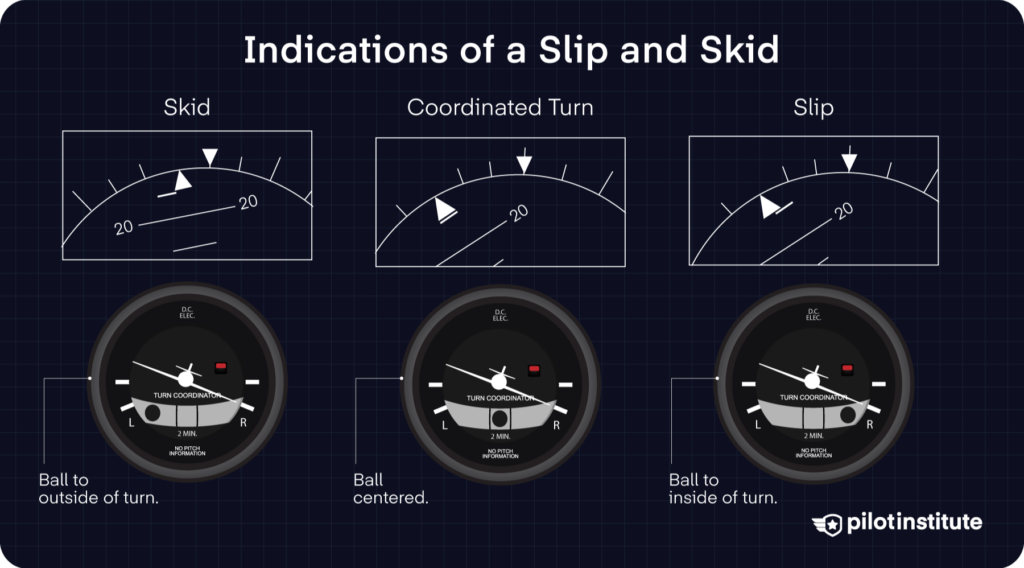
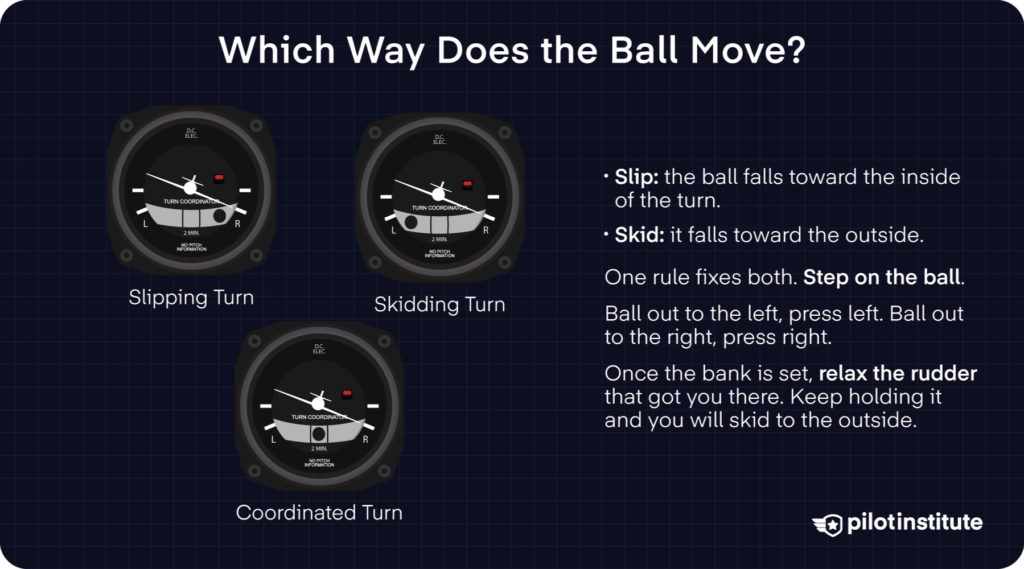
The ball in your slip/skid indicator falls toward the inside of the turn in a slip, and toward the outside of the turn in a skid.
You learn how to fix this in your early days of training. Step on the ball.
Whichever side the ball has slid toward, press the rudder pedal on that same side until it slides back to center.
Ball out to the left, press left. Ball out to the right, press right.
Keeping the Ball Centered
Once the bank is set, the amount of rudder pressure usually decreases, but it doesn’t necessarily go away. Most single-engine airplanes and co-rotating multi-engine airplanes still need some right rudder pressure to stay coordinated through the turn.
Use too much rudder, though, and the airplane can skid to the outside of the turn, moving the ball off-center.
Keep holding it, and the airplane could skid to the outside of the turn and drag the ball out with it.
The opposite error is just as easy. Press the rudder the other way, maybe by trying to force the pedals back to center, and you yaw the nose against the direction you’re turning.
You’re slipping the airplane into the inside.
Either way, the ball drifts off-center the instant it happens. Keep half an eye on it through every turn.
Why Is a Skidding Turn More Dangerous Than a Slipping Turn?
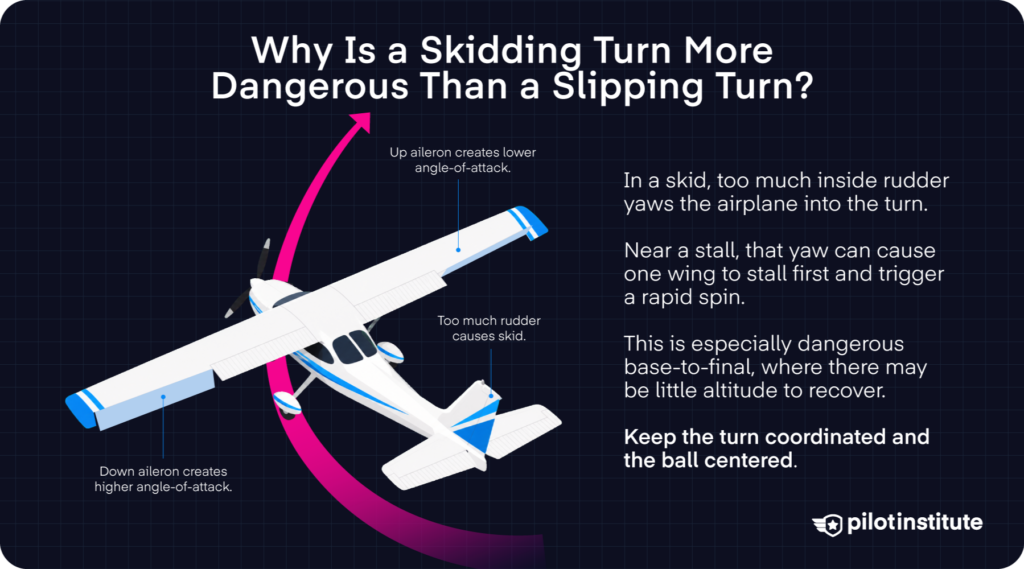
The skid is the more dangerous of the two. It can even be catastrophic if you’re close to the ground.
In a skidding turn, excess bottom rudder (the inside rudder) yaws and rolls the airplane deeper into the turn. The bank will then keep steepening causing the downward wing to reach the critical angle of attack.
Why the Inside Wing Stalls First
Because of improper rudder input, the yaw speeds up the outer wing and slows the inner one. The growing lift difference between the two increases the bank beyond what you wanted.
To hold your intended bank, you’ll feed in opposite aileron. Holding that opposite aileron deflects the aileron on the inside wing downward.
But remember, the down-deflected aileron raises that wing’s angle of attack and drives a more complete stall once the critical angle of attack is reached.
That brings the inside wing to its critical angle before the outer wing. It stalls and drops first, and the airplane rolls hard into the turn.
Slip to Spin
Now, a slip behaves differently. The outer, raised wing may stall first and drop, rolling the airplane back toward wings level instead of deeper into the turn.
But that doesn’t make a slip safe. Hold enough top rudder, and a slip can still break into a spin in the direction of that rudder.
The FAA is careful to add that the recovery is the same either way. Do not let the difference change what your hands do.
How Does a Skid Turn Into a Spin?
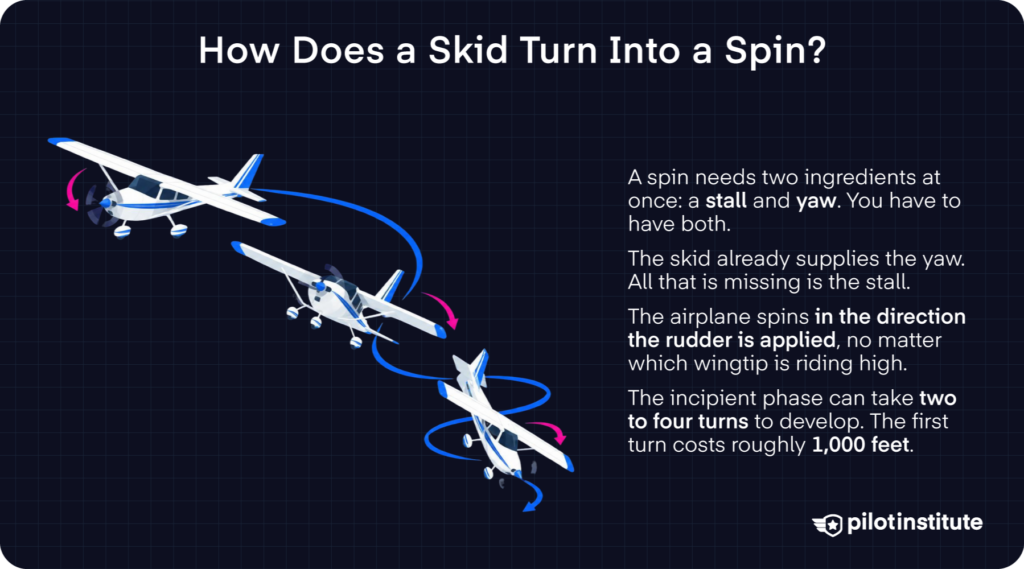
A spin needs two ingredients, and you have to have both. An airplane has to be stalled and yawed at the same time before it can spin, and every spin is preceded by a stall on at least part of the wing.
The skid supplies the yaw. That bottom rudder is already yawing you deeper into the turn, so the rotational ingredient is sitting right there.
All that’s missing is the stall, which could come from back pressure or turning the yoke outside the turn.
As the nose starts to drop, you pull to hold it up. Or, the inside aileron deflects downward. Either way, the inside wing’s angle of attack goes critical, and it stalls.
AC 61-67C also tells you not to forget about load factor. Pulling G in a turn raises the speed at which the wing will stall, and it climbs faster than most pilots expect. More on that below.
In the Thick of the Spin
When a wing finally lets go, the airplane spins in the direction the rudder is applied, no matter which wingtip is riding high. The rotation points straight into the turn and toward the ground.
A spin doesn’t arrive fully formed. It builds through an incipient phase that can take two to four turns to develop. Remember, every one of those turns is rapidly eating altitude.
The Airplane Flying Handbook puts the first turn at roughly 1,000 feet. Each subsequent turn loses about half that amount.
The Base-to-Final Stall and Spin
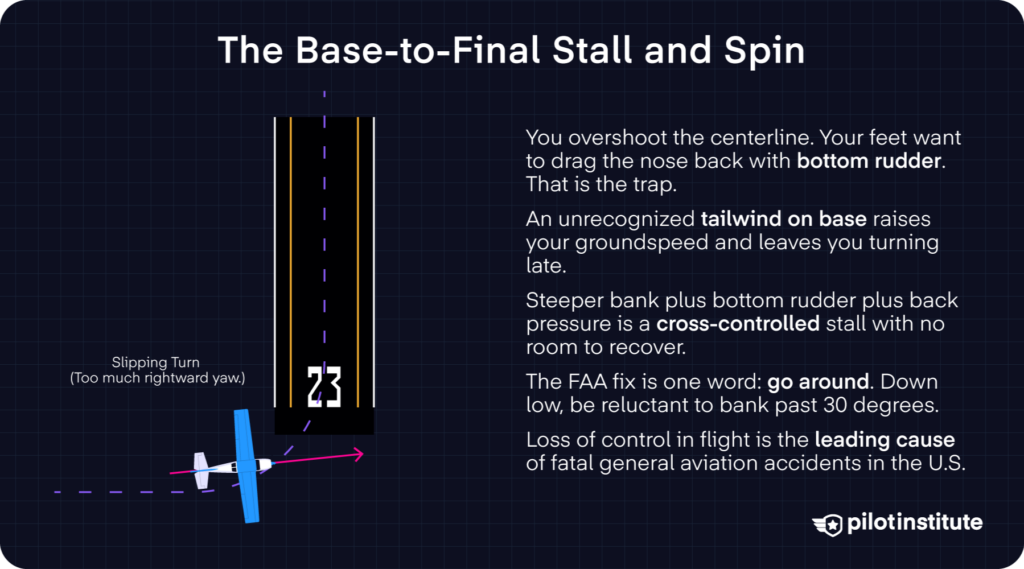
The deadliest version of this mistake unfolds on the turn from base to final. You could overshoot the runway centerline, and rather than accept the overshoot, you try to force the nose back around with bottom rudder and a little back pressure.
Sometimes, an unrecognized tailwind on base pushes your groundspeed up and leaves you turning late.
You overshoot the centerline, then try to force the airplane back with too much rudder in the direction of the turn. As the airplane tries to roll farther into the turn, you add opposite aileron to hold the bank—and may add back pressure to keep the nose up.
Put a stall on top of that cross-controlled mess, and the airplane can snap into a spin with no room to recover.
The fix, coming from the FAA itself, is simple. Go-around.
Down that low, you should be reluctant to bank past 30 degrees, and you should never reach for a skidding turn to save the line.
Accident Review: Caldwell, Texas
In November 2017, near Caldwell, Texas, a Luscombe 8 flew a tight right downwind, only about a quarter mile from the runway.
By the pilot’s own account, what followed was a “poorly planned and executed base to final approach” with an uncoordinated 45-degree right bank.
The right wing, the inside wing, dropped, and the airplane rolled down into the turn.
The pilot failed to maintain yaw control and went past the critical angle of attack, which resulted in an aerodynamic stall and spin. The NTSB reported that the aircraft was substantially damaged.
Concerning Statistics
None of this is a fringe risk. Loss of control in flight is the leading cause of fatal general aviation accidents in the United States.
The NTSB counts aerodynamic stall accidents as loss of control in flight, per Safety Alert SA-019. They flagged it as the top defining event behind fatal accidents in general aviation’s personal-flying sector.
Why Turning Raises Your Stall Speed
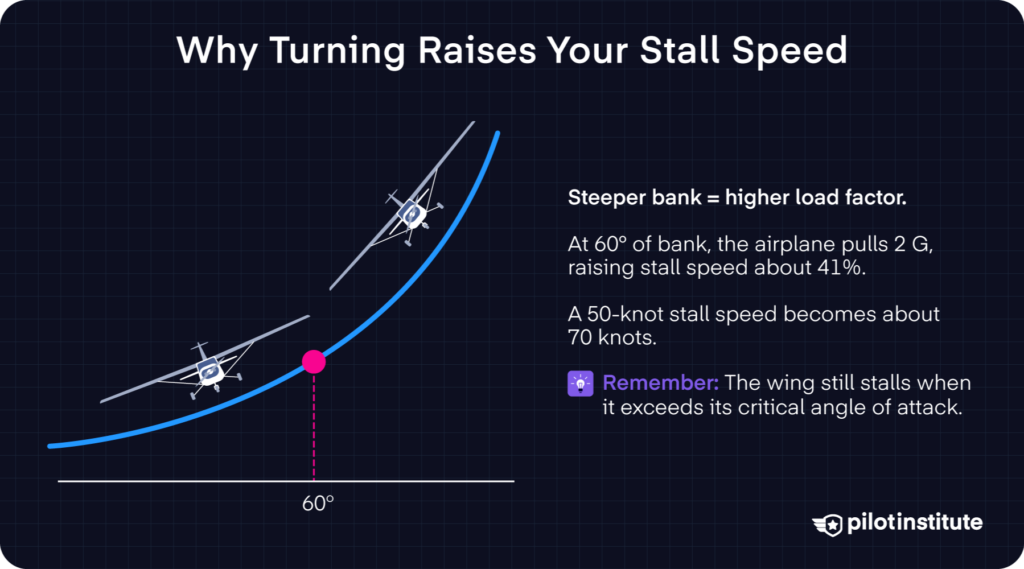
Your stall speed climbs with the square root of the load factor.
In a coordinated, level 60-degree banked turn, the wings have to support twice the airplane’s weight. In other words, the aircraft experiences a load factor of 2.0, or 2 Gs.
Take the square root of 2, and you get about 1.41, so your stall speed jumps by roughly 41 percent.
Now, to put real numbers in it. An airplane that stalls at 50 knots in level flight will stall at about 70 knots once the bank reaches 60 degrees.
Therefore, banking will cost you some of that speed margin before a stall. And since the relationship isn’t linear, that margin shrinks faster than you’d expect.
When Is a Slip the Right Move?
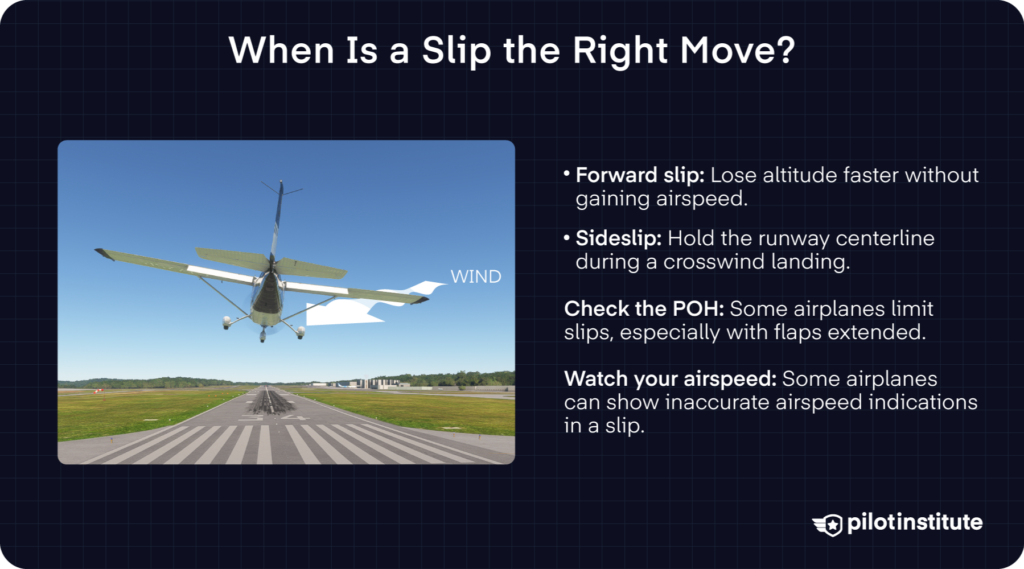
A slip is the right move when you need to lose altitude without gaining speed, or when you need to stay lined up with the centerline in a crosswind.
A slip is still a yawed, cross-controlled condition. If the airplane stalls while slipping, it can still enter a spin, although the entry is usually less aggressive than from a skid. That makes it the safer of the two. It does not make it safe.
But while it can be dangerous, it isn’t always something to fear. It’s a normal, useful maneuver you’ll reach for in some ordinary approaches.
Let’s say you’re high on final and need to come down without letting your speed run away. A forward slip can steepen the descent and shed altitude without increasing airspeed.
When you’re landing in a crosswind, a sideslip keeps the airplane lined up with the runway centerline instead of drifting off to one side.
Both are cross-controlled. Ailerons go one way, and rudder goes the other. But this can be perfectly safe when flown at a sensible altitude and airspeed.
Can You Slip With Flaps Down?
Some POHs restrict slips with the flaps extended. The disturbed airflow can wash over the tail and cut into the effectiveness of your elevator.
Others warn against prolonged slips when fuel is low. That’s because holding the airplane sideways can force fuel to one side of the tank and starve the engine.
Slips still deserve respect. For the full breakdown of how a forward slip and a sideslip differ, we cover that in our guide to forward slips and sideslips.
Why Your Airspeed Reads Wrong in a Slip
And the airspeed indicator itself can mislead you in a slip. With the static source reading the airflow from an odd angle, the number can be well off.
Keep the airspeed indicator in your scan and fly the proper attitude, while recognizing that the indicated airspeed may be less accurate during a slip.
These risks are all included in the Private Pilot ACS. But above all, your POH/AFM is the manufacturer’s word for your airplane. Fly what it tells you.

Private Pilot
Study Sheet

Grab a printable PDF that highlights must-know PPL topics for the written test and checkride.
- Airspace at-a-glance.
- Key regs & V-speeds.
- Weather quick cues.
- Pattern and radio calls.
Frequently Asked Questions
What Is the Difference Between a Slip and a Skid?
Both are uncoordinated turns, but they’re opposites.
In a slip, you’re banked too much for your rate of turn, so the nose ends up yawed toward the outside of the turn, and the airplane slides toward the low wing. In a skid, it’s the reverse. Your rate of turn is too great for the bank you’re holding, so the aircraft gets pulled toward the outside of the turn instead.
The ball in your slip/skid indicator tells the story either way. It falls toward the inside of the turn in a slip, and toward the outside in a skid.
Why Is a Skidding Turn More Dangerous Than a Slipping Turn?
It comes down to which wing quits flying first. In a skid, the inside and lower wing rides at a higher angle of attack, so it tends to reach its critical angle and stall before the outer wing does.
When that low wing drops, the airplane rolls and yaws deeper into the turn instead of away from it, and that motion is the doorway to a spin.
A slip does the opposite. There, the raised outer wing may stall first, so the airplane tends to roll back toward wings level rather than winding tighter.
This is why a skid low to the ground has brought down so many airplanes. The recovery is the same either way.
What Does “Step on the Ball” Mean?
It’s the rule for straightening out an uncoordinated turn. The ball in your slip/skid indicator drifts off-center whenever you’re slipping or skidding, and the fix is to press the rudder pedal on whichever side the ball has slid toward.
If it’s out to the left, you press left. If it’s out to the right, you press right. Your feet just chase the ball back to the middle.
Keep pressure on until it re-centers, and you’re coordinated again. Keep half an eye on that ball through every turn to catch a slip or skid before it ever becomes a problem.
Can You Spin an Airplane Without Stalling It?
No. A spin needs two things happening at once, a stall and yaw. At least one wing has to be stalled for the airplane to spin at all.
Take the stall away, and your aircraft won’t have a chance to spin.
All spins are preceded by a stall on at least part of the wing. It means the stall is the event you’re really trying to prevent.
Keep the wing flying and stay coordinated, especially down low in the pattern, and the spin never gets its chance to start in the first place.
Is It Safe to Slip an Airplane With the Flaps Down?
It depends on the airplane. Some manufacturers permit slips with the flaps extended without any issue, while others restrict or outright prohibit them.
This is because the disturbed airflow in a slip can wash over the tail and cut into elevator effectiveness. There can also be a noticeable pitch or buffet in some airplanes when you slip with full flaps.
Your POH/AFM is the authority here. Check the limitations section for your specific make and model, and fly exactly what it tells you.
What Should You Do if You Overshoot the Turn to Final?
Go around. Trying to salvage an overshoot by racking in more bank and bottom rudder is exactly what sets up the skidding stall and spin. And down that low, you have no altitude to recover.
It’s tempting to increase the bank and feed in bottom rudder to drag the nose back around, but that cross-controlled setup leads to a skidding stall and spin.
Conclusion
When the centerline drifts away on the base-to-final turn, your feet will want to press rudder and haul the nose back around. But now you know better than that.
The wrong control input can turn a harmless overshoot into a stall, and the stall becomes a spin with no room to recover.
The rudder is the wrong answer here. The throttle is the right one. Accept that you’ve overshot, and go around.