
-
Key Takeaways
-
What Is Class G Airspace?
- The Rules that Govern Class G Airspace
-
Where Does Class G Airspace Start and End?
- Class G Ceiling Over High Terrain
-
How Do You Find Class G Airspace on a Sectional Chart?
- Sample Chart Reading: Prescott Regional
-
What Are the VFR Weather Minimums in Class G Airspace?
- VFR Minimums Above 1,200 ft AGL
- Exceptions to the VFR Minimums
-
What Rules Still Apply in Class G Airspace?
- Speed and Altitude Limits
- Pilot Certificate Requirements
-
How Do You Operate at a Non-Towered Airport in Class G?
- Pattern Procedures and Right-of-Way
-
What Goes Wrong in Class G Airspace?
- Scud Running
- Day to Night Minimums
- Class G Traffic Hazards
-
Frequently Asked Questions
- Is Class G Airspace Controlled or Uncontrolled?
- Do You Need a Radio to Fly in Class G Airspace?
- Can a Student Pilot Fly in Class G Airspace?
- What Is the Highest Class G Airspace Can Go?
- Can You Fly a Drone in Class G Airspace Without Authorization?
- What Happens if You Fly Below Class G Weather Minimums?
-
Conclusion
Class G airspace falls under uncontrolled airspace. In these parts of the sky, there’s no ATC to provide separation service. Staying clear of traffic and obstacles is your job entirely.
Say you find yourself a thousand feet over open farmland. You keyed the mic out of habit, but radio silence is all the response you get.
The nearest control tower is forty miles behind, then your palms go sweaty. You realize that no one on earth is watching this flight.
Let’s talk about how to fly safely inside uncontrolled airspace. We’ll look at the rules and requirements that govern the airspace, as well as the risks involved when they get broken.

Free Private Pilot Study Sheet
Grab a printable PDF that highlights must-know PPL topics for the written test and checkride.
- Airspace at-a-glance.
- Key regs & V-speeds.
- Weather quick cues.
- Pattern and radio calls.
Key Takeaways
- Class G is uncontrolled airspace, defined as anything not designated Class A through E.
- Air traffic control provides neither clearance nor separation service in Class G.
- Class G starts at the surface and stops at the overlying airspace.
- Observe the rules and minimums to prevent inadvertent flight into IMC.
What Is Class G Airspace?
The Pilot’s Handbook of Aeronautical Knowledge defines Class G airspace as “the portion of the airspace that has not been designated as Class A, B, C, D, or E.”
Reading that statement again, Class G seems to be defined by what it isn’t. So, allow us to provide you with more context.
First things first, is Class G airspace controlled? No. In fact, it’s even classified under uncontrolled airspace.
ATC won’t separate you from other traffic in Class G. You may be able to get flight following if you’re within radar coverage, and ADS-B In helps. But none of it replaces your own eyes.
In uncontrolled airspace, you, the pilot, are responsible for seeing and avoiding other traffic and obstacles. We call this practice the see-and-avoid system.
The Rules that Govern Class G Airspace
The rules in 14 CFR Part 91 still apply in uncontrolled airspace the same way they do everywhere else. Regulations are usually written to provide the minimum requirements for safe and efficient operations.
Such rules include the minimum flight visibility and distance-from-clouds requirements in 14 CFR 91.155. We’ll talk more about those requirements later on.
As for the general operating rules in Class G airspace, you’ll find them at various places in 14 CFR Part 91.
Where Does Class G Airspace Start and End?
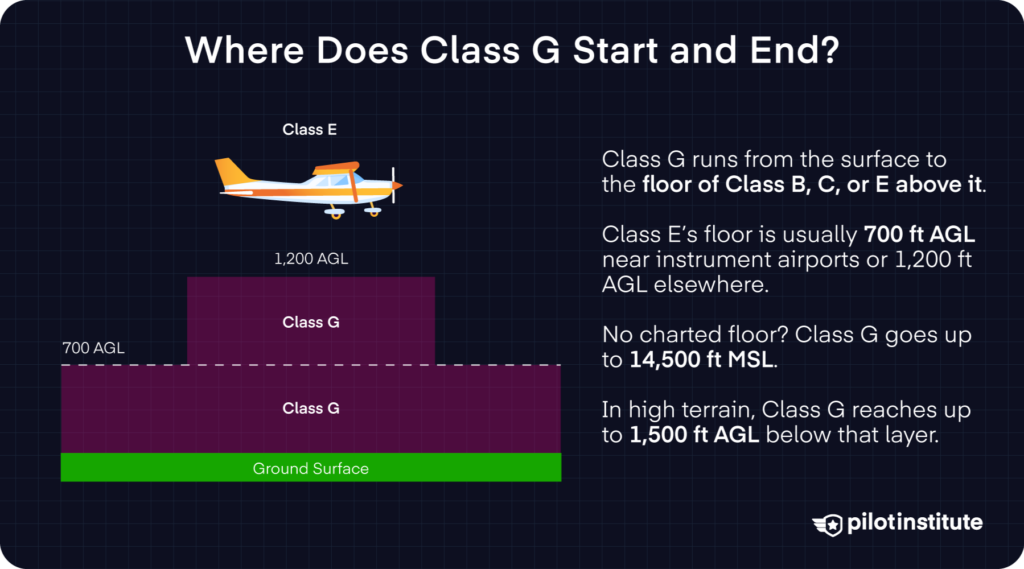
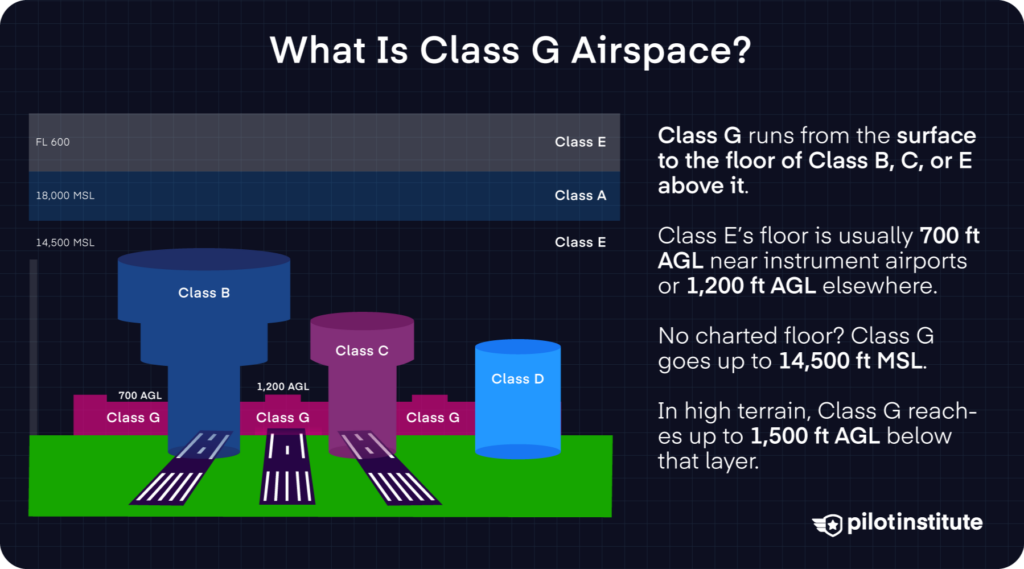
Class G airspace altitude usually begins at the surface and extends up to the base of the overlying airspace, which is Class B, C, or Class E.
Therefore, the ceiling of the Class G airspace depends on the designated floor of the overlying airspace. The easiest resource for viewing airspace is on the sectional aeronautical chart.
Keep in mind that the height of Class G airspace isn’t the same everywhere. For example, airports with an approved instrument approach are usually surrounded by Class E that starts at 700 feet above ground level (AGL), so Class G only goes from the surface up to 700 AGL.
Other times, Class G might extend up to a shelf for Class B or C because it’s outside the Class E beginning at 700 AGL. .
Between VOR navigation facilities, Victor Airways are in Class E that begins at 1,200 AGL. Victor Airways are 8 nautical miles wide, or 4 nautical miles on either side of the centerline. In the Lower 48 states, the edges of Victor Airways aren’t charted, which means the Class E airspace from one airway extends to the next airways, so they all blend together.
In these cases, Class G airspace is 1,200 AGL and below. Finally, don’t forget irregular Class E floors near coastlines. They can start at almost any altitude, and Class G is usually found below the charted floor.
And unless a lower floor is designated, Class E begins at 14,500 feet above mean sea level (MSL) across the United States. Look closely, now, because we’re using two different measurements.
Class G Ceiling Over High Terrain
You might wonder where Class G airspace lies in high-elevation areas close to (or even higher than) 14,500 ft MSL. Well, according to 14 CFR 71.71, Class E airspace does not include the airspace from the surface up to 1,500 feet AGL.
Therefore, unless otherwise indicated, there’s a Class G cutout from the surface up to 1,500 ft AGL.
Even when you’re flying in the mountains in the western half of the United States, Class E usually begins at 1,200 AGL because there are Victor airways criss-crossing most of the area.
Over high mountain ranges, you might find Class E beginning above 14,500 MSL when the mountain peaks are higher than 13,000 MSL.
With that said, please always check the sectional chart before flying somewhere unfamiliar.
How Do You Find Class G Airspace on a Sectional Chart?
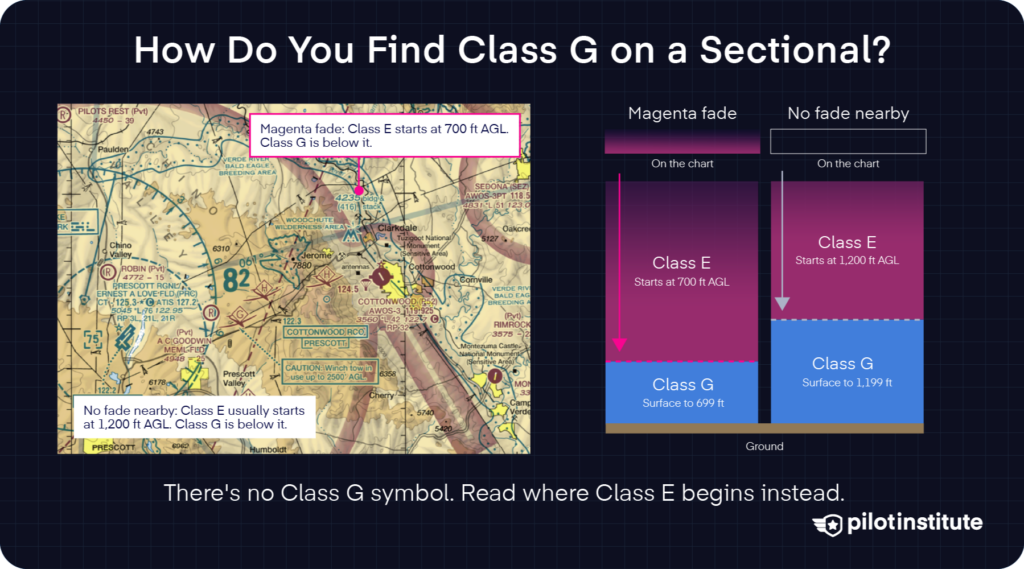
There’s no dedicated Class G airspace symbol. Instead, you find it by eliminating every other type of airspace. In most cases, Class G will extend up to Class E, so finding Class E is the first step. Charts indicate the Class E boundaries through shaded bands called vignettes.
Class E can start in four possible locations, but we’ll ignore Class E beginning at the surface because you can’t find Class G underneath. Let’s start with the magenta vignette airspace marking.
On the faded, soft side of the gradient, the Class E floor drops deeper to 700 ft AGL. So, the Class G beneath it also gets “shorter,” with a ceiling of 699 ft AGL.
On the solid, hard side, you might find Class B, C, or Class E starting at 1,200 feet AGL, so Class G goes up to the overlying airspace.
The faded blue vignette is a different case. On its faded side, the Class E floor is 1,200 feet AGL. On its solid side, you might find Class B, C, or Class E starting at 14,500 feet MSL.
Sample Chart Reading: Prescott Regional
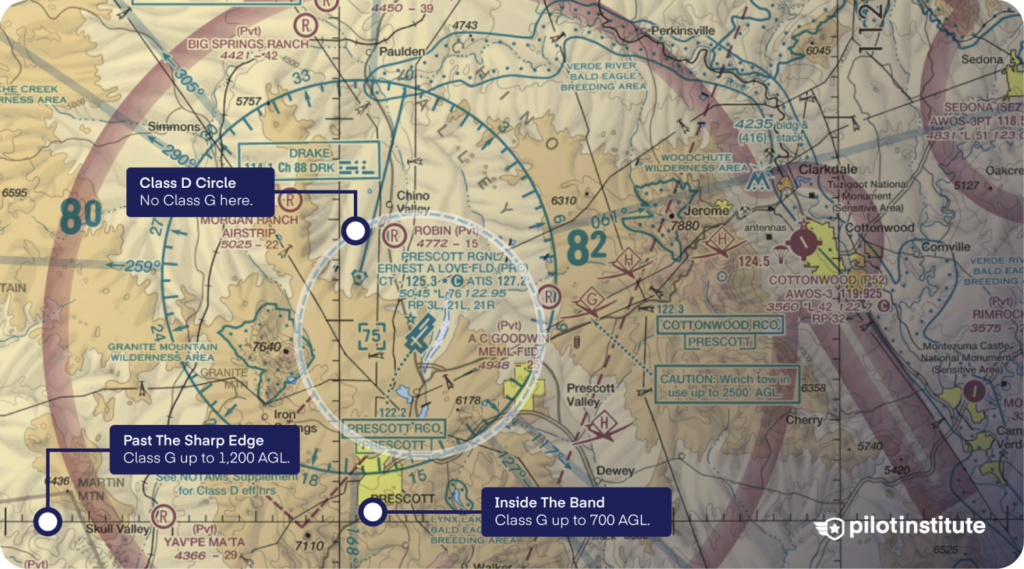
Take a look at this portion of the Phoenix sectional chart, for example. You’ll see how the magenta band is saturated on the outside and washes out toward the interior.
Now, inside the vignette, over Prescott and Chino Valley, Class E begins at 700 AGL. There’s only a thin 699-foot layer of Class G airspace over those areas.
Outside the 700 AGL Class E vignette, the Class E floor changes to 1,200 AGL. The Class G ceiling now extends up to 1,199 AGL.
You’ll also notice a blue dashed line surrounding Prescott Regional Airport. It means that Class D airspace covers the area within that line.
The [75] tells you the Class D goes from the surface up to 7,500 ft MSL, roughly 2,500 ft above the field. Therefore, there’s no Class G coverage inside that circle.
What Are the VFR Weather Minimums in Class G Airspace?
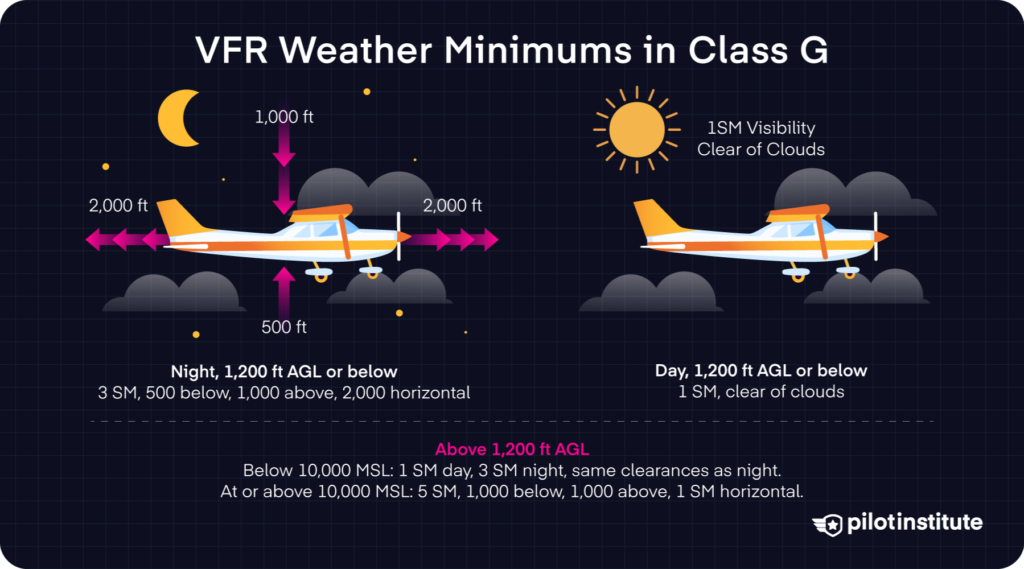
The Class G VFR minimums are known for being quite relaxed.
First, let’s look at the Class G rules for aircraft other than helicopters. During the day, you only need 1 statute mile of flight visibility and to remain clear of clouds.
The requirements get more specific at night. Visibility must be at least 3 statute miles. As for distance from clouds, you’ll need to stay at least 500 ft below, 1,000 ft above, and 2,000 horizontally away from clouds.
If you fly a helicopter, you’ll need at least 1/2 statute miles of visibility during the day, and 1 statute mile at night. And regardless of the time of day, just stay clear of clouds, and you’re all good.
| Altitude | Aircraft/time | Flight visibility | Distance from clouds |
| 1,200 feet or less above the surface (regardless of MSL altitude) | Aircraft other than helicopters, day (except as provided in 91.155(b)) | 1 statute mile | Clear of clouds |
| Aircraft other than helicopters, night (except as provided in 91.155(b)) | 3 statute miles | 500 feet below, 1,000 feet above, 2,000 feet horizontal | |
| Helicopters, day | 1/2 statute mile | Clear of clouds | |
| Helicopters, night (except as provided in 91.155(b)) | 1 statute mile | Clear of clouds | |
| More than 1,200 feet above the surface but less than 10,000 feet MSL | Day | 1 statute mile | 500 feet below, 1,000 feet above, 2,000 feet horizontal |
| Night | 3 statute miles | 500 feet below, 1,000 feet above, 2,000 feet horizontal | |
| More than 1,200 feet above the surface and at or above 10,000 feet MSL | Day or night | 5 statute miles | 1,000 feet below, 1,000 feet above, 1 statute mile horizontal |
These Class G airspace weather minimums come straight from the table in 14 CFR 91.155.
VFR Minimums Above 1,200 ft AGL
Now, as you climb above 1,200 feet AGL while staying below 10,000 feet MSL, the minimums get even more precise.
By day, you need 1 statute mile of visibility plus 500 below, 1,000 above, and 2,000 horizontal cloud clearance. By night, visibility jumps to 3 statute miles with those same cloud distances.
Go above 1,200 feet AGL and reach 10,000 feet MSL or higher, and the rules no longer distinguish between day and night.
Aircraft up here move fast and need more room to see and avoid. As such, the Class G airspace visibility requirements become 5 statute miles, with Class G airspace cloud clearance of 1,000 below, 1,000 above, and 1 statute mile horizontal.
Exceptions to the VFR Minimums
Even with the standard rules we laid out earlier, there are certain operations you can conduct in Class G below 1,200 feet above the surface.
If you’re flying a helicopter, you’re allowed to stay clear of clouds within an airport traffic pattern. But only so long as you’re within half a mile of your intended runway or helipad, and your flight visibility holds at 1/2 statute mile or better.
There are exceptions for airplanes, powered parachutes, and weight-shift-control aircraft, too.
Say your visibility dips below 3 statute miles but is still at least 1 statute mile during the night, and you’re flying the traffic pattern within half a mile of the runway. In that case, you’re cleared to operate clear of clouds.
What Rules Still Apply in Class G Airspace?
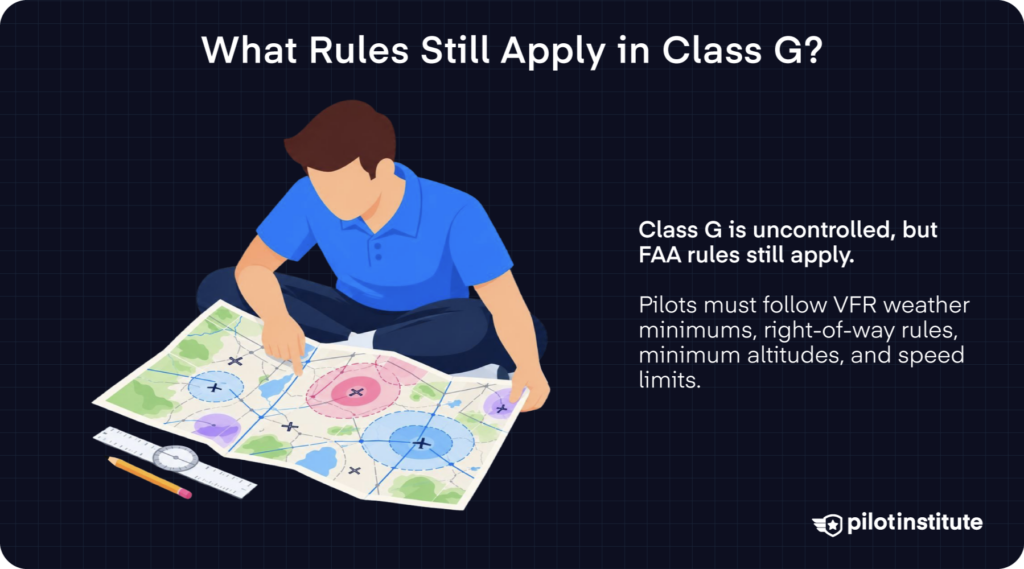
First question, do you need clearance for Class G airspace? You don’t. Under VFR, there’s no ATC clearance required to fly in Class G. You won’t need two-way radio contact either.
However, if you’re flying to, from, through, or on an airport with an operational control tower, there are a couple more conditions. Unless ATC authorizes or requires otherwise, you must establish two-way radio communication with ATC.
There are also other rules that apply to you when you’re in the Mode C veil. It’s the ring within 30 nautical miles of the primary airports listed in Appendix D, Section 1 of Part 91 (generally Class B airports), from the surface up to 10,000 feet MSL.
14 CFR 91.215 and 91.225 say that once you’re inside that ring, regardless of the airspace class you’re in, you’ll need an altitude-reporting transponder and ADS-B Out.
Aircraft certificated without an engine-driven electrical system, along with balloons and gliders, have a limited exception.
Speed and Altitude Limits
Next item in the Class G airspace requirements is speed. Under 14 CFR 91.117, you still can’t operate below 10,000 feet MSL at more than 250 KIAS.
And if your patch of Class G sits beneath a Class B shelf, that limit tightens to 200 KIAS.
Minimum safe altitudes hold too. Under 14 CFR 91.119, you have to stay at least 1,000 feet above the highest obstacle within a horizontal radius of 2,000 feet over congested areas.
The minimum is at least 500 feet above the surface in other than congested areas. Over open water or sparsely populated areas, stay at least 500 feet away from any person, vessel, vehicle, or structure.
Pilot Certificate Requirements
Now, here’s some good news for student pilots. A student pilot with the right endorsements for the flight operation, or any private pilot, can legally operate in Class G without an extra rating or sign-off.
How Do You Operate at a Non-Towered Airport in Class G?
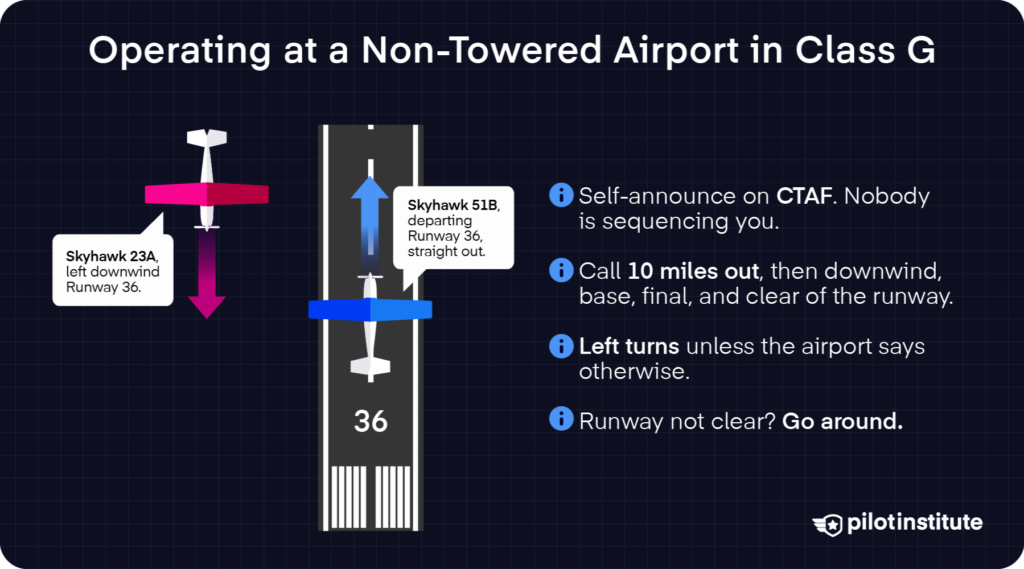
Flying into a non-towered airport Class G field, you’ll be self-announcing your position and intentions over the common traffic advisory frequency (CTAF). It’s the bedrock of CTAF Class G airspace operations.
Outbound, announce before you taxi and again before you taxi onto the runway. Inbound, call about 10 miles out. Self-announce when entering downwind, base, and final, and once more after you clear the runway.
Pattern Procedures and Right-of-Way
Per 14 CFR 91.126, you must make all turns to the left in an uncontrolled airport traffic pattern. That is, unless the airport displays approved light signals or visual markings indicating that turns should be made to the right.
The VFR sectional chart flags those right-traffic airports, so they’re easy to spot. You’ll also find an airport’s traffic procedures in the Chart Supplement.
Right-of-way rules in 14 CFR 91.113 also apply to Class G. For example, aircraft in distress have the right-of-way over all other air traffic.
When you’re on final approach or in the act of landing, you’ve got the right-of-way over other aircraft in the air or moving on the surface.
Now, with that said, you should still be considerate of the other pilots around you. Don’t abuse your rights to push an aircraft off the runway. It has already touched down, and it’s doing its best to clear the way for you.
Be patient. If the runway isn’t clear, go around.
What Goes Wrong in Class G Airspace?
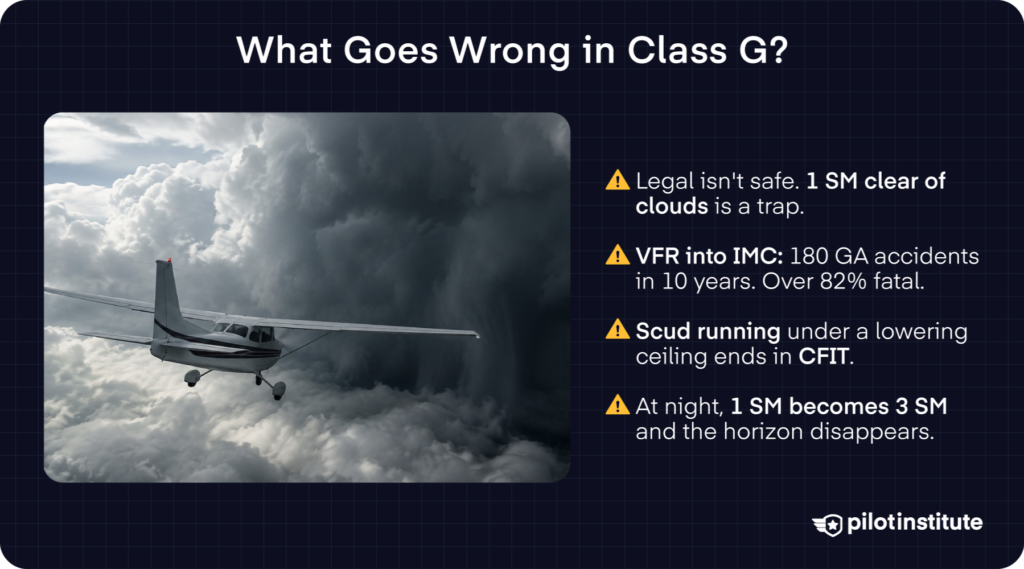
The biggest of the Class G airspace risks isn’t the airspace itself, so much as the conditions you’re technically allowed to fly into. Even when, and perhaps especially when, you might think you’re perfectly legal.
Because the minimums down low are so forgiving, one statute mile visibility clear of clouds is still allowed. It’s also an easy way to go looking for trouble.
Flying VFR into IMC, usually by pushing into deteriorating weather, is still one of the most fatal accident categories in general aviation.
An analysis of the NTSB accident database covering 2014 to 2023 counted 180 general aviation accidents tied to IMC. Tragically, more than 82% of them were fatal.
Those accidents claimed 268 lives and left another 29 people seriously injured.
Scud Running
Another foolish display of invulnerability is called scud running. As the ceiling lowers, some pilots descend to stay beneath it. Then, they descend again. They’re just going lower for those Class G minimums, these pilots think.
Well, in AC 61-134, the FAA says that scud running often ends in controlled flight into terrain (CFIT). CFIT can happen when a pilot tries to keep maneuvering beneath a lowering ceiling. Then, they strike terrain or an obstacle.
Day to Night Minimums
Remember that those low daytime numbers get real tight after dark. Class G minimums grow to three miles of visibility with defined cloud clearances.
A pilot comfortable at one mile in the afternoon can find themselves out of options when dusk falls. Suddenly, they’re flying illegally. And they lose sight of the visual horizon that helps them stay level.
Far too many non-instrument-rated pilots have departed shortly after sunset and crashed after encountering IMC en route. Please, don’t be one of them.
Class G Traffic Hazards
We’d like to emphasize again that in Class G airspace, no controller is watching you. Nobody hands you traffic advisories. See-and-avoid is your only defense against a midair collision.
Flight following and ADS-B In can help, but neither is guaranteed.
In AC 90-48E, the FAA says that a considerable number of midair collisions occur within airport traffic patterns, both towered and non-towered.
Remember, no amount of air traffic equipment relieves you of your responsibility to see and avoid. And in Class G, there’s no advisory to lean on anyway.
Class G airspace safety, in the end, depends purely on your own judgment.
Frequently Asked Questions
Is Class G Airspace Controlled or Uncontrolled?
Class G is uncontrolled airspace, which simply means any airspace the FAA hasn’t designated as Class A, B, C, D, or E.
Air traffic control doesn’t manage traffic in uncontrolled airspace, and nobody provides any separation service. Staying clear of other aircraft is entirely your job as the pilot.
Do You Need a Radio to Fly in Class G Airspace?
Generally, no.
Under VFR, Class G has no radio requirement.
You’re not technically required to carry a two-way radio in most other areas. With that said, though, we strongly recommend that you use the CTAF to self-announce.
Can a Student Pilot Fly in Class G Airspace?
Yes. With an instructor on board, no special endorsement is needed.
To fly solo, the student needs the 14 CFR 61.87(n) endorsement for the specific make and model, given within the preceding 90 days.
The endorsement rule is for solo privileges, and not so much about the airspace class.
What Is the Highest Class G Airspace Can Go?
In most of the country, the Class G ceiling lies where the overlying Class E begins, which is often at 700 or 1,200 feet AGL.
If there’s no charted floor for the Class E airspace, Class G can extend up to, but not including, 14,500 feet MSL.
Over tall terrain (which could get close to and even exceed 14,500 ft MSL), Class G might extend from the surface up to 1,500 feet AGL.
Can You Fly a Drone in Class G Airspace Without Authorization?
Yes. The FAA allows small drone operations in Class G without ATC authorization or LAANC. 14 CFR 107.41 requires prior authorization only in Class B, C, D, and surface Class E.
With that said, you must still observe the standard Part 107 rules, including the 400-foot altitude limit.
What Happens if You Fly Below Class G Weather Minimums?
There will be serious legal and potentially physical consequences.
Breaking the minimums in 14 CFR 91.155 is a regulatory violation that can bring FAA enforcement. You could get a retraining. Your certificate can get suspended or revoked altogether. And these are the best-case scenarios.
The greater consequence is the risk to your safety. Far too many times, flying in reduced visibility has led to spatial disorientation and controlled flight into terrain.
Conclusion
Class G gives you room to make your own calls more than any other airspace. But that doesn’t entail an absence of responsibility or rules.
Not being tied to any clearance in this uncontrolled airspace means that you call the shots, and it’s a privilege that you need to take seriously.
Your judgment must be built on the Class G airspace rules. It takes a deep kind of understanding, both in the fine print and in your self-control.
Those who master and respect it are the ones who get to enjoy the freedom of the airspace. And when you’re ready to explore other airspace classes, Pilot Institute’s online ground school will help get you there.