
 Up to 50% off airplane classesShop the sale →
METAR KBOS 141754Z 04012KT 3SM -RA BR FEW006 SCT012 BKN025 OVC040 08/07 A2989
Can you find the ceiling in that report in under five seconds?
METARs (aviation routine weather reports) and TAFs (terminal aerodrome forecasts) are the coded airport weather reports you’ll have to decode on the FAA knowledge test. And under 14 CFR 91.103, you also need them before any flight under instrument flight rules (IFR) or away from the airport vicinity.
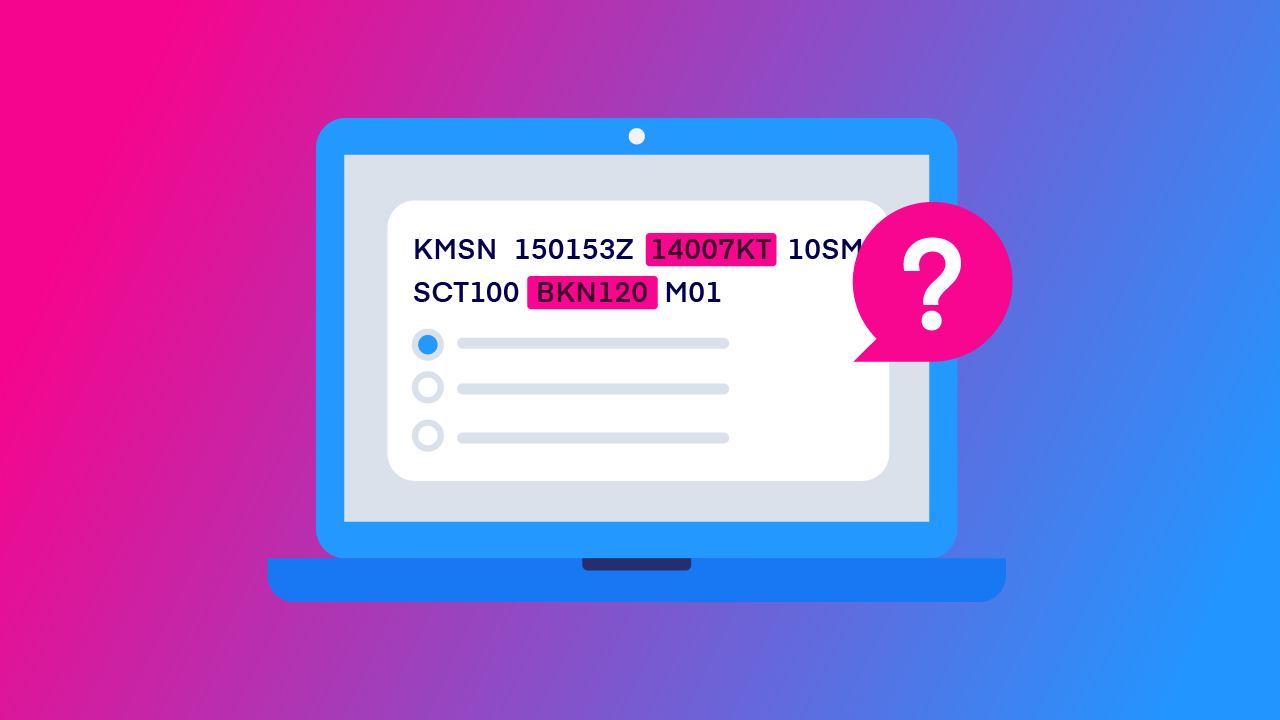
This free METAR and TAF quiz gives you six realistic reports to decode, with an explanation for every answer. Scroll down to take it.
Up to 50% off airplane classesShop the sale →Test Yourself: 6 METAR and TAF Questions
The quiz below has six questions built on three METARs, one special report (SPECI), and two TAFs. Each sample follows the format U.S. weather stations and National Weather Service forecasters use, and all times are in Zulu.
Pick an answer, then check it to see if you got it right, along with a short explanation. If you want a refresher first, read our guides on how to read a METAR and how to read a TAF.
Quiz: METAR and TAF
Question 1 of 6
Your score
0/6
Perfect score. You read METARs and TAFs like a pro. Put it to work in our Private Pilot Made Easy ground school.
Solid work. Brush up on change groups and valid periods in our guide to reading a TAF, then go for a perfect score.
Good start. Work through our guides to reading a METAR and reading a TAF, then try again.
What wind is Denver International reporting?
Answer: From 270° true at 18 knots, gusting 29 knots, with the direction varying between 240° and 300°.
What is the ceiling at Boston Logan?
Answer: 2,500 feet AGL.
What does +TSRA BR describe in this special report from Memphis?
Answer: A thunderstorm with heavy rain, plus mist.
Which decode of this Minneapolis report is correct?
Answer: Temperature −7°C, dewpoint −12°C, altimeter 30.27 inHg, fully automated.
What is the valid period of this Atlanta TAF?
Answer: 1800Z on the 14th to 2400Z on the 15th (30 hours).
What does this TAF forecast for DFW between 0400Z and 0700Z on the 15th?
Answer: Prevailing P6SM and BKN040, with temporary spells of 3 SM, thunderstorms with light rain, and a BKN030CB ceiling.
Sample reports are for training. Always get a current weather briefing before flight.
Quick Decoding Cheat Sheet
| Code | Meaning |
|---|---|
| 27018G29KT | Wind from 270° true at 18 knots, gusting 29 knots |
| 240V300 | Wind direction varying between 240° and 300° |
| 10SM / P6SM | Visibility 10 statute miles (METAR) / more than 6 statute miles (TAF) |
| BKN, OVC, VV | Broken, overcast, vertical visibility. The lowest of these is the ceiling. |
| M07/M12 | Temperature −7°C, dewpoint −12°C |
| A3027 | Altimeter setting 30.27 inHg |
| AUTO / AO2 | Fully automated report / automated station with a precipitation discriminator |
| SPECI | Unscheduled special report |
| FM, TEMPO, PROB30 | TAF change groups: lasting change, temporary fluctuation, 30% chance |
Frequently Asked Questions
Where Can I Practice Reading METARs and TAFs?
Start with the quiz above, then decode live reports on the Aviation Weather Center site. Pick an airport near you, write out your decode, and check it against the site’s decoded view. When you need a refresher on the two reports, our METAR vs. TAF guide compares them side by side.
How Often Are METARs and TAFs Issued?
Routine METARs go out every hour, and stations issue a SPECI between them when conditions cross thresholds listed in AIM TBL 7-1-1. Scheduled TAFs come out four times a day, at 0000, 0600, 1200, and 1800Z. Forecasters issue an amended TAF (TAF AMD) whenever the forecast needs an update, and it replaces the previous one right away.
What Do FM, TEMPO, PROB30, and BECMG Mean in a TAF?
FM (from) marks a rapid change that replaces the earlier forecast, while TEMPO marks brief fluctuations that each last less than an hour. PROB30 gives a 30% chance of thunderstorms or precipitation, and it’s the only probability group in National Weather Service TAFs. BECMG (becoming) shows a gradual change and mostly appears in international and military TAFs.
Are METARs and TAFs on the FAA Private Pilot Knowledge Test?
Yes, the Private Pilot Airplane Airman Certification Standards (ACS) list METARs, SPECIs, and TAFs under Area I, Task C, Weather Information. Test questions often show a report from the FAA’s testing supplement and ask you to decode one element, such as wind or the ceiling. Our free private pilot practice exam and written test checklist can help you get ready.
Conclusion
That Boston METAR at the top of the page has a 2,500-foot ceiling, set by the BKN025 layer. Wind direction is true, M means minus, the ceiling is the lowest BKN, OVC, or VV layer, and TAF times are always Zulu.
If a question tripped you up, review our METAR guide and TAF guide, then retake the METAR and TAF quiz.