
- Key Takeaways
- Does ADHD Disqualify You From Being a Pilot?
- Why Do I Need an ADHD FAA Medical Exam?
- Can You Fly While Taking ADHD Medication?
- How Does the FAA Decide Your ADHD Path?
- What If My ADHD FAA Medical Gets Deferred?
- What’s the Difference Between the ADHD Fast Track and Standard Track?
- ADHD Fast Track
- ADHD Standard Track
- Do You Have to Report ADHD on Your FAA Medical?
- Can You Fly Without an FAA Medical Certificate?
- Sport Pilot With a Driver’s License
- BasicMed
- Gliders and Balloons
- Part 107 Drones
- How Long Does the FAA ADHD Process Take?
- Frequently Asked Questions
- Can You Be an Airline Pilot With ADHD?
- Can Pilots Take Adderall?
- What if You Were Diagnosed With ADHD but Never Took Medication?
- How Long Do You Have to Be off ADHD Medication to Fly?
- Can You Start Flight Training Before Getting Your Medical?
- What Is a HIMS AME?
- Conclusion
 Up to 50% off airplane classesShop the sale →
Perhaps you took Ritalin when you were in middle school. You haven’t needed it in years, and you barely even think about it now.
That is until you book your first discovery flight, and someone at the flight school mentions, almost offhand, that ADHD could ground you for good.
Just to make it clear, you can be a pilot with ADHD. It adds a few steps to your FAA medical process, but plenty of applicants still manage to earn their certificate.
The FAA sorts you into one of two tracks, and your medical and personal history will decide which one you’ll take.
Now, let’s take a closer look at the path ahead for an aspiring pilot with ADHD.
Key Takeaways
- Applicants with ADHD take either the Fast Track or the Standard Track, based on personal and medical history.
- In the Fast Track, you only need to see a doctoral-level psychologist or neuropsychologist, then the AME.
- The Standard Track involves in-person HIMS neuropsychological testing and a review by the FAA.
- ADHD medications and stimulants are on the FAA’s Do Not Issue list, so you can’t get a medical or fly while taking them.
Up to 50% off airplane classesShop the sale →
Does ADHD Disqualify You From Being a Pilot?
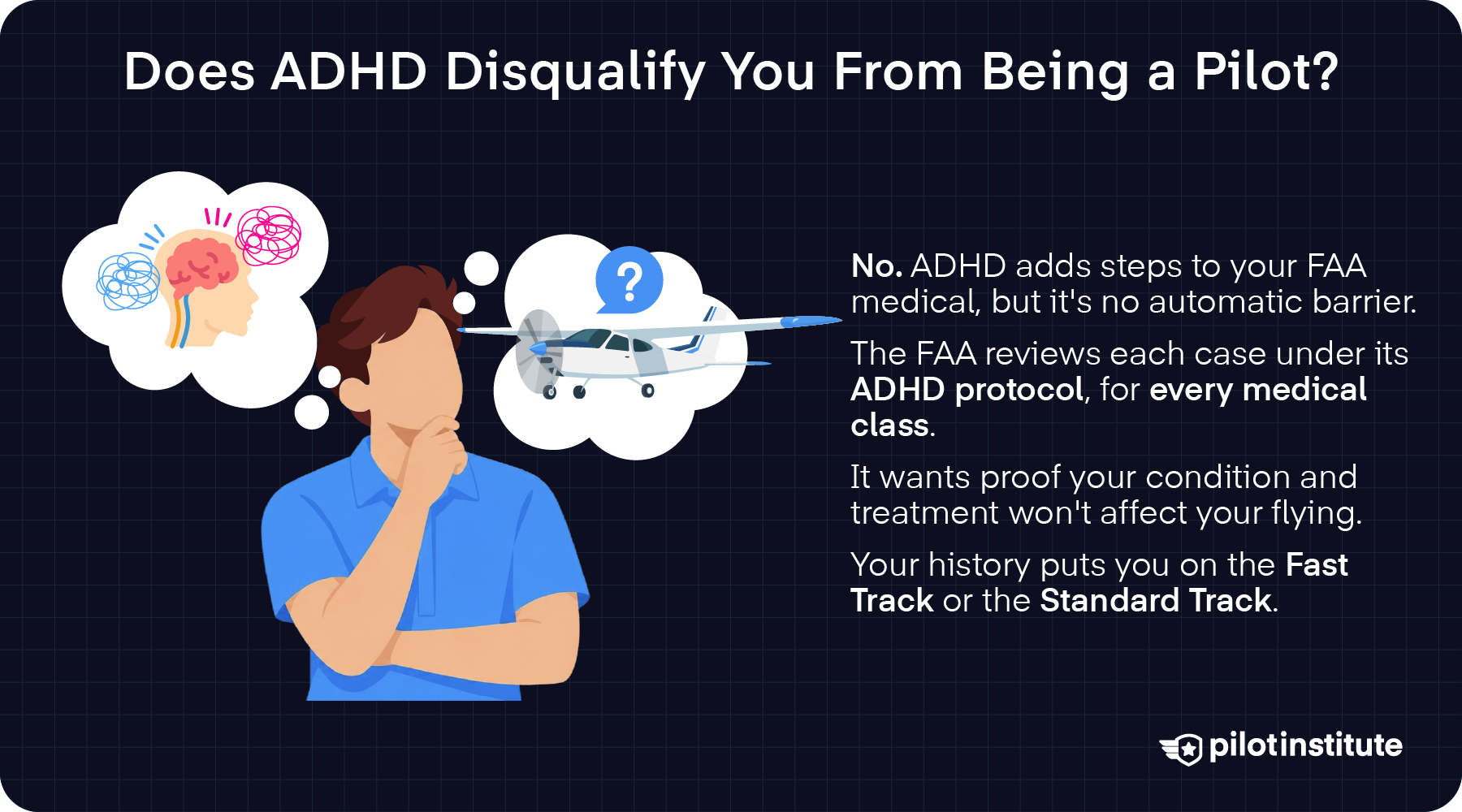
Not by itself. Based on how the FAA handles ADHD, the condition deserves a closer look, understandably in the name of safety. Nonetheless, ADHD is not an automatic barrier to getting certified.
The FAA reviews each case under the ADHD protocol in the Guide for Aviation Medical Examiners. The protocol applies to the process of getting a medical certificate in any class.
If you’ve had no ADHD symptoms, treatment, or medication in the past 4 years, and no other psychiatric diagnosis, you may qualify for the Fast Track. Your school and work life also needs to have stayed steady.
But if any of that shows up, the Standard Track is how you’ll make your case. We’ll examine these possibilities later on.
So, can you be a pilot with ADHD? Yes, you can. Having ADHD doesn’t automatically shut the cockpit door on you, but you will need to prove that it won’t put anyone at risk, either.
Why Do I Need an ADHD FAA Medical Exam?
As the FAA explains, ADHD (along with the medications used to treat it) may result in cognitive deficits that pose a risk to aviation safety.
Flying takes steady attention and sound judgment. So, the FAA wants reliable evidence that neither your condition nor your treatment will get in the way once you’re in the air.
That said, please know that simply having ADHD does not make you any less of a pilot. The FAA strives to accommodate different conditions and disabilities, even during knowledge testing.
If you’re able to clear the FAA’s checklists and earn your license, you deserve your spot in the cockpit, same as any certificated aviator.
Can You Fly While Taking ADHD Medication?
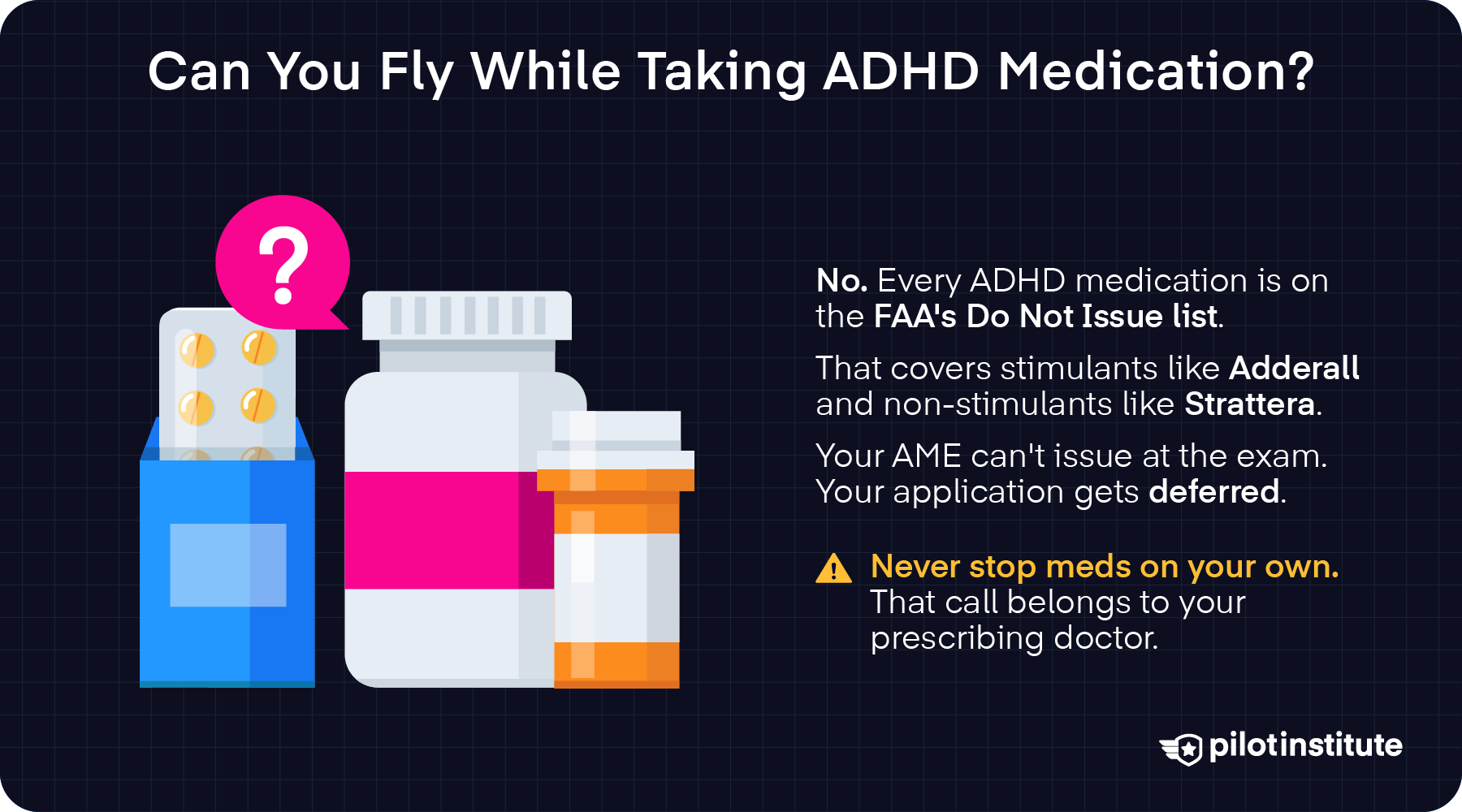
Unfortunately, no. The FAA ADHD medication policy is quite strict. If you’re currently taking medication for ADHD, you cannot hold a medical certificate.
The FAA’s Do Not Issue list covers ADHD medications and stimulants like Adderall, which means your AME can’t issue your certificate at the exam and has to defer your application.
The restriction applies to ADHD medication as a whole class, including Vyvanse, Ritalin, and Concerta, along with non-stimulant options like Strattera and Intuniv. The FAA list names drug classes, so ask your AME about your specific medication.
14 CFR 61.53 prohibits you from acting as pilot-in-command while taking any medication that prevents you from meeting your medical standards.
Now, please do not take this as a reason to go cold turkey on your prescription. Stopping your medication is a decision for your prescribing doctor, and it is not something you do just to snag a certificate.
How Does the FAA Decide Your ADHD Path?
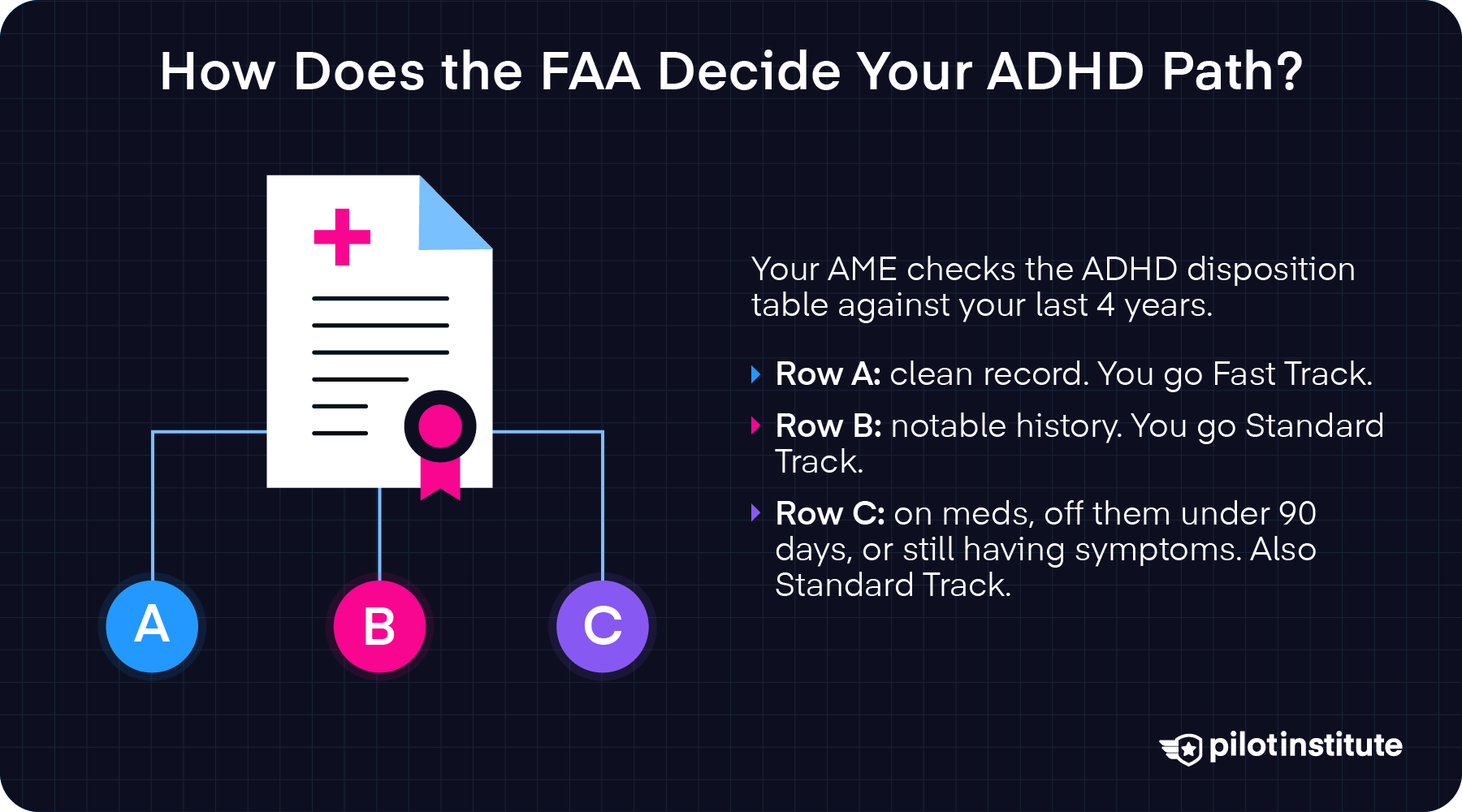
Your AME follows the FAA ADHD disposition table, which places applicants based on their records in the past 4 years. The entries of concern are the use of any treatment, ADHD medication use, or manifestation of any related symptoms. It also looks for any other psychiatric diagnoses or instability at school or work.
If your record is clean, then you belong to Row A, which is the Fast Track row.
Row B is for applicants who need a closer look, those with notable items in their records, which brings you to the Standard Track.
Row C applies if you’re currently taking ADHD medication (even as needed), or stopped it only within the last 90 days. It also includes anyone still showing symptoms. In Row C, your AME has to defer and send your prescribing doctor’s latest clinical progress note to the FAA. If your doctor decides you can safely stop, you’d wait at least 90 days before the Standard Track evaluation.
What If My ADHD FAA Medical Gets Deferred?
A deferral is not a denial. Instead, your file moves off of your AME’s desk and up to the FAA for review.
An FAA ADHD deferral review takes time, often months. But not to worry, plenty of applicants come out the other side holding a valid medical.
Your certificate could also possibly come as a Special Issuance under 14 CFR 67.401.
Under the section, the Federal Air Surgeon could grant you authorization for a limited time, provided you can perform the duties of your certificate without endangering public safety.
What’s the Difference Between the ADHD Fast Track and Standard Track?
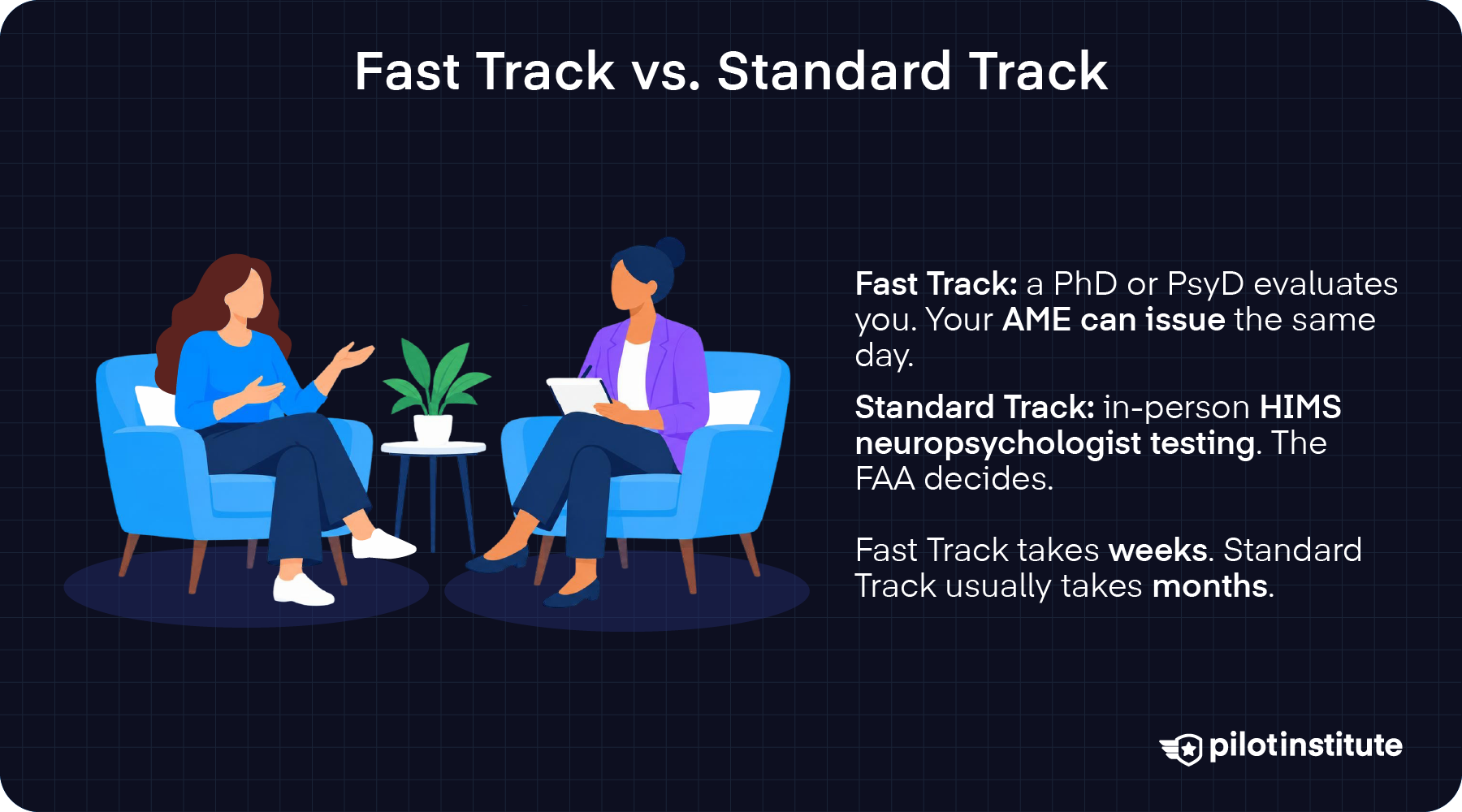
The FAA Fast Track can end with your AME issuing a medical certificate the same day, with no wait for an FAA review.
On the other hand, the Standard Track procedure is slower, since it sends your case to the FAA for a decision. And only after in-person neuropsychological testing.
| Questions | Fast Track | Standard Track |
|---|---|---|
| Who evaluates me? | PhD or PsyD psychologist or neuropsychologist. | HIMS-trained neuropsychologist. |
| In person or virtual? | Records review and interview can be virtual or in person. | In person only. |
| Who decides? | Your AME can issue. | The FAA reviews and decides. |
| Testing cost? | Set by the provider. | Set by the provider, usually higher. |
| How long before getting my medical? | Weeks. | Months, usually. |
ADHD Fast Track
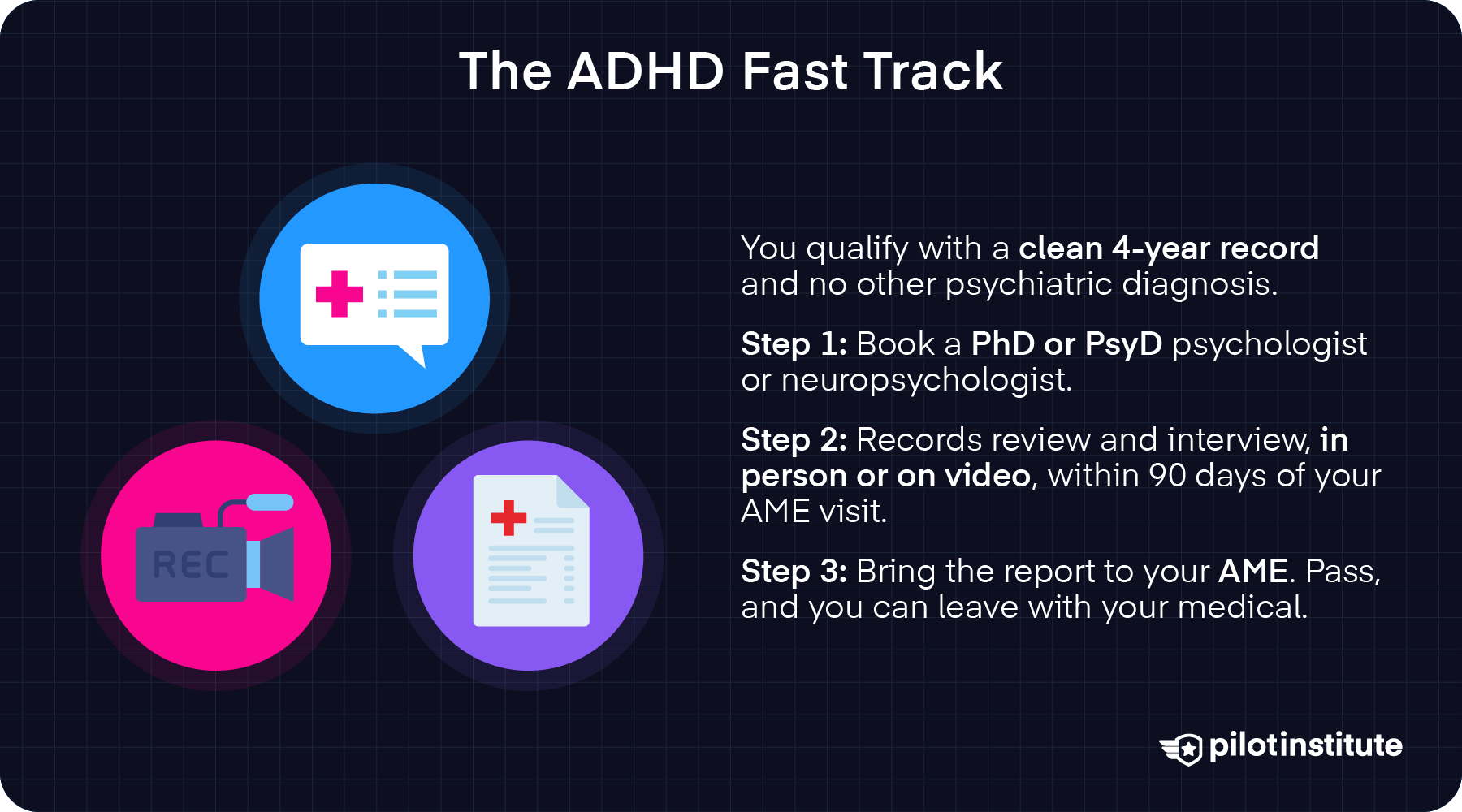
If your 4-year record shows no ADHD medication or treatment and no symptoms, you qualify for the Fast Track.
Your functioning at school and work should have held steady, as should your social life. You also can’t carry another psychiatric diagnosis (current or historical) except for when you qualify for the Anxiety, Depression, and Related Conditions Fast Track pathway, as explained in the ADHD disposition table.
Step 1: Pre-Evaluation Checklist
First, reach out to a doctoral-level (PhD or PsyD) psychologist or neuropsychologist to run your evaluation, where they’ll review your records and interview you.
Be sure to prepare all the requirements listed in the ADHD Document Checklist before your appointment (and don’t forget to keep copies for the AME).
You should also provide these papers to your doctor:
- FAA Information for the Psychologist or Neuropsychologist
- Fast Track Evaluation Report Requirements
- Fast Track FAA ADHD Summary
Step 2: Document Review and Interview
The interview can happen in person or over video, as long as it’s face-to-face on screen instead of just audio.
The doctor will then complete the ADHD summary and write up the report. Just make sure that the evaluation and report are completed within 90 days of your AME exam.
You can learn more about what to expect during your interview in the Fast Track General Information for Pilots and ATCS.
Step 3: Medical Exam with an AME
Once that’s done, it’s off to the AME. Bring the ADHD summary and the actual clinical report (not patient portal notes). Also, this is where you’ll need those copies of all reviewed supporting documents.
If your papers are good and you pass the rest of your medical exam, the AME can issue your medical certificate right away! If your AME has concerns or can’t verify your history, you’ll move to the Standard Track instead.
ADHD Standard Track
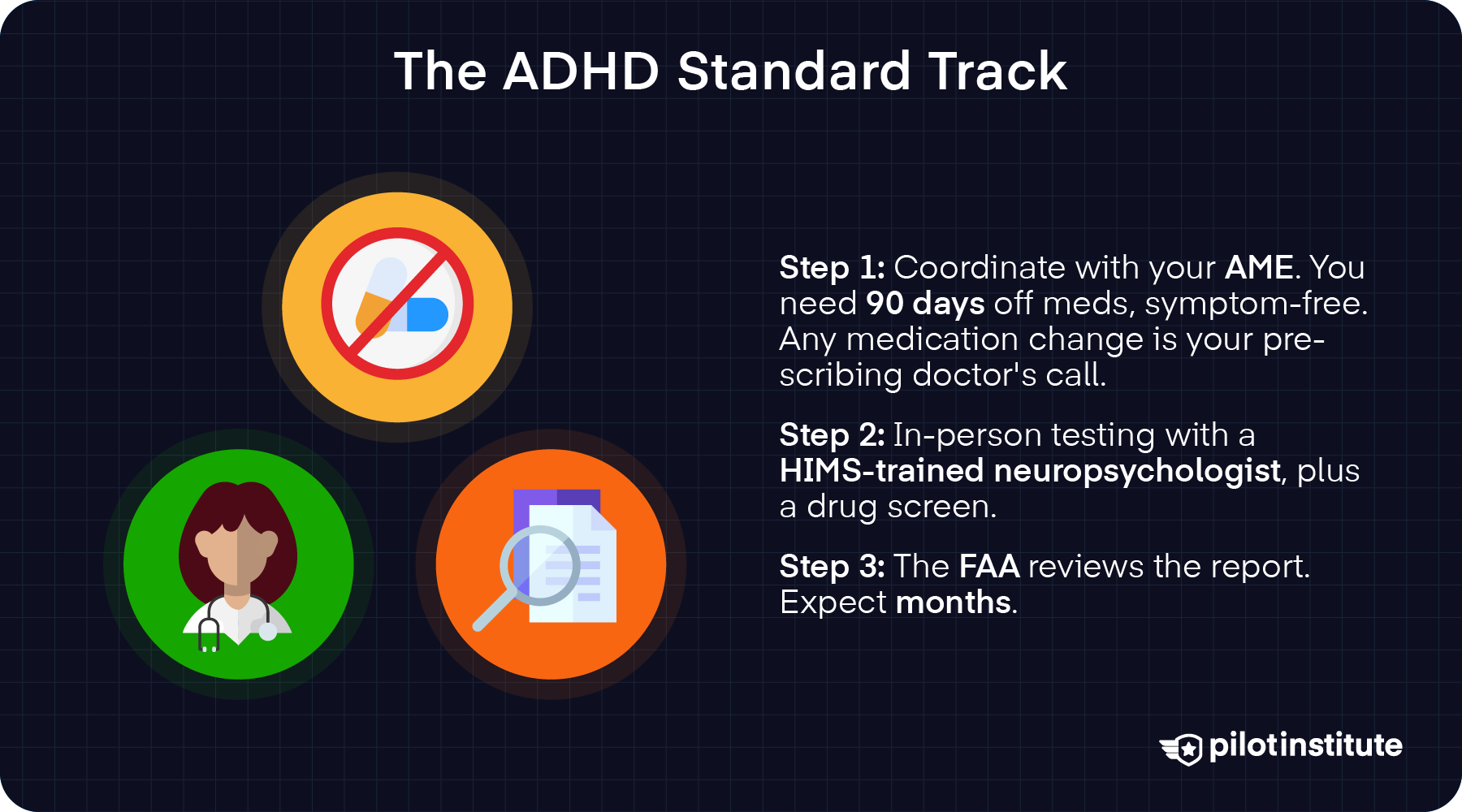
So you don’t qualify for the Fast Track criteria. Don’t lose hope, you’ll just have to take a different (albeit somewhat longer) path. Per the ADHD disposition table, you’ll be taking the Standard Track.
Step 1: Coordinate With Your AME
Before anything else, if you’ve been taking ADHD medication, you’ll need to be off it for at least 90 days before your evaluation. Please discuss this with your prescribing doctor first.
Next, contact your AME to coordinate the Standard Track evaluation. If you’ve already sat for your AME exam, the AME will defer your application to the FAA, as shown in the ADHD pathway chart.
Step 2: In-Person Testing With a HIMS Neuropsychologist
An FAA HIMS-trained neuropsychologist will then have to test you, referencing the Standard Track ADHD General Information for Pilots and ATCS.
Just like the Fast Track, prepare everything on the ADHD Document Checklist before your appointment and make copies for the AME. The testing has to happen within 90 days of your AME exam.
Take note that the evaluation is in person only. During the evaluation, the neuropsychologist will run a thorough clinical interview, where you’ll work through a battery of cognitive and psychological tests. Don’t be surprised if they also contact people who know you well.
The FAA keeps the full list of required tests on a secure site for evaluators.
On top of that, within 24 hours after testing, you’ll give a urine sample for drug screening, with separate tests for amphetamines and methylphenidate to confirm you’re off ADHD medication. The FAA can’t use your test results without it.
Step 3: Wait for The FAA’s Decision
Suppose your first round of testing raises any concerns. In that case, the neuropsychologist adds supplemental tests to sort it out.
Once testing wraps up, the neuropsychologist will write a detailed report that follows the Standard Track Report Requirements.
From there, the whole package goes to the FAA (not your AME) for the final call. These reviews usually take months before your certificate, and the FAA can also ask for more testing.
But hopefully, if everything clears, then your medical should finally arrive!
Do You Have to Report ADHD on Your FAA Medical?
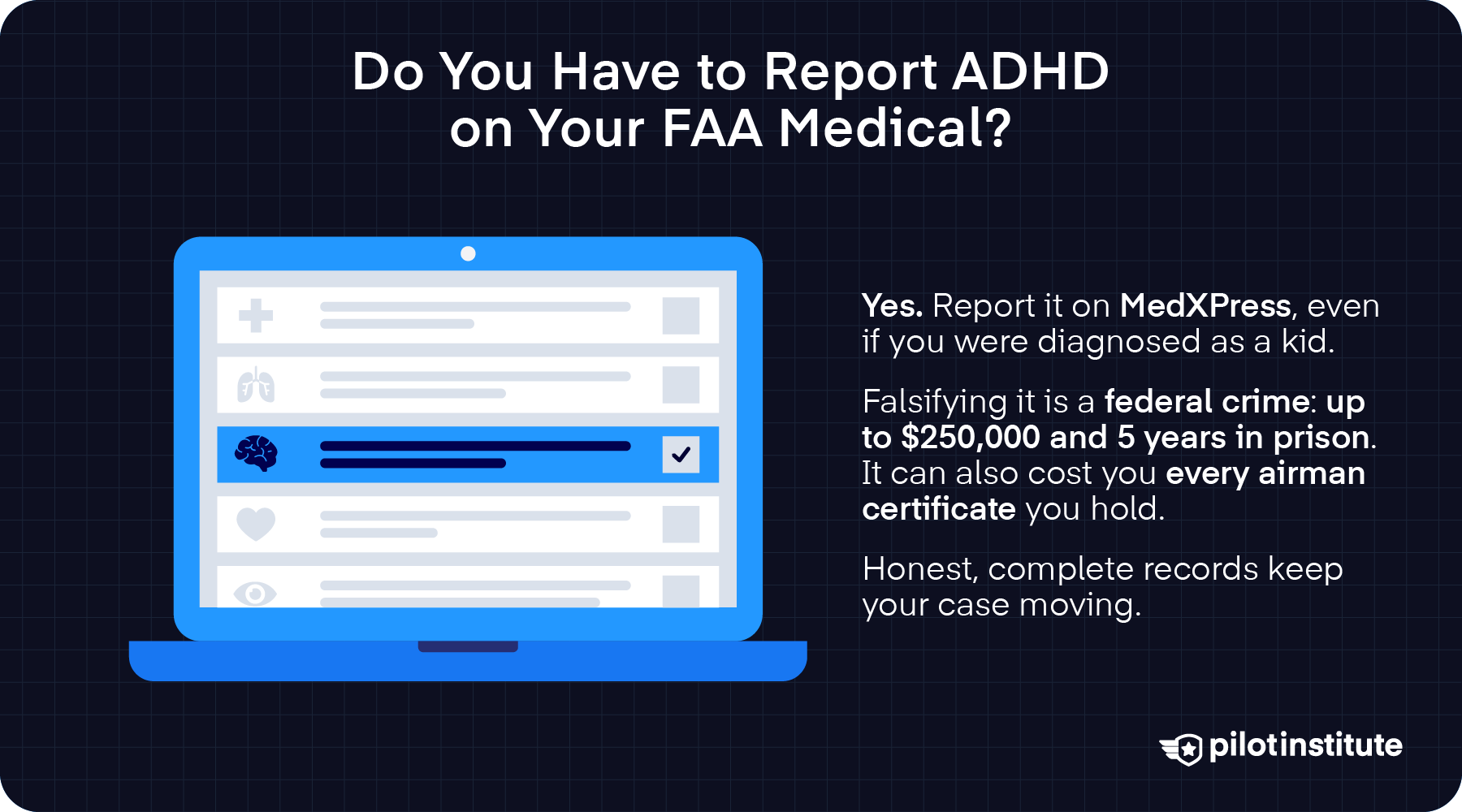
Yes, you have to report ADHD on MedXPress (the online version of FAA Form 8500-8).
The form asks if you have ever been diagnosed with certain conditions, including “mental disorders of any sort.” You’ll also list the medications you take and any visits to a health professional in the past 3 years.
Now, any diagnosis still counts, even if it happened long ago. A childhood ADHD diagnosis belongs on the FAA form too.
We don’t mean to spook you, but knowingly falsifying your application is a federal crime under 18 U.S.C. 1001. The penalties aren’t fun. You could face a fine of up to $250,000, up to 5 years in prison, or both.
And per 14 CFR 3.403, falsification can cost you every airman certificate and rating you hold, along with your medical.
Being forthcoming is the safer move. Both FAA tracks for ADHD examine your records from the last 4 years, so complete paperwork is what lets your evaluator and AME move your case forward.
Can You Fly Without an FAA Medical Certificate?
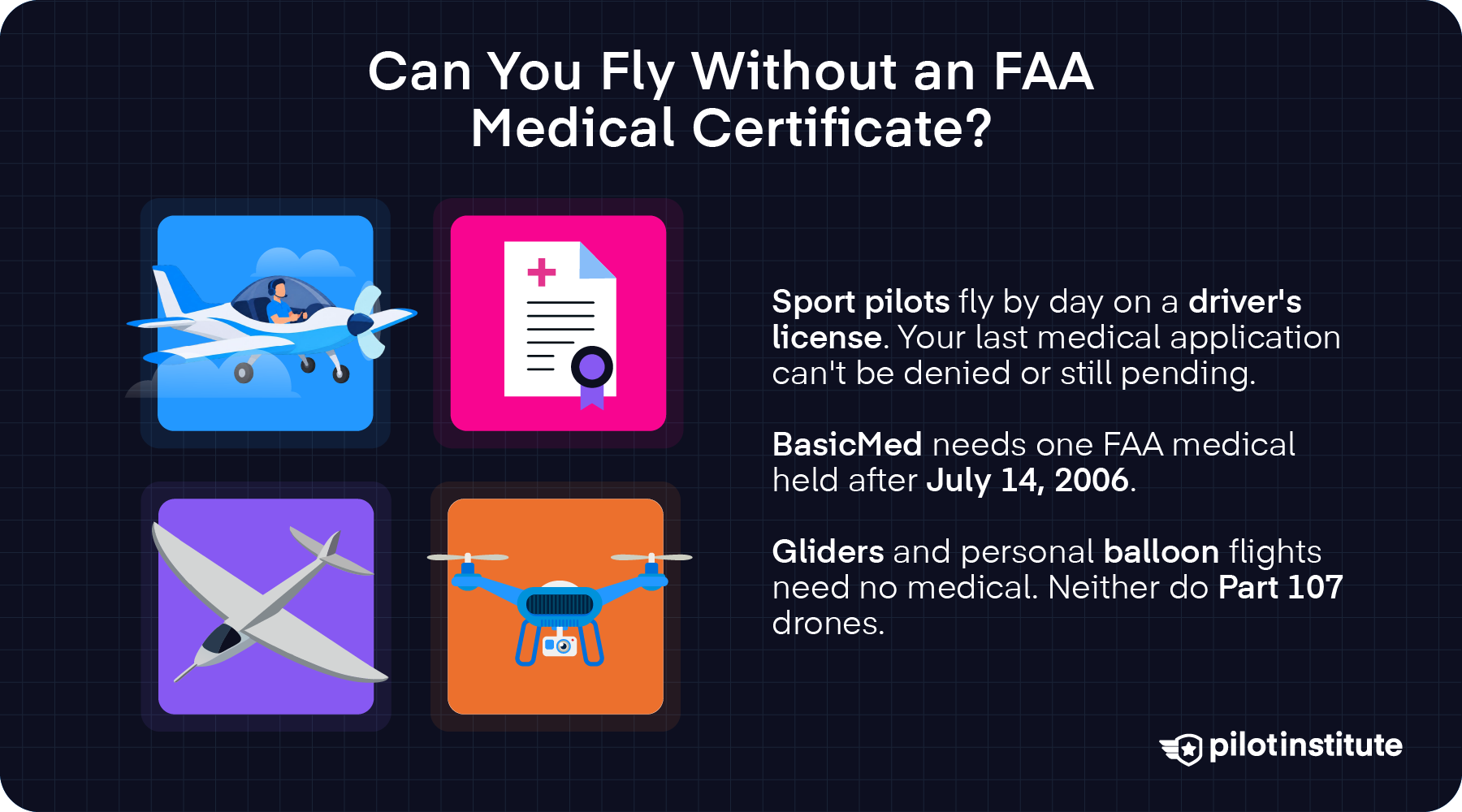
Yes. You can fly without a medical for several kinds of flying.
As expected, each option comes with its own conditions. If you need an extra hand, don’t hesitate to reach out to an AME or a pilot organization. They can help you figure out which path is right for you.
Sport Pilot With a Driver’s License
Thanks to the FAA’s MOSAIC rule, whose sport pilot changes took effect on October 22, 2025, you can fly as a sport pilot with ADHD during the day. Instead of an FAA medical, you’ll be using a valid U.S. driver’s license. Flying at night as a sport pilot takes an FAA medical or BasicMed.
Under 14 CFR 61.23, if you’ve ever applied for an FAA medical, the FAA must have found you eligible for at least a third-class medical on your most recent application.
A deferral still under review doesn’t count, since the FAA hasn’t found you eligible yet. A denial closes this path.
Moreover, your most recent medical can’t have been suspended or revoked, and any special issuance can’t have been withdrawn. So if your ADHD case is with the FAA right now, wait for a decision before you fly on your driver’s license.
And don’t forget that 14 CFR 61.53 still applies. You’re in charge of the go/no-go, as well as assessing if your condition would make a flight unsafe.
BasicMed
BasicMed lets you keep flying without a current medical, but there is a threshold to keep in mind.
To use BasicMed with ADHD, you must have held an FAA medical certificate at some point after July 14, 2006. If you’re a brand-new pilot who’s never held one, you’ll need to earn at least one regular FAA medical first.
However, you can’t use this option if your most recent medical application was completed and denied, your most recent medical was suspended or revoked, or your most recent special issuance was withdrawn. An expired medical, or one issued with a special issuance, still counts.
You can find the full requirements in our BasicMed guide.
Gliders and Balloons
Some aircraft let you forgo the medical requirement altogether.
Flying a balloon for personal, non-commercial purposes requires no FAA medical certificate. On the other hand, glider pilots don’t need an FAA medical certificate at all, even if they hold a commercial pilot certificate.
The exception is commercial balloon work. Under a 2022 rule, carrying paying passengers in a balloon for hire now requires a valid second-class medical, though giving balloon flight training doesn’t. You’ll see that reflected in 14 CFR 61.23.
Part 107 Drones
If your goal is commercial drone work, we’ve got good news. Operating under Part 107 requires no FAA medical certificate at all.
That said, 14 CFR 107.17 still bars you from flying if you know, or have reason to know, of a physical or mental condition that would interfere with safe operation. So a diagnosed ADHD drone pilot still has to fly only when fit.
How Long Does the FAA ADHD Process Take?
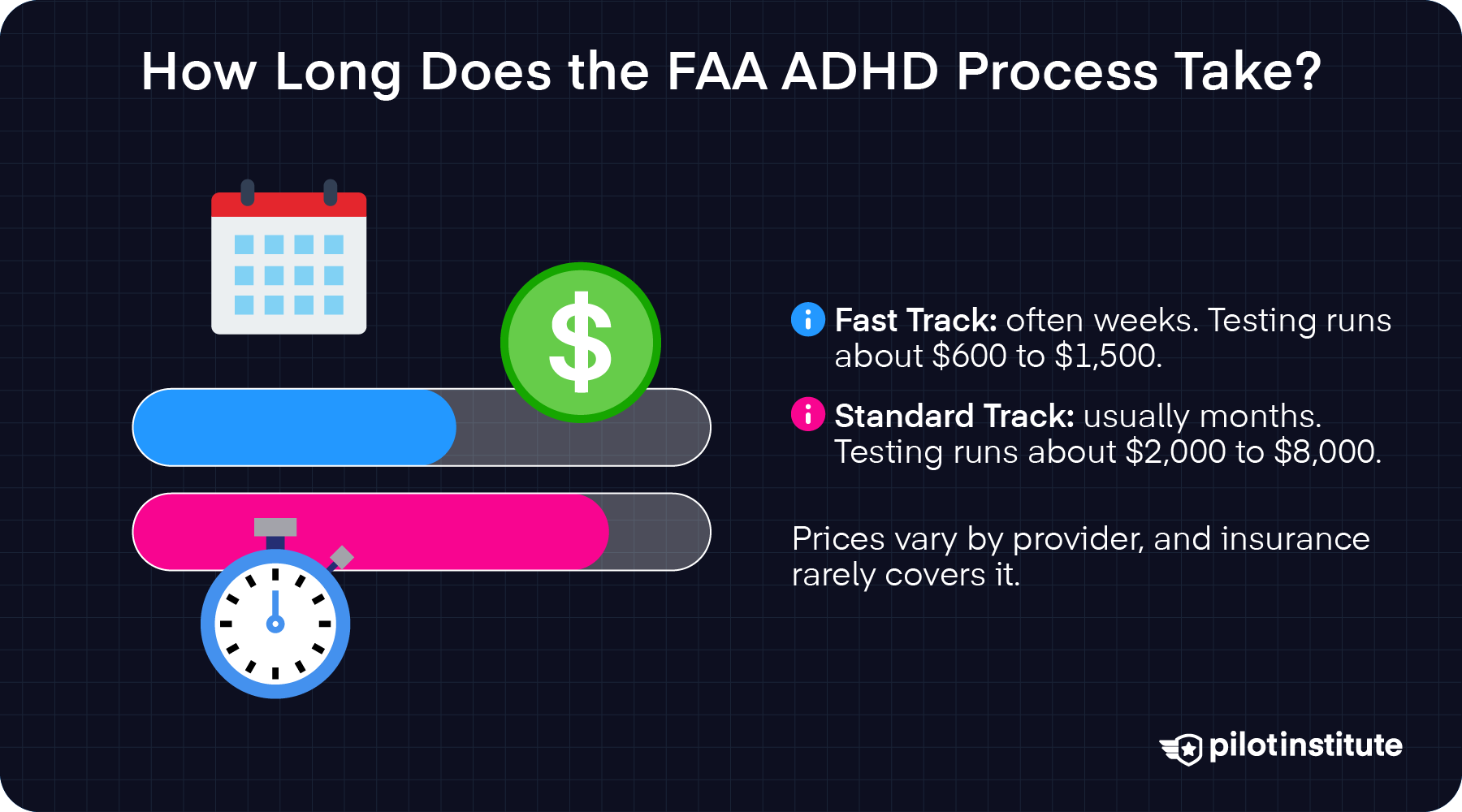
As you may expect, your FAA ADHD medical timeline depends on which track you land on.
A Fast Track applicant can walk out of the AME visit with a medical certificate, provided the psychologist’s evaluation is complete and the AME has no concerns. The whole thing can take only a matter of weeks.
Standard Track cases are slower because they go to the FAA for review, and that can stretch on for months.
The FAA has been speeding up these reviews. In July 2026, the Federal Air Surgeon reported that deferred cases now reach a decision in under 80 days on average, down from nearly 200. Missing paperwork is a common cause of delays, so send a complete package the first time.
Now, the other half of the equation is cost. Each psychologist or neuropsychologist sets their own fees. The Standard Track ADHD neuropsych testing cost usually runs higher than a Fast Track evaluation, since it includes a full battery of in-person tests.
Ask for a written quote before you book.
Your health plan may not cover an evaluation done for FAA certification, so check with your insurer first.
Frequently Asked Questions
Can You Be an Airline Pilot With ADHD?
Yes. The FAA’s ADHD protocol applies to first-class medicals too, so both Fast Track and Standard Track applicants can qualify to hold one.
If your sights are set on the airlines, we recommend getting your first-class medical early. You can clear any ADHD review long before investing in a career path with stringent medical requirements.
Can Pilots Take Adderall?
No. ADHD medications and stimulants are on the FAA’s Do Not Issue list. Adderall falls in both groups, so you can’t hold a medical certificate while taking it.
If your prescribing doctor determines you can stop, the Standard Track requires at least 90 days off before testing.
What if You Were Diagnosed With ADHD but Never Took Medication?
You still need to report the diagnosis. Remember, the diagnosis itself is what the FAA is concerned about, on top of your medication.
The four-year Fast Track criteria look at your symptoms and your stability at school and work. Now, if those four years are clean, you may still qualify for the Fast Track.
How Long Do You Have to Be off ADHD Medication to Fly?
For the Standard Track, you must be off ADHD medication for at least 90 days before your testing. For the Fast Track, the window is longer. Four years with no medication or symptoms and no instability in your academic or work life.
Either way, any decision to stop medication belongs to your prescribing doctor.
Can You Start Flight Training Before Getting Your Medical?
Yes. Sport pilot students can solo on a driver’s license, and glider students don’t need a medical.
For a student pilot certificate holder on the private pilot path, dual instruction with a flight instructor doesn’t require a medical certificate. Under 14 CFR 61.23, you just need your medical in hand before your first solo flight.
However, some flight schools require students to hold a medical from the start. You’re going to solo sooner or later anyway, so it’s best to secure your medical before you invest further in flight training.
What Is a HIMS AME?
A HIMS AME is an aviation medical examiner with extra training in handling mental health and substance-related cases.
For ADHD, the HIMS-trained specialist you need is the neuropsychologist on the Standard Track. Any AME can handle the Fast Track, though a HIMS AME can help with complicated histories.
To find a HIMS AME near you, use the FAA’s AME Locator tool. For a HIMS neuropsychologist, check the FAA’s list of aviation neuropsychologists and psychologists.
Conclusion
For many hopefuls out there, becoming a pilot with ADHD is within your reach.
Now it’s time to gather your records and talk with an AME. They can start the process of your FAA medical and keep your application on track.
And when you’re ready to build the knowledge that gets you in the cockpit, Pilot Institute’s Private Pilot ground school is a great place to start.