
- Key Takeaways
- What Is a Helicopter Traffic Pattern?
- Does the Traffic Pattern Run the Same Everywhere?
- How Is a Helicopter Pattern Different From an Airplane Pattern?
- What the Pattern Looks Like
- Do Helicopters Have to Avoid Fixed-Wing Traffic?
- How to Avoid Fixed-Wing Traffic
- What Altitude Do Helicopters Fly in the Traffic Pattern?
- Why 500 Feet?
- Do Helicopters Turn Left or Right in the Traffic Pattern?
- Why Right Turns Are Routine
- The Legs of a Helicopter Traffic Pattern
- The Final Approach
- Flying the Pattern at Towered and Non-Towered Airports
- Pattern Principles at Towered Airports
- Local Procedures at Non-Towered Airports
- Frequently Asked Questions
- What Is a Helicopter Traffic Pattern?
- Do Helicopters Have to Follow a Traffic Pattern at All?
- Do Helicopters Fly Left-Hand or Right-Hand Patterns?
- Can a Helicopter Land on the Runway?
- Conclusion
A helicopter pattern is the standard path you fly around an airport. You’ll depart and return to land while staying clear of airplanes.
Let’s imagine you’re on downwind in a Robinson R22, halfway through your first solo pattern. Then, a pilot in a Cessna calls the field.
You scan for it, so hard in fact that you have to squint your eyes. But because the Cessna is about 500 feet above you and all the way to the far side of the runway, you see nothing.
Moments like this are why we have helicopter traffic pattern procedures. Now, let’s discuss how that pattern differs from an airplane’s, plus the rules and procedures around it.
Key Takeaways
- Federal regulations order helicopters to avoid the flow of fixed-wing traffic.
- A helicopter traffic pattern is usually flown lower and tighter than an airplane’s.
- No regulation dictates turn direction, but the FAA describes the standard helicopter pattern as right turns.
- At towered fields, you follow the controller. At non-towered fields, you follow local policy.
What Is a Helicopter Traffic Pattern?
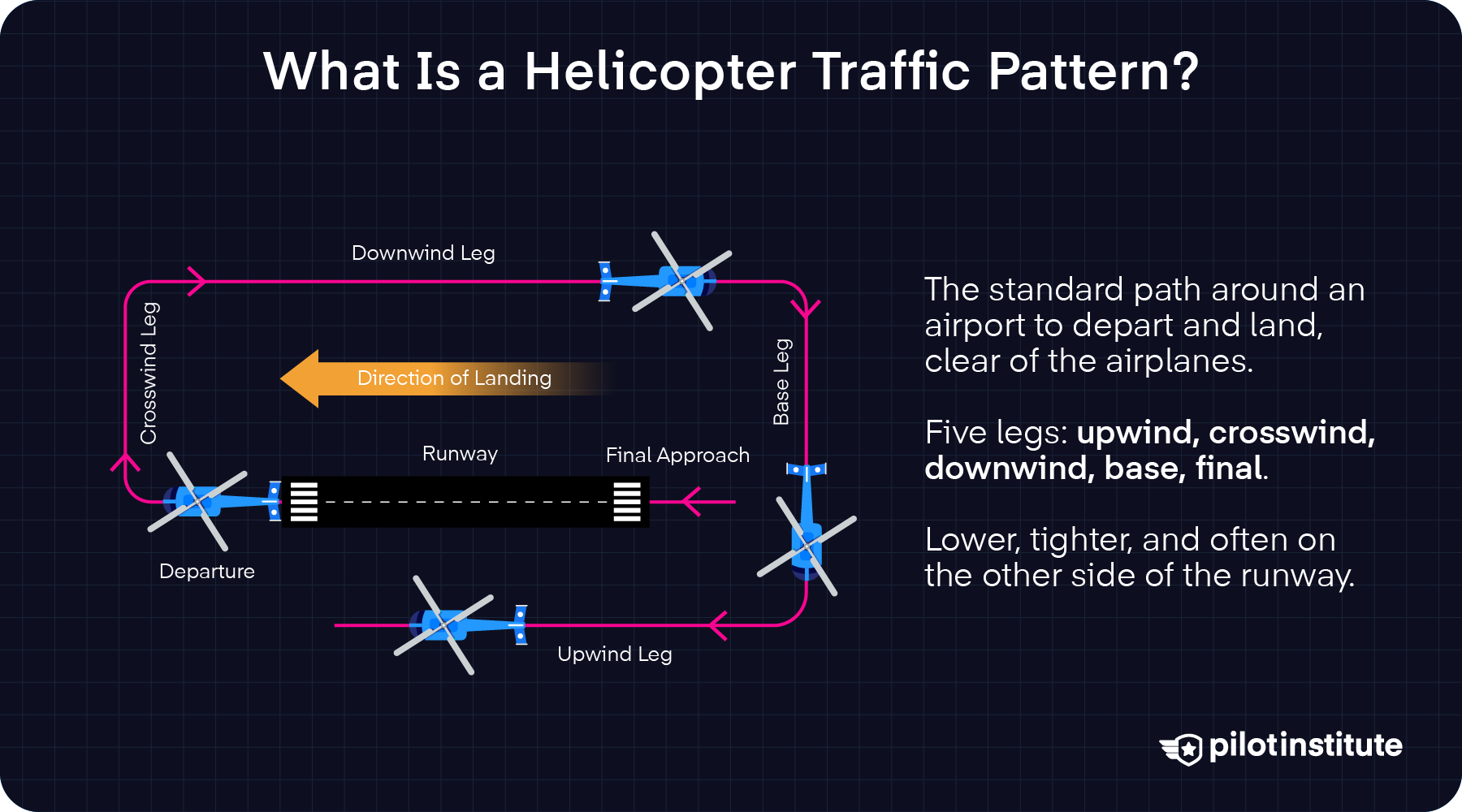
A helicopter traffic pattern is the standard flight path a helicopter follows around an airport as it departs and comes back around to land. All the while, you’re keeping clear of the airplanes you’re sharing the airspace with.
It has certain similarities to the path taken by fixed-wing aircraft. Helicopters borrow the same shape and the naming of the legs. You’ll still hear callouts for upwind, crosswind, downwind, base, and final.
Scale and direction are how they’re different. A helicopter may fly a pattern similar to the fixed-wing one, but at a lower altitude of about 500 feet AGL and closer to the runway.
The standard airplane pattern turns left. However, AC 90-66C and the Aeronautical Information Manual (AIM) single out helicopters. They say that turns are made to the left “except for helicopters, as applicable.”
Does the Traffic Pattern Run the Same Everywhere?
The regulations require only that a helicopter avoid the flow of fixed-wing aircraft. That said, neither the AIM nor 14 CFR prescribes a standard mandatory technique to fly the helicopter pattern.
You’ll notice how the language in the AIM and AC 90-66C uses the word “may.” The FAA recommends the lower, closer pattern as something a helicopter may fly, but not something it strictly must.
The final call is still yours to make.
Quiz: Helicopter traffic patterns
Question 1 of 7
Your score
0/7
Which of these is a regulatory requirement for all helicopter traffic patterns?
Answer: Avoid the flow of fixed-wing aircraft.
How is a helicopter pattern different from an airplane pattern?
Answer: It is usually lower and tighter.
In which airspace class must you avoid fixed-wing aircraft during approach for landing?
Answer: Class G, Class B, Class C, Class D, Class E
True or False: Helicopters must always fly the traffic pattern at 500 feet.
Answer: False
If fixed-wing aircraft are flying a left-hand pattern, which direction would helicopter traffic turn?
Answer: Right turns
At what altitude would you typically turn from upwind to crosswind?
Answer: 300 ft
Which radio frequency do you use to self-announce?
Answer: Common Traffic Advisory Frequency
How Is a Helicopter Pattern Different From an Airplane Pattern?
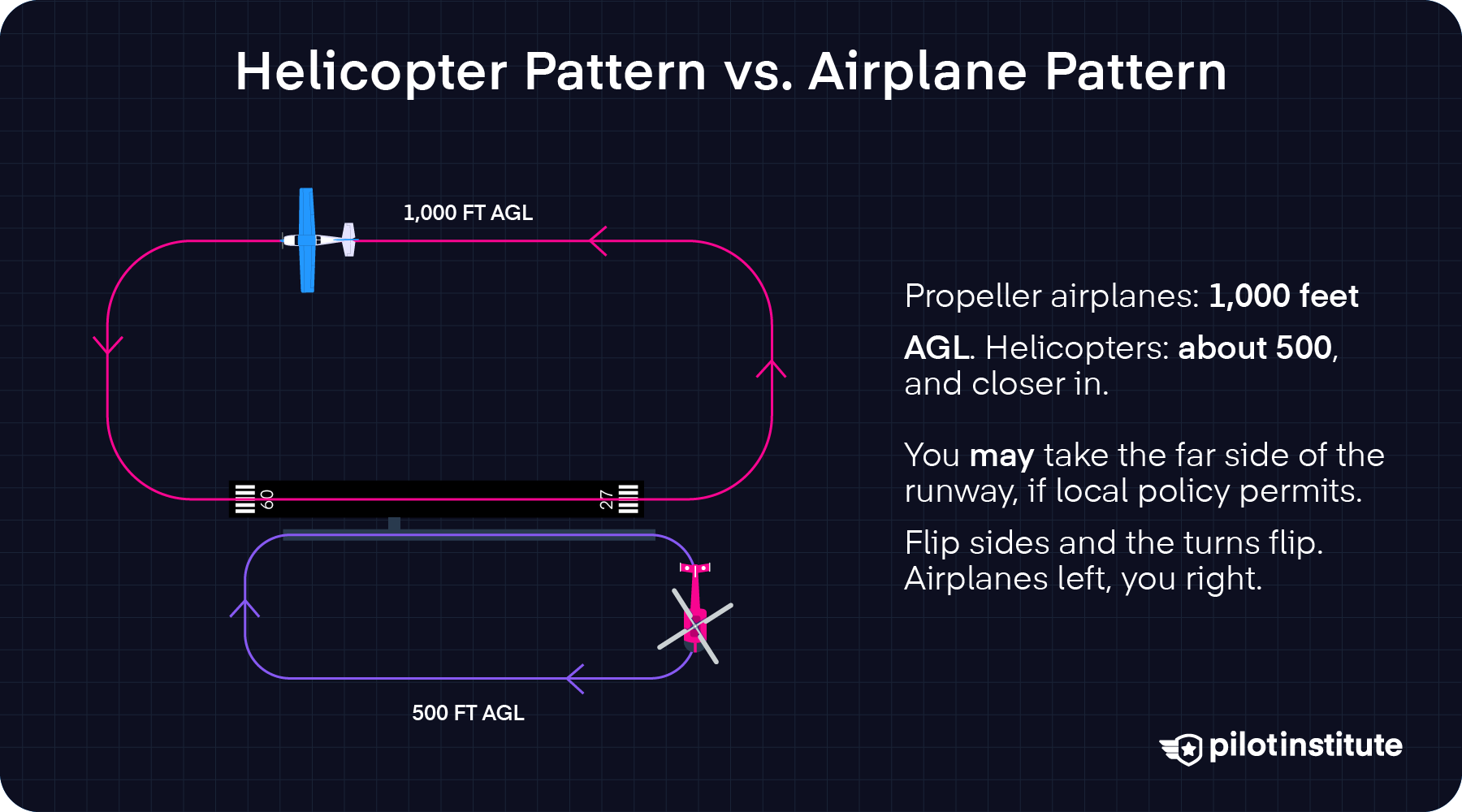
A helicopter pattern is lower and tighter than an airplane’s. It may also be on the opposite side of the runway from fixed-wing traffic.
The AIM has propeller-driven airplanes entering at 1,000 feet AGL. A helicopter, on the other hand, flies its version down around 500 feet AGL.
Helicopters also stay closer in, and they fly a smaller “box” than an airplane.
Your traffic pattern could run at the opposite side of the runway when airspeed calls for it. Or, when you’re setting up a practice power-off landing (an autorotation). Just make sure you’re adhering to local policy.
When you flip your pattern to the far side, the turns flip with it as well. If fixed-wing aircraft fly a left-hand pattern, you’re making your turns to the right.
What the Pattern Looks Like
The size of the pattern you make isn’t “locked in” either. Per the AIM, you may vary the size of the traffic pattern based on the aircraft’s performance.
Also, remember that helicopters can set down on a marked helipad or another suitable clear area. That means you don’t have to aim for the runway at all.
At a towered field, you still need a clearance before you touch down anywhere on the movement area.
If that’s the case, you’ll usually peel away from the runway centerline during approach. Then, your path will bend towards your landing point.
Do Helicopters Have to Avoid Fixed-Wing Traffic?
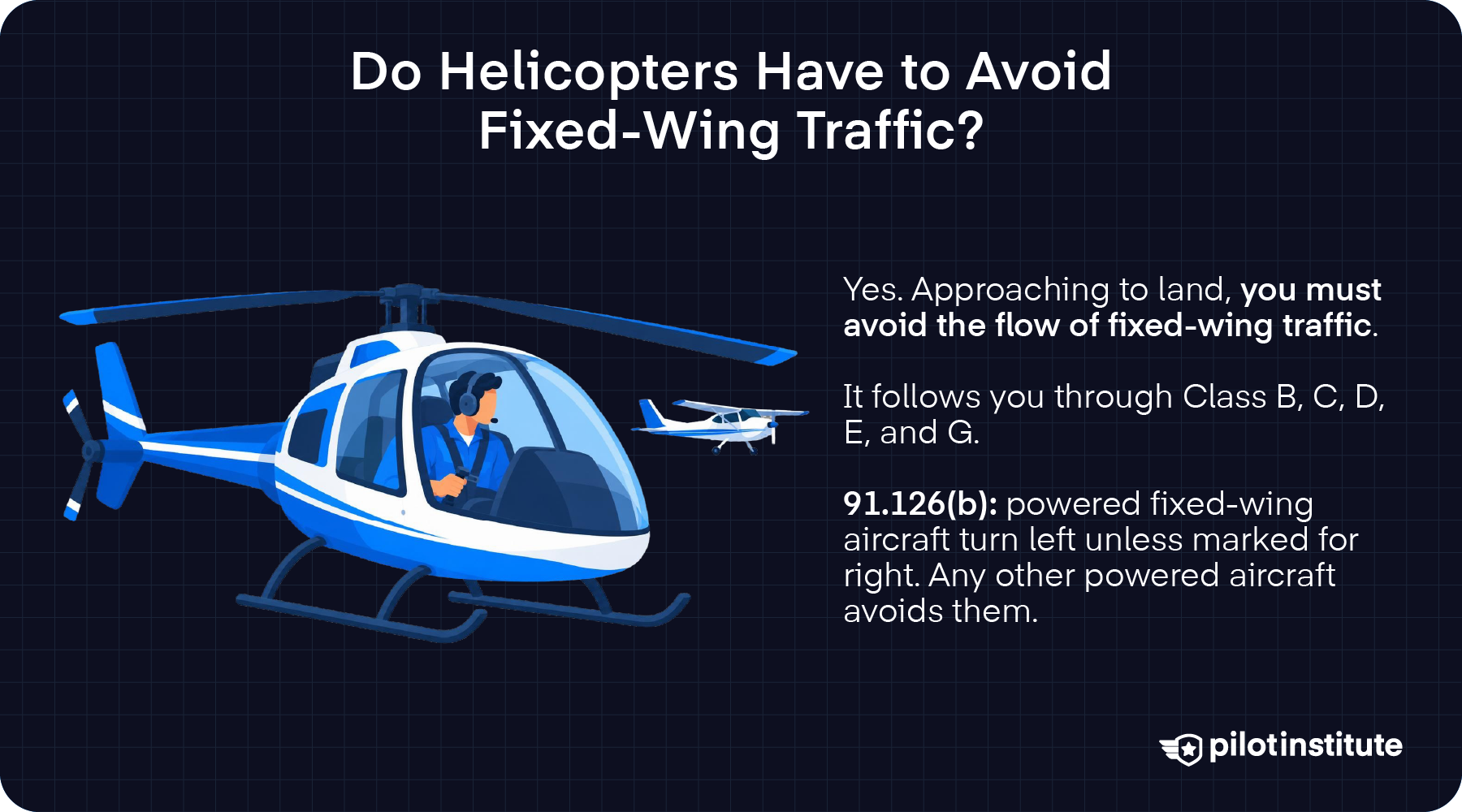
Yes. When you’re approaching to land at an airport, federal regulations require you to avoid the flow of fixed-wing traffic. That duty follows you through Class B, C, D, E, and G.
14 CFR 91.129(f) explicitly calls out helicopter pilots. If you’re approaching to land in Class D airspace, you’ll have to avoid the flow of fixed-wing aircraft.
The FAA’s MOSAIC final rule widened the categories in 14 CFR 91.126(b). It used to name airplanes on one side and helicopters and powered parachutes on the other.
The rule now says that when you’re approaching to land at an airport without an operating control tower in Class G airspace, a pilot of a “powered fixed-wing aircraft” must turn left unless markings call for right turns.
A pilot of “any other powered aircraft” must avoid the flow of that fixed-wing traffic. Helicopters fall within that category.
The rules for different airspace classes echo this, too. Class E rules in 14 CFR 91.127 point back to 14 CFR 91.126. Both 14 CFR 91.130 for Class C and 14 CFR 91.131 for Class B reference 14 CFR 91.129.
How to Avoid Fixed-Wing Traffic
If you’re landing somewhere other than the runway, you should stay clear of the fixed-wing pattern. Then, set down on a marked helipad or another suitable clear area.
But if you’re landing on the runway itself, you may fly a pattern much like the fixed-wing one. It could be lower, around 500 feet AGL, and closer to the runway.
What Altitude Do Helicopters Fly in the Traffic Pattern?
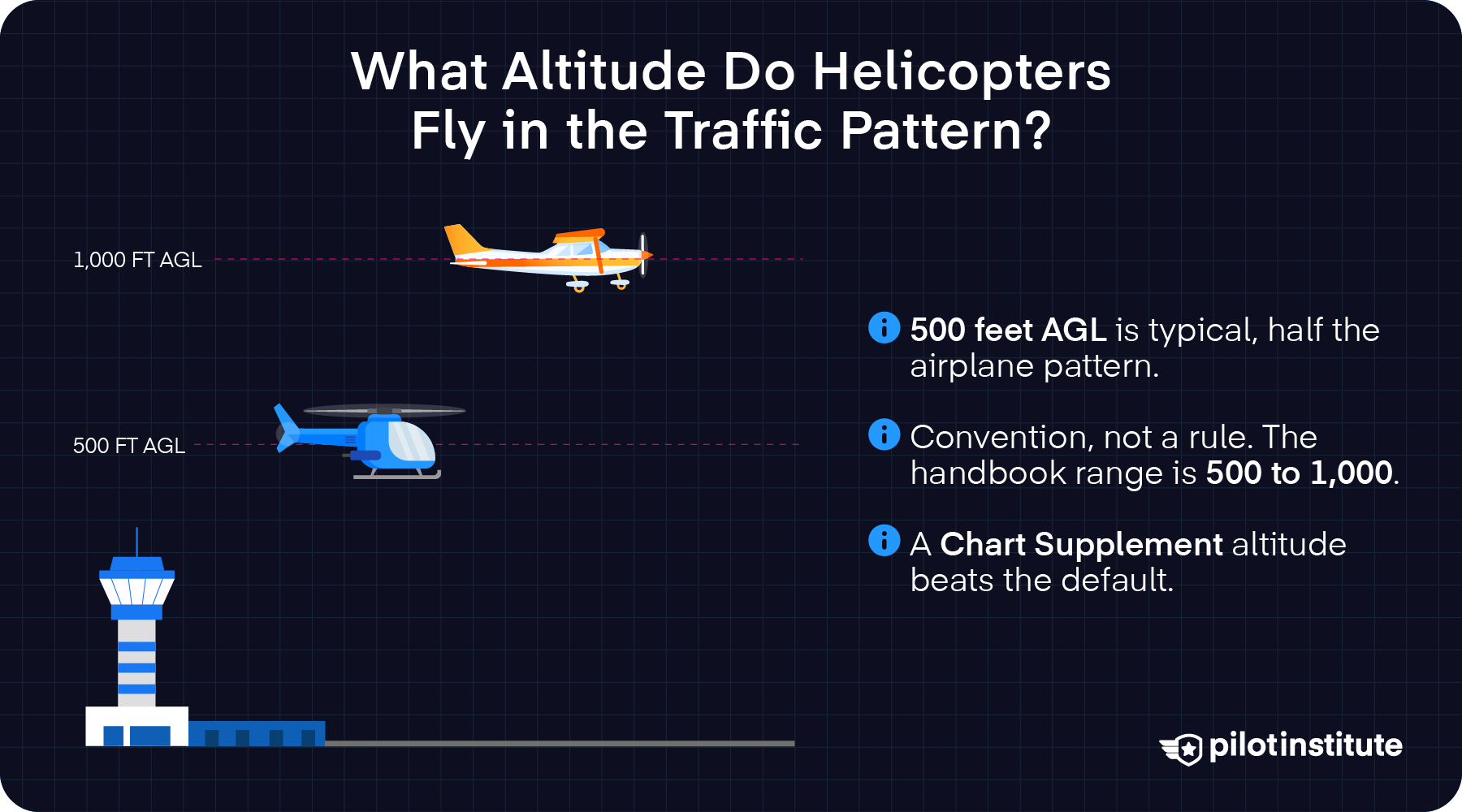
The typical helicopter traffic pattern altitude is about 500 feet AGL. That is, unless terrain or a Chart Supplement says otherwise.
That’s roughly half the standard 1,000-foot pattern altitude for a propeller-driven airplane. But take note that 500 feet is just a convention. It’s not technically a universal number.
500 to 1,000 feet AGL is the working range in the Helicopter Flying Handbook. The height of the pattern you make can still slide up or down depending on many variables. It could depend on the terrain below and the traffic that’s already in the pattern.
Absent an ATC instruction, the pattern altitude published in the Chart Supplement overrides the default 500 feet. Make sure you’ve checked it before you take off.
Why 500 Feet?
Flying low tucks you safely beneath 1,000 feet, which is, again, the default for propeller-driven airplanes.
Now, as for the tight shape of the pattern, it comes down to performance. You can draw a smaller box because a helicopter can fly the pattern more slowly than an airplane.
You can vary the size of the traffic pattern depending on your aircraft’s performance.
Do Helicopters Turn Left or Right in the Traffic Pattern?
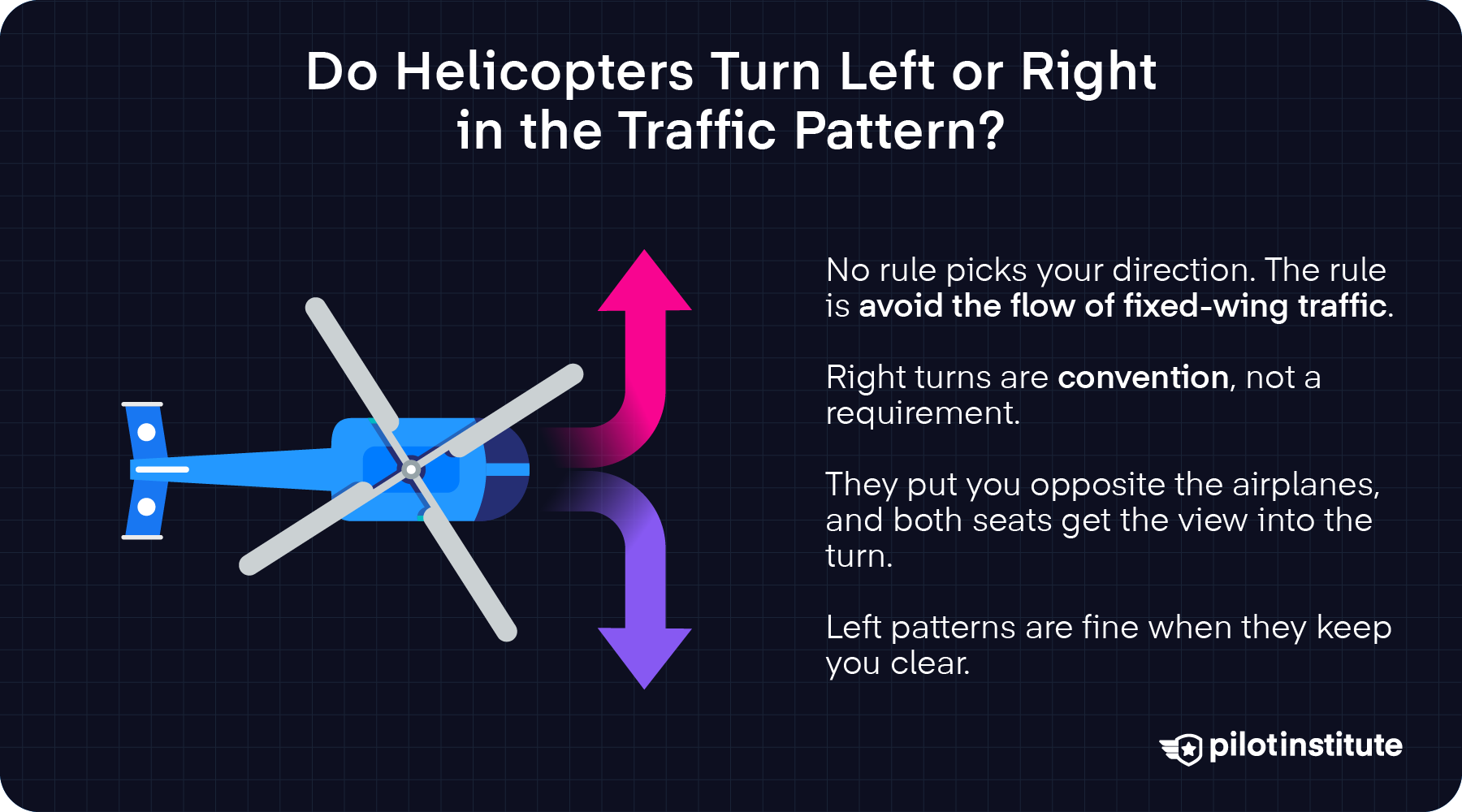
Nowhere in the rules does it explicitly tell a helicopter which way to turn. Instead, regulations order you to avoid the flow of fixed-wing traffic.
What’s important legally is that you stay clear of the airplanes. You can then draw the connection that you’ll have to use a right-hand pattern on the other side of the runway.
But again, just to be clear, this right-hand pattern is largely only convention or routine practice. The Helicopter Flying Handbook does call right turns the standard helicopter pattern. That’s a description of normal practice, though. It’s not a regulatory requirement.
Your traffic pattern still comes down to local policy or the controller’s instructions. In fact, plenty of helicopters fly left patterns if that’s what keeps them clear of fixed-wing aircraft.
Turn whichever direction is compliant with the rules in the airspace.
Why Right Turns Are Routine
There are a couple of sensible reasons for making a right-hand traffic pattern. First, there’s separation.
A right-hand helicopter pattern runs opposite the left-turning airplanes. The slower rotorcraft and the faster airplanes aren’t crammed in close proximity to each other.
Second, it makes accommodations for where pilots sit.
Airplane pilots usually fly from the left seat and helicopter pilots from the right. Therefore, a left pattern for airplanes and a right pattern for helicopters gives everyone the best view into the turns.
The Legs of a Helicopter Traffic Pattern
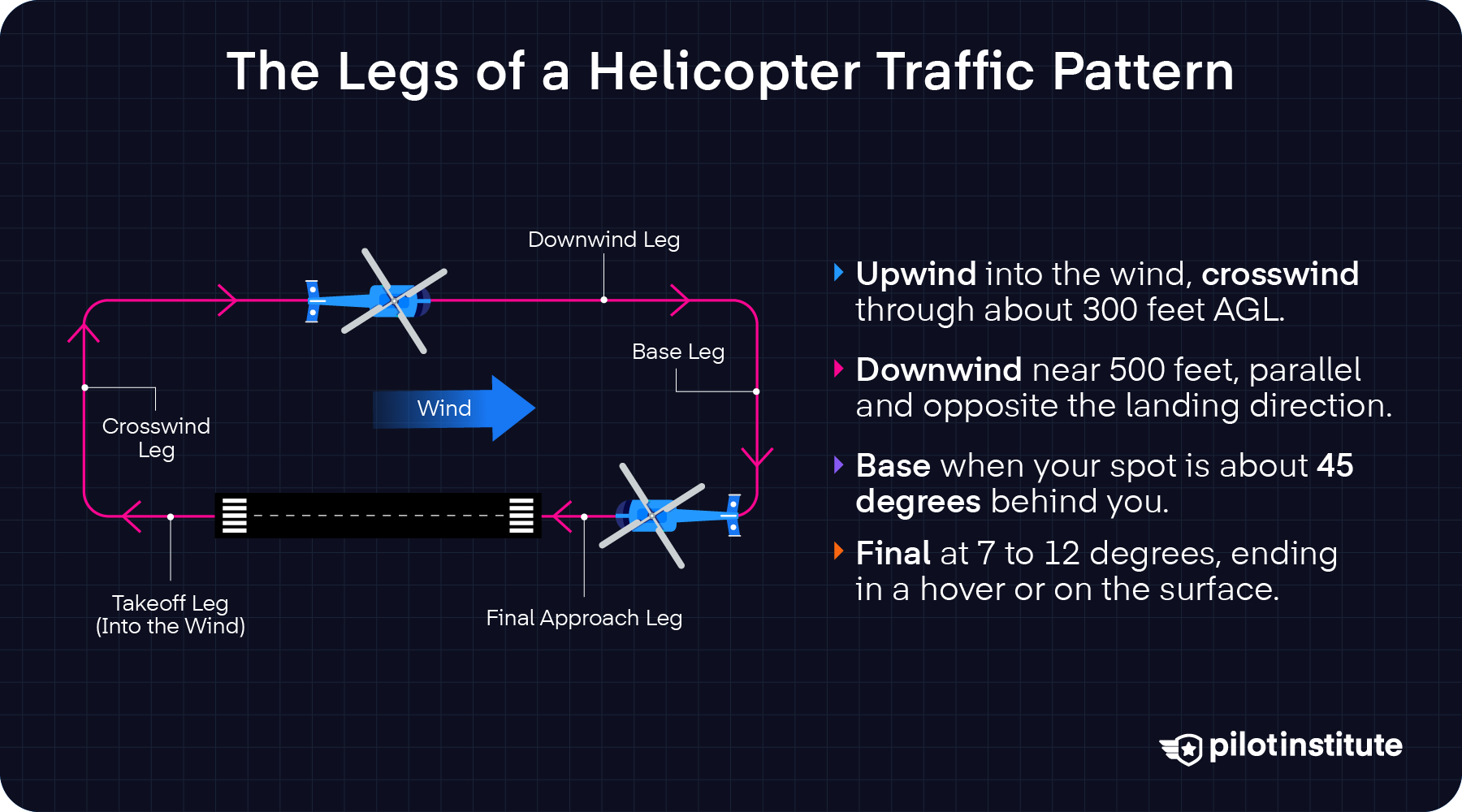
A helicopter pattern runs through the same five legs as an airplane. They are upwind, crosswind, downwind, base, and final.
The Helicopter Flying Handbook walks through a typical pattern departing a helipad into the wind with right turns. Take the altitudes we’ll mention as a reference point, even when your pattern could look different.
You lift off into the wind on the upwind or takeoff leg. Then, as you climb through roughly 300 feet AGL, you turn onto the crosswind leg.
Upon reaching the pattern altitude near 500 feet AGL, you’ll roll level and settle onto the downwind. This leg runs parallel to the runway in the opposite direction from landing.
Hold that until the spot you’re aiming for sits about 45 degrees behind your abeam position. From there, turn and start down onto the base leg, descending toward roughly 300 feet AGL.
From base, you’ll turn final and roll out on the approach path while bearing the wind and any obstructions in mind.
The Final Approach
A smooth and gentle approach is entirely achievable with the right technique. Normal helicopter approaches follow a shallow descent angle. It could be somewhere between about 7 and 12 degrees, down to the spot you’ve chosen.
But instead of rolling onto a runway like an airplane, the approach ends in a termination. Together, your rate of descent and groundspeed bleed to zero.
The termination could be either to a hover a few feet off the ground, or all the way to the surface.
Which one you fly depends on the surface conditions. For instance, you might be landing on a dusty or snow-covered landing area. In that case, a normal approach to the surface would be the more reasonable call.
Flying the Pattern at Towered and Non-Towered Airports
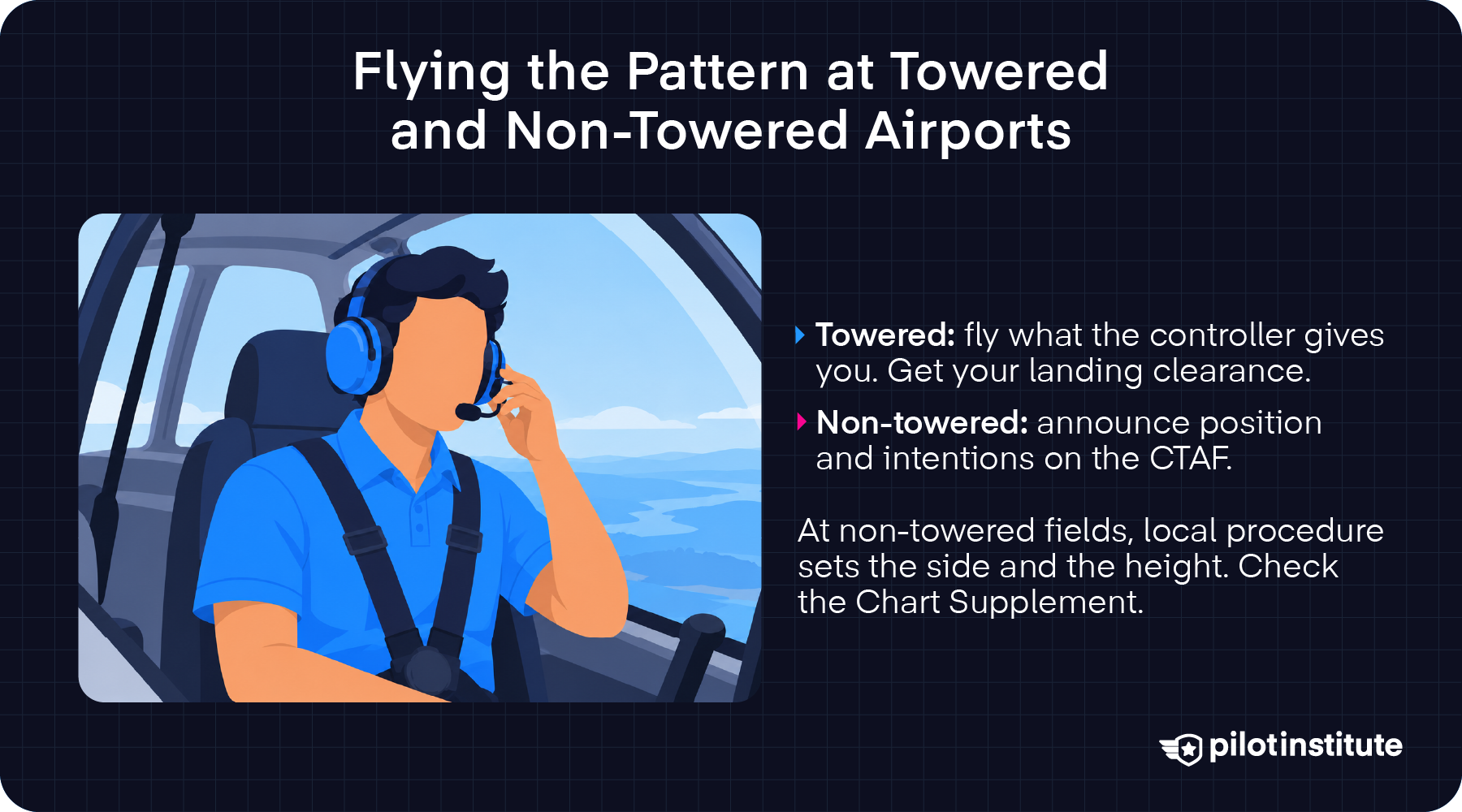
The tower runs the show at a towered airport. You’ll fly what the controller tells you. Follow the instructions you’re given and get your landing clearance before you touch down.
There’s no one to clear you at a non-towered field, so you take on that job yourself. You’ll be announcing your position and intentions on the Common Traffic Advisory Frequency (CTAF). At the same time, you’re listening out for radio calls from other pilots in the area.
AC 90-66C explains the self-announce practice. It reminds helicopter pilots to keep clear of the airplanes, no matter if you’re landing on a runway or off to a helipad.
But there’s one constant in both airports. Stay out of the fixed-wing flow.
Pattern Principles at Towered Airports
There are just a couple of nuances to that principle. First of all, the controller can still put you in the airplane pattern.
Don’t be surprised if the control tower asks you to fly the standard fixed-wing pattern at 1,000 feet AGL. You’ll likely encounter scenarios that call for it.
Even though you’d normally stay lower and tighter, you should train for a wide range of traffic procedures. For instance, if you lose two-way radio communication, you’ll need to be familiar with light gun signals.
Local Procedures at Non-Towered Airports
Now, when you’re at a non-towered airport, local procedure has the real say over your pattern. Which side of the runway you use and how high you fly will typically depend on local policy and noise abatement measures.
A helicopter drifting low over houses or livestock is just what those rules seek to prevent. So before you commit to a side, make sure you’ve looked up the Chart Supplement and any published local procedures.
Frequently Asked Questions
What Is a Helicopter Traffic Pattern?
A helicopter traffic pattern is the standard flight path a helicopter follows around an airport as it departs and returns to land.
It borrows the same shape and the names of the legs as the rectangular airplane pattern. We still call them upwind, crosswind, downwind, base, and final.
What makes a helicopter pattern different is the scale. A helicopter flies a lower traffic pattern, usually around 500 feet AGL. You’re also flying pulled in closer to the runway than an airplane would.
That tighter, lower box carves out a lane for the slower rotorcraft to work near the airport. You’re also not getting crammed with the faster fixed-wing traffic.
With all of that said, the only hard requirement is that a helicopter stay clear of the airplane flow. The rest isn’t technically set in stone by regulation, although the FAA does recommend the pattern procedure.
Do Helicopters Have to Follow a Traffic Pattern at All?
Not the way an airplane does. Neither 14 CFR nor the AIM strictly describes a required traffic pattern for helicopters. The FAA recommends one, but it’s not a mandate.
The single binding rule is that you avoid the flow of fixed-wing traffic during approach for landing.
A helicopter doesn’t have to trace a set pattern, then, but it does have to stay clear of the airplanes. At a towered field, you’ll still fly whatever the controller assigns you. At a non-towered field, you’ll follow local policy.
Do Helicopters Fly Left-Hand or Right-Hand Patterns?
No regulation forces a helicopter to turn a particular direction. Instead, the rules call on helicopter pilots to avoid the flow of that fixed-wing traffic.
So if airplanes make left turns in the traffic pattern, helicopters should logically follow a right-hand pattern. This practice keeps the two streams of traffic on their own sides of the runway.
The convention also makes accommodations for where pilots sit. Airplane pilots usually fly from the left seat and helicopter pilots from the right. A left pattern for one and a right pattern for the other gives each a better view into the turns.
Just remember that while it’s a widely used convention, it is not a legal requirement. Air traffic control or local policy still has the final say.
Can a Helicopter Land on the Runway?
Yes, a helicopter can land on the runway. At some airports, the runway could be the only suitable landing area.
Even then, you still have to avoid the flow of fixed-wing traffic. You should also fly the pattern without conflicting with the airplanes already using it.
The option to land on the runway will also depend on who’s directing traffic. At a towered airport, for example, you’ll need a landing clearance before you touch down.
No one clears you at a non-towered field. You’ll announce your intentions on the CTAF and work the runway or your chosen spot around the flow of fixed-wing traffic.
Conclusion
There’s a reason why you’re having a hard time spotting that Cessna from your R22. Helicopters fly lower and tighter than airplanes. You’re safely tucked out of their flow.
Look high and wide when you’re scanning for traffic. By now, you should know where airplanes and helicopters each fit around the airport.
Get the helicopter pattern right. It’s a skill that you’ll depend on a lot, possibly even bookending the beginning and the end of every flight.
And once you’re comfortable with helicopter traffic patterns, you’ll fly them legally and safely, whatever the field throws at you.