
-
Key Takeaways
-
What Are the Four Forces Acting on a Helicopter?
- Two Forces In One
-
How Do Rotor Blades Create Lift?
- Blade Twist
- Angle of Attack vs. Pitch Angle
-
How Do Helicopter Controls Change the Airflow?
- Collective Pitch Control
- Governor/Correlator
- Throttle Control
- Cyclic Pitch Control
- Antitorque Pedals
-
Why Do Helicopters Need a Tail Rotor?
- No Tail Rotor
- What Is Translating Tendency?
-
What Happens Aerodynamically When a Helicopter Hovers?
- In Ground Effect
- Out of Ground Effect
-
What Changes When the Helicopter Flies Forward?
- What Is Effective Translational Lift?
- Dissymmetry of Lift
-
What Aerodynamic Limits Do Helicopter Pilots Train For?
- Autorotation
- Vortex Ring State
- Loss of Tail Rotor Effectiveness
- Retreating Blade Stall
-
Frequently Asked Questions
- Is Flying a Helicopter Harder Than Flying an Airplane?
- Can a Helicopter Land Safely if the Engine Fails?
- Why Do Helicopter Blades Bend and Flap While Spinning?
- How Fast Can a Helicopter Fly?
- Do All Helicopters Have a Tail Rotor?
- Can a Helicopter Fly Upside Down?
-
Conclusion
You watch a helicopter lift off the ramp at a small airport, hang about three feet off the pavement, then slide sideways and climb away.
Nothing about that looks like an airplane taking off.
Helicopter aerodynamics is the story of how a spinning rotor makes lift, and how the helicopter pilot aims that lift in whatever direction they want.
Now, let’s talk about how helicopters fly. We’ll go from the four forces and the rotor blade itself to the hazards pilots train for.
Key Takeaways
- In a helicopter, the main rotor produces both lift and thrust.
- Tilting the rotor disc splits the total rotor thrust into vertical and horizontal components.
- Ground effect near the surface reduces the helicopter’s necessary power to hover.
- Pilots train for autorotation, vortex ring state, tail rotor loss, and retreating blade stall.
What Are the Four Forces Acting on a Helicopter?
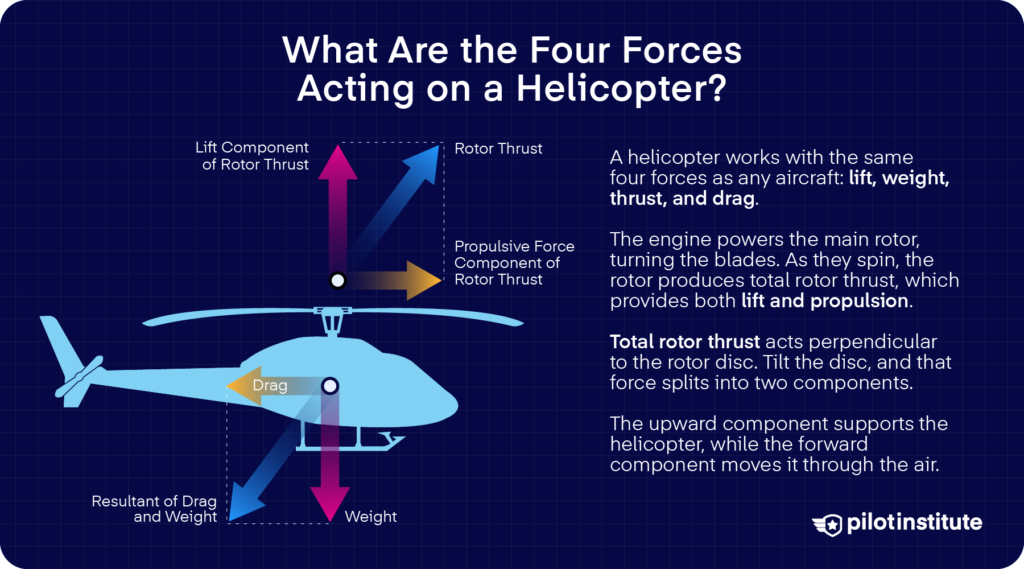
Every helicopter runs on the same four forces of flight, just like any aircraft: lift, weight, thrust, and drag.
Lift holds you up, weight pulls you toward the ground, thrust moves you where you want to go, and drag resists that motion.
On an airplane, the wing generally makes lift while the engine and propeller make thrust. The work is split between two parts.
But helicopter aerodynamics work differently. It gives both jobs to one component. The main rotor produces the lift that supports the aircraft and the thrust that moves it.
Two Forces In One
So how does a single rotor pull double duty?
The force exerted by the rotor disc on the helicopter is called the total rotor thrust. This force acts perpendicular to the rotor disc.
Now, when you tilt that disc, you’re “splitting” one force into two.
The upward component of that force carries your weight, and this is the lift component. The rest of the force that points sideways is the propulsive component.
How Do Rotor Blades Create Lift?
A rotor blade is an airfoil, so it makes lift the same way a wing does. What’s different is how the blade meets that air.
An airplane wing only makes lift once the aircraft moves forward.
A rotor blade, on the other hand, spins on its own and generates its own airflow. That’s how the helicopter rotor produces lift even when it sits still in a hover.
Blade Twist
But the spinning also adds a little wrinkle. Every point on the blade turns at the same rpm, yet the tip travels much farther each revolution than the root.
More distance in the same time means more speed. The tip meets the air far faster, and faster air makes more lift.
Left alone, the outer blade would carry most of the load.
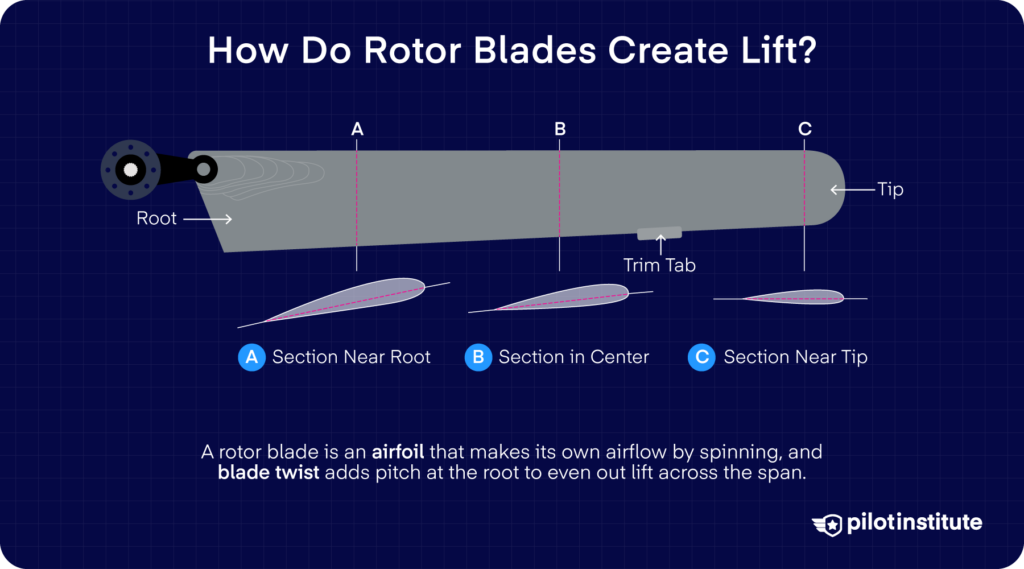
To fix that, designers build in blade twist. The airfoil’s pitch is higher near the root and lower toward the tip. Lift gets spread evenly along the span.
Angle of Attack vs. Pitch Angle
Essentially, two angles govern how much lift the rotor blade airfoil makes: pitch angle and angle of attack. They sound alike, but don’t get them mixed up.
Pitch angle (or angle of incidence) is the angle between the blade’s chord line and the plane of rotation, and you set it directly with the controls.
The collective input raises or lowers pitch on every blade at once. When you pull it up, every blade bites harder into the air.
Angle of attack goes up on all of them at once, so lift goes up and the helicopter climbs.
Drag goes up, too, and that added drag drags the rotor rpm down. That’s why the collective is really a power control as much as an altitude control.
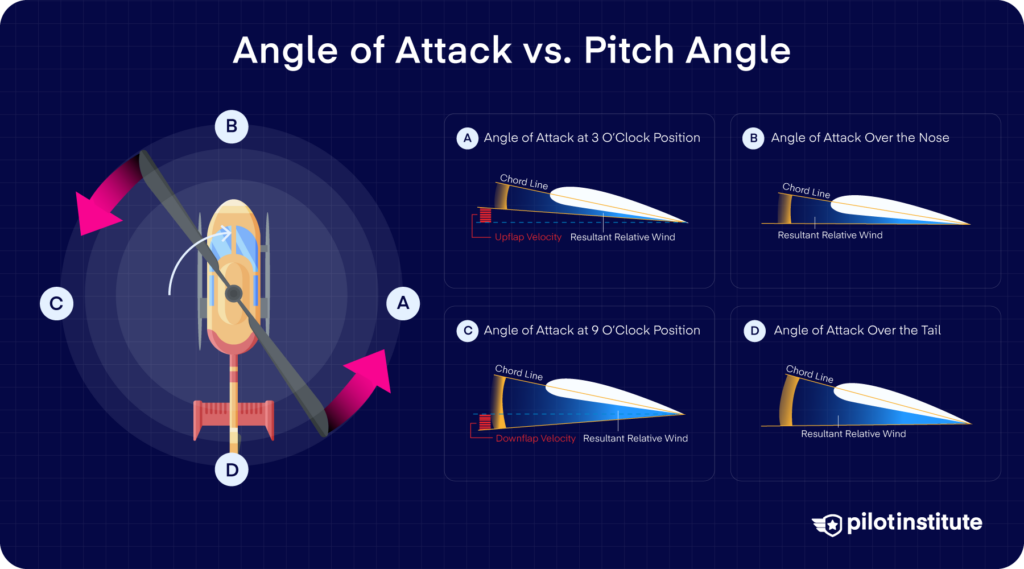
But when we say angle of attack (AOA), we’re talking about the angle between the chord and the resultant relative wind. That resultant combines the rotational relative wind with induced flow.
As induced flow changes, the resultant shifts along with it. Your angle of attack changes even when your pitch angle holds steady.
All that said, you command pitch directly but angle of attack only indirectly. That’s because AOA depends on the pitch you set and airflow, which you can’t fully control.
How Do Helicopter Controls Change the Airflow?
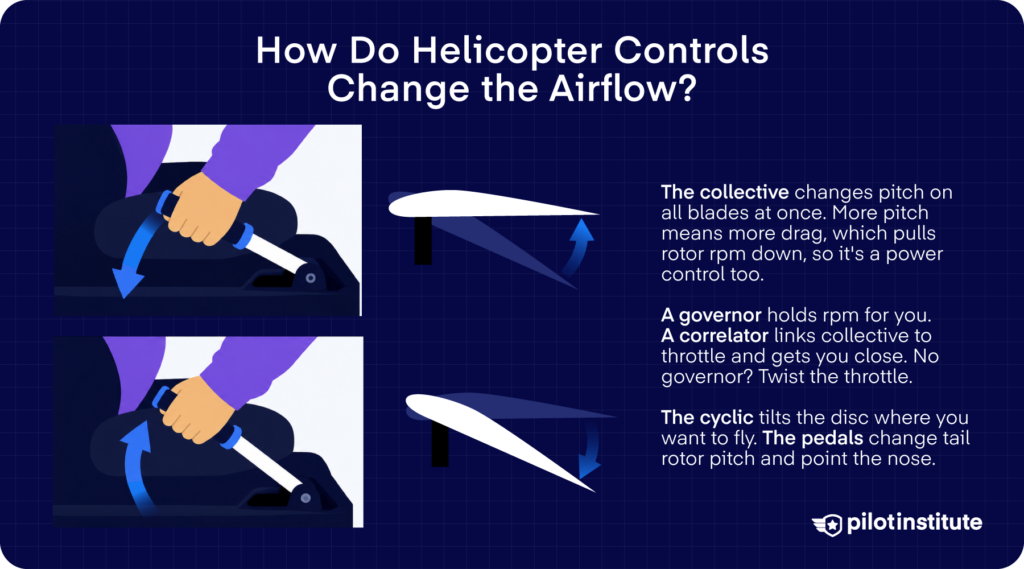
Helicopter flight controls come down to a couple of main inputs, and each one reshapes the airflow through the rotor in its own way.
Collective Pitch Control
The collective pitch lever changes the angle of incidence of every blade at once. When you pull it up, all the blades bite harder into the air. Hence, collective.
That decreases the rotor rpm but also raises the drag.
Governor/Correlator
Many modern helicopters take most of that chore off your hands.
A governor senses the rotor and engine rpm and holds it automatically. Once the speed is set, you rarely touch the throttle at all.
A correlator is a mechanical connection between the collective lever and the engine throttle. When you raise the collective lever, power gets automatically increased; when lowered, power is decreased.
You get close to your desired rpm, but it still leaves the fine-tuning to you.
Throttle Control
But what happens if those systems aren’t installed, or they fail to hold the rpm you need? That’s where the throttle control comes in.
By rotating the twist-grip throttle away from you (counter-clockwise), you increase the engine rpm. By twisting it the other way, you decrease the rpm.
Cyclic Pitch Control
The cyclic control works differently. It changes each blade’s pitch at specific points in its trip around the circle.
That, in turn, tilts the rotor disc so the helicopter moves in the direction you intend to fly.
Antitorque Pedals
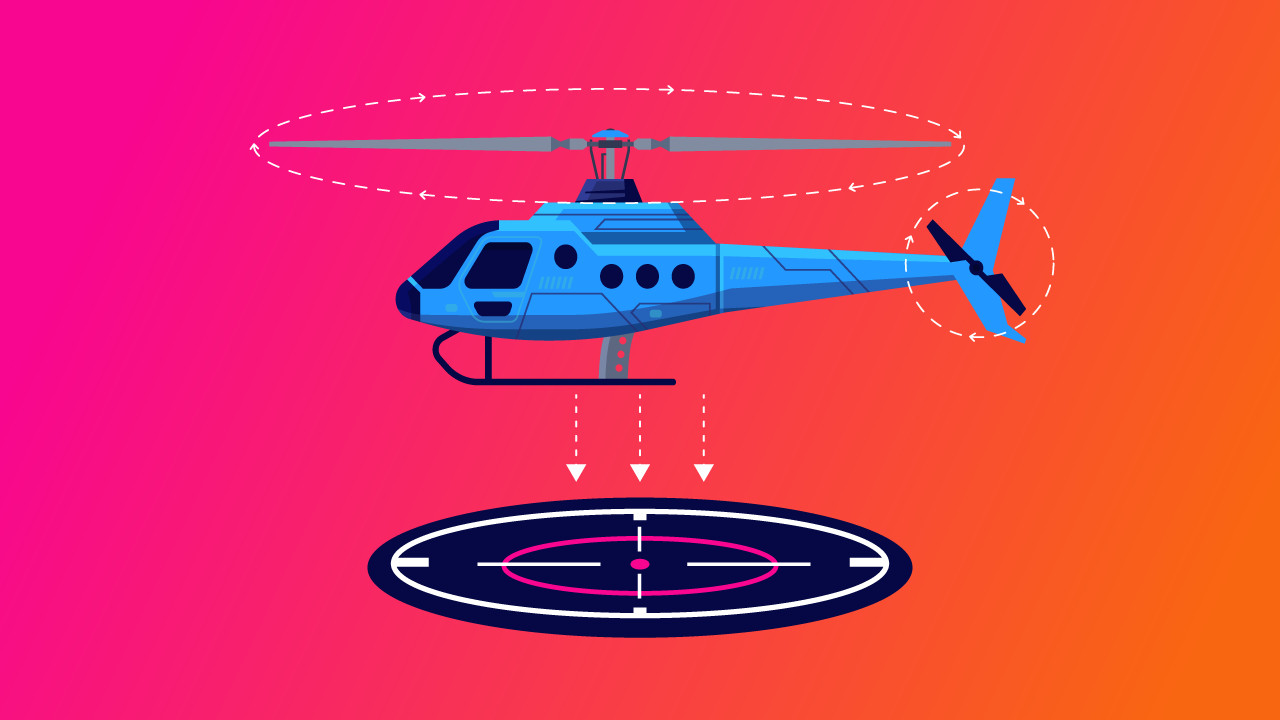
The antitorque pedals adjust the pitch of the tail rotor blades. With them, you vary the tail rotor thrust to offset the torque of the spinning main rotor.
That’s what aims the nose where you want it, most directly when you’re hovering.
Why Do Helicopters Need a Tail Rotor?
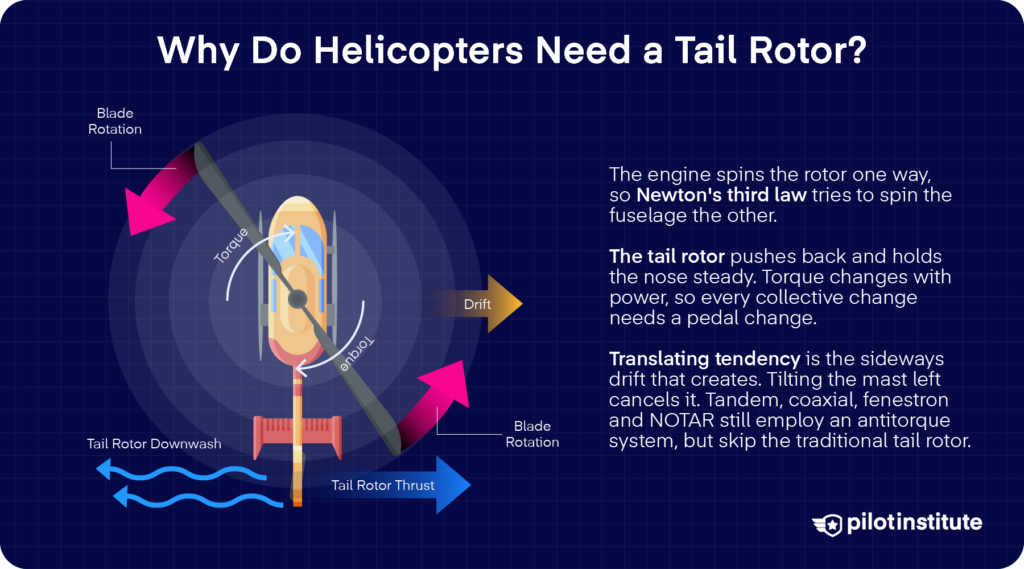
Because of torque.
The engine spins the main rotor one way, but Newton’s third law doesn’t let you get away with flight that easily.
With an equal and opposite reaction, the fuselage will try to spin the other way.
Without something to stop it, the body would rotate under its own rotor. The tail rotor prevents that.
Mounted at the end of the tailboom, the tail rotor produces sideways thrust. It pushes against the torque reaction and holds the nose steady.
And because that thrust is adjustable, it does double duty. The tail rotor cancels torque and gives you heading control.
You can point the nose where you want it, most directly while you’re hovering.
But torque isn’t constant. It rises and falls with engine power, so each collective change means a matching pedal adjustment.
No Tail Rotor
Some helicopters skip the tail rotor. Tandem and coaxial designs use two main rotors turning opposite ways, so each cancels the other’s torque.
Others replace it with a fenestron, a tail rotor shrouded in a duct. You could also see some with NOTAR, which uses directed airflow and no tail rotor at all.
What Is Translating Tendency?
When you’re hovering in a single main rotor helicopter, the aircraft tends to drift in the direction of tail rotor thrust. This is translating tendency, and designers have a few ways to counteract it.
Let’s say a helicopter has a counterclockwise-rotating main rotor disk.
Some manufacturers mount the main transmission at a slight leftward angle when viewed from behind. That gives the rotor mast a built-in tilt that opposes the tail rotor thrust.
Others rig the flight controls so the rotor disk tilts slightly to the left, even when the cyclic is centered.
What Happens Aerodynamically When a Helicopter Hovers?
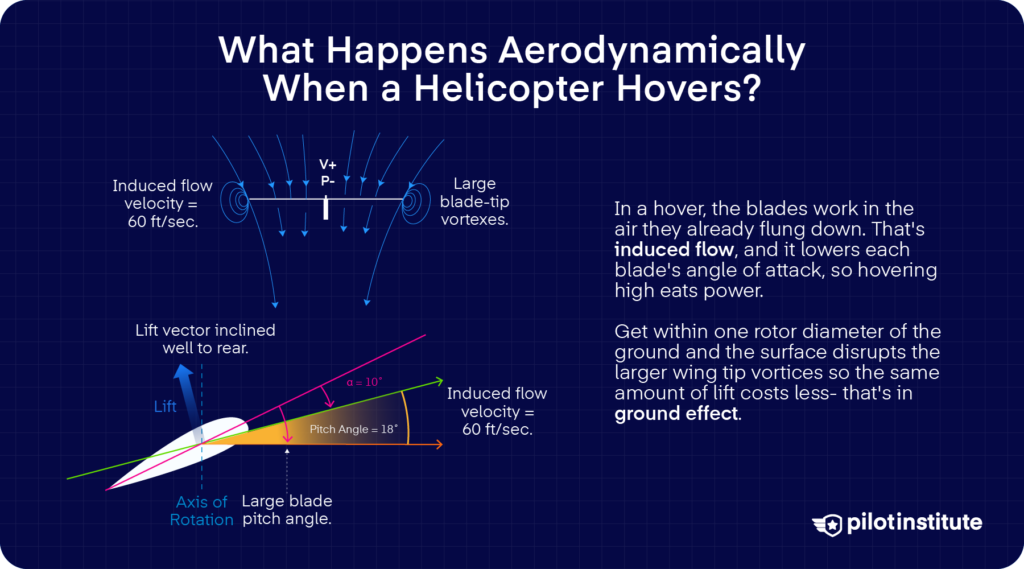
In a steady, no-wind hover, the total rotor thrust points straight up and balances the helicopter’s weight, so it holds its spot.
But the rotor isn’t biting into calm air. It’s working in the very air it has already flung downward. That column of descending air is called induced flow, or downwash.
That induced flow meets each blade from a steeper angle, which lowers the blade’s angle of attack.
To keep making enough lift against that headwind of its own making, the rotor needs a lot of power. Hovering, especially away from the ground, is one of the most power-hungry things a helicopter does.
In Ground Effect
Get close to the surface, though, and the physics changes.
When you hover within about one rotor diameter of the ground, the ground interrupts that downward flow and slows the induced flow.
The relative wind lines up more horizontally, the lift vector stands more upright, and induced drag drops.
Now a lower blade pitch produces the same lift, which trims the power required. More of each blade’s span does useful work. Pilots call this hovering in ground effect (IGE).
Out of Ground Effect
Climb higher, and the benefit of ground effect is lost..
Past roughly one rotor diameter, you’re hovering out of ground effect (OGE). Here, induced flow runs free, wingtip vortices reduce the lift capability of each blade, the blade AOA climbs back up, and the power demand rises again.
What Changes When the Helicopter Flies Forward?
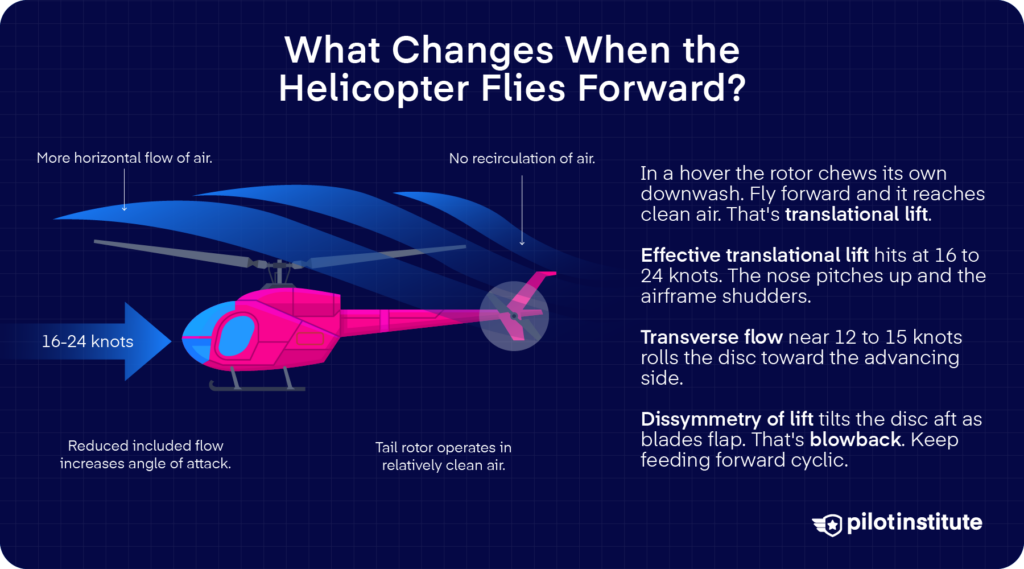
You’ll remember that in a hover, the rotor keeps chewing through its own recirculated downwash.
But once you fly forward, the disc outruns those old swirling vortices and starts working in clean, undisturbed air.
That added efficiency is called translational lift.
It begins building from the very first knot of relative wind. Then, it turns into a distinct step-change once you reach the effective translational lift range.
What Is Effective Translational Lift?
You go through effective translational lift (ETL) at about 16 to 24 knots. As you pass through it, the nose tries to pitch up, and a shudder runs through the airframe.
Three effects overlap to cause that pitch-up. Dissymmetry of lift and gyroscopic precession do most of it, with transverse flow effect adding the rest.
The vibration itself belongs mostly to transverse flow effect, which shows up around 12 to 15 knots.
Transverse flow also rolls the disc toward the advancing side. That’s to the right in a counterclockwise rotor system, so you feed in a little left cyclic.
And as the tail rotor moves into cleaner air, it grows more efficient. The extra antitorque thrust swings the nose left, which you anticipate with right pedal.
You don’t even need to be moving for some of this. Sit in a hover with a strong enough headwind, and transverse flow effect arrives on its own.
Dissymmetry of Lift
But forward speed also introduces a new problem.
On the side where the blade advances into the direction of flight, it meets a higher airspeed than the blade retreating on the other side.
Left alone, that dissymmetry of lift would roll the disc over.
The fix is built into the rotor. The blades flap.
The advancing blade flaps up, which lowers its angle of attack and sheds the extra lift. The retreating blade flaps down, raising its angle of attack and picking lift back up.
That evens things out across the disc.
Flapping brings a side effect, though. The disc tends to tilt aft as it speeds up, an effect called blowback. You should feed in forward cyclic to keep accelerating through it.
What Aerodynamic Limits Do Helicopter Pilots Train For?
Rotor aerodynamics has hard edges.
You’ll spend much of training on conditions where the rotor or tail rotor stops behaving normally. That, along with the skill of flying the aircraft down when the engine quits.
For the actual recognition and recovery procedures, check out the FAA Helicopter Flying Handbook and AC 90-95.
Autorotation
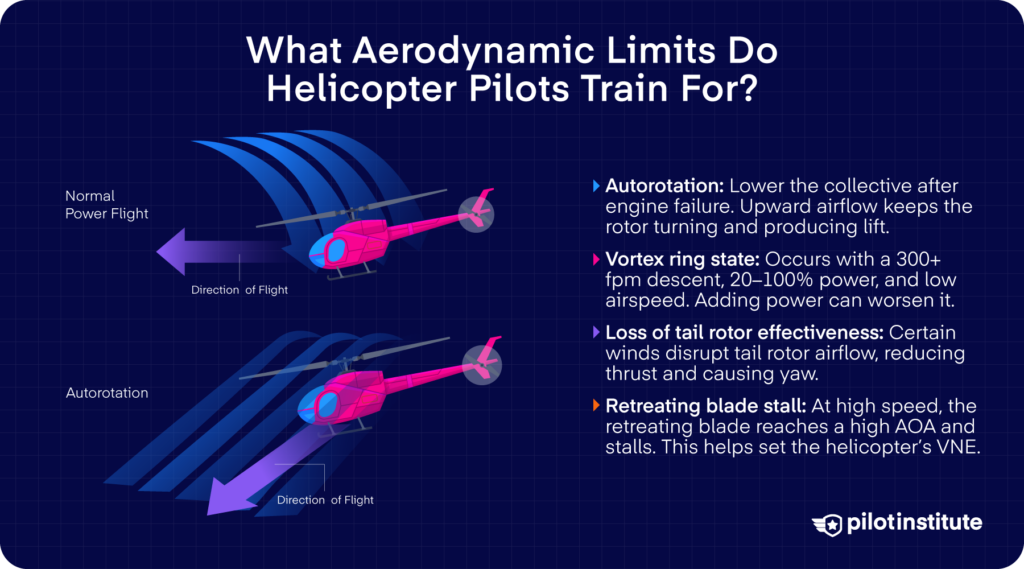
Autorotation is the reassuring one. If the engine quits, you lower the collective and let the helicopter descend.
Reducing collective allows blade pitch angle to match the upward flow of air through the falling rotor, which keeps the blades spinning and making lift.. It’s like a built-in safety net.When done properly, a helicopter in autorotation can maneuver in any direction and glide to the ground, landing safely even in very small spaces like a parking lot.
That’s why certain helicopters must have their autorotation performance determined for certification. These are single-engine and multiengine helicopters that don’t meet Category A engine isolation requirements.
Vortex Ring State
Vortex ring state is the opposite kind of surprise. Three things have to line up:
- Lower horizontal velocity than effective translational lift.
- Roughly 20 to 100 percent of engine power applied- this just means you’re not in an autorotation.
- A vertical or nearly vertical descent of at least 300 feet per minute.
When they do, the recirculating tip vortices choke off lift. Adding power only feeds the problem. It was long called settling with power. Thankfully, there are recovery techniques that pilots must train for and demonstrate for the examiner in order to receive a pilot certificate.
Loss of Tail Rotor Effectiveness
Loss of tail rotor effectiveness is an aerodynamic condition, even though it might seem like a mechanical failure.
Below about 30 knots, certain wind directions disrupt the airflow through the tail rotor. That reduces the thrust the tail rotor produces. Worse, you could be up against an uncommanded, rapid yaw.
On US helicopters, whose main rotors turn counterclockwise, that yaw goes right. The fix is to pedal opposite the direction of the turn, and try to maneuver into clean, undisturbed air where the tail rotor can aerodynamically produce lift again.
Retreating Blade Stall
Retreating blade stall waits at the other end of the envelope, at high forward speed.
The retreating blade already sees the slowest relative airflow, so it needs a high angle of attack to keep up. Past a certain speed, its tip stalls. This results in a roll to the retreating side and a pitch up of the nose. Since a pitch up of the nose will cause the helicopter to slow down, the primary way to recover from retreating blade stall, this is a self correcting phenomenon.
That’s one of the factors behind your helicopter’s never-exceed speed, VNE. However, turbulence can also be a factor in inducing retreating blade stall.
Frequently Asked Questions
Is Flying a Helicopter Harder Than Flying an Airplane?
It’s less about difficulty than about workload and stability.
You’re working several controls that each affect the others. And unlike an airplane, a helicopter has little inherent stability and no natural tendency to stay put, so it needs constant correction. Most people do find helicopters harder to control than airplanes.
Can a Helicopter Land Safely if the Engine Fails?
Yes, through autorotation.
If the engine quits, a freewheeling unit automatically disengages it from the rotor so the rotor keeps spinning on the upward airflow of the descent. This is called an autorotative glide, and while it is a much steeper profile than an airplane’s glide, the concept is similar.
A helicopter can turn in any direction, even fly backwards, in an autorotative state. With a proficient pilot and sufficient altitude, it can land without a functioning engine almost anywhere.
Why Do Helicopter Blades Bend and Flap While Spinning?
Two different things are happening.
Flapping is the rotor evening out lift between the faster advancing blade and the slower retreating blade as each one circles the disc.
Coning is different. It’s the steady upward bend the blades take under the combined pull of lift and centrifugal force.
How Fast Can a Helicopter Fly?
A helicopter has an aerodynamic ceiling for a couple of reasons.
Retreating blade stall and structural capacity set the never-exceed speed, VNE. For a Robinson R44, it can be 130 KIAS. Other helicopters can go faster.
Take note that this is a placard value that drops in thinner, hotter air and at heavier weights. Hence, it is not a fixed top speed.
Do All Helicopters Have a Tail Rotor?
No, but all helicopters do have some type of antitorque system..
Tandem designs, like the Boeing CH-47 Chinook, and coaxial designs, like the Kamov Ka-52, use two counter-rotating main rotors that cancel each other’s torque. Therefore, a traditional bladed tail rotor is not needed.
NOTAR aircraft like the MD 520N and MD 902 Explorer keep one main rotor but swap the tail rotor for directed airflow.
Can a Helicopter Fly Upside Down?
Yes, in theory.
An inverted helicopter would need to reverse its blade pitch so the rotor still drives air toward the ground. That keeps thrust pointed away from it.
However, a common helicopter’s design makes sustained inverted flight unsafe. Without stiffer blades and reworked engines, you may as well be asking for trouble.
Some purpose-built types like the BO 105 have been cleared for aerobatics. But most civil helicopters prohibit them outright. Low-G pushovers are even specifically prohibited in Robinson R22 and 44s.
Conclusion
That helicopter hanging three feet off the ramp is doing all of this at once.
It’s balancing total rotor thrust against its weight while holding heading against torque, all in the air it’s churning up beneath itself.
Every control input changes the airflow through the rotor disc, so a helicopter pilot trims constantly.
If you’d like to feel that for yourself rather than just read about it, our Private Pilot course is a solid place to begin your helicopter pilot training.