
-
Key Takeaways
-
What Happens If a Helicopter Tail Rotor Fails?
-
How the Tail Rotor Cancels Main Rotor Torque
- Which Way Does the Main Rotor Spin?
-
What Is Loss of Tail Rotor Effectiveness?
- Main Rotor Disk Vortex Interference
- Weathercock Stability
- Tail Rotor Vortex Ring State
- Recovery Technique (Uncontrolled Right Yaw)
-
What Happens When the Tail Rotor Drive Fails?
- Tail Rotor System Failure in Forward Flight
- Tail Rotor System Failure in a Hover
-
What Is a Stuck Pedal Failure?
- Stuck Left Pedal
- Stuck Neutral or Right Pedal
-
What Happens If the Tail Rotor Control Linkage Breaks?
- When to Autorotate
-
Why Airspeed Changes Everything
- Accident Statistics Involving LTE
-
Frequently Asked Questions
- Can a Helicopter Fly Without a Tail Rotor?
- Is LTE a Mechanical Failure?
- What Is the Difference Between LTE and a Tail Rotor Failure?
- Why Does a Helicopter Spin Right When the Tail Rotor Fails?
- Can You Land a Helicopter With a Stuck Pedal?
- How Common Are Tail Rotor Accidents?
-
Conclusion
A tail rotor failure could come from a drive failure, a stuck pedal, or a break in the control linkage. Loss of tail rotor effectiveness is an aerodynamic condition that results in a diminished capacity to produce thrust. While not considered a mechanical failure, the symptoms can be similar.
Say you’re holding a low hover with a light quartering wind drifting in from your left. Then suddenly, the nose starts to swing right on its own.
You see, the tail rotor’s job is to stabilize the fuselage so it doesn’t spin under the main rotor’s torque. And there’s no single appropriate response when your tail rotor stops functioning.
What happens next and how you should manage it will depend on which type of failure you’re facing. Now, let’s talk about how to distinguish tail rotor failures and what to do for each type.
Key Takeaways
- Loss of tail rotor effectiveness is an aerodynamic condition, not a broken mechanical part.
- A tail rotor drive failure calls for autorotation, which removes the torque needing counteraction.
- A stuck pedal typically requires a power-on running landing.
- A broken control linkage can behave like a stuck pedal or a total disconnection.
What Happens If a Helicopter Tail Rotor Fails?
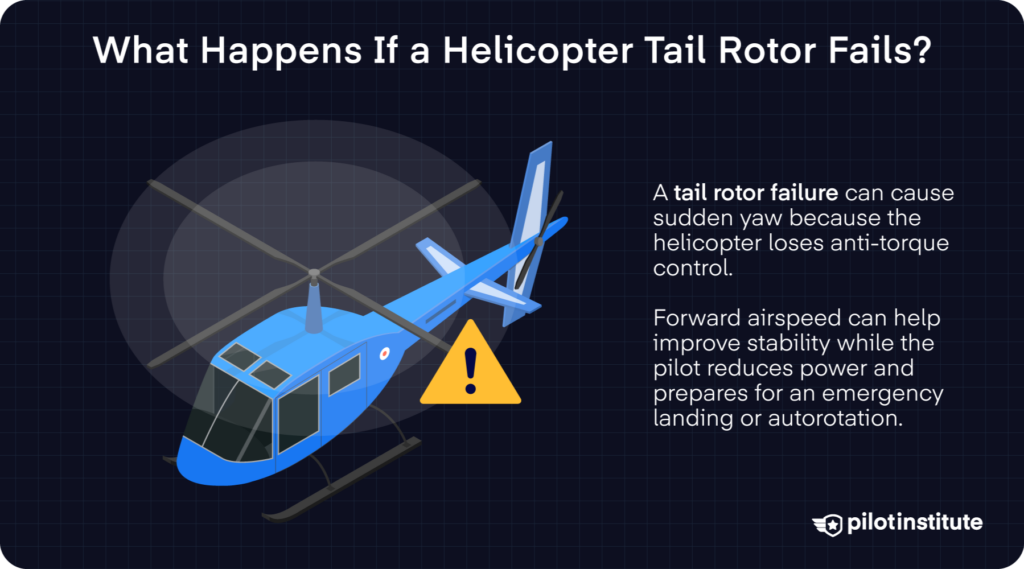
There are four usual suspects when you’re facing a tail rotor failure.
The first is loss of tail rotor effectiveness. Nothing’s broken mechanically. But because of a disruption in normal airflow, the tail rotor stops performing its function.
Second is a complete loss of thrust from a drive failure. It could come from a failed gearbox or a lost tail rotor.
The third is a stuck pedal. The tail rotor pitch freezes, and it locks you into the thrust setting at the moment the pedal got jammed.
Lastly, you could experience a break in the control linkage. You lose all ability to change the tail rotor thrust, even if the blades are still spinning.
These failures occur differently, and so there’s a proper response for each. The first step, though, is recognizing which type you’re facing.
| Failure Type | What Is Happening | Yaw Direction (Counterclockwise Main Rotor) | Pilot Response |
| Loss of tail rotor effectiveness | The tail rotor works, but disrupted airflow keeps it from producing enough antitorque. | Usually right, though weathercock winds (120 to 240 degrees) can accelerate a yaw either way | Apply left pedal and move cyclic forward to regain airspeed. Reduce power if altitude allows. |
| Complete loss of thrust (drive failure) | A severed driveshaft or failed gearbox leaves the tail rotor producing no thrust at all. | Right | Enter autorotation, which removes the engine torque. |
| Stuck pedal | The tail rotor still produces thrust, but its pitch is frozen and can no longer be changed. | Depends on power setting relative to the frozen pitch | Fly a power-on landing and manage heading with throttle and airspeed. |
| Break in the control linkage | A snapped cable or linkage leaves pitch fixed (partial) or fully uncommanded (total disconnection). | Depends on where the pitch settles | Treat a partial break like a stuck pedal. A full disconnection may require autorotation. |
How the Tail Rotor Cancels Main Rotor Torque
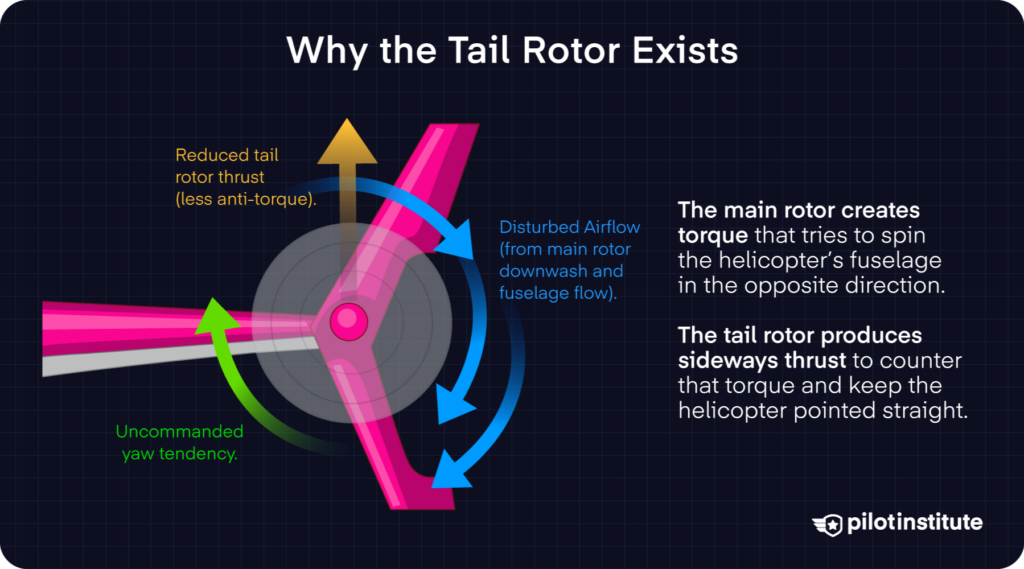
The tail rotor produces sideways thrust. That thrust counteracts the turning force your engine applies to the main rotor.
That turning force is torque, which is a direct consequence of Newton’s third law. As the engine drives the main rotor one way, the fuselage will want to spin the opposite way.
Without the tail rotor, the fuselage rotates opposite the main rotor’s direction.
The tail rotor’s job is to hold that tendency in check. You use the antitorque pedals to control the pitch and the thrust they produce.
Which Way Does the Main Rotor Spin?
When viewed from above, the main rotor spins counterclockwise on most US helicopters, such as the Robinson R22 and R44. The fuselage then reacts by turning clockwise.
Essentially, torque will yaw the aircraft to the right. That’s why you’ll hear helicopter pilots talk about a right-yaw tendency. That’s also why the left pedal becomes your friend when you add power.
Not every helicopter is the same, though. Some Airbus designs, such as the H125/AS350, spin their main rotors clockwise. Their torque reaction yaws the nose left instead.
We’ll talk in terms of a counterclockwise-spinning main rotor for the rest of this article. If you want a fuller look at what keeps a helicopter aloft, see our guide on how helicopters fly.
What Is Loss of Tail Rotor Effectiveness?
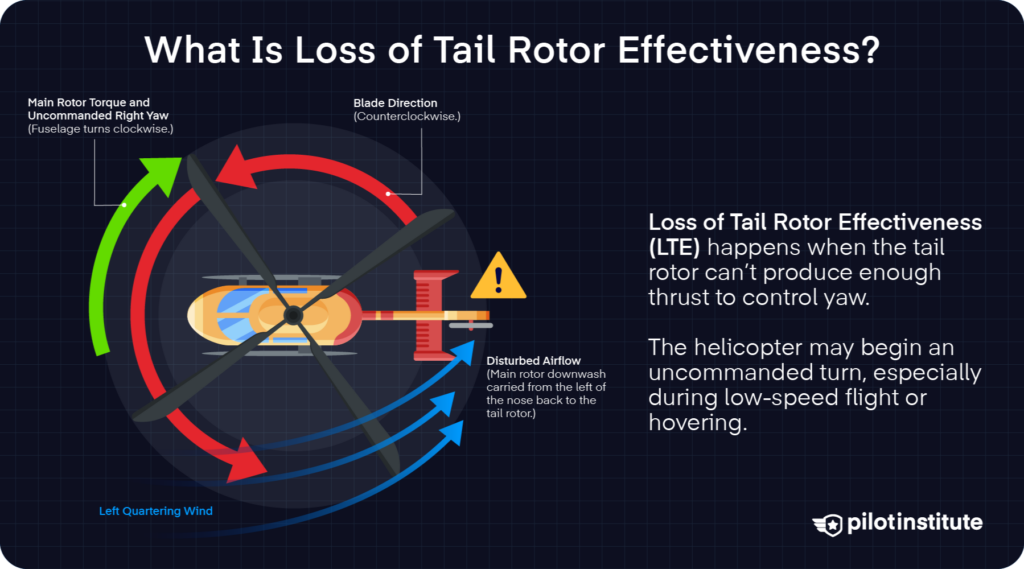
The Helicopter Flying Handbook emphasizes that loss of tail rotor effectiveness (LTE) is not from a broken part. Your tail rotor is still spinning and still producing thrust. Your pedals are still connected to it.
According to AC 90-95, LTE is a critical, low-speed aerodynamic flight characteristic that can result in an uncommanded yaw rate which does not subside on its own.
The operative word is “aerodynamic.” The airflow feeding the tail rotor gets disrupted, so a given pedal position suddenly delivers less antitorque than it did moments earlier.
It may occur to varying degrees in all single-main-rotor helicopters, mostly at airspeeds below 30 knots. LTE can result in the loss of aircraft control if not corrected.
Main Rotor Disk Vortex Interference
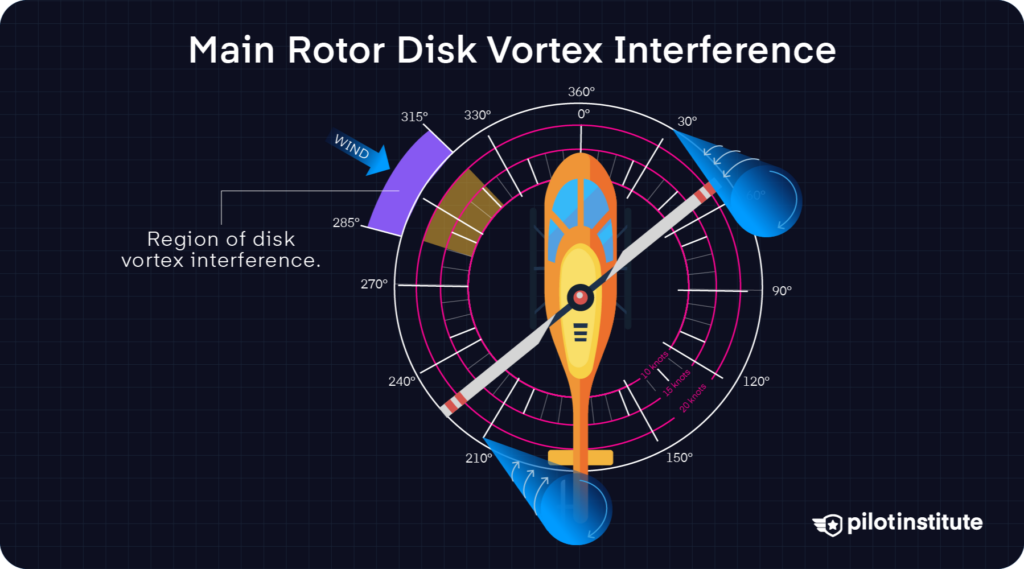
The FAA pins the trouble to three degree-defined wind regions. The first is main rotor disk vortex interference, between 285 and 315 degrees.
When wind hits at 10 to 30 knots off your left front, the main rotor vortex blows into the tail rotor.
As that vortex sweeps across, tail rotor thrust drops off suddenly, and the nose accelerates right. Be ready to feed in left pedal.
Weathercock Stability
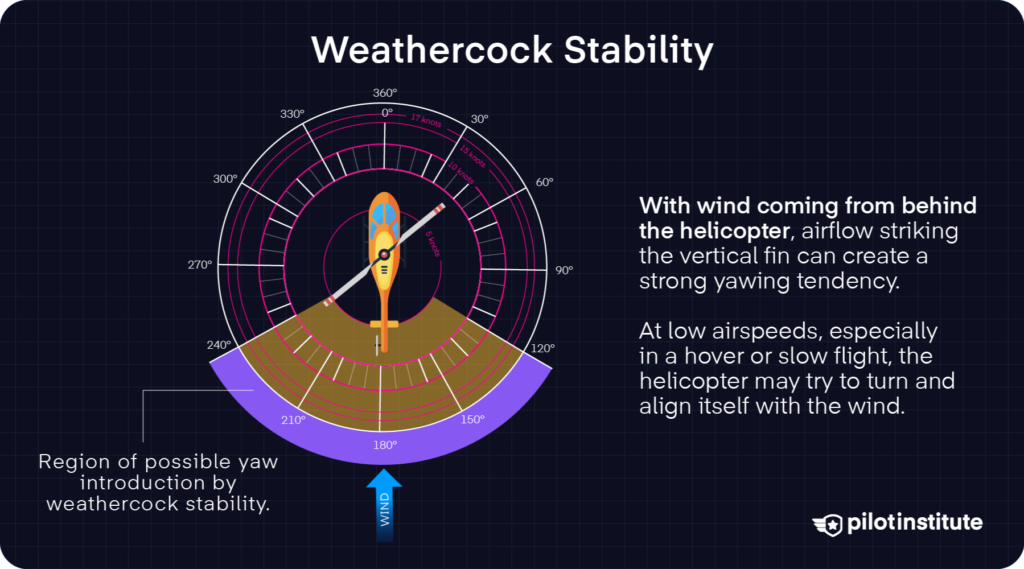
Wind coming from 120 to 240 degrees could lead to weathercock stability. The name comes from the fact that the helicopter attempts to weathervane, or weathercock, its nose into the relative wind.
The helicopter could drift into a slow, uncommanded turn in either direction unless you resist with the pedals.
But if you let a right yaw (specifically) build and swing the tail into this region, the rate can accelerate quickly. Stay ahead of it and maintain positive control as always.
Tail Rotor Vortex Ring State
The third is the tail rotor vortex ring state, from 210 to 330 degrees. A left crosswind blows unsteady, swirling air into the tail rotor. That makes the thrust oscillate, and the tail rotor can experience aerodynamic stall.
You’ll need quick and smooth pedal work to hold heading. It is manageable, but don’t let a right yaw slip in. Otherwise, you could end up in the weathercock region, where you know the turn only accelerates.
Recovery Technique (Uncontrolled Right Yaw)
Apply full left pedal in case of an unanticipated right yaw. Move the cyclic forward to gain airspeed at the same time.
Reduce power if your altitude allows it. A lower collective setting eases the tail rotor’s workload.
As control returns, settle the controls back into normal forward flight. And if the spin won’t stop and the ground is closing in, an autorotation is your best option.
What Happens When the Tail Rotor Drive Fails?
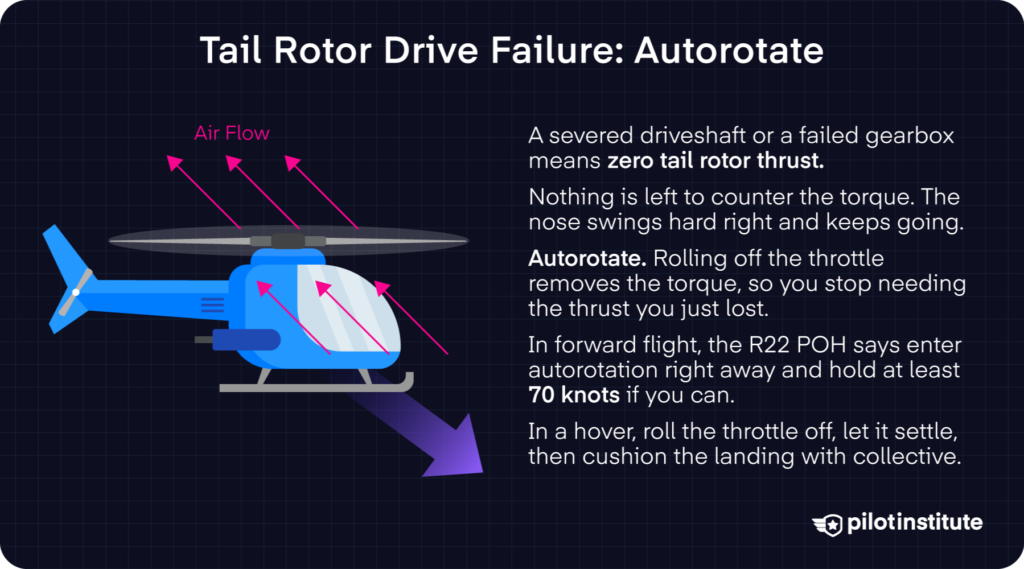
When the drive to the tail rotor gives out, possibly from a severed driveshaft or a failed gearbox, the tail rotor stops producing thrust entirely.
There’s nothing left to counter the engine’s torque. Now, the nose swings hard right and keeps going. The best course of action is to autorotate in this situation.
The torque that was spinning your fuselage disappears once the engine stops driving the main rotor.
With no torque left to fight, you won’t need that missing tail rotor thrust anymore.
Tail Rotor System Failure in Forward Flight
Section 3 of the Robinson R22 Pilot’s Operating Handbook echoes this procedure.
If the drive quits in forward flight, you’ll usually feel a nose-right yaw that the left pedal can’t correct.
The handbook says that if a suitable landing site is available, you must enter autorotation right away and hold at least 70 knots if you can. Then, complete an autorotative landing.
If a suitable landing site is not immediately available, airspeed gives you an extra hand because the vertical fin lends a bit of directional stability at speeds above 70 knots. However, the manual still wants you back in full autorotation before you slow down.
For the full mechanics of getting a helicopter down without power, see our guide on what happens if a helicopter engine fails.
Tail Rotor System Failure in a Hover
Now, if the drive fails while you’re hovering, roll the throttle off immediately and let the aircraft settle. Then, raise the collective just before touchdown to cushion the landing.
It’s essentially a hovering autorotation. Cut off the engine’s torque, and the yaw goes away with it.
What Is a Stuck Pedal Failure?
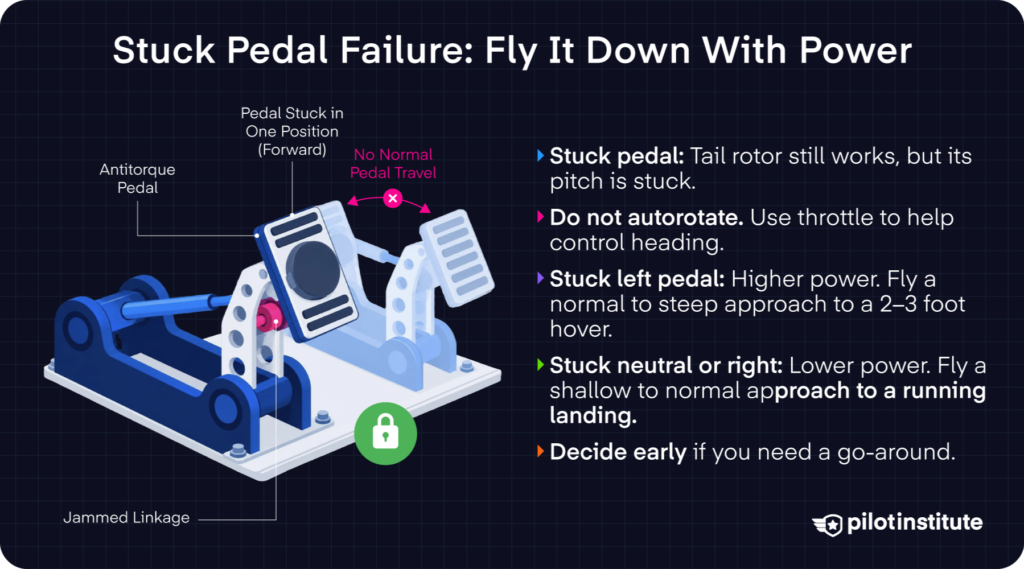
A stuck pedal is not a drive failure. Your tail rotor is still spinning, and it’s still making thrust. The pitch is just frozen at whatever setting the pedals were jammed at. Now, you’ve lost the ability to adjust it.
While this may sound counterintuitive, autorotating can make things worse rather than better. The proper response is a power-on landing.
The tail rotor is still producing a fixed amount of thrust. Therefore, engine power will now be your tool to steer your heading.
Stuck Left Pedal
A stuck left pedal leaves you in a high-power configuration, the sort you’d carry on takeoff or in a climb. The tell is that the nose yaws left when you reduce power.
The Helicopter Flying Handbook calls for a normal to steep approach that brings you to a brief, low hover about 2 to 3 feet up, right as translational lift bleeds away.
From there, you make the landing. And if the nose begins creeping right, you adjust airspeed or roll the throttle gently to flight idle. That should stop the turn as you touch down.
Stuck Neutral or Right Pedal
A stuck neutral or stuck right pedal is the mirror image. It’s a low-power configuration where the nose yaws right when you add power.
Here, the Handbook calls for a shallow to normal approach flown to a running, or a roll-on landing.
Carry the lowest airspeed that still gives you directional control so the nose stays straight. Then, let the aircraft roll out on its gear.
Keep in mind that at airspeeds below translational lift and when close to the ground, a go around might not be possible. Make the go around decision early and keep control inputs smooth.
What Happens If the Tail Rotor Control Linkage Breaks?
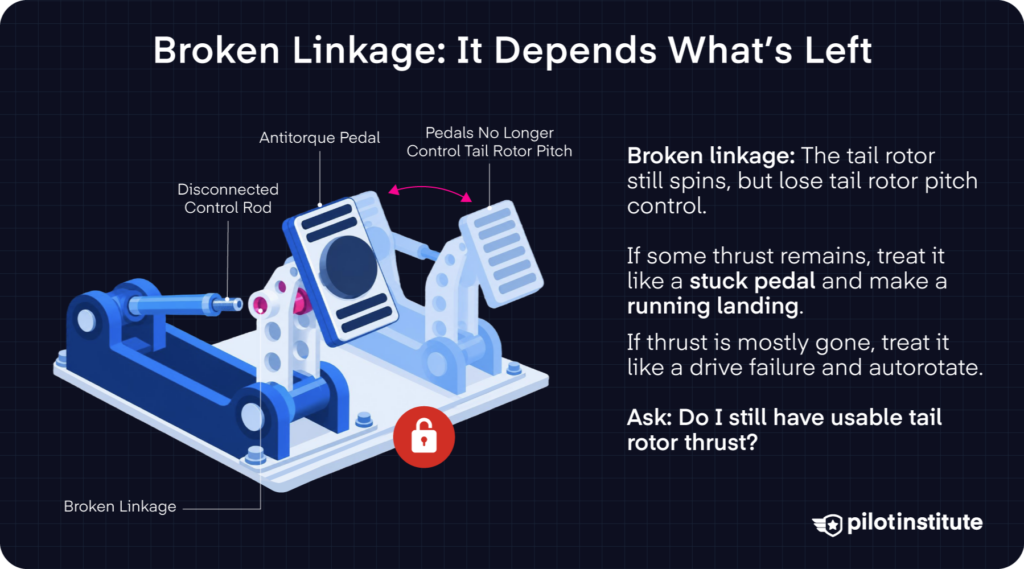
A break in the tail rotor control run, possibly from a snapped cable or linkage or a pedal attachment that separates, prevents your ability to command tail rotor pitch.
The tail rotor keeps turning and keeps producing thrust, but it’s now stuck at a certain pitch.
Since the pitch tends to freeze at a roughly known setting, the helicopter behaves much like a stuck pedal. In that sense, you should fly it to a power-on run-on landing.
When to Autorotate
The pitch can settle toward little or no thrust at all during a full separation. In that scenario, you no longer have a usable setting to work with.
You’ve effectively lost antitorque altogether. The less you’re left with, the more the situation resembles a drive failure.
An autorotation would be the right call. Dropping into autorotation removes the torque that the tail rotor should normally counter.
Why Airspeed Changes Everything
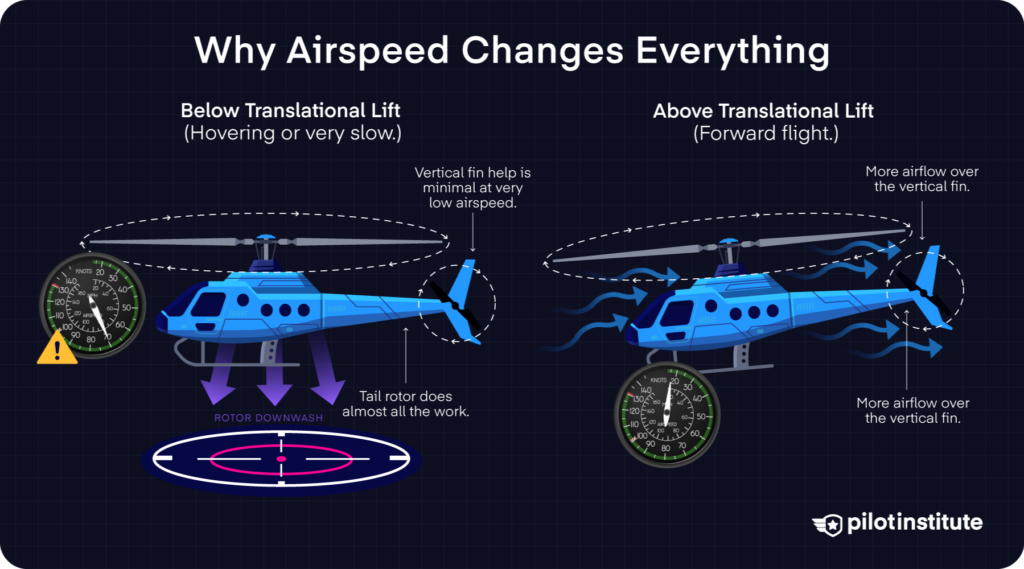
Airspeed is a big deciding factor in how to respond to tail rotor emergencies.
When you’re moving forward with enough speed, the vertical fin weathervanes the nose into the wind.
That effect shoulders part of the directional control load for you. The faster you go, the less the helicopter leans on tail rotor thrust to hold heading.
Slow down below translational lift, though, and that help disappears.
AC 90-95 emphasizes the importance of airspeed. Below translational lift, the tail rotor has to produce nearly 100 percent of your directional control. If that thrust isn’t there for any reason, the nose will yaw right.
NTSB Safety Alert SA-062 echoes the same principle. Maintain awareness of the wind direction and speed in flight, especially when hovering in wind of about 8 to 12 knots, when a loss of translational lift can occur.
Flying in tailwinds or crosswinds (the direction depends on the type of helicopter you are flying) when operating below an airspeed of 30 knots demands extra caution, and controllability may be limited.
Accident Statistics Involving LTE
The NTSB had investigated 55 accidents involving LTE over the ten years from 2004 to 2014 as per SA-062.
In one case, a Bell 206L-1 flown by Air Evac Lifeteam was approaching a hospital helipad at night in Wichita Falls, Texas.
The pilot decided the approach was too high and fast, so he went around. But as he lowered the nose and pulled power to climb away, the helicopter snapped into a violent right spin.
Left pedal and cyclic did nothing, and it spun several times before striking power lines and terrain.
The trouble came from speed, or a lack thereof. Just before he added power, the helicopter was down to about 5 knots groundspeed.
At that crawl, the tail rotor has to supply nearly all your directional control. The sudden power demand triggered LTE. In these scenarios, high gross weight or high density altitude can also play a big factor.
The cues that warn you of drift and low speed are hardest to read if you fly at night. Brush up on the added risks in our guide to helicopter night flying.
Frequently Asked Questions
Can a Helicopter Fly Without a Tail Rotor?
It’s possible in autorotation. Rolling off the throttle removes the engine torque that the tail rotor normally counteracts. You take away your dependency on the tail rotor to keep the nose straight.
In forward flight, some types can manage limited controlled flight at low power settings, as long as you carry enough airspeed for the vertical fin to supply directional stability.
What you can’t do is hold a powered hover. Remember that a hover demands full antitorque authority to balance the torque. Without a working tail rotor, there’s nothing to provide the balancing force.
That’s why the recommended responses always steer you toward either an autorotation or a landing with forward speed.
Is LTE a Mechanical Failure?
No. Loss of tail rotor effectiveness is an aerodynamic condition, not a broken component, and the FAA is explicit about this.
AC 90-95 states that LTE is not related to a maintenance malfunction. It can occur in varying degrees in any single main rotor helicopter at airspeeds below 30 knots.
During an LTE event, your tail rotor is still turning and still producing thrust. The trouble is that disrupted airflow keeps it from generating enough antitorque to hold your heading. The nose yaws even though nothing has actually failed.
It’s important to recognize that distinction, because the recovery for LTE is different from what you’d do for a genuine mechanical failure of the tail rotor system.
What Is the Difference Between LTE and a Tail Rotor Failure?
Loss of tail rotor effectiveness is an aerodynamic issue and not a mechanical one. It is caused by airflow disruption from particular wind directions and can be exacerbated by high power demands. .
A drive failure, on the other hand, means the tail rotor can’t produce thrust at all. Meanwhile, a stuck pedal or broken linkage means it still makes thrust, but you can no longer control it.
You correct LTE by increasing airspeed and easing the power demand, whereas a mechanical failure sends you toward an autorotation or a controlled running landing.
Why Does a Helicopter Spin Right When the Tail Rotor Fails?
It comes down to torque and the direction your main rotor turns.
On most US helicopters, the main rotor spins counterclockwise when viewed from above, so the engine’s torque tries to rotate the fuselage the opposite way, carrying the nose to the right.
The tail rotor normally counters that pull. When it stops doing its job, say from a failure or from LTE, there’s nothing left to hold the nose. The helicopter yaws and spins right.
If you fly a type with a clockwise main rotor, the torque gets flipped, and the spin goes left instead.
Either way, the runaway yaw heads in the same direction as the torque reaction.
Can You Land a Helicopter With a Stuck Pedal?
Yes. A stuck pedal leaves your tail rotor producing thrust at a fixed pitch you can no longer adjust, but you still have a good option. You can perform a power-on running landing.
Because the tail rotor is still working, you manage heading by matching engine power to that fixed thrust. Then, fly a shallow approach and let the aircraft roll out on its landing gear.
Ideally, you should land on a hard, smooth surface that lets the skids or wheels slide.
The surface makes a difference since touching down with forward speed on rough ground risks digging in or tipping over.
How Common Are Tail Rotor Accidents?
They’re uncommon compared with the overall accident count, but they do still happen.
NTSB Safety Alert SA-062 reported that the Board investigated 55 accidents involving LTE during the ten-year period from 2004 to 2014.
In the cases the safety alert highlights, the pilots were unable to recover once the rapid yaw set in.
The good news, though, is that LTE is largely preventable. It takes an understanding of the conditions that trigger it. Even a genuine mechanical failure is survivable.
Conclusion
Back to that low hover with the wind off your left and the nose creeping right. Your odds of a safe landing now depend on one question. Ask yourself first, Which type of tail rotor failure is this?
Get that answer right, and the correct response will follow. But get it wrong, and you might find yourself in an unfavorable approach or with increased risk of dynamic rollover.
Memorize your emergency procedures. Identify the failure first. Afterward, react. And if you’re ready to become a helicopter pilot, we’ve got you covered.