
-
Key Takeaways
-
What Is a Running Takeoff in a Helicopter?
- Conditions to Verify Before a Running/Rolling Takeoff
-
What Is a Roll-On Landing?
- What to Check Before and After a Roll-On Landing
-
When Do You Need a Running Takeoff or Roll-On Landing?
- What Is Effective Translational Lift?
-
How to Perform a Running Takeoff (Step-by-Step)
- 1. Line Up and Get Light on the Skids
- 2. Roll Forward on Cyclic and Collective
- 3. Fly Off at Effective Translational Lift
- 4. Climb Out Through the Clear Zone
-
How to Fly a Shallow Approach and Roll-On Landing (Step by Step)
- 1. Set Up a Shallow Approach
- 2. Carry Speed, Then Slow With Aft Cyclic
- 3. Level Off and Cushion With Collective
- 4. Slide or Roll Straight to a Stop
-
What Are the Main Hazards?
- What Is Dynamic Rollover?
- The Tailboom Strike
- What Makes Weight and Density Altitude So Important?
-
When Are Roll-On Landings Used in Emergencies?
- Stuck Pedal to Roll-On Landing
- Governor and Hydraulic Failure Helicopter Landing
-
Frequently Asked Questions
- Are Running Takeoffs and Roll-On Landings on the Helicopter Checkride?
- Is a Roll-On Landing the Same as an Autorotation Landing?
- Is a Running Takeoff the Same as a Maximum Performance Takeoff?
- Can You Do a Running Takeoff on Grass or a Dirt Strip?
-
Conclusion
Running takeoffs and roll-on landings trade a hover for forward airspeed. Both rely on effective translational lift to fly the helicopter off the surface or back onto it.
Say it’s a hot afternoon at a high-elevation strip. You’re loaded with fuel and a passenger.
You pull in power, and the skids come light. But the moment you try to hold three feet, you can’t seem to climb any higher.
If that’s your situation, the answer isn’t a running takeoff. It’s offloading weight or waiting for cooler air.
Running takeoffs and roll-on landings are real techniques with fairly narrow uses. Let’s look at when you’ll actually reach for each one, and how to fly it safely.
Key Takeaways
- Running takeoffs and roll-on landings trade a hover for forward airspeed, and both rely on effective translational lift around 16 to 24 knots.
- Running landings are mostly an emergency technique, used for hydraulic, governor, stuck pedal, and tail rotor problems.
- If you can’t hover because you’re too heavy or the density altitude is too high, don’t take off. Offload weight or wait for conditions to improve.
- Keep the landing gear aligned with your direction of travel to avoid dynamic rollover during the ground run.
What Is a Running Takeoff in a Helicopter?
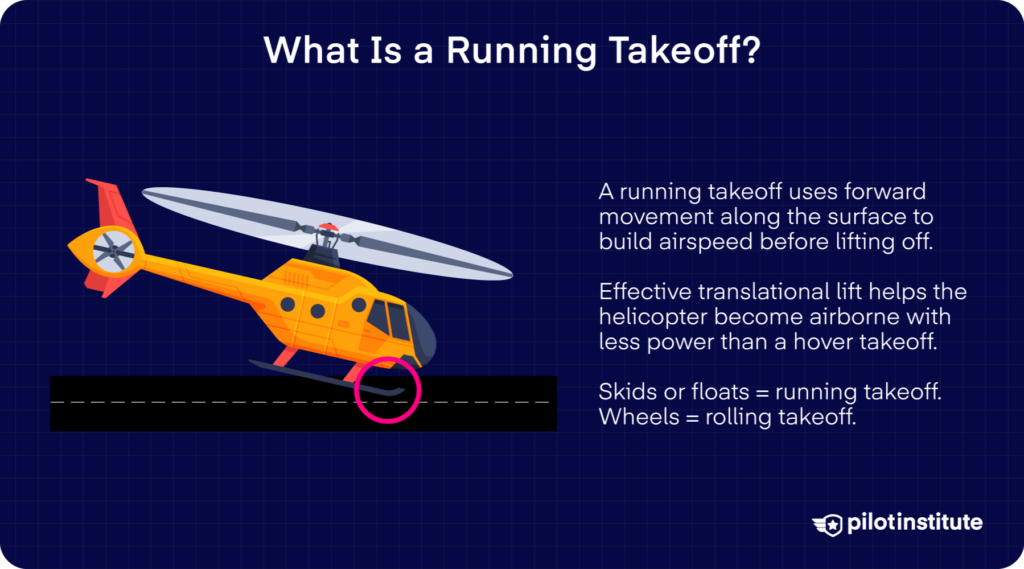
In a running takeoff, the helicopter accelerates along the surface. Once it gains enough speed, effective translational lift will help carry it into the air.
Instead of lifting straight up, you let the aircraft build forward airspeed on the ground, similar to an airplane. The FAA presents this takeoff procedure as an option for a helicopter that can’t sustain a hover.
Read that carefully, though. If you’re flying a skid-equipped helicopter and you don’t have the power to hover, you shouldn’t be taking off at all.
And once effective translational lift kicks in, you’ll have enough lift to climb away.
The term “running takeoff” applies to helicopters with fixed landing gear, like skids or floats. If your helicopter rides on wheels, we call it a rolling takeoff instead, although the technique is just the same.
Power usually isn’t the reason a wheeled helicopter rolls. These aircraft are often twin engine with plenty of hover power available.
The wheels simply make a ground run easy. A rolling takeoff also cuts down on the downwash you stir up lifting off from a hover.
Conditions to Verify Before a Running/Rolling Takeoff
You need enough power to hover, at least momentarily. Without that, your helicopter’s performance becomes unpredictable and you’re left guessing at how it will behave.
Momentary hover power is only a floor. If you need this technique to get airborne, you’re at or past your weight or density altitude limits, and the flight should wait.
You’ll also need a sufficiently long, smooth surface to accelerate on. Take note of the effects of wind to maintain a steady ground track. And because the climb-out will be shallow, the departure path must be clear of obstacles.
What Is a Roll-On Landing?
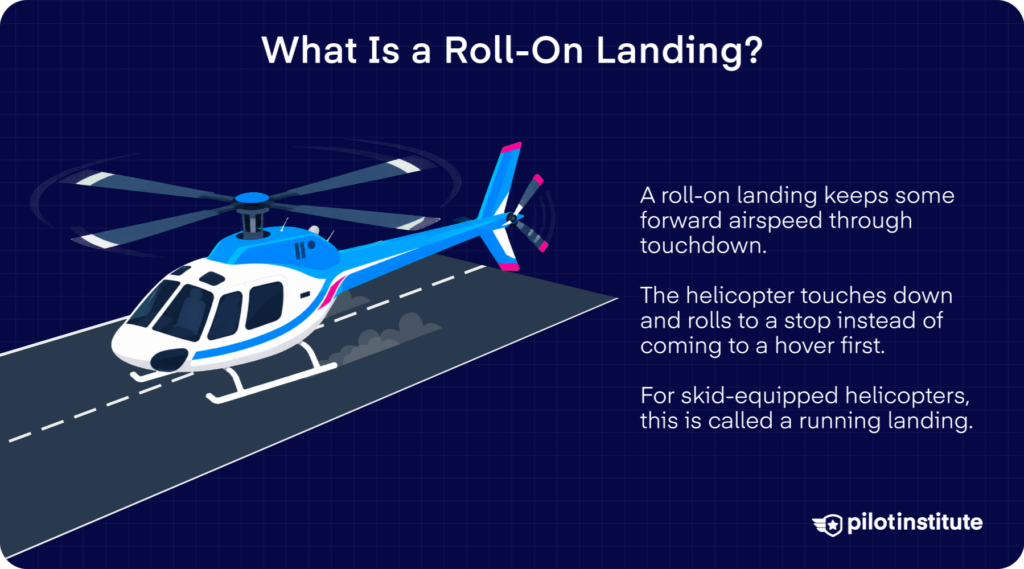
A roll-on landing is a landing you fly with forward airspeed. Your helicopter slides or rolls to a stop instead of settling straight down. In a helicopter with skids, we call this a running landing.
You’ll fly one when you can’t hover for a normal vertical landing. In small helicopters, that usually means something has failed.
You’re riding translational lift all the way down in a roll-on landing. It carries you until the gear meets the surface or at least until you are in ground effect.
You’ll typically fly it as a shallow approach, which means you’ll come in on a flatter path than usual. The glide angle for a shallow approach runs roughly 3° to 5°, which is similar to the angle on a typical airplane approach.
What to Check Before and After a Roll-On Landing
Because the helicopter is sliding or rolling as it comes to rest, the landing area should be smooth. It also has to be long enough to let the aircraft come to a stop.
Your landing gear also has to stay aligned with the direction of travel.
A headwind shortens the ground run and lowers touchdown groundspeed. A tailwind or crosswind lengthens the run and pushes you off ground track, which could send you into a dynamic rollover.
Keep the disc from tilting too far aft after touchdown. Too much aft blade pitch can bring the blades down far enough to strike the tailboom.
When Do You Need a Running Takeoff or Roll-On Landing?
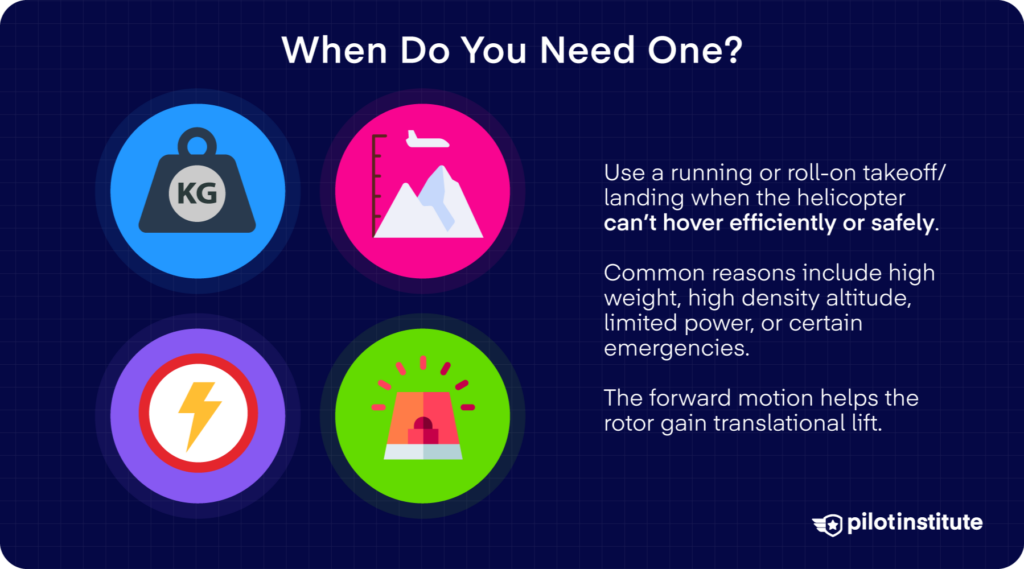
You’ll need these maneuvers when your helicopter is having a hard time hovering. Emergencies are the main reason. A stuck pedal, a hydraulic failure, a governor problem, or an engine making partial power can all take a hover off the table.
In a wheeled helicopter, a rolling takeoff is also just a normal way to get moving.
Weight and density altitude are the third reason, and the one to be careful with. If you don’t have the power to hover before takeoff, delay the flight until conditions improve.
That call happens on the ground. A running takeoff is not a workaround for being too heavy or too high.
What Is Effective Translational Lift?
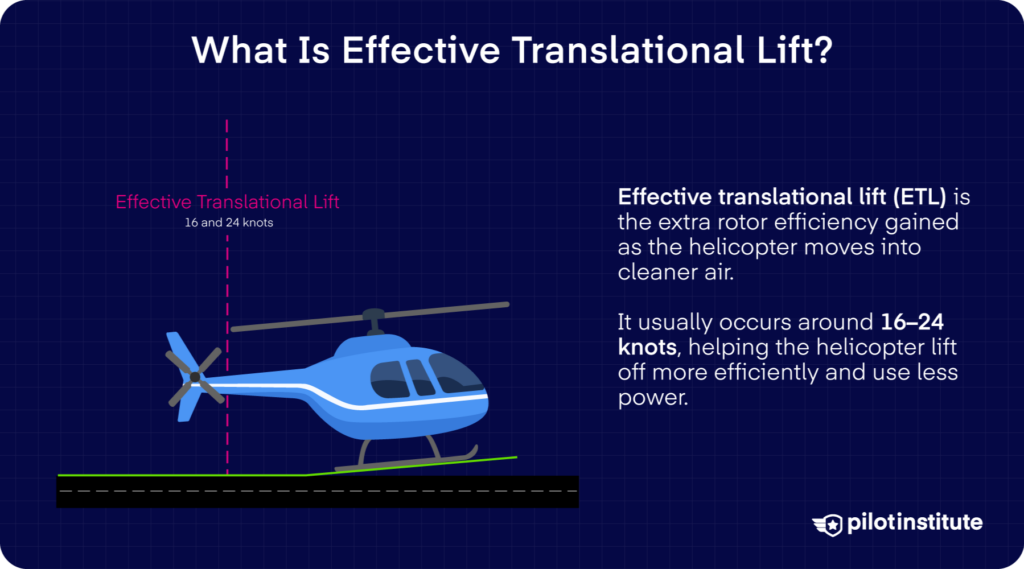
Effective Translational Lift (ETL) is the aerodynamic lift advantage that comes from forward airspeed. Your rotor is far more efficient flying forward than it is sitting still in a hover.
A lot of effort actually gets wasted in a hover. The disc chews through its own recirculated downwash. But once you build a little forward speed, the rotor outruns those vortices and starts biting into clean air.
Translational lift builds with every knot of airflow through the disc up to and including ETL, which is the point around 16 to 24 knots where the rotor outruns its own downwash. This is where you get a real helpful boost from that efficiency gain.
It’s what finally lets you climb away on a running takeoff. During a roll-on landing, ETL keeps you safely flying at a lower power setting all the way to touchdown.
How to Perform a Running Takeoff (Step-by-Step)
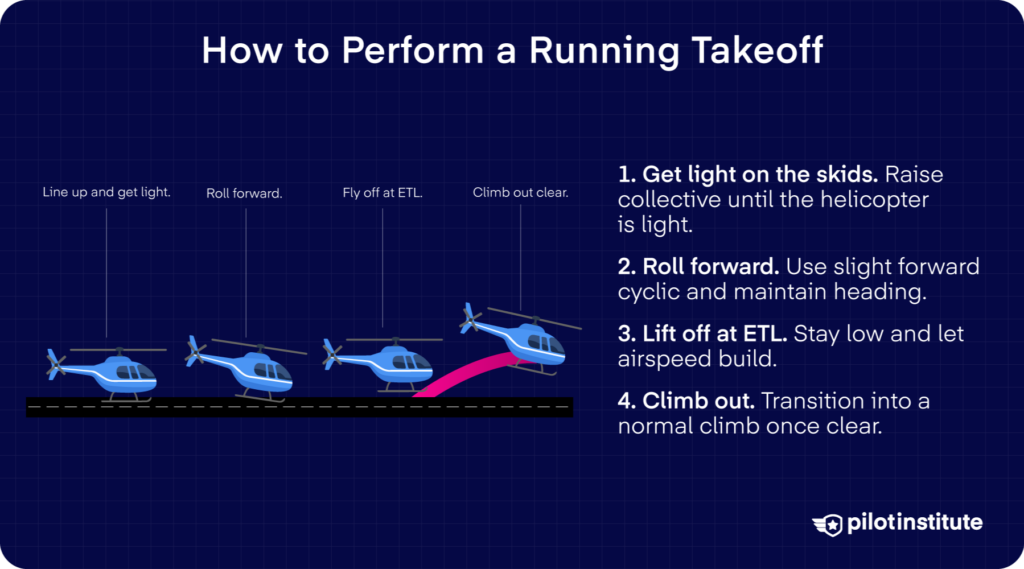
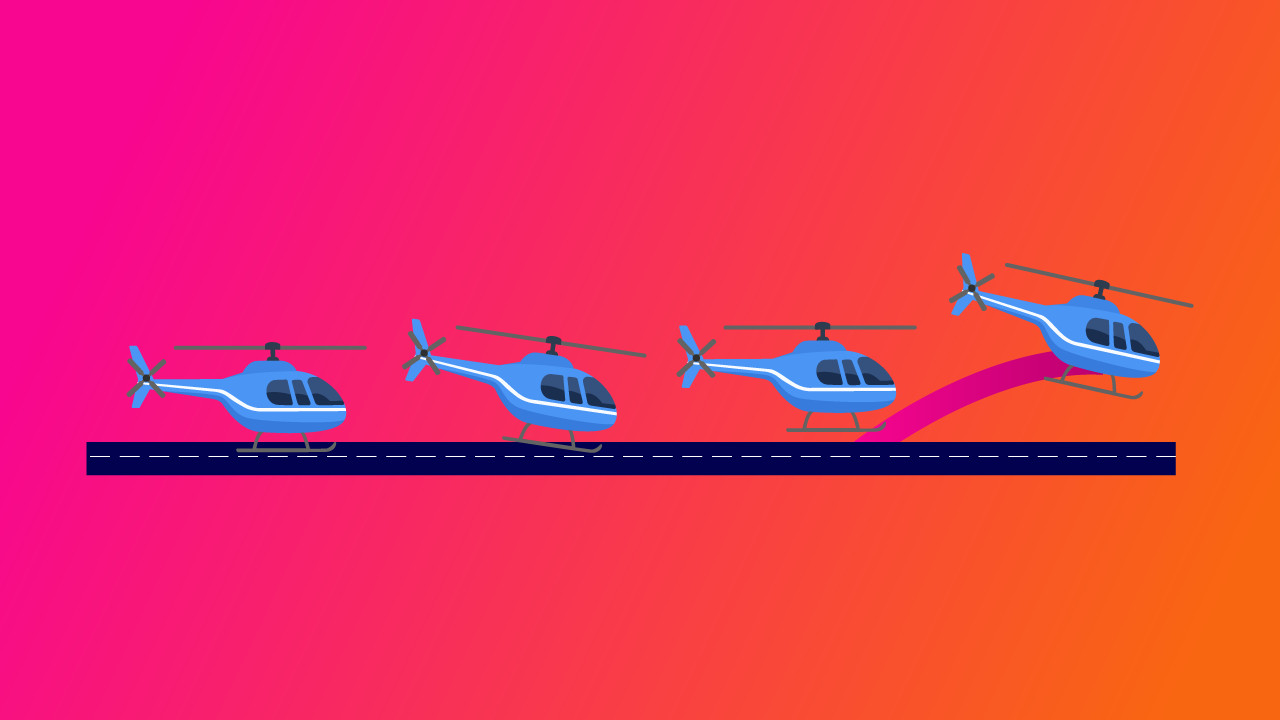
The FAA Helicopter Flying Handbook gives us a general procedure for performing a running takeoff, which it divides into four positions.
To rehearse this with a safe margin, simulate reduced power by pulling about one to two inches less manifold pressure, or three to five percent less torque, than the power you’d need to hover.
That’ll simulate the conditions of a heavy or high-density-altitude day without putting you at any real, uncontrollable risk.
1. Line Up and Get Light on the Skids
First of all, take care of your ground track. Make sure you’re aligned with your intended takeoff path. A straight run keeps surface friction low and your track predictable.
Bring the throttle up to takeoff rpm, then raise the collective smoothly until the helicopter goes light on the skids or gear.
If you’re departing from water, make sure the floats are mostly clear of the surface before you go any further.
2. Roll Forward on Cyclic and Collective
Once the helicopter is light, ease the cyclic slightly forward of its neutral hover position. Add a touch more collective to get it rolling.
Your job now is to keep things tracking straight. Use lateral cyclic to hold a straight ground track and the pedals to hold your heading. Stay on those inputs until you establish a climb.
3. Fly Off at Effective Translational Lift
As speed builds and you gain effective translational lift, the helicopter will fly itself off in a fairly level attitude with little or no pitching. Don’t rush it upward.
Stay low, since you’re taking advantage of ground effect. Let your airspeed keep climbing toward normal climb speed before you commit to going up.
4. Climb Out Through the Clear Zone
Now, follow a climb profile that keeps you inside the clear area of the height/velocity diagram.
Stay well away from the shaded zones. In those height and velocity combinations, a power loss would leave you with no good options.
Once your airspeed is safely in the climb range, settle into a normal climb attitude and power setting.
How to Fly a Shallow Approach and Roll-On Landing (Step by Step)
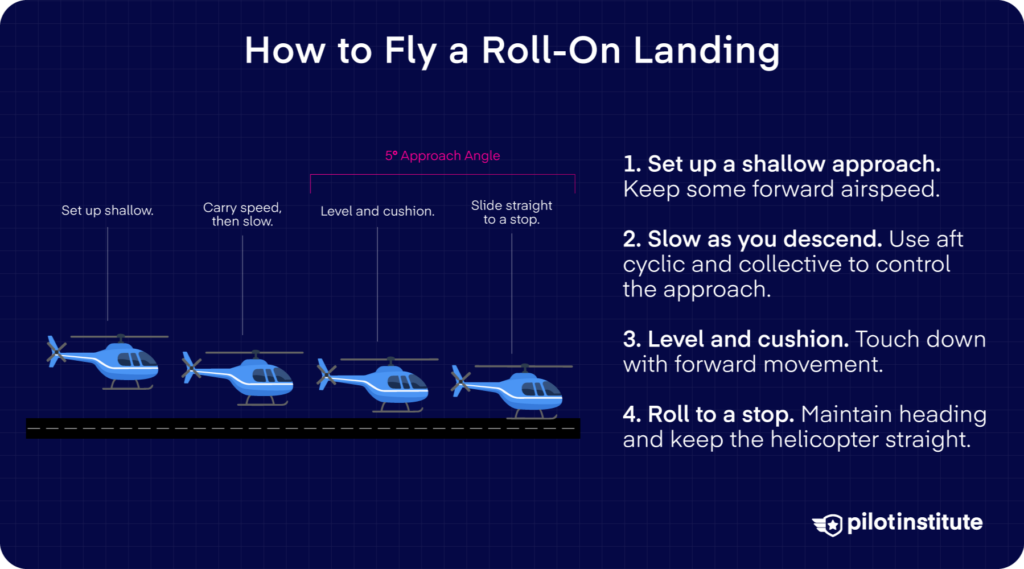
You fly a roll-on landing as a shallow approach, carrying airspeed all the way to touchdown. Effective translational lift keeps the descent controlled at a lower power setting.
Like the running takeoff, the Handbook also illustrates the procedure in four positions.
1. Set Up a Shallow Approach
You’ll start the same way you would a normal approach. This time, though, you’ll make a flatter angle of descent at roughly 3° to 5°. It looks similar to the approach angle of airplanes.
Now, because the angle is shallower, the power reduction needed to start down is smaller than on a normal approach. As you lower the collective, hold your heading with pedal pressure and manage rpm with the throttle.
2. Carry Speed, Then Slow With Aft Cyclic
Maintain your approach airspeed until the rate of closure with your landing spot starts to increase.
Then, begin to slow down the helicopter with aft cyclic. Keep the division of labor in mind. Collective controls your angle and rate of descent, and cyclic governs your groundspeed.
Aim to arrive at touchdown at or just above effective translational lift. Because that lift gets away from you at low speeds, blend your deceleration smoothly. But hold just enough in reserve so the helicopter doesn’t settle abruptly.
3. Level Off and Cushion With Collective
Just before touchdown, use the cyclic to set a level attitude and the pedals to hold your heading. Be mindful that what feels level is probably still nose high, so push more forward than you think you need to. Keep your direction of travel and ground track aligned.
Then, let the helicopter descend gently to the surface in a straight-and-level attitude. If appropriate, cushion with collective so the gear gently meets the ground.
4. Slide or Roll Straight to a Stop
Once you’ve made surface contact, move the cyclic slightly forward to keep clearance between the rotor disk and the tailboom.
From there, use the cyclic to hold your surface track, and the pedals to control yaw. The helicopter should slide or roll straight ahead until it decelerates to a stop.
You’d usually keep the collective stationary until the helicopter stops. But to get more braking action, lower the collective slightly. Do NOT use aft cyclic to stop.
What Are the Main Hazards?
The two big ones are a tailboom strike and a dynamic rollover.
You prevent dynamic rollover by keeping the landing gear aligned with your direction of travel and making sure the landing area is smooth.
For helicopters with skids, damage and wear on the skid shoes are also a concern.
If weight or density altitude is the problem, wait or offload weight instead of flying the maneuver to get around it.
What Is Dynamic Rollover?
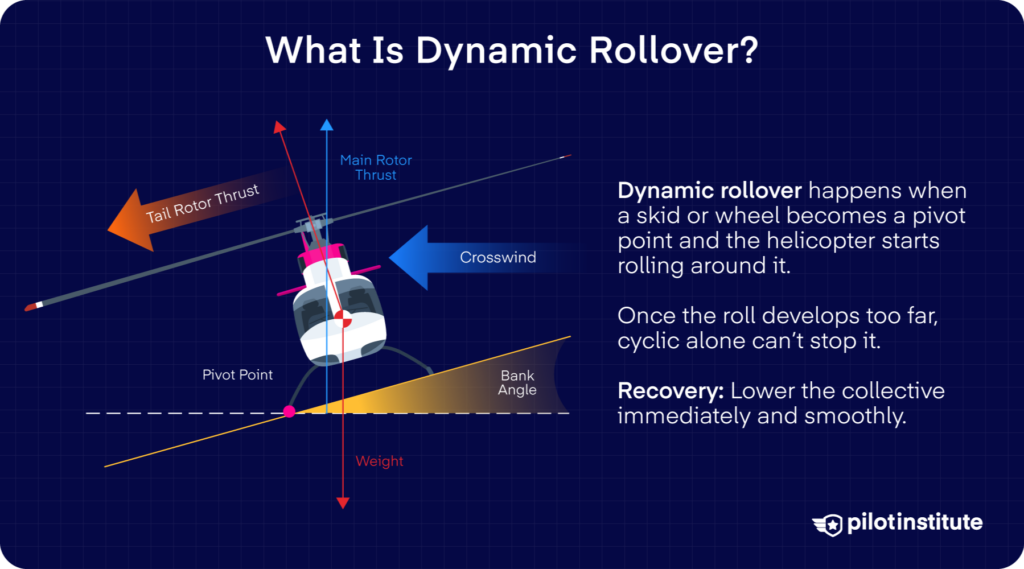
Three things must all be present for dynamic rollover to happen. First, you need a skid or wheel that stays planted on the ground or contacts something immobile and becomes a pivot point.
For example, a skid or wheel could get caught on an object or stick to a surface like ice or mud. Or perhaps you’re not aligned with your ground track.
A rolling motion, the second necessary factor, then builds up around that pivot.
The third factor is thrust that exceeds the aircraft’s weight. Thrust allows you to approach and potentially exceed the critical rollover angle, which is roughly 5° to 8° depending on the helicopter and the conditions.
Once started, you can’t stop a dynamic rollover with opposite cyclic alone.
There’s only one recovery technique available. Lowering the collective quickly and smoothly can be enough to arrest that rolling motion.
The Tailboom Strike
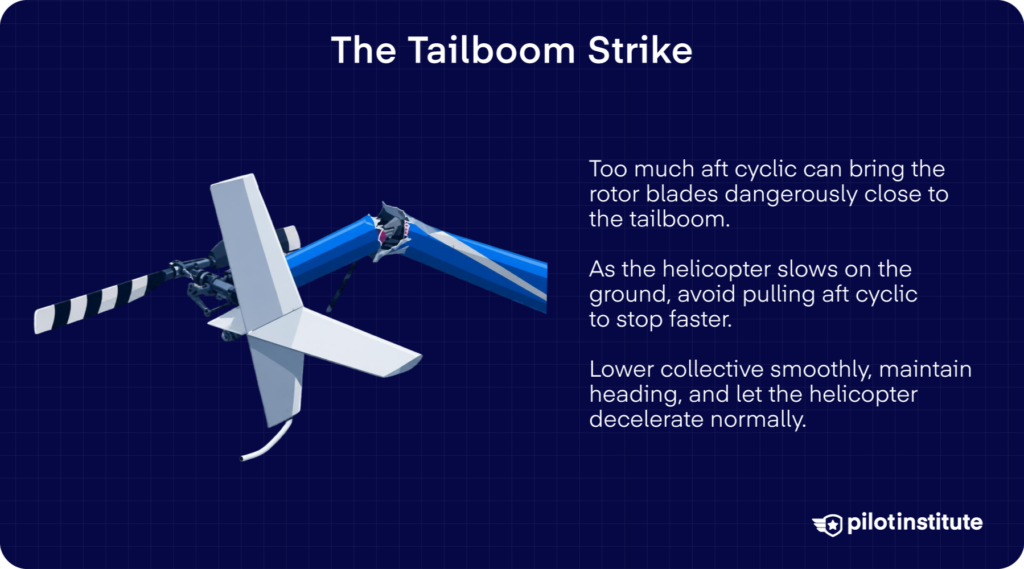
You could also be at risk of a tailboom strike during a running landing.
The main thing to watch out for is ground friction, which increases when you lower the collective. And if you’re setting down on rough or uneven ground, the helicopter can stop abruptly and pitch its nose forward.
Now, while it sounds counterintuitive, resist the urge to fix that pitch with aft cyclic. Otherwise, the rotor blades could end up striking the tail boom.
Instead, hold normal rpm with the throttle and maintain directional control using the antitorque pedals throughout the landing.
The same technique goes if you’re landing a wheeled helicopter. But once you’re down, lower the collective and neutralize the controls. Then, apply the brakes as needed to slow down.
What Makes Weight and Density Altitude So Important?
It’s true that we perform these takeoff and landing procedures when weight or density altitude prevents a sustained hover, or during an equipment malfunction. The operative word here, though, is sustained.
If your helicopter can’t pull off a hover, even momentarily, these variables have gone past safe limits.
Also, please bear this in mind. If you’re flying a modern helicopter and you need a running takeoff to get airborne, then you’re probably right up against, or already past, the maximum operating weight or performance limitations for the density altitude. Consider waiting until conditions improve.
Always respect the height/velocity diagram for your aircraft. Select a suitable altitude that allows you to achieve a safe acceleration consistent with the diagram.
When Are Roll-On Landings Used in Emergencies?
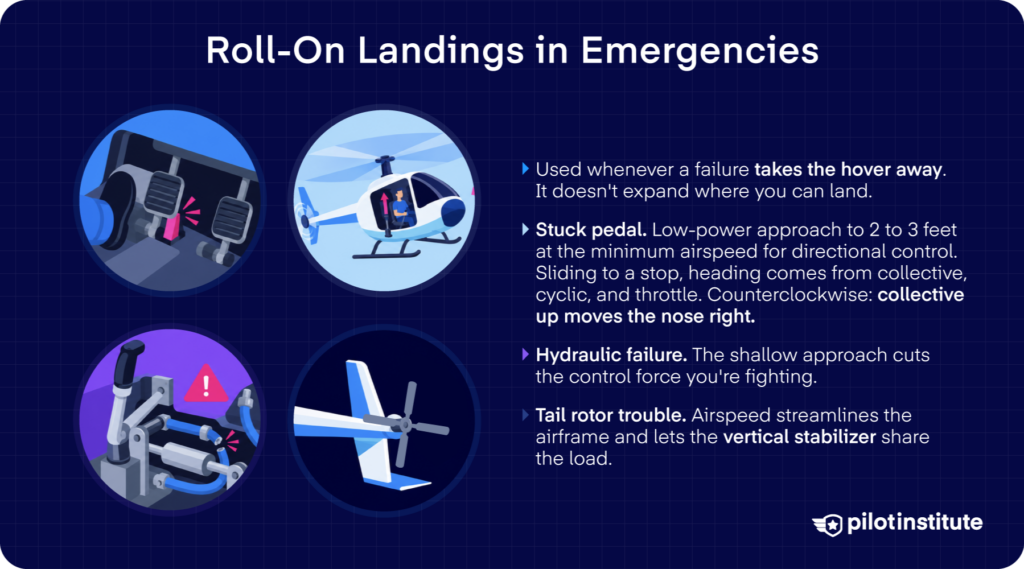
This is the most common real-world use, especially in small helicopters. A running landing gets you down when a failure means you can’t safely stop in a hover.
During tail rotor problems, for instance, the main assistance that running landings lend you is forward airspeed, which provides stability and minimizes collective power adjustments.
Forward airspeed streamlines the airframe, which lets the vertical stabilizer help with directional control. In a drive failure, the reduced power also trims the torque you’d otherwise fight.
Roll-on or running landings could also be the safest way down when the engine is running but not producing normal power, or during a governor or hydraulic failure.
One thing to be clear about. A running landing doesn’t expand where you can land. The technique exists because a failure took your hover away. It doesn’t let you accept a spot you couldn’t otherwise hover into.
Stuck Pedal to Roll-On Landing
One scenario is a stuck pedal. The tail rotor is still producing thrust, but you just can’t change its pitch.
Holding a heading in a hover would be nearly impossible. So instead, you keep forward airspeed and run the landing on.
Fly a low-power shallow-to-normal approach and plan to arrive about 2 to 3 feet above the landing area at the minimum airspeed for directional control. That minimum is the slowest speed that keeps the nose from continuing to yaw.
Once you’re down and sliding to a stop, your heading now comes from the collective, cyclic, and throttle rather than the pedals.
In a counterclockwise system, raise the collective to bring the nose right, and lower the collective to bring it left. You can also manipulate the throttle to make subtle heading adjustments. These inputs will be opposite in a clockwise rotating system.
Governor and Hydraulic Failure Helicopter Landing
For a hydraulic failure, a shallow approach and running landing will help reduce the necessary control force, which eases your workload.
A governor or fuel control failure is more type-specific. Some conditions can allow a running/roll-on landing, but please refer to your aircraft’s RFM for the exact procedure.
Frequently Asked Questions
Are Running Takeoffs and Roll-On Landings on the Helicopter Checkride?
Yes. The shallow approach and running/roll-on landing is a required task in the helicopter Airman Certification Standards from the private level up. For wheel-equipped helicopters, the rolling takeoff is its own task.
You should be able to explain when to use the maneuver. You should also understand how wind, weight, temperature, and density altitude affect it.
Then, you’ll demonstrate it in the cockpit. All the while, you’re managing risks like dynamic rollover. You should also keep your ground track, manifold pressure and rotor rpm within limits.
Is a Roll-On Landing the Same as an Autorotation Landing?
Not quite, though it’s easy to see why they get conflated.
The difference, though, is power. A roll-on landing is flown power-on, usually because you can’t hover.
An autorotation is flown power-off. The engine is disengaged from the main rotor, and the blades are driven by air flowing up through the disc.
Engine or drivetrain failure is the usual reason. You’ll also autorotate for a complete tail rotor failure, or a high-side governor failure you can’t control with the throttle.
Is a Running Takeoff the Same as a Maximum Performance Takeoff?
No, and in some ways they’re opposites. A running takeoff accelerates along the surface until effective translational lift flies you off, and it’s flown at low power.
A maximum performance takeoff assumes you do have that power. You’re climbing at a steep angle, possibly to clear obstacles that surround a confined area.
Can You Do a Running Takeoff on Grass or a Dirt Strip?
Yes, in a wheeled helicopter, as long as the surface is firm and smooth with no obstacles in your flightpath.
With skids, it’s not recommended. A skid can snag a rut or a rock, and that’s a dynamic rollover waiting to happen.
Keep the gear aligned with your direction of travel either way. Tall grass and rough terrain also disturb the airflow and disrupt ground effect, so you may need more room to reach effective translational lift.
Conclusion
Back to that hot, high-elevation strip. If you can’t hold a hover there, a running takeoff isn’t the answer. Waiting or offloading weight is.
Running takeoffs and roll-on landings earn their place elsewhere. Rolling takeoffs suit wheeled helicopters that have the gear and the power for them.
A running landing can be the safest way down when a hydraulic, governor, or tail rotor problem takes your hover away. You’ll also demonstrate one on your checkride, so the practice pays off.
Fly them when the situation calls for it. Being out of power doesn’t count.