
-
Key Takeaways
-
What Is the Commercial Pilot Checkride?
- 2024 Checkride Update
-
What Do You Need Before You Can Take the Checkride?
- General Eligibility Requirements
- Paperwork To Secure
-
What Happens During the Commercial Oral Exam?
- Commercial Privileges and Limitations: The Holding Out Problem
-
What Maneuvers Are on the Commercial Checkride?
-
Common Gotchas That Bust Commercial Checkrides
- You Do Not Need a Complex Airplane for the Checkride
- The Power-Off 180
- Clearing Turns and Coordination
- Airworthiness and Inoperative Equipment
-
How Long Is the Commercial Checkride and What Does It Cost?
- Checkride Duration
- Checkride Cost
- What Else Should You Budget For?
-
What Happens If You Fail the Commercial Checkride?
- Notice of Disapproval vs. Letter of Discontinuance
- What Is the Commercial Checkride Pass Rate?
-
Frequently Asked Questions
- Is the Commercial Checkride Harder Than the Private Pilot Checkride?
- Do You Need a Complex Airplane for the Commercial Checkride?
- How Many Hours Do You Need for a Commercial Pilot Certificate?
- What Is on the Commercial Pilot Oral Exam?
- How Much Does a Commercial Checkride Cost?
- What Happens if You Fail the Commercial Checkride?
-
Conclusion
The commercial pilot checkride is the FAA practical test that stands between you and your commercial certificate. It’s the day when you’ll need to prove that you can fly and reason like a professional.
You have 250 hours, and the endorsements are signed. The DPE just texted to confirm your schedule. Now, you’re lying awake running lazy eights in your head.
Take a breath. The next step is knowing what the day will look like.
Let’s go through what to expect at every stage, from the oral to the maneuvers. We’ll also talk about the gotchas that catch applicants off guard.
Key Takeaways
- The commercial checkride is the FAA practical test for your commercial certificate.
- Make sure to secure your endorsements and current paperwork before test day.
- The flight portion includes five additional maneuvers, plus steep turns at a 50-degree bank.
- Failure means a Notice of Disapproval. Retrain and take your retest within the 60-day credit window.
- Plan for a half day. The FAA charges nothing for the test, but a DPE may charge around $800 to $2,000.
What Is the Commercial Pilot Checkride?
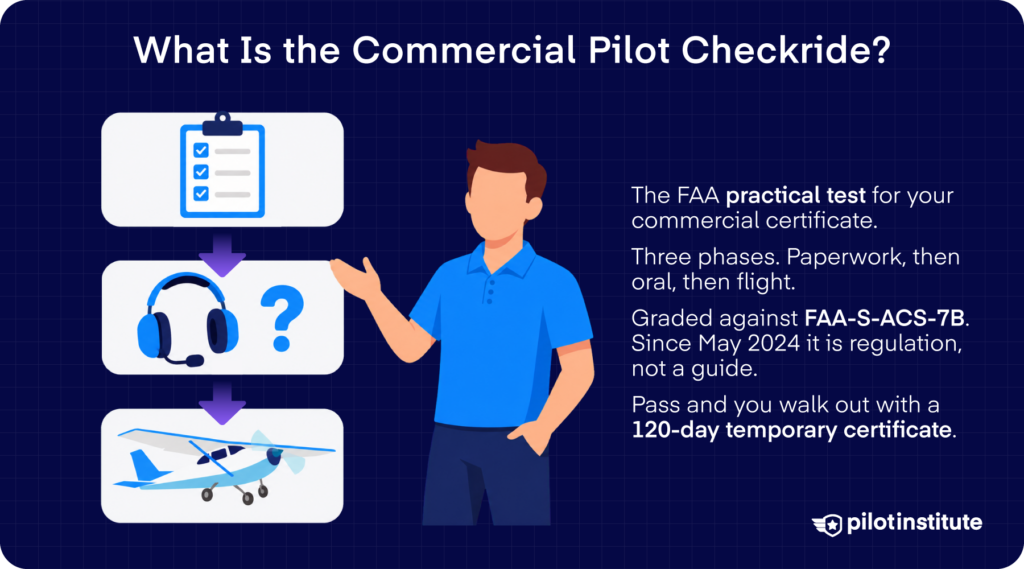
The commercial pilot checkride is the FAA practical test you take to earn your commercial pilot certificate.
Your examiner will grade you against the Commercial Pilot for Airplane Category Airman Certification Standards (ACS), coded as FAA-S-ACS-7B.
You can look at the test in three phases, essentially. First, you’ll need to pass the eligibility and paperwork check.
The examiner confirms you meet the prerequisites in 14 CFR 61.39. They’ll also review your airman knowledge test report (AKTR), logbook endorsements, ID, FAA certificates, and application.
Next is the ground portion. Some pilots call it the oral exam, and it’s where you’ll answer questions and reason through different flight scenarios.
Last will be the flight portion, where you’ll get in the air and demonstrate the maneuvers in the ACS. Your examiner can also continue oral questioning during this part.
If you clear all three successfully, the examiner will issue you a temporary pilot certificate. The temporary certificate is valid for up to 120 days under 14 CFR 61.17.

Commercial Pilot
Made Easy
Study better with animations, flashcards, and scenarios.
- Avg. 3–5 min videos.
- 350+ flashcards.
- Scenario-based training.
- Lifetime access plus 30-day refund.
2024 Checkride Update
For years, the ACS has been the testing standard examiners were required to follow. The document itself, though, wasn’t explicitly mentioned in federal regulatory text.
A final rule effective May 31, 2024, changed that. It amends 14 CFR parts 61, 63, and 65 to incorporate the ACS and Practical Test Standards.
FAA-S-ACS-7B is now listed in 14 CFR 61.14 and incorporated by reference for 14 CFR 61.43 and Appendix A to Part 61.
The ACS now carries the full force and effect of the regulations, and is no longer just a guide or reference.
It breaks the test into individual tasks. Each task comes with its own knowledge, risk management, and skill elements. Those tasks are grouped into 11 Areas of Operation.
Not all of them apply to every applicant, since the same document covers single-engine and multi-engine airplanes on both land and sea.
That said, you can be sure your commercial checkride will follow this structure.
What Do You Need Before You Can Take the Checkride?
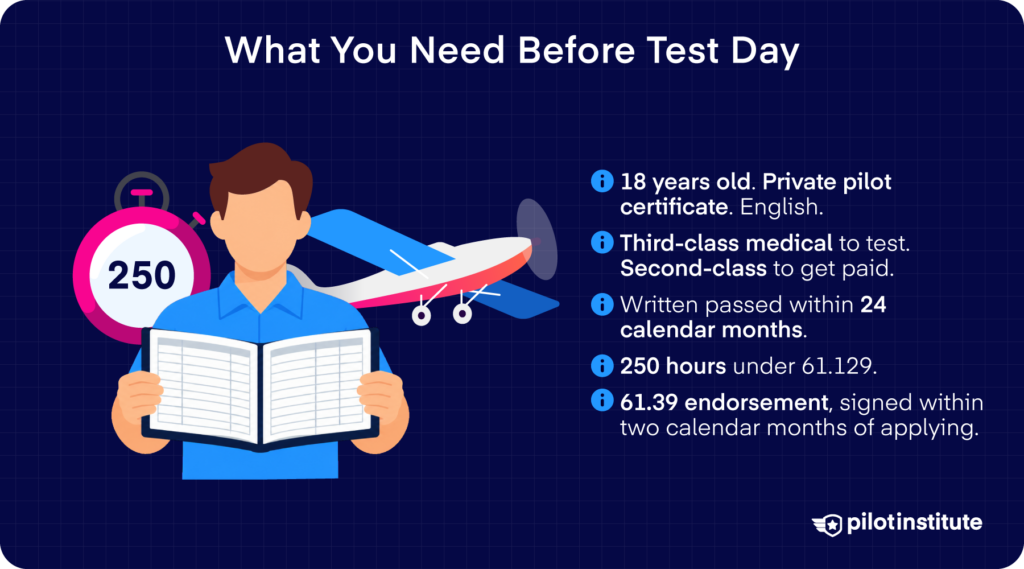
Before you can sit for the commercial checkride, a handful of boxes need to be checked.
General Eligibility Requirements
You must be at least 18 years old and hold at least a private pilot certificate, per 14 CFR 61.123. You should also be able to read, speak, write, and understand the English language.
The rules also require a medical certificate. And yes, a third-class is enough to take the test. But to exercise commercial privileges afterward, 14 CFR 61.23 requires at least a second-class.
Your commercial knowledge test has to be current. That means you should have passed the written test within 24 calendar months before the month you complete the practical test.
You also have to meet the aeronautical experience requirements in 14 CFR 61.129. It’s where your 250 total flight hours are required, and this number is further broken down into different operations.
Finally, your instructor needs to sign the 14 CFR 61.39 endorsement. Make sure it fits within two calendar months preceding the month of application.
Paperwork To Secure
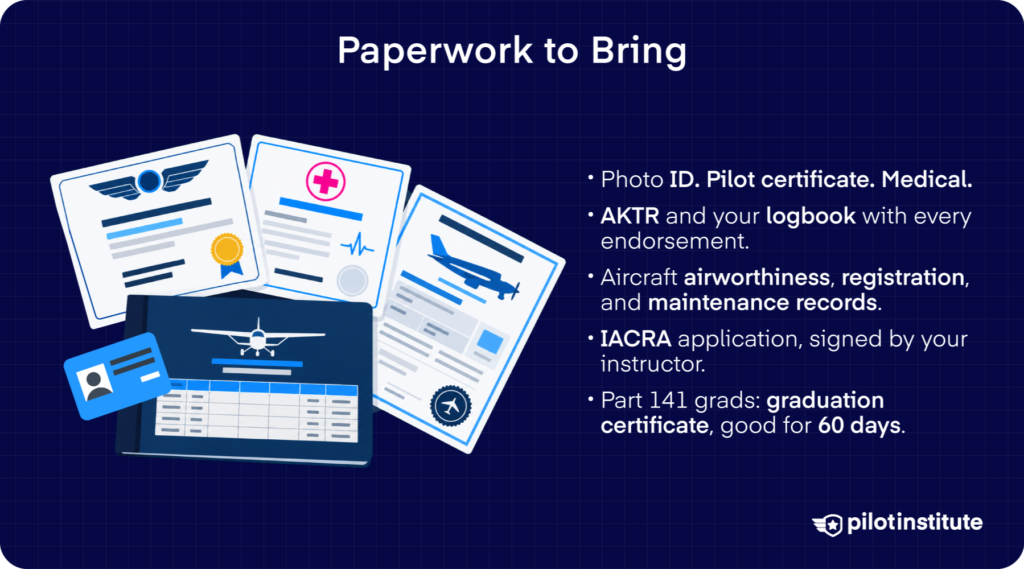
Showing up organized is the first step for a smooth checkride. Now, let’s talk about your paperwork checklist according to the ACS Companion Guide.
First, bring a government-issued photo ID. You’ll also need your private pilot certificate and current medical certificate in hand.
Don’t forget your Airman Knowledge Test Report (AKTR). This is the printout that proves you passed the required knowledge test.
Bring your logbook, complete with every required endorsement.
The examiner will also have you confirm that the aircraft is legal to fly.
Have its airworthiness and registration paperwork ready. Along with that, prepare its maintenance records that show current inspections and airworthiness directive compliance.
You should have your practical test application form filled out in IACRA beforehand. Don’t forget to have your instructor sign the recommendation in the system.
And if you trained under Part 141 or 142, bring your graduation certificate.
Mind the calendar with this one. Under 14 CFR 61.71, the certificate only gives you credit if you present it and pass the practical test within the 60-day period after your graduation date.
What Happens During the Commercial Oral Exam?
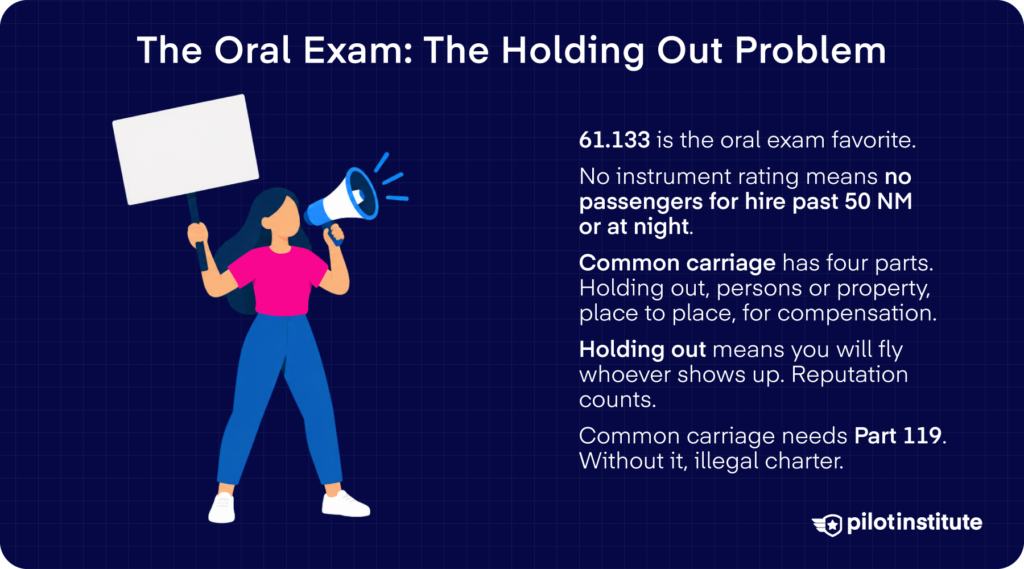
Examiners place the greatest emphasis on the topics that distinguish a commercial pilot from a private pilot.
They could ask you about commercial privileges and limitations under 14 CFR 61.133.
The oral exam also usually covers questions about common carriage versus private carriage, airworthiness and inspection requirements, inoperative equipment, aircraft systems, and performance planning. These come from ACS Area of Operation I.
Commercial Privileges and Limitations: The Holding Out Problem
One big topic during the commercial oral is 61.133. Let’s take a look at what it says.
Your certificate lets you act as pilot in command for compensation or hire, but only if you’re also qualified under whatever operating rules apply to that flight.
Under 14 CFR 61.133(b)(1), without an instrument rating in the same category and class, your commercial pilot certificate will include this limitation:
“The carriage of passengers for hire in (airplanes) (powered-lifts) on cross-country flights in excess of 50 nautical miles or at night is prohibited.”
There’s also the topic of common carriage. The FAA explains it in AC 120-12A, and it mentions four elements:
- A holding out of a willingness…
- To transport persons or property…
- From place to place…
- For compensation.
Holding out means signaling to the public that you’ll fly whoever shows up. The advisory circular notes that it can happen through reputation or course of conduct.
But if the operation is common carriage, for example, you generally need a Part 119 certificate and must fly under Part 135 or 121.
Without these, you’re running an illegal charter. And that’s what your examiner wants you to understand.
What Maneuvers Are on the Commercial Checkride?
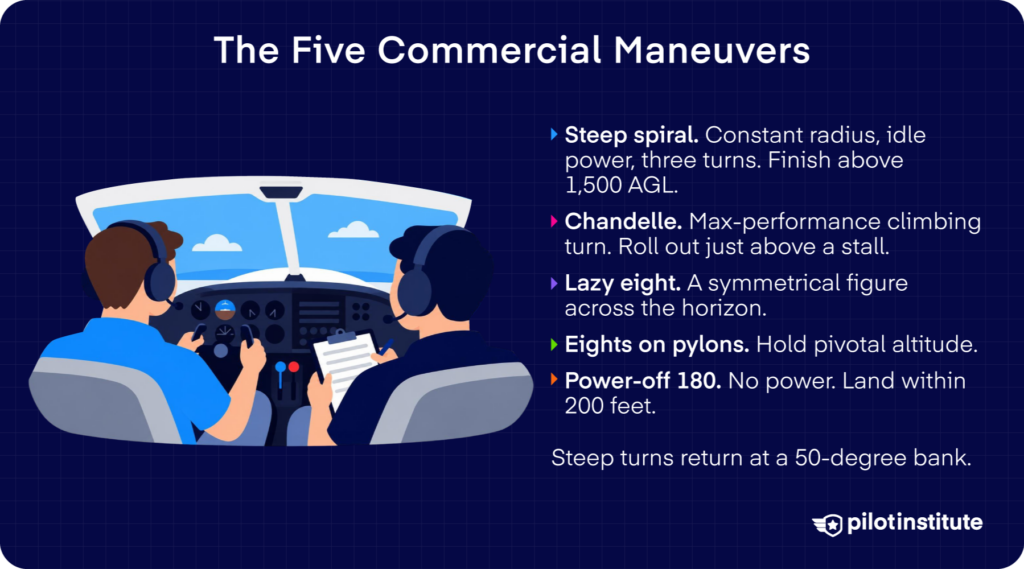
There are five maneuvers unique to the commercial airplane checkride. You’ve most likely practiced them painstakingly during your training.
These maneuvers are:
- The Steep Spiral. It checks your ability to fly a constant-radius descending turn around a point with the power at idle, correcting for wind the whole way down.
- Chandelles. Here, you measure your control as you trade airspeed for altitude in a maximum-performance climbing turn.
- Lazy Eights. This tests your ability to manage control inputs that are constantly changing as you carve a symmetrical figure across the horizon.
- Eights on Pylons. It will test how well you hold a pivotal altitude and divide attention outside the cockpit.
- Power-off 180 accuracy approach and landing. This is an exercise in energy management to land on a pre-selected spot without power.
Steep turns come back too, but at a steeper 50-degree bank.
These are the polish-and-precision maneuvers that separate a commercial pilot from a private one. You’ll need to fly them to tight tolerances with little room for error.
| Maneuver | Bank tolerance | Altitude tolerance | Airspeed tolerance | Heading tolerance |
| Steep Turns (V.A) | ±5° (approx. 50° bank) | ±100 ft (entry altitude) | ±10 kt | ±10° (entry heading) |
| Steep Spiral (V.B) | Not to exceed 60° at the steepest point. | – | ±10 kt (specified airspeed) | ±10° (rollout toward object or specified heading) |
| Chandelles (V.C) | Approx. 30° | – | Complete just above stall airspeed | ±10° (rollout at the 180° point) |
| Lazy Eights (V.D) | Approx. 30° at the steepest point. | ±100 ft at the 180° point (from entry altitude) | ±10 kt at the 180° point (from entry airspeed) | ±10° at the 180° point |
| Eights on Pylons (V.E) | Not to exceed 40° | – | – | – |
But don’t assume that’s all you’ll fly. Everything from your private checkride is still fair game. The commercial checkride builds on your private pilot foundation, which the examiner will still want to see.
Common Gotchas That Bust Commercial Checkrides
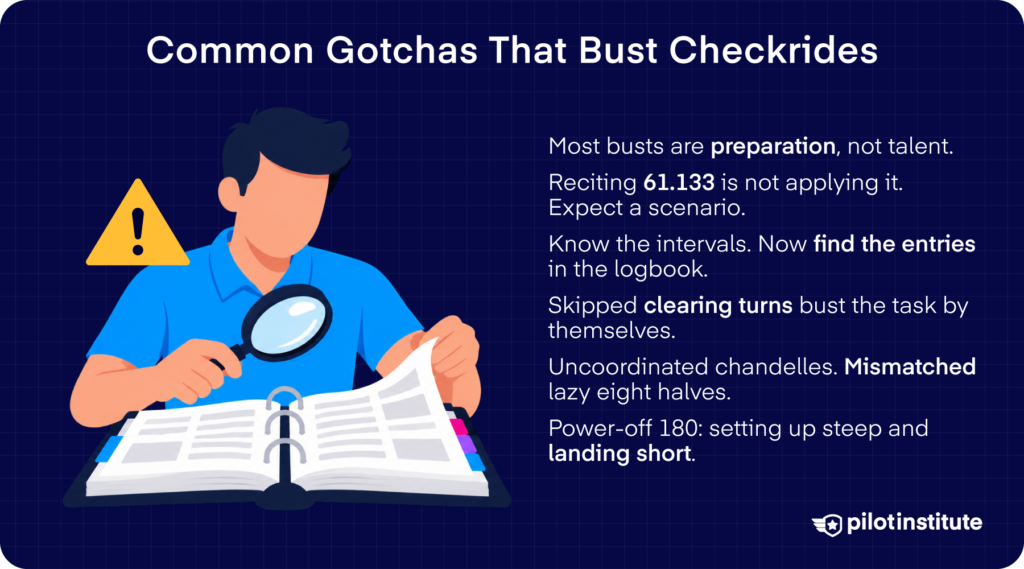
Instructors and examiners tend to see the same handful of problems.
In the oral, many pilots can recite the rules, especially about privileges and limitations. But not everyone can apply them.
Paperwork is another common downfall. Applicants know the inspection intervals, but can’t find the entries in the aircraft’s logbooks.
You’ll notice that none of these have been about raw flying talent so much as preparation. You should know where to look, especially when it counts the most.
You Do Not Need a Complex Airplane for the Checkride
No, you don’t. Training and testing are two distinct requirements, so don’t get them mixed up.
The airplane needs only to be of U.S. registry, capable of performing all required areas of operation, and be in the appropriate category and class.
It must also have a standard airworthiness certificate or special airworthiness certificate in the limited, primary, or light-sport category.
Nothing in 14 CFR 61.45 mentions a complex airplane.
At the examiner’s discretion, 61.45(a)(2) also allows a military aircraft or an aircraft of foreign registry in specific cases.
The training requirement, however, didn’t change.
Under 61.129(a)(3)(ii), you still need 10 hours in a complex, turbine-powered, or technically advanced airplane (TAA), and you must satisfy these hours in an airplane.
The Power-Off 180
The ACS gives precise tolerances. You’ll need to:
“Touch down at a proper pitch attitude, within 200 feet beyond or on the specified point with no side drift and with the airplane’s longitudinal axis aligned with and over the runway centerline or landing path, as applicable.”
Applicants who are afraid of floating long will set up too steep and land short instead. That is an instant deficiency.
Clearing Turns and Coordination
There are also two mistakes that can hold you back before you even get to execution.
First, failing to clear the area. Skipping your clearing turns is a deficiency on its own, no matter how clean the maneuver that follows.
Second, there’s coordination. Chandelles that go uncoordinated and lazy eights with mismatched halves both show up regularly.
Airworthiness and Inoperative Equipment
Expect the examiner to hand you the logbooks and ask you to find the annual inspection, and the 100-hour if the aircraft carries any person other than a crewmember for hire, or is used for flight instruction for hire in an airplane the instructor provides.
You should also know where to verify the transponder and static system checks. It won’t be enough to just memorize the intervals. You have to point to the entries in black and white.
How Long Is the Commercial Checkride and What Does It Cost?
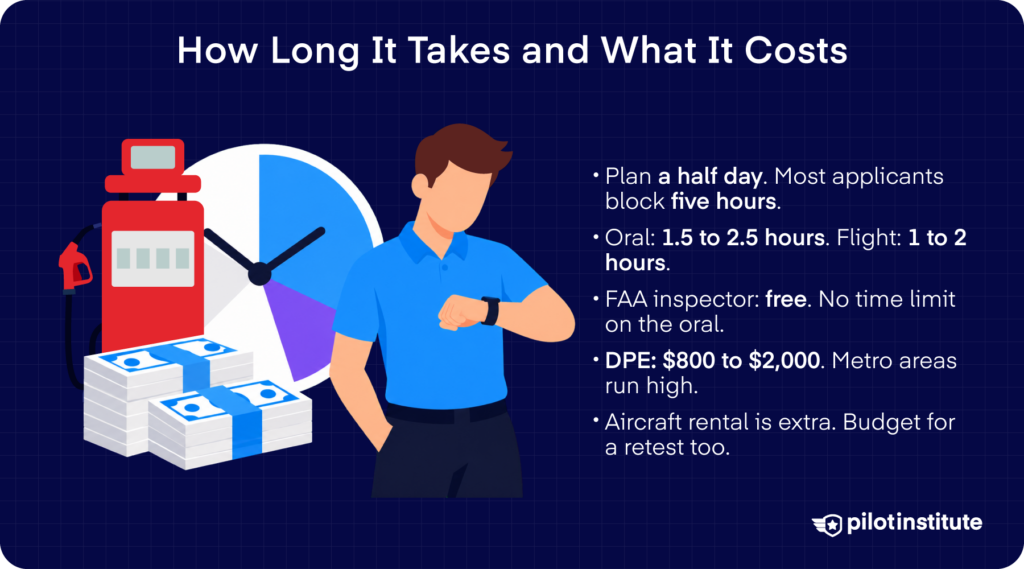
Plan on giving up a half day. The FAA sets no time limit on the oral. In practice, it commonly runs about 1.5 to 2.5 hours. The flight that follows tends to add another 1 to 2 hours.
If you schedule with a DPE, the fee can cost around $800 to $2,000. This range covers high-demand metropolitan areas, which cost more, and rural areas, which cost less.
Checkride Duration
There’s no single universal number for how long your checkride will take.
Some examiners wrap up in four hours. A sudden shift in weather could leave you grounded longer than you’d expect. Most applicants block out around five hours, once you factor in setup and paperwork check.
All that said, a half day is the realistic planning window.
Checkride Cost
If you take the test from an FAA inspector, there is no charge. But if you schedule with a Designated Pilot Examiner (DPE), there’s going to be a fee. DPE fees commonly run $800 to $2,000.
DPEs aren’t FAA employees. They’re designees appointed under 14 CFR Part 183, and FAA policy allows them to charge a reasonable fee for their time.
That’s why prices swing so widely depending on the type of checkride and the region of the country.
What Else Should You Budget For?
Take note that these numbers also don’t include your school’s aircraft rental rate, which you’ll have to add on top of the examiner fee.
And while we’re hoping for the best, you should also budget for the retest.
You’ll usually pay the examiner again. It could either be the full fee or a reduced amount for re-flying only the failed portion, depending on the DPE.
What Happens If You Fail the Commercial Checkride?
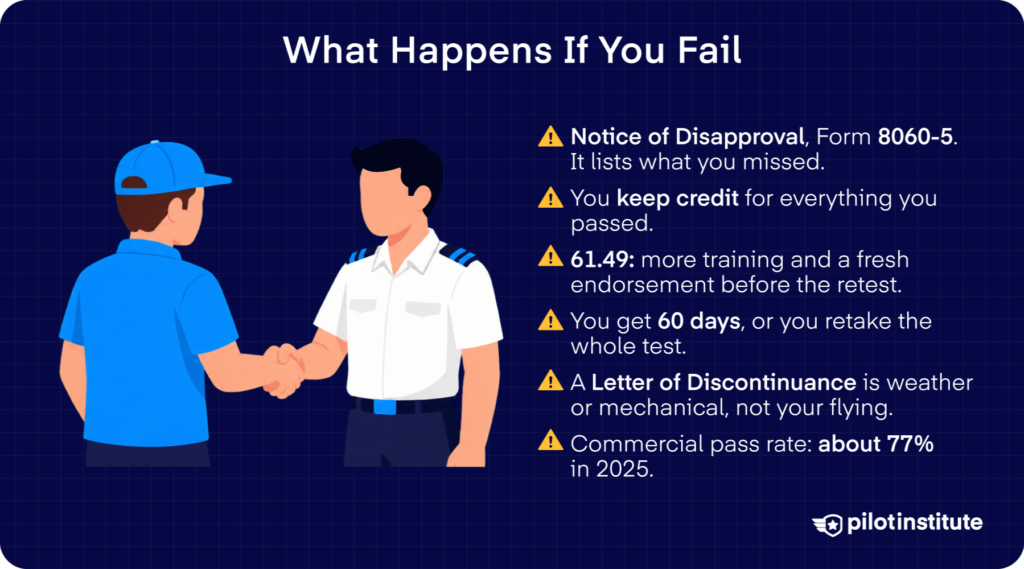
Failure is not the end of the road.
The examiner will issue a Notice of Disapproval, FAA Form 8060-5, which lists the specific Areas of Operation you didn’t meet.
The good news is that you keep credit for everything you passed, so you’re not starting from zero.
But before you can retest, per 14 CFR 61.49, you’ll need additional training from an authorized instructor and an endorsement from that instructor confirming you’re ready.
Then, with that 8060-5 in hand, you schedule the retest and go back to finish what you missed.
But take note that the examiner isn’t limited to your failed areas on the retest. They may re-evaluate any task, including ones you already passed.
Notice of Disapproval vs. Letter of Discontinuance
The examiner issues a Letter of Discontinuance when the test stops for a reason outside your performance, like weather or a mechanical issue with the aircraft.
Mind the calendar on this one, as well.
Under 14 CFR 61.43, the credit for the Areas of Operation you passed holds only if you complete the rest within 60 days of the date the test was discontinued or disapproved.
The credit expires if you miss that window, meaning you’ll retake the entire test.
What Is the Commercial Checkride Pass Rate?
Now, for some encouraging news. According to the FAA’s U.S. Civil Airmen Statistics, the commercial pilot practical test posted an overall pass rate of roughly 77% in 2025.
Note the word overall. The statistic doesn’t distinguish first attempts from retests. This isn’t a first-time pass rate, and plenty of people who fail at first go on to pass on their next try.
Frequently Asked Questions
Is the Commercial Checkride Harder Than the Private Pilot Checkride?
In many respects, yes.
Some tolerances tighten. The normal landing touchdown box shrinks from 400 feet at private to 200 feet at commercial.
Steep turns go to a 50-degree bank, though the numbers you have to hold stay the same: altitude within 100 feet, airspeed within 10 knots, bank within 5 degrees, and rollout heading within 10 degrees.
You’ll also perform precision maneuvers you never flew for the private. These are the steep spiral, chandelles, lazy eights, eights on pylons, and the power-off 180.
The oral gets stricter, too. The examiner will push hard on privileges and limitations and the rules around flying for hire.
Do You Need a Complex Airplane for the Commercial Checkride?
No. The airplane you bring only has to satisfy 14 CFR 61.45.
It must be capable of performing every area of operation on the test, so a simple fixed-gear trainer can qualify.
The complex, turbine, or technically advanced airplane appears in a different rule, at 14 CFR 61.129(a)(3)(ii). It’s a 10-hour training requirement you complete before the checkride.
How Many Hours Do You Need for a Commercial Pilot Certificate?
You need at least 250 hours of total flight time under Part 61, including 100 hours of pilot-in-command time, 50 of which must be cross-country. At least 10 of those cross-country hours must be in airplanes.
On top of that, you’ll log 20 hours of dual training and 10 hours of solo or PIC-duty flying, each with its own detailed sub-requirements.
We break the whole thing down in our commercial pilot requirements guide.
What Is on the Commercial Pilot Oral Exam?
The oral leans most heavily on commercial privileges and limitations, especially the common carriage and holding out concepts under 14 CFR 61.133 and Part 119.
Beyond that, expect airworthiness and inspection requirements, inoperative equipment, aircraft systems, and performance planning, all drawn from Area I of the ACS.
That, along with the knowledge and risk management elements across the entire ACS.
How Much Does a Commercial Checkride Cost?
The FAA charges nothing for the test itself.
What you pay is the Designated Pilot Examiner’s fee, which varies widely by region and demand and commonly runs from $800 up to around $2,000.
Budget toward the higher end in busy metropolitan areas. Also, keep in mind the fee covers the appointment, so it’s due no matter if you pass or fail.
What Happens if You Fail the Commercial Checkride?
You receive a Notice of Disapproval (FAA Form 8060-5) listing the Areas of Operation you didn’t meet, and you keep credit for everything you passed.
Before retesting, 14 CFR 61.49 requires additional training and a fresh instructor endorsement. You’ll also want to retest within 60 days, since that’s how long you can credit the passed areas.
Conclusion
When checkride day finally comes, lean on the reps.
Successful applicants have chair-flown the maneuvers and talked their way through the oral so many times that the real thing feels like just any other practice session.
Consistency is what earns you the right to get paid to fly.
Plenty of freshly minted commercial pilots go straight for the right seat as a flight instructor. Instructing is how most new commercial pilots build hours and start getting paid for them.