
-
Key Takeaways
-
What Is the Commercial Pilot License?
-
The 250-Hour Commercial Pilot Requirements Broken Down
- 250 Hours Total Flight Time
- 100 Hours of Pilot-in-Command Time
- 20 Hours of Training
- 10 Hours of Solo or PDPIC Time
-
The Complex, Turbine, or TAA Requirement Explained
- Complex Airplane
- Turbine-Powered Airplane
- Technically Advanced Airplane
-
The Long Cross-Country and Night Requirements
- What Is PDPIC?
- The Long XC
- Night Flying
-
Knowledge Test, Practical Test, and Medical
- Knowledge Test Requirements
- Practical Test Requirements
- Medical Certificate
-
Part 61 vs. Part 141 Commercial Requirements
- The Fork In the Road
-
Frequently Asked Questions
- How Many Hours Do You Need for a Commercial Pilot License?
- Can You Get a Commercial Certificate Without an Instrument Rating?
- What Counts as a Technically Advanced Airplane (TAA)?
- What Is PCPIC and How Does It Work?
- How Long Is the Commercial Knowledge Test Valid?
- Can I Do My Commercial Training in a Part 141 School With Fewer Hours?
-
Conclusion
You hit 250 hours and figure you’ve met every one of the commercial pilot requirements. Then your instructor opens your logbook, spots that you’re short on night cross-country time, and the checkride slips a month.
To earn a commercial pilot certificate in airplanes, you must be at least 18, read and speak English, and hold a private pilot certificate. You need at least 250 hours of flight time under Part 61, or 190 hours through an approved Part 141 course.
You also have to pass the FAA commercial knowledge test and a checkride. A third-class medical certificate covers the checkride, but flying for pay requires a second-class medical. These rules come from 14 CFR 61.123 and 61.129.
One thing that trips people up is that those smaller hour minimums sit inside the 250-hour total, not on top of it. This guide breaks down every requirement, so your logbook is ready the first time you meet your examiner.
Key Takeaways
- The commercial pilot certificate lets you fly for compensation or hire once you meet every requirement.
- Part 61 requires 250 total hours, while an approved Part 141 course requires only 190.
- The smaller hour minimums nest inside the 250-hour total rather than stacking on top of it.
- You must pass the knowledge test, pass the practical test, and hold a second-class medical.
What Is the Commercial Pilot License?
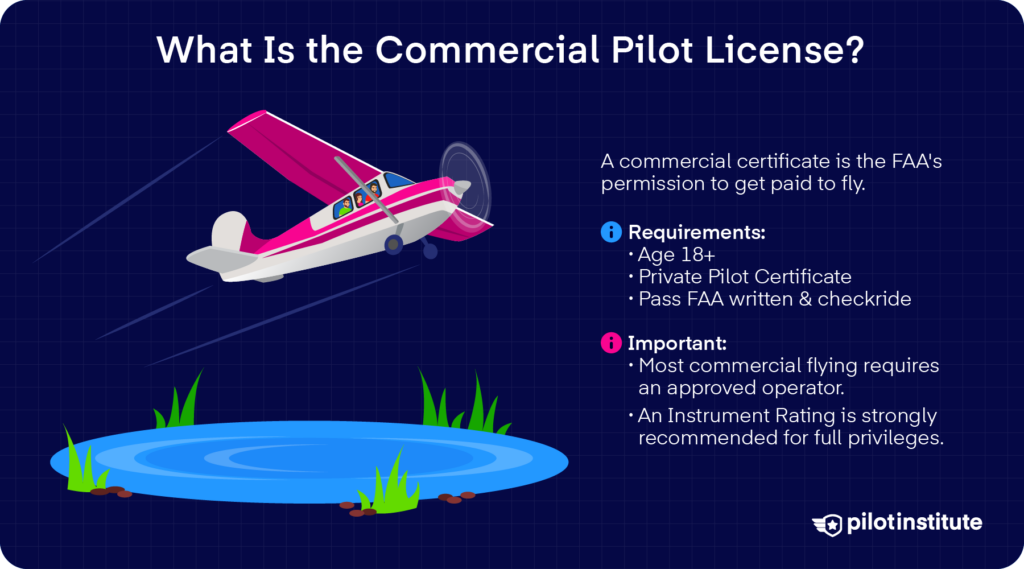
The commercial pilot certificate(also known as a license) is the FAA’s way of saying you’re allowed to get paid to fly.
Under 14 CFR 61.133, a commercial pilot may act as pilot in command of an aircraft for compensation or hire, as long as they’re qualified for the specific operation.
You’ll find the basic eligibility requirements in 14 CFR 61.123.
You must be at least 18 years old, be able to read, speak, write, and understand English, and hold at least a private pilot certificate.
You’ll also need to pass the commercial knowledge test and the practical test, with the appropriate instructor endorsements along the way.
CPL Limitations
The certificate alone doesn’t let you hang out a shingle and start selling flights.
Most paid flying, like charter or air tours, requires the company you fly for to hold an operator certificate under the appropriate regulations.
The privileges and limitations section spells this out.
There’s also a big catch you should know as soon as possible.
Without an instrument rating in the same category and class, your certificate will be quite limited. You can’t carry passengers for hire on cross-country flights beyond 50 nautical miles or at night.
The 250-Hour Commercial Pilot Requirements Broken Down
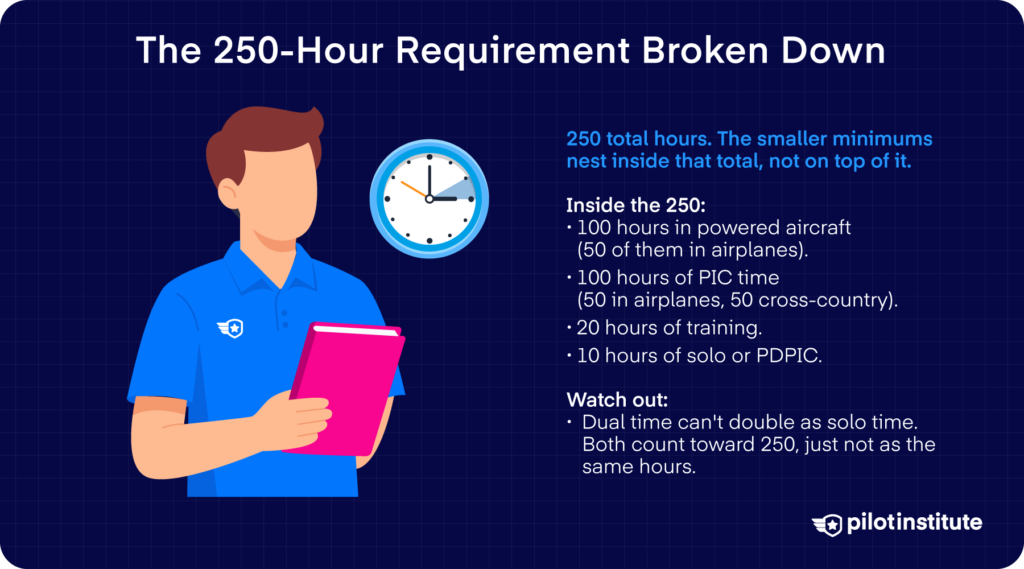
So, which operations count, and how do smaller numbers fit inside that total?
250 Hours Total Flight Time
You must log at least 250 hours of flight time as a pilot. This is the headline figure straight from the regulation.
Of that total, at least 100 hours must be in powered aircraft. And of those, at least 50 hours must be in airplanes.
Notice the structure already. A requirement within a requirement, like a Russian doll.
100 Hours of Pilot-in-Command Time
Next up is your PIC time. (Still counting toward the same 250, not on top of it.)
You need at least 100 hours of PIC time.
That must include 50 hours in airplanes, plus 50 hours of cross-country flight, of which at least 10 hours must be in airplanes.
The minimums nest inside the 250 total, but watch the dual-versus-solo line. Training received from an instructor can’t double as solo time, even though both count toward the 250.
20 Hours of Training
These are those nitty-gritty training hours, and they cover the areas of operation in 61.127(b)(1).
You need 10 hours of instrument training using a view-limiting device, 5 of which must be in a single-engine airplane.
You also need 10 hours in a turbine-powered, complex, or technically advanced airplane (TAA). You can go with just one or any combination of those.
Then come the cross-countries.
One is a 2-hour daytime cross-country in a single-engine airplane covering a straight-line distance of more than 100 nautical miles from the departure point. You’ll also do another one at night.
Finally, 3 hours in a single-engine airplane with an instructor in preparation for the practical test. You should do this within the 2 calendar months before the test.
10 Hours of Solo or PDPIC Time
Now, let’s get something clear.
You need either 10 hours solo or 10 hours performing the duties of PIC with an instructor on board, in a single-engine airplane.
It must include one cross-country of at least 300 nautical miles total with landings at three points, one of which is a straight-line distance of at least 250 nautical miles from departure.
In Hawaii, the longest leg needs only be 150 nautical miles.
It also includes 5 hours of night VFR with 10 takeoffs and 10 landings, each landing involving a flight in the traffic pattern at an airport with an operating control tower.
The Complex, Turbine, or TAA Requirement Explained
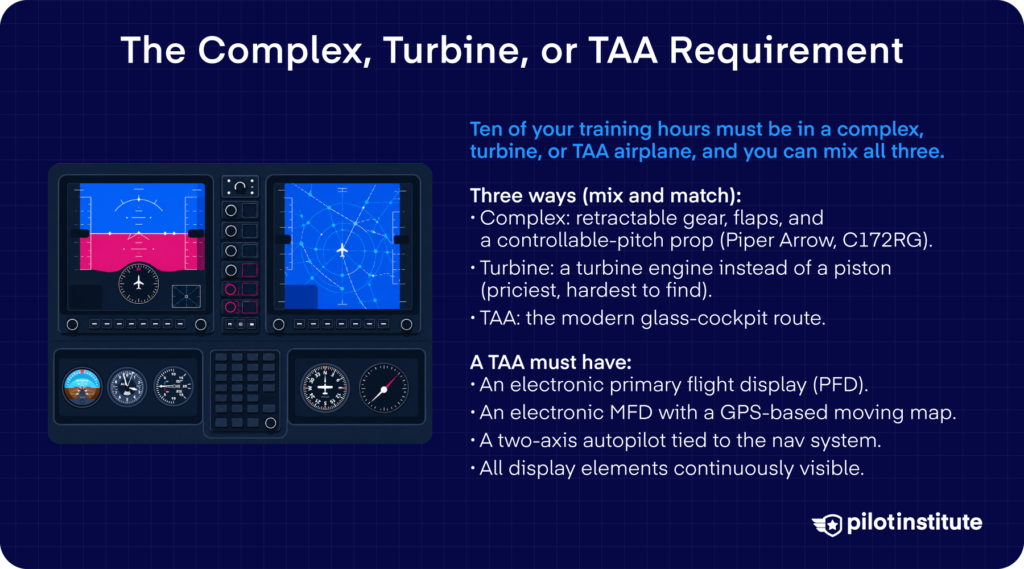
Remember that 10-hour training requirement? It hands you three ways to satisfy it, and you’re allowed to mix and match between them.
Now, let’s define each.
Complex Airplane
A complex airplane is the old-school option. It’s one with retractable landing gear, flaps, and a controllable-pitch propeller, including airplanes equipped with a digital engine control system, such as a FADEC.
Picture a Piper Arrow or a Cessna 172RG. More moving parts to manage, and usually a higher rental rate to match.
Turbine-Powered Airplane
A turbine-powered airplane is exactly what it sounds like. It’s an airplane driven by a turbine engine instead of a piston.
These tend to be even pricier and tougher for a student to get hold of, so most people skip this path.
Technically Advanced Airplane
Then there’s the technically advanced airplane, or TAA, which is the modern route.
To qualify as a TAA, an airplane must have:
- An electronic primary flight display (PFD).
- An electronic multifunction display (MFD) that includes a GPS-based moving map showing the aircraft’s position.
- A two-axis autopilot integrated with the navigation and heading guidance system.
The PFD and MFD elements must be continuously visible.
The Long Cross-Country and Night Requirements
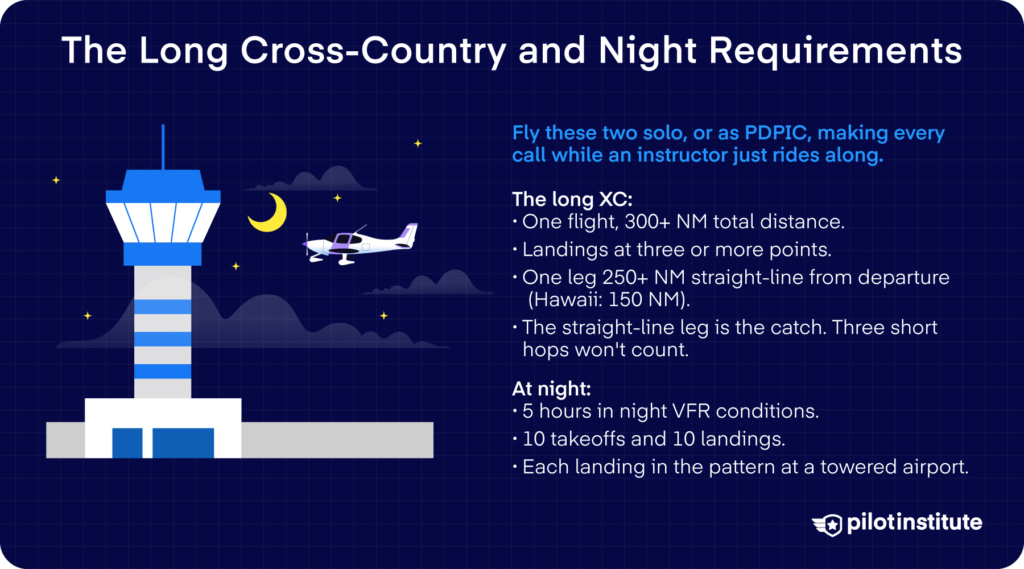
If any two parts of the requirement list cause the most headaches, it’s these. Both of these operations count toward your 100 hours of PIC time.
You can complete the long cross-country and flight requirements solo. Or, you can fly them performing the duties of pilot in command (PDPIC) with an authorized instructor on board.
What Is PDPIC?
So what does PDPIC mean? You make every decision and fly the airplane as though you were alone, while an instructor simply rides along.
This option exists because some flight schools and insurance policies won’t clear a student to fly solo operations this demanding.
The Long XC
Okay, now let’s talk about the long cross-country.
You need one flight of not less than 300 nautical miles total distance, with landings at a minimum of three points, and at least one of those points must be a straight-line distance of at least 250 nautical miles from your original departure point.
In Hawaii, the longest segment only needs to cover a straight-line distance of at least 150 nautical miles.
The detail that trips people up is that 250 NM straight-line leg. A 300 NM total trip flown as three short hops won’t cut it.
Night Flying
Then comes the night requirement.
You need 5 hours in night VFR conditions, plus 10 takeoffs and 10 landings, with each landing involving a flight in the traffic pattern, at an airport with an operating control tower.
A quiet, untowered strip won’t satisfy it. Plan on heading somewhere with a control tower.
Knowledge Test, Practical Test, and Medical
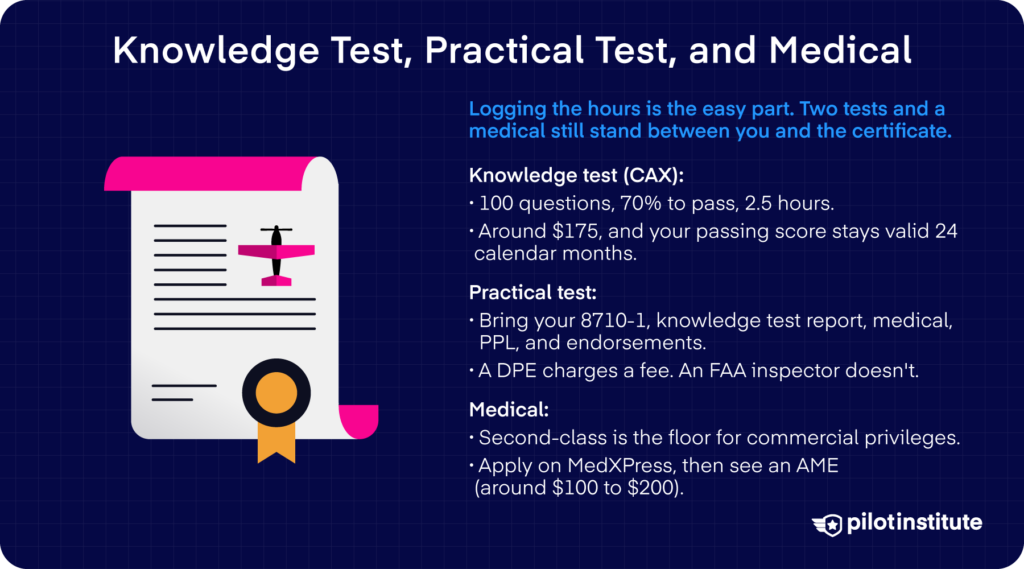
So you’ve logged every required hour in the right category. You’re almost there, but the work isn’t over yet.
Next up, you’ll need to sit down in the exam room and take your knowledge test. If you’ve trained under the airplane category, you’ll be taking the FAA Commercial Pilot Airplane Knowledge Test (CAX).
You’ll have 2.5 hours to take the test. The CAX consists of 100 questions, and you’ll need a score of at least 70 to pass.
Knowledge Test Requirements
But first, you need to find a testing center and book your exam.
Sign in at the PSI website to schedule and pay for your knowledge test. The minimum age to take the CAX is 16 years old, and the exam costs around $175.
Valid Identification
After that, there’ll be documents you need to collect. So, what papers will you need to bring to the testing center?
You can find the full breakdown in the FAA Airman Knowledge Testing Matrix.
You should already have your FTN by now. You’ll also need to bring a valid, current ID showing your full name, a recent photo, date of birth, signature, and your home address.
Test Authorization
Finally, you need to bring at least one of the required forms of authorization.
If you’ve trained through an FAA-approved course, your school can issue a certificate of graduation once you’ve completed your ground training.
The second option is an endorsement from an authorized ground or flight instructor.
It’s either a written statement or a logbook endorsement confirming two things. You’ve completed the required ground training, and your instructor considers you prepared to pass the test.
Your logbook endorsement can look something like this:
I certify that [First name, MI, Last name] has received the required training of 14 CFR § 61.125. I have determined that they are prepared for the Commercial Pilot Airplane knowledge test.
Timing Your Knowledge Test
You can actually take the knowledge before you even complete your flight training. But because of that, you also need to pay attention to your timing.
Your knowledge test result has a validity window, and you must take your practical test before it expires. 14 CFR 61.39(a)(1) sets this window at 24 calendar months for most pilot certificate knowledge tests.
Once you pass, you receive an Airman Knowledge Test Report (AKTR). You’ll use this AKTR later for the practical test application.
Start with the Right Study Plan
Use the sheet as your roadmap, then reinforce with lessons and quizzes.
- Fits any ground school.
- Find weak spots.
- Test-day essentials.
- Extra resources.
Practical Test Requirements
Scheduling your checkride starts well before you call anyone. First, you finish your training and earn an endorsement from your instructor certifying you’re ready.
Here’s a sample endorsement:
I certify that [First name, MI, Last name] has received the required training of 14 CFR §§ 61.127 and 61.129. I have determined that they are prepared for the Commercial Pilot Airplane practical test.
Pilot Requirements
When you arrive for your practical test, the examiner will first go through your paperwork. You’ll need to hand over your FAA Form 8710-1, complete with your flight instructor’s recommendation.
You’ll also need your Airman Knowledge Test Report showing your passing grade.
After that comes your medical certificate. Don’t forget your Private Pilot Certificate and your instructor’s endorsements.
Aircraft Requirements
The paperwork is only half of it, though. You’ll also need to supply an airworthy aircraft equipped for the areas of operation your practical test covers.
The examiner will ask you to produce and explain several documents tied to that aircraft, like the registration certificate and airworthiness certificate.
Who Is Evaluating You?
You can get a list of examiner names from your local FSDO. In most cases, you could fly with a Designated Pilot Examiner (DPE).
The DPE charges you a reasonable fee for their time. If an FAA inspector happens to conduct your test instead, though, there’s no charge at all.
Three Hours, Two Months
We also ought to warn you, finishing your training early isn’t always a good thing.
Why is that? You’ll still need three hours of training with an authorized instructor two months from the month of your checkride.
That comes with a logbook endorsement, and it looks something like this:
I certify that [First name, MI, Last name] has received and logged training time within 2 calendar months preceding the month of application in preparation for the practical test and they are prepared for the required practical test for the issuance of [applicable] certificate.
Those three hours should be spent on review and polishing, so don’t use up your training flight hours too soon.
Medical Certificate
To exercise commercial pilot privileges in an airplane, you need at least a second-class medical certificate.
The FAA’s Guide for Aviation Medical Examiners assigns each class to specific privileges, and the second-class certificate is the one tied to commercial pilots.
You can train on a third-class medical certificate. But the moment you start exercising commercial privileges, second-class becomes the floor.
Medical Application
To earn your second-class medical, fill out FAA Form 8500-8 through the MedXPress system. It gathers your personal information and medical history.
Once that’s submitted, you book an appointment with an Aviation Medical Examiner, or AME. After the exam, the AME can issue your certificate the same day.
An AME, by the way, is a physician the FAA has specifically trained and designated to perform these exams. You can locate one through the FAA’s AME locator.
The Medical Exam
The AME reviews your application, then runs a physical. Assuming you get cleared and nothing needs follow-up, you walk out with the certificate in hand.
As for price, the FAA doesn’t set the fee, so it varies by examiner and region. We suggest you set aside around $100 to $200, depending on the AME.
Part 61 vs. Part 141 Commercial Requirements
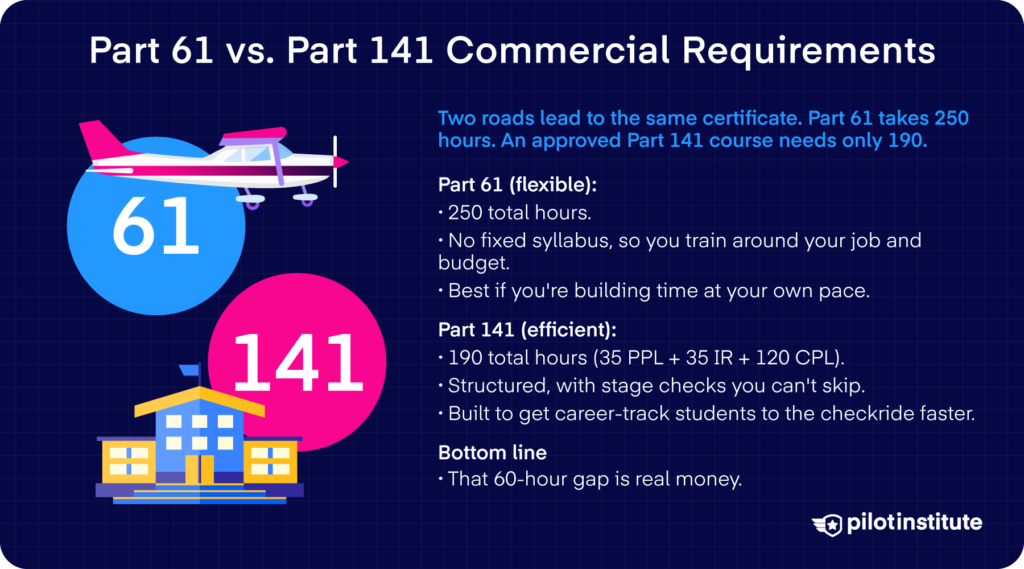
Everything we’ve walked through so far sits under Part 61, but that isn’t the only road to a commercial certificate. Remember that under Part 61, you need 250 hours.
There’s actually a second route, Part 141.
Now, the rules in Part 141 don’t explicitly give a minimum total flight time. But they do require you to have a PPL (35 hours) and an IR (35 hours) before you complete your Part 141 CPL (120 hours).
That adds up to 190 total flight hours once you finish training.
You’re looking at a 60-hour gap, and 60 hours of flying is real money.
The curriculum for these courses is laid out in Appendix D to Part 141, with defined stages and completion standards you follow from day one.
The Fork In the Road
So which one fits you?
Part 61 is the flexible option. Your training isn’t chained to a fixed syllabus, so you and your instructor can build a schedule around your job and your budget.
It suits people building time at their own pace. Maybe you’re flying on weekends or logging hours wherever you can rent an airplane.
Part 141 is the efficiency option. It’s built for career-track students at flight academies who want to go from zero to professional as fast as possible.
The structure asks more of you, with stage checks you can’t sidestep. But it gets you to the checkride on fewer hours and in less calendar time.
Frequently Asked Questions
How Many Hours Do You Need for a Commercial Pilot License?
Under Part 61, you need at least 250 hours of total flight time. Train under an approved Part 141 program instead, and the total can drop to 190 hours.
Just keep in mind that in practice, you’ll probably need to log more than the minimum required flight hours. It takes time to refine your skills, and you’ll need to demonstrate real mastery to pass your checkride.
It’s simply the reality of flight training, so don’t feel discouraged if it takes longer than expected.
Can You Get a Commercial Certificate Without an Instrument Rating?
Yes, an instrument rating isn’t technically required to earn the certificate. But without one, your certificate carries a limitation under 61.133(b)(1).
Since that wipes out most paid airplane work, nearly everyone earns the instrument rating first anyway.
What Counts as a Technically Advanced Airplane (TAA)?
Under 14 CFR 61.129(j), a TAA must have an electronic primary flight display, an electronic multifunction display with a GPS-based moving map showing the airplane’s position, and a two-axis autopilot integrated with the navigation system. The display elements also have to stay continuously visible.
What Is PCPIC and How Does It Work?
PDPIC means performing the duties of pilot in command. Instead of flying a required maneuver solo, you fly it as though you were alone while an authorized instructor rides along in the airplane.
How Long Is the Commercial Knowledge Test Valid?
Your passing knowledge test result must have been earned within the 24 calendar months before the month you take your practical test, per 14 CFR 61.39(a)(1). Take your checkride in August, and the written needs to have been passed on or after August, two years prior.
Can I Do My Commercial Training in a Part 141 School With Fewer Hours?
Yes. An approved Part 141 commercial course lets you qualify at 190 total hours instead of the 250 required under Part 61.
Appendix D to Part 141 requires 120 hours of flight training.
On top of that, you must have a private pilot certificate, which takes 35 hours of flight training. You’ll also need to complete your instrument rating training, which also requires 35 hours of flight training.
It all adds up to at least 190 flight hours, whereas Part 61 requires at least 250.
Conclusion
Remember that logbook gap from the start, the missing hours that bump your checkride back a month? That’s the outcome this whole guide exists to prevent.
The commercial pilot requirements in 61.129 are detailed, sure, but they aren’t complicated once you see how the numbers nest inside that 250-hour total rather than piling on top of it.
So do yourself a favor. Audit your logbook against the regulation early, and your checkride won’t get derailed by a stray three hours you forgot to log.