
-
Key Takeaways
-
What Counts as an In-Flight Emergency Under Part 107?
-
What Are the Most Common Drone In-Flight Emergencies?
- Lost Link
- Flyaway
- Battery or Power Failure
- Motor or Propeller Failure
- GPS and Compass Errors
- Sudden Weather or Wind Change
- The Importance of Pre-Flight Inspections and Drone Maintenance
-
What Should You Do During a Drone In-Flight Emergency?
-
When Do You Have to Report a Drone Accident to the FAA?
- Part 107 Reporting
- Optional Reporting
-
How Do You File a Part 107 Accident Report?
- FAADroneZone
- FAA Regional Operations Center
-
When Does the NTSB Need to Know About a Drone Accident?
- Aircraft Accident
- How to Report to the NTSB
-
Should You File a NASA ASRS Report After an Emergency?
-
Frequently Asked Questions
- Do You Have to Report Every Drone Crash to the FAA?
- What Counts as a Serious Injury Under Part 107?
- How Long Do You Have to Report a Drone Accident?
- Can You Break Part 107 Rules During an Emergency?
- What Happens if You Do Not Report a Drone Accident?
- Does a NASA ASRS Report Protect You After a Crash?
-
Conclusion
Drone In-Flight Emergencies and FAA Reporting (Part 107)
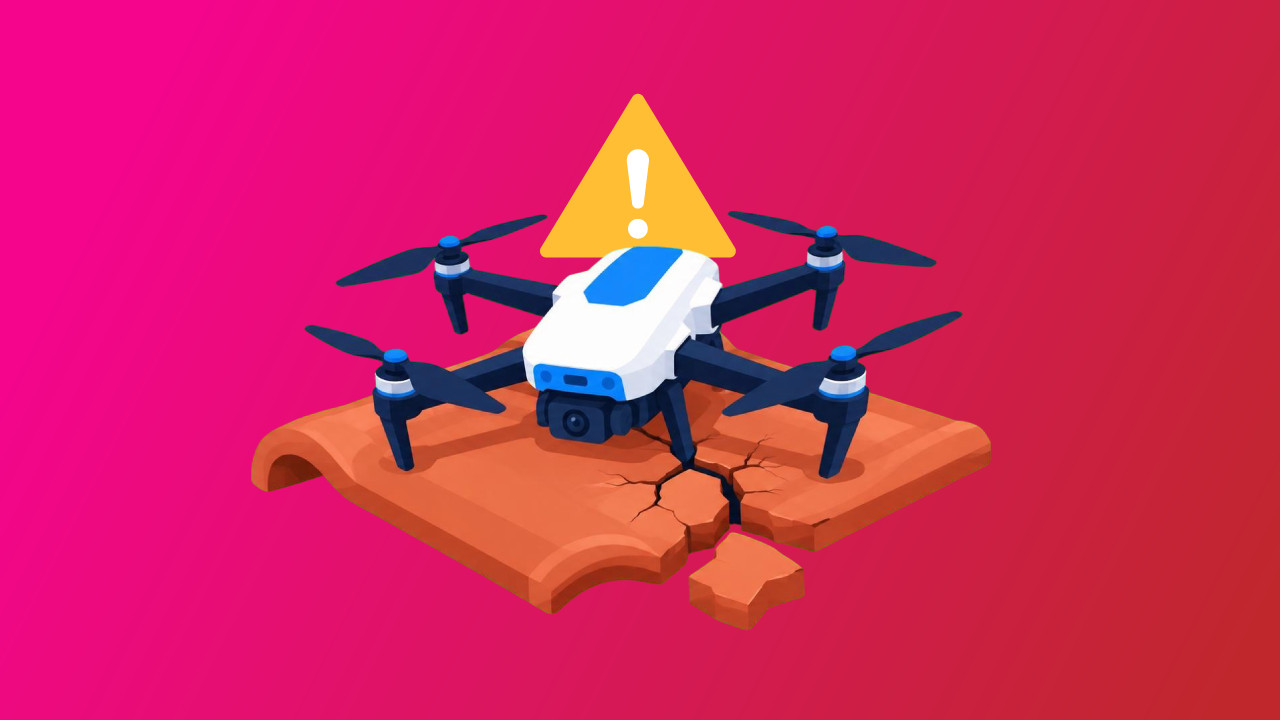
You’re halfway through a roof inspection when a sudden gust of wind pushes your drone onto a neighbor’s roof. It’s not too bad, but a repair estimate comes back at $800 to fix some cracked roof tiles and gutter damage.
That’s a hefty repair bill, but is it also grounds to report the accident to the FAA? To the NTSB?
Knowing when and how to report a drone accident is a critical responsibility for every remote pilot in command working under Part 107. Let’s take a look at what incidents need to be reported and the process involved.
Key Takeaways
- Report to the FAA within 10 days if there was a serious injury or over $500 in property damage.
- Notify the NTSB immediately for any death, serious injury, or property damage over $25,000.
- File a NASA ASRS report after close calls — it can limit penalties but doesn’t replace your §107.9 report.
- In an emergency, §107.21 lets you deviate from Part 107 rules to protect people and property.
What Counts as an In-Flight Emergency Under Part 107?
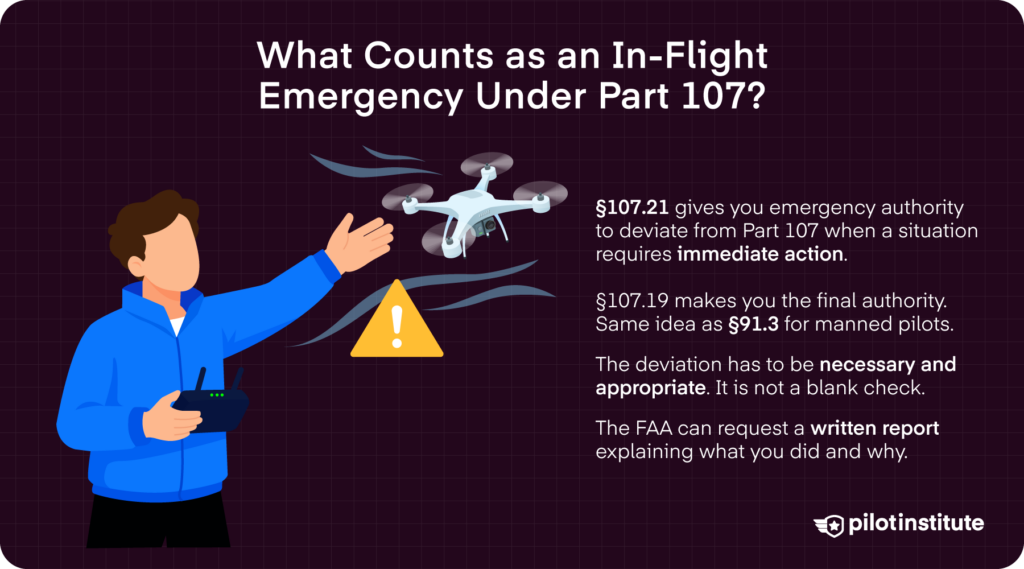
A drone in-flight emergency is a situation “requiring immediate action,” according to 14 CFR 107.21. This includes unexpected situations that could endanger people, property, or the aircraft.
When a remote pilot in command (PIC) encounters an in-flight emergency, he or she has the emergency authority to deviate from Part 107 as “necessary to meet that emergency.” If something starts to go wrong, you as the pilot can prioritize safety and take action to bring the situation under control.
However, this isn’t unbridled authority. The deviation has to be necessary and appropriate.
For manned aviation pilots moving into drone operations, the concept is similar to 14 CFR 91.3, which gives the PIC the ability to deviate from Part 91 regulations when necessary to address an emergency.
Just remember, §107.21(b) allows the FAA to request a written report explaining the in-flight emergency, the actions taken by the remote PIC, and the reason for deviating from Part 107 regulations.
What Are the Most Common Drone In-Flight Emergencies?
Lost Link
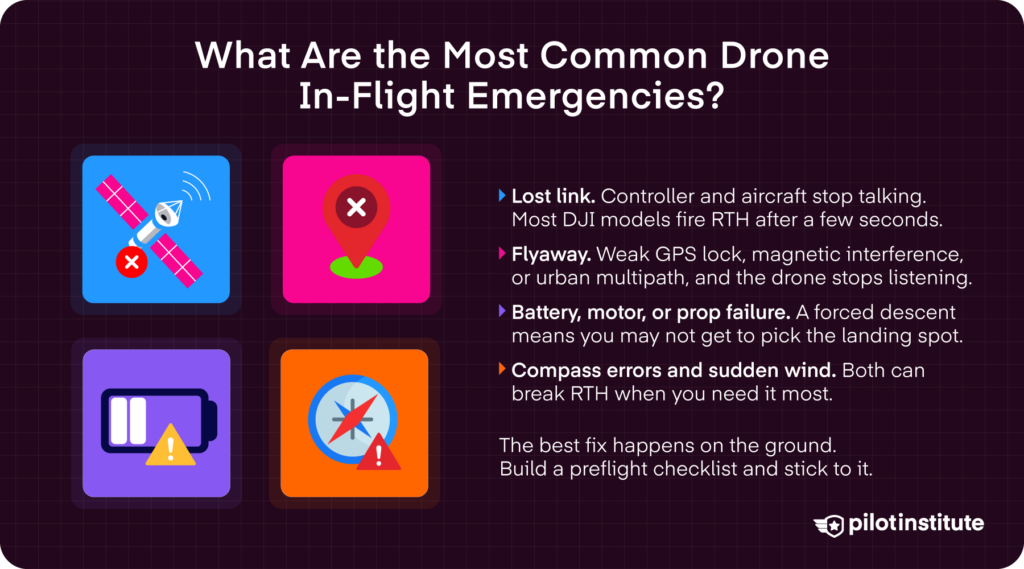
A lost link occurs when the drone’s connection between the controller and aircraft drops and the remote PIC loses command and control links to the aircraft.
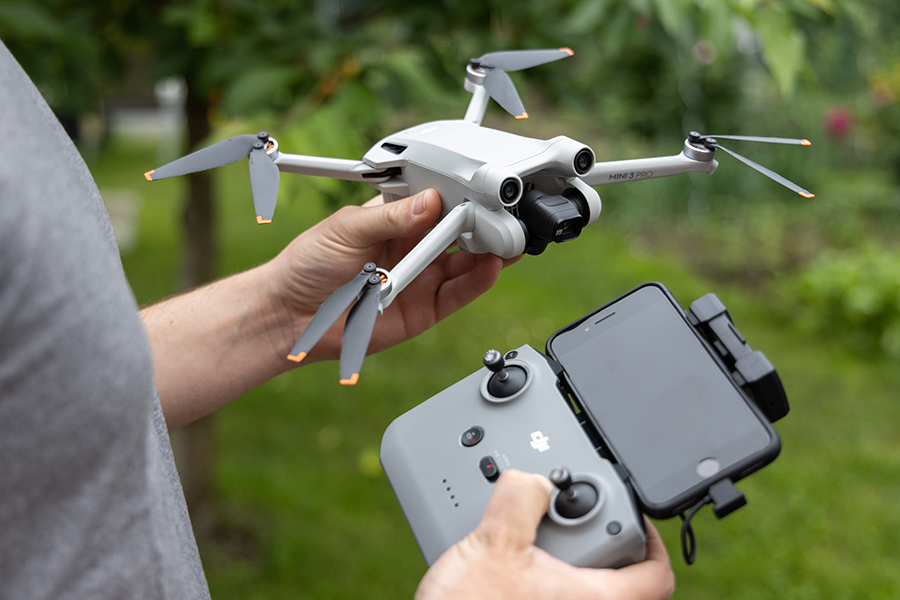
On DJI drones, your controller will beep rapidly to warn you that you have lost connection to the aircraft. The DJI Fly App will also pop up visual and audio alerts. In many DJI models, there is a failsafe return-to-home function that launches when the controller cannot regain connection to the aircraft.
Exact behaviors are defined in the manufacturer’s user manual. For example, the Mavic 3 Pro will launch RTH if a connection cannot be re-established in six seconds.
Make sure you have a lost link emergency procedure beforehand, so you can respond quickly, maintain situational awareness, and attempt to recover the aircraft safely.
Flyaway
Flyaways are just what they sound like: when your drone suddenly takes off on its own! Weak connections to GPS satellites, magnetic interference, or multipath interference in dense urban environments can impact your GPS positioning lock. This can cause the aircraft to erratically drift or fly away, ignoring pilot commands.
To prevent flyaways, DJI recommends fully charging your batteries, scouting out the environment, and confirming obstacle avoidance and sensor status through the DJI Fly App. During flight, try to maintain stable signals from at least 10 to 12 GPS satellites.
Battery or Power Failure
Most DJI drones will execute an emergency RTH function when batteries hit critically low levels. If the DJI Fly App calculates that your drone does not have sufficient battery power to return to its set RTH location, it will execute a forced descent. Unlike normal landing, however, you may have little to no control over where the aircraft descends.
Maybe you did charge your batteries, but hardware failures or electrical faults can still cause power loss to an sUAS. The vibrations caused during flight can disconnect power connections, or overheating can cut power to the motors.
Motor or Propeller Failure
Propellers may crack or loosen, while motors can fail because of overheating, worn bearings, or electrical problems. Consequently, the sUAS may become unstable or rapidly lose altitude.
If a motor or propeller failure occurs, your priority is to minimize risk while maintaining as much control over the aircraft as possible.
GPS and Compass Errors
GPS signals give your drone its positioning information, while the compass helps determine its orientation. Poor satellite connection, interference, or incorrect compass calibration can cause the aircraft to drift, fly erratically, or experience RTH failures.
DJI drones will flash compass error warnings, such as “Compass Calibration Required,” prompting you to calibrate the compass on the ground.
Sudden Weather or Wind Change
Unexpected gusts of wind, incoming rain, and other changing weather conditions can push the drone beyond its performance capabilities.
As a reminder, §107.51 requires drone pilots to stay 500 feet below and 2,000 feet horizontally away from clouds. If clouds come rolling in, make sure you are maintaining safe distances. Remote PICs should also maintain at least 3 statute miles of visibility. If conditions affect this visibility, reschedule your flight operations for another day.
High winds can also impact an aircraft’s ability to execute its RTH function. Be extra cautious when flying at higher altitudes or along sheer cliff faces, where wind speeds can be significantly stronger and unpredictable due to changing terrain and air currents.
The Importance of Pre-Flight Inspections and Drone Maintenance
Just a note: the best way to prevent these types of emergencies is good drone maintenance and inspection procedures. Remote PICs are responsible for the safe operation of their aircraft, according to the FAA’s Aeronautical Information Manual (AIM) §11.8.1. Build a strong preflight inspection checklist and keep up with regular maintenance to identify potential problems before takeoff and reduce the chance of an inflight emergency.

Get Your FREE Drone Sticker
Stop using masking tape.
Add a pro label in minutes.
- Fits on drone arms.
- Clean, readable format.
- Free, mailed to you.
- Ships in ~7–10 days.
What Should You Do During a Drone In-Flight Emergency?
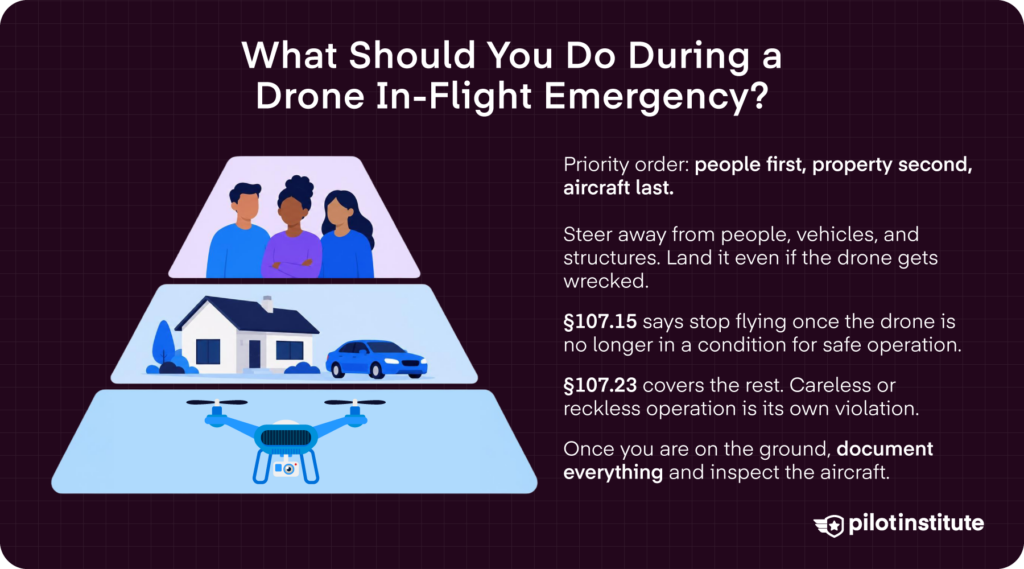
During a drone in-flight emergency, your priority order is simple: protect people first, property second, and the aircraft last. Avoid trying to save the aircraft at the expense of public safety.
Remain calm. Assess the situation and take immediate action to reduce risk. Follow your preplanned drone emergency procedures.
If you still have control of the aircraft, direct it away from people, vehicles, structures, or other hazards. Try to find a safe landing area, even if that means damaging the drone.
Once on the ground, document what happened and inspect the drone for damage. Under 14 CFR 107.15, you must not continue flight when the sUAS is no longer in a condition for safe operation. 14 CFR 107.23 also prohibits operating a sUAS in a “careless or reckless manner” that would endanger people or property.
When Do You Have to Report a Drone Accident to the FAA?
Part 107 Reporting
Under Part 107, some (but not all) accidents have to be reported to the FAA. The stipulations are defined in AC 107-2A §4.4 and focus on injury and property damage.
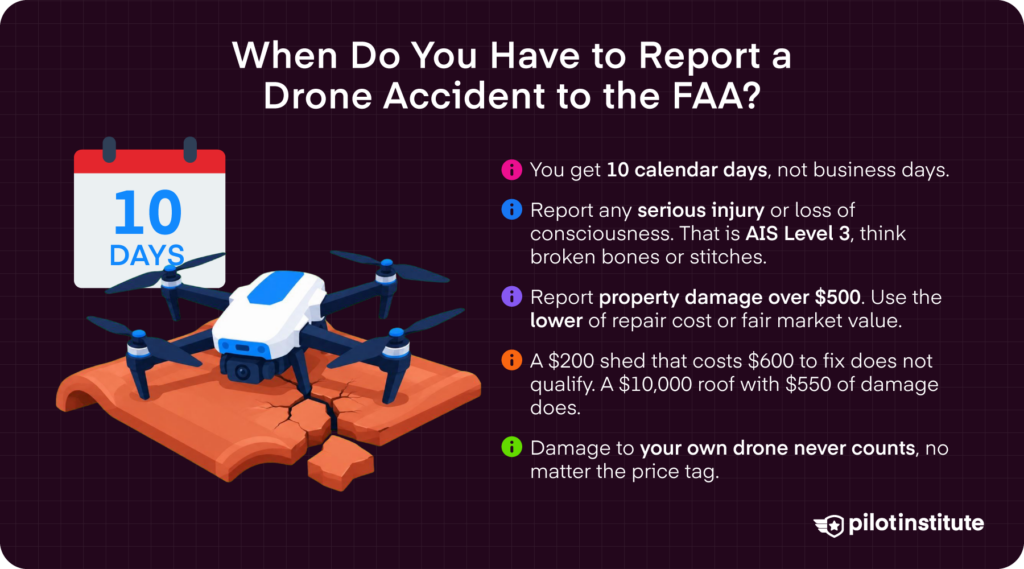
You must report an applicable accident to the FAA within 10 calendar days (not business days).
Serious Injury
First, report a drone accident if it resulted in a serious injury or any loss of consciousness to anyone involved.
Serious injury is defined as a Level 3 or higher by the Association for the Advancement of Automotive Medicine’s Abbreviated Injury Scale (AIS). This is a scale from 1 to 6 that assesses the severity of injuries. A level 3 injury is considered serious, but not life-threatening.
The FAA uses the example of an injury that requires hospitalization, but will fully heal. This could include loss of consciousness, head trauma, broken bones, or lacerations that require suturing.
Property Damage Greater than $500 (Repairs or Replacements)
The second condition is property damage greater than $500 to repair or replace.
Damage assessment is linked to repair costs (labor and material) and fair market value (in the event of a total loss). Whatever is lower determines the $500 reporting threshold.
So, if damages occur to a property with a $200 fair market value (a shed, for example) that cost $600 to repair (with labor and materials), this would not need to be reported. The repair cost exceeds $500, but the fair market value does not.
Meanwhile, a $10,000 roof that experienced $550 worth of damage thanks to a drone crash would need to be reported.
Damage to your drone never counts, no matter the cost.
Optional Reporting
In addition to the required Part 107 accident reporting, several aviation agencies encourage optional reporting to improve a culture of safety in the industry.
Pilots can voluntarily report safety issues, hazards, and other incidents. This helps build common awareness of operational risks, improve safety practices, and prevent similar incidents from happening in the future.
How Do You File a Part 107 Accident Report?
FAADroneZone
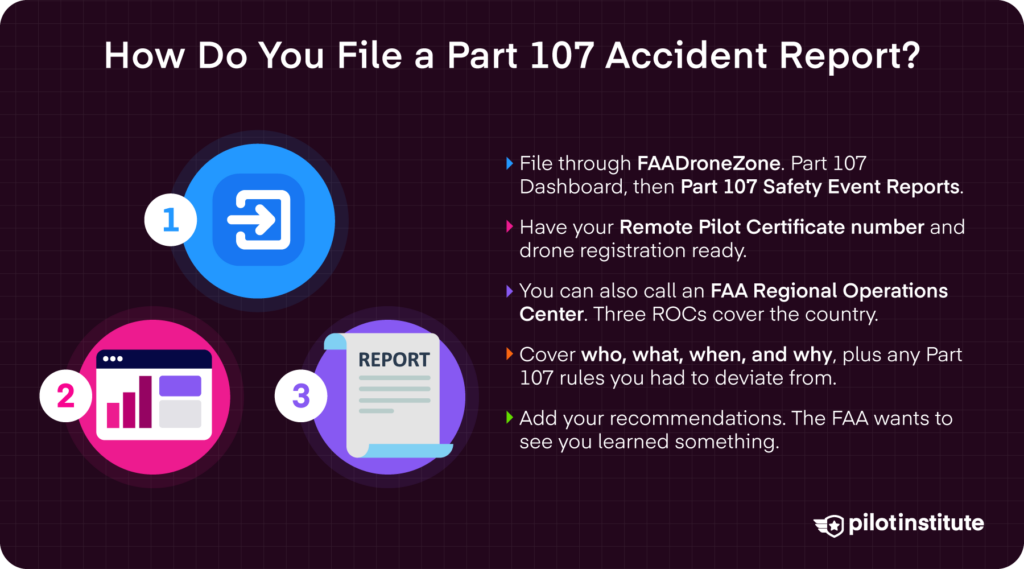
You can report drone accidents to the FAA through the FAADroneZone portal. After signing in, launch your Part 107 Dashboard. Scroll down until you see “Part 107 Safety Event Reports.” Click on “Submit Part 107 Safety Event Reports.”
The Part 107 Safety Event Report form asks for your basic information, Remote Pilot Certificate Number, and sUAS Registration. It also asks for operation details, including damages incurred (three categories: serious injury, death, and property damage greater than $500).
What to Include in Your Accident Report
In your description, include key factors about your drone, the operation, and environmental conditions. Define who was involved, what happened, when it happened, and why.
Include:
- Contact information.
- Describe the environment, including any external obstacles, weather, or light conditions.
- Details of the incident. What do you think were the contributing factors?
- Your involvement/ actions.
- Any deviations from Part 107 regulations you were forced to take.
- Result.
- Any recommendations to prevent similar events in the future.
FAA Regional Operations Center
You can also report a drone accident to a local FAA Regional Operations Center (ROC).
In your report, provide the location with GPS coordinates, the date, and time the incident occurred. Also describe the drone (including any attached payloads), any injuries, and any property damage over $500.
ROC locations include:
- Alaska Region (AAL).
- Central Region (ACE) in Kansas City, MO serving Iowa, Kansas, Missouri, and Nebraska.
- Eastern Region (AEA) in Queens, NY serving New York, New Jersey, DC, Delaware, Pennsylvania, Virginia, & West Virginia.
- Great Lakes Region (AGL) in Des Plaines, IL serving Illinois, Indiana, Michigan, Minnesota, North Dakota, South Dakota, Ohio, and Wisconsin.
- New England Region (ANE) in Burlington, MA serving Massachusetts, Connecticut, Maine, New Hampshire, Rhode Island, and Vermont.
- Northwest Mountain Region (ANM) in Des Moines, WA serving Washington, Colorado, Idaho, Montana, Oregon, Utah, and Wyoming.
- Southern Region (ASO) in College Park, GA serving Georgia, Alabama, Florida, Kentucky, Mississippi, North Carolina, South Carolina, Tennessee, Puerto Rico, & the U.S. Virgin Islands.
- Southwest Region (ASW) in Fort Worth, TX serving Texas, Arkansas, Louisiana, New Mexico, and Oklahoma.
- Western-Pacific Region (AWP) in Lawndale, CA serving California, Arizona, Nevada, Hawaii, and the Pacific territories.
When Does the NTSB Need to Know About a Drone Accident?
The National Transportation Safety Board (NTSB) is the federal agency responsible for investigating major transportation accidents across the United States. Unlike the FAA, its authority extends beyond aviation, including railroads, highways, pipelines, and marine transportation as well.
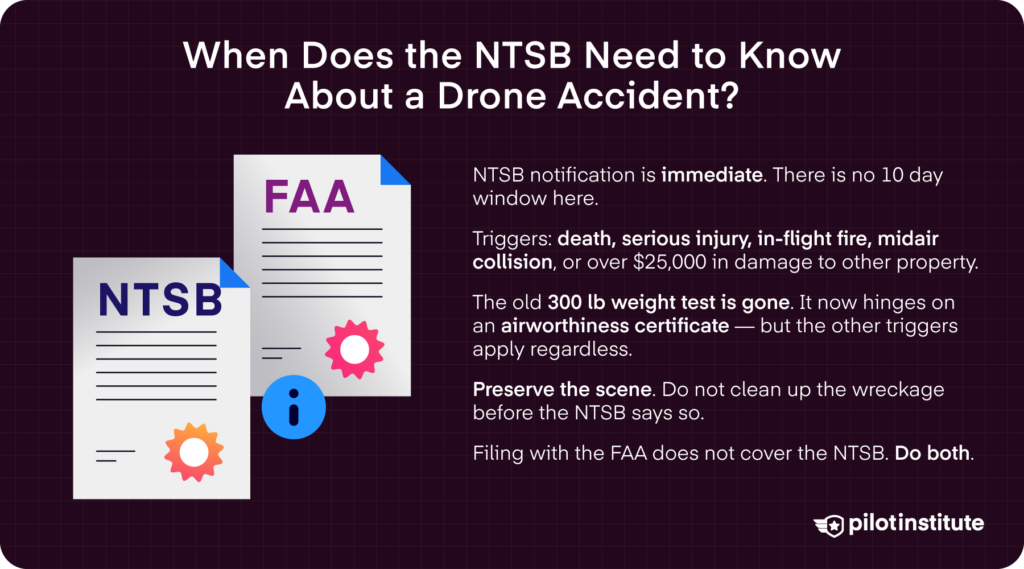
You must notify the NTSB when you are involved in an aircraft accident, flight control system malfunction or failure, in-flight fire, collision in flight, serious injury or death, or damage to property other than the aircraft that exceeds $25,000.
Aircraft Accident
An aircraft accident is defined as causing death or serious injury, or when an aircraft that holds an airworthiness certificate sustains substantial damage (exceeding $25,000).
The NTSB recently altered its definition of unmanned aircraft accidents, removing the previously 300 lb weight threshold. This has been replaced by an airworthiness certificate requirement.
Serious Injury NTSB Criteria
49 CFR 830.2 defines an accident as an occurrence where someone suffers a serious injury or death.
A serious injury involves hospitalization requiring more than 48 hours, commencing within 7 days of the injury.
It can also include the fracture of any bone (except simple fractures of fingers, toes, or nose), severe hemorrhages, nerve, muscle, or tendon damage.
Injury to any internal organ is also considered a serious injury. Finally, second- or third-degree burns, or any burns affecting more than 5% of the body surface.
Flight Control System Malfunction
This is primarily for manned aircraft that have lost in-flight controls. You do not have to report to the NTSB in cases of lost links or the loss of control due to factors external to the aircraft (interference, for example).
In-FlightFire
This includes incidents of drone battery fires that occur during flight operations.
Collision in Flight
Notify the appropriate authorities immediately if your drone collides with another drone or manned aircraft.
How to Report to the NTSB
NTSB reporting must be immediate, not like the FAA’s 10 calendar days.
Follow NTSB’s guidance for dealing with an accident, which includes preserving the accident scene and providing an initial report.
Call the 24-hour Response Operations Center or notify the nearest NTSB Field Office.
An NTSB investigator will review the report and decide whether further investigation is warranted. If an investigation is opened, you will need to fill out NTSB Form 6120.1 Pilot Operator Aircraft Accident/Incident Report.
Just a word to the wise: filing with one agency does not satisfy the other. Make sure you stay compliant with the FAA and NTSB independently.
Should You File a NASA ASRS Report After an Emergency?
As a third-party agency, the NASA Aviation Safety Reporting System (ASRS) collects safety reports to identify trends, improve aviation policy, and encourage a healthy safety culture in the aviation community.
“When in doubt, fill it out! CONTRIBUTE to aviation safety,” says NASA. Sharing experiences and warning others about hazards helps prevent accidents. It can even save lives.
Fill out the ASRS UAS Report Form and submit it to the NASA Aviation Safety Reporting System Office in California. Like the FAA’s reporting, this should be submitted within 10 days of the incident.
Examples of things to report include hazards at specific locations, drone crashes, mechanical failures, temporary flight restrictions (TFR) violations, and unsafe flying behavior.
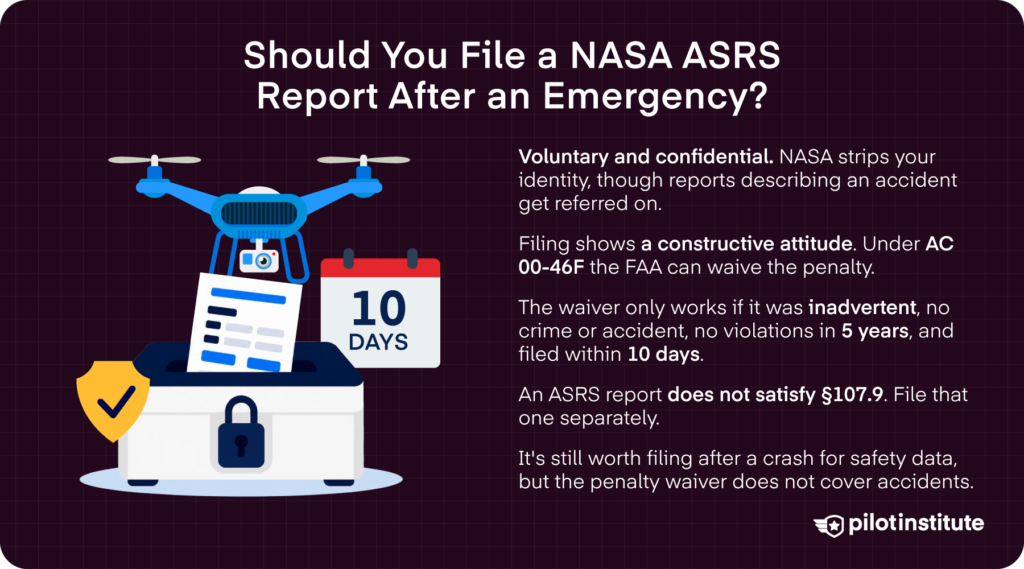
NASA keeps reports completely confidential, generalizing potentially recognizable content, like dates and locations. This is meant to encourage reporting without fear of negative consequences for voluntary safety-related information.
Reporting incidents to NASA’s ASRS is not required but is highly recommended. This is especially true for self-reporting close calls or unintended regulatory violations. For example, let’s say you are flying near an airport and accidentally end up on the edge of Class C airspace, which requires prior FAA authorization.
Ding! That is a rule violation, but you could soften the blow by filing an ASRS report. Guidance provided in Advisory Circular (AC) 00-46F allows the FAA to consider a voluntary ASRS report in determining your fate if you accidentally broke a regulation.
Essentially, filing a NASA ASRS report shows the FAA that you “have a constructive attitude” that “will tend to prevent future violations,” resulting in an acknowledgment of the violation without punishments like civil penalties or suspension of your certification.
However, the waiver applies only if the violation was inadvertent, did not involve a criminal offense or accident, you have no prior enforcement findings in the previous 5 years, and you filed within 10 days.
Also important, an ASRS report does not satisfy your §107.9 reporting obligation. If your incident meets FAA or NTSB reporting thresholds, you must file those reports separately.
Frequently Asked Questions
Do You Have to Report Every Drone Crash to the FAA?
Not all drone crashes must be reported. Part 107 accident reporting requires reporting incidents that resulted in a serious injury or any damage to property where the cost of repair exceeds $500 (or fair market value if there’s a total loss).
What Counts as a Serious Injury Under Part 107?
An AIS Level 3 injury is serious but not life-threatening. This includes: loss of consciousness, head trauma, broken/ fractured bones, or lacerations that require stitches.
How Long Do You Have to Report a Drone Accident?
You have 10 calendar days to report a drone accident to the FAA and to NASA’s ASRS. NTSB reports must be filed immediately.
Can You Break Part 107 Rules During an Emergency?
Under §107.21, remote PICs can deviate from Part 107 rules if such action is necessary and appropriate within an emergency situation. The FAA may request a written report of a drone emergency if it meets its reporting criteria.
What Happens if You Do Not Report a Drone Accident?
Not reporting a drone accident that falls under FAA or NTSB reporting requirements is a violation of §107.9 and can bring enforcement action against you. Don’t get stuck paying civil penalties or having your Remote Pilot Certification suspended.
Does a NASA ASRS Report Protect You After a Crash?
While filing an ASRS report does not guarantee protection from FAA enforcement actions, it makes you look a lot better in the eyes of the FAA. If you violate an FAA regulation accidentally, you can demonstrate acting in good faith by reporting the incident with NASA’s ASRS report.
Conclusion
Yes, drone crashes happen. You didn’t mean to smash into that roof, but hey, that’s what good drone insurance is for!
Just remember that we as Part 107 pilots have a responsibility to report incidents as required, document what happened, and take responsibility.
The goal is not to be perfect; any pilot will tell you that’s impossible. It’s to learn from your mistakes and prevent more from happening in the future.