
- Key Takeaways
- Can You Bring a Drone on an Airplane?
- TSA Screening
- FAA and DOT Hazmat Rules Under 49 CFR §175.10
- Airline Policies
- Carry-On or Checked Bag: Where Each Piece Goes
- What About the Controller, Chargers, and Accessories?
- What Are the Battery Rules for Flying With a Drone?
- What Changed for 2026?
- Where Consumer Drone Batteries Actually Land
- The Enterprise Battery Problem
- Does the Two-Charger Cap Apply to Your Drone Batteries?
- How to Pack a Drone for a Flight
- What Happens at the TSA Checkpoint?
- Can You Take a Drone on an International Flight?
- Registering to Fly at Your Destination
- Countries That Confiscate Drones at the Border
- Bringing Your Drone Home Through US Customs
- Frequently Asked Questions
- Can You Put a Drone in Checked Luggage?
- How Many Drone Batteries Can You Take on an Airplane?
- Do You Have to Tell TSA You Have a Drone in Your Bag?
- Does Your Part 107 Certificate Let You Fly at Your Destination?
- Should You Charge or Discharge Drone Batteries before Flying?
- Conclusion
It’s 5 a.m., and the security line at your local airport is already backed up. The folded drone body and three lithium-ion batteries in your bag suddenly feel like a thousand pounds. Can you bring a drone on an airplane?
Yes, but the drone itself is rarely the problem. The batteries are.
From watt-hour limits to carry-on requirements, knowing battery rules and how to pack your drone can keep it from becoming a problem on your next flight.
Key Takeaways
- TSA typically allows drones through security checkpoints.
- Lithium-ion batteries rated at 100 Wh or less are generally permitted.
- Those rated from 101 to 160 Wh require the airline’s approval and are capped at two spares per passenger.
- Meeting federal requirements doesn’t necessarily mean you’re clear to fly, as airlines are imposing their own stricter rules on spare lithium batteries on flights.
Can You Bring a Drone on an Airplane?
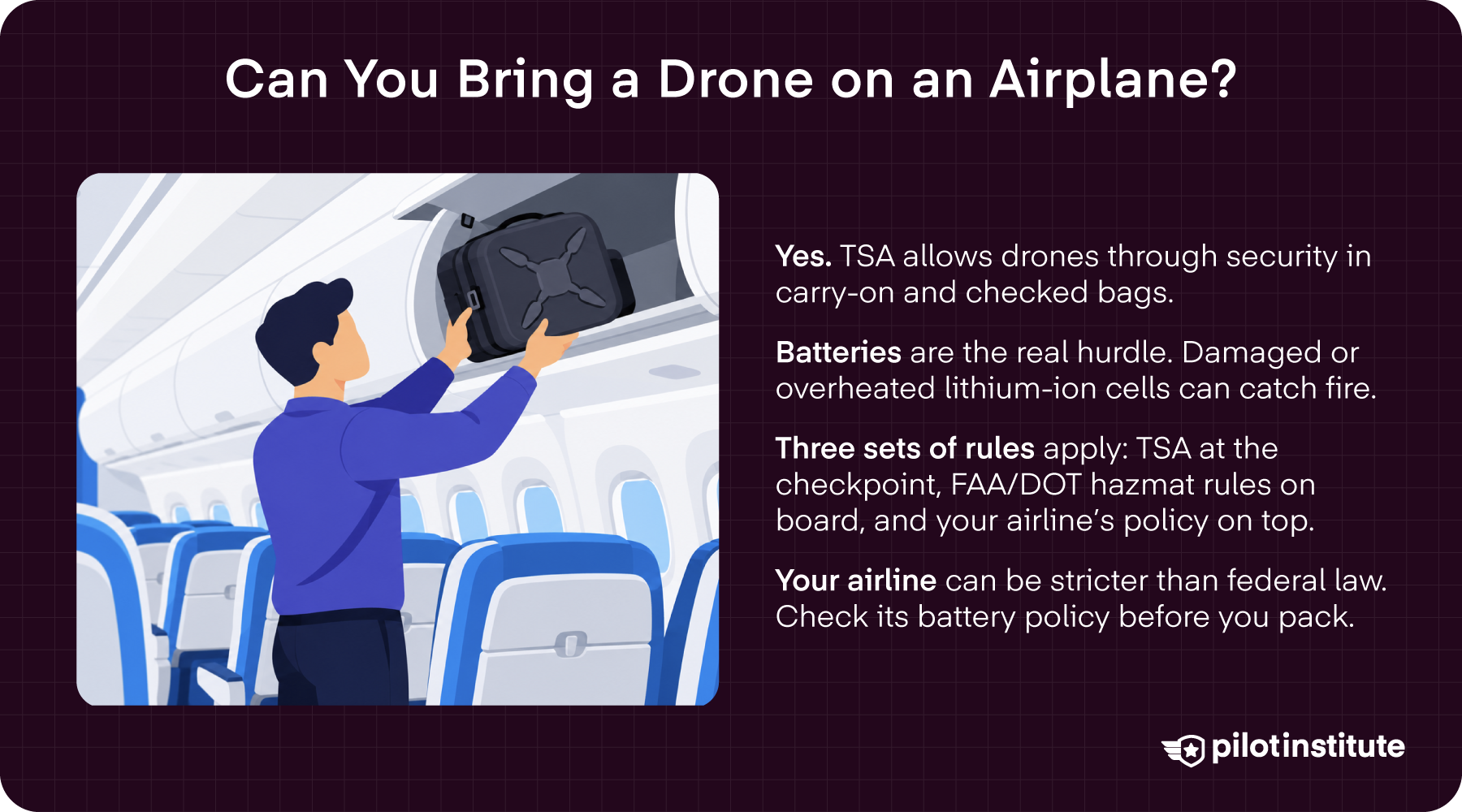
Yes, you can bring a drone on an airplane.
The Transportation Security Administration (TSA) does permit drones through the security checkpoint and allows them in both carry-on and checked luggage. Still, the final decision rests with the TSA officers at the airport.
The most concerning factor is often the lithium-ion batteries that power your drone, which come with their own set of restrictions because they can be dangerous when they overheat or are damaged.
As more consumer electronics rely on efficient lithium-ion batteries, passengers are bringing more on board than ever before. In fact, the FAA recorded 89 cases of lithium battery incidents in 2024 alone. Such incidents have prompted increased regulations on the number and type of lithium batteries you can carry on an airplane.
The bigger the drone battery, the more restrictions you may face, especially when carrying multiple spares.
TSA Screening
The first layer here is TSA security screening, which controls what happens at the security checkpoint. Their decisions ultimately decide whether your drone and other equipment pass through security screening.
According to TSA drone rules, drones are generally permitted through security checkpoints.
In standard screening lanes, TSA requires passengers to remove personal electronics larger than a cell phone and place them in a separate bin for X-ray screening. So, if you’re carrying your drone in your carry-on, TSA may require you to remove it from your bag for additional screening.
If you have TSA PreCheck, you generally follow the expedited screening procedures through that lane. Still, TSA officers can require additional screening that may slow you down.
But, just because you get through TSA screening doesn’t mean you’re automatically clear for your flight.
FAA and DOT Hazmat Rules Under 49 CFR §175.10
The FAA and Department of Transportation (DOT) regulate batteries under federal hazmat rules.
49 CFR §175.10 sets limits on the transport of lithium-ion batteries based on the watt-hours (Wh). Spare batteries rated at 100 Wh or less are generally permitted, provided they meet the applicable safety and packing requirements.
Many DJI Intelligent Flight Batteries fall under this 100 Wh limit. A DJI Mavic 3 Pro battery, for example, is listed at 77 Wh, while a Mini 4 Pro is only 18.96 Wh.
However, as the batteries get larger, so do restrictions on how you can fly with them. Lithium-ion batteries rated from 101-160 Wh are limited to two spare batteries per passenger in carry-on luggage only, pending airline approval.
Batteries over 160 Wh are not permitted on passenger flights. The TB65 Intelligent Flight Battery used by a DJI Matrice 350 RTK, for example, is 263 Wh, meaning it cannot be carried on to a passenger flight.
Airline Policies
But it all still boils down to the airline, as they can impose stricter requirements on top of federal rules. Always check with your airline before traveling with spare lithium-ion drone batteries.
| Airline | Power Bank Policy | Spare Battery Policy |
|---|---|---|
| American Airlines | 2 power banks per passenger, with each charger not exceeding 100 Wh. | Up to 4 spare lithium batteries below 100 Wh and 2 between 101 and 160 Wh. Carry on only. |
| United Airlines | 2 power banks per passenger. | Up to 2 lithium batteries larger than 100 Wh but not exceeding 160 Wh, carry on only. Personal devices that have lithium batteries can be included in checked or carry-on bags, capped at 100 Wh each. |
| Delta Air Lines | 2 power banks per person, each limited to 100 Wh, “with no exceptions.” | Up to 20 spare batteries per passenger, each 100 Wh or less. Spares rated 101-160 Wh limited to 2. Carry-on only, terminals protected. |
| Southwest Airlines | 1 power bank per passenger, not to exceed 100 Wh. | Up to 20 spare batteries, each 100 Wh or less (2 spare lithium-ion batteries for each personal electronic device). Carry on only, terminals protected. |
DJI also publishes a great list of international airline baggage battery policies that may impact DJI products and batteries.
Most airlines treat drones as personal electronic devices, so a drone can go in a carry-on that meets the airline’s size limit: 22 x 14 x 9 inches on American, United, and Delta, and 24 x 16 x 10 on Southwest. Batteries must be removed before travel, packed in the carry-on, and are subject to the airline’s spare battery policy.
Carry-On or Checked Bag: Where Each Piece Goes
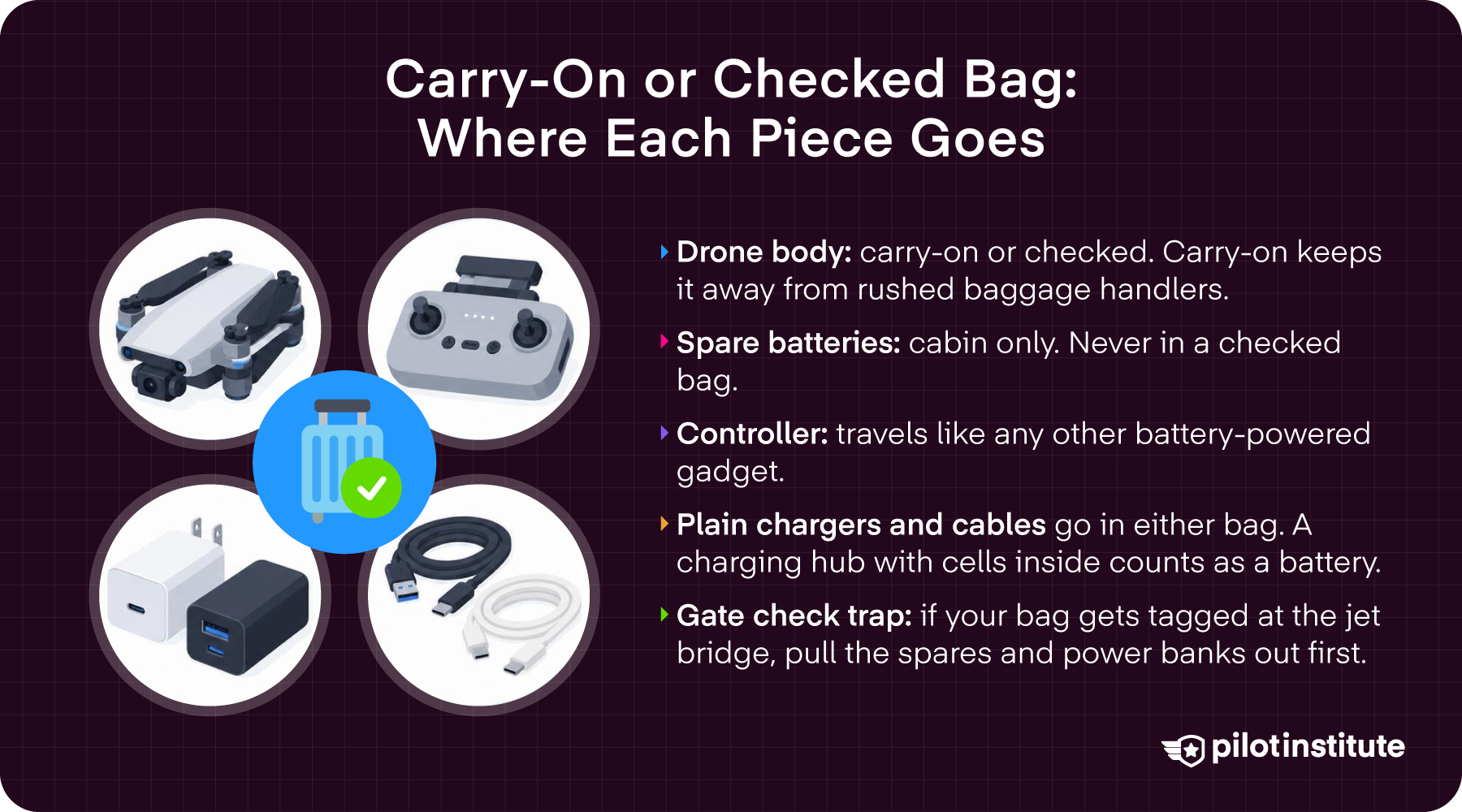
The drone body can go in either carry-on or checked luggage.
Honestly, your drone is safer with you than in the hands of hurried airport ground crew, so carry-on is often the best choice.
Plus, spare batteries can only go in the cabin due to the risk of fire.
But there’s a gate check trap to watch out for. Sure, it’s easier to check your carry-on at the bridge than to lug it on board yourself. However, any spare lithium-ion batteries or power banks must be removed first. Last-minute gate checks can complicate compliance with new rules.
What About the Controller, Chargers, and Accessories?
Drone controllers with built-in batteries can generally travel with you, like other battery-powered electronics.
Chargers that simply connect your drone to an outlet, without containing batteries themselves, are not subject to the same lithium-ion battery restrictions and can be checked or carried on.
But a charging hub or portable charger with lithium-ion cells inside it still counts as a battery and may be subject to the same restrictions as power banks.
Cords and cables are unrestricted and can be packed in either checked or carry-on luggage.
What Are the Battery Rules for Flying With a Drone?
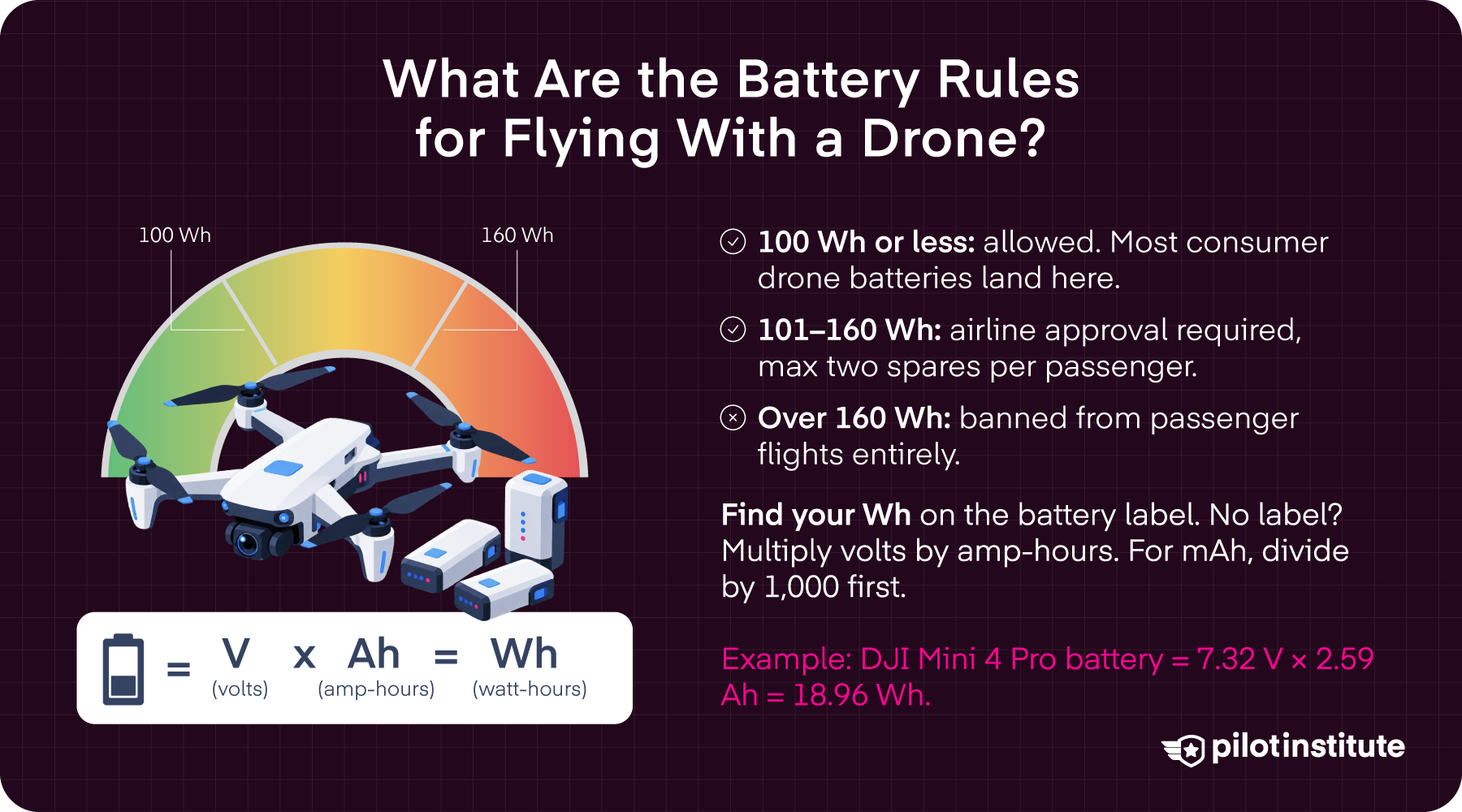
Lithium-ion batteries rated at 100 Wh or less are generally allowed on passenger aircraft. Batteries rated 101 to 160 Wh require the airline’s approval and are capped at two spares per passenger. Anything over 160 Wh is forbidden on passenger aircraft.
Spare lithium-ion batteries permitted for passenger travel must be carried in the cabin, not checked baggage.
How can you tell how many Wh your drone batteries are rated for? Well, check the battery label or user manual first. The Wh rating is often printed right on the battery.
You can also calculate Wh by multiplying the battery’s voltage (V) by its capacity in amp-hours (Ah). For batteries listed in milliamp-hours (mAh), divide the mAh by 1,000 before multiplying the voltage.
What Changed for 2026?
2026 saw a major change in the regulation of passenger power banks on flights. Effective March 27, 2026, the International Civil Aviation Organization (ICAO) adopted an addendum to its Technical Instructions limiting passengers to two power banks each, regardless of capacity.
Power banks up to 100 Wh need no approval. ICAO permits 100-160 Wh battery units with airline approval, though the International Air Transport Association (IATA) battery guidance treats those as prohibited, so assume 100 Wh as the practical ceiling.
Importantly, the new two-unit limit applies to power banks, not to spare drone batteries generally.
Power banks are not to be recharged while on the aircraft. They are also still required to be “individually protected” to avoid short circuits when stored. That means covering any exposed terminals with electrical tape, placing batteries in protective pouches, or keeping them in their original packaging.
Also in 2026, many US airlines layered their own caps on top. Southwest, for example, began limiting passengers to one power bank in carry-on luggage starting in April of 2026.
Several airlines are also tightening rules on where you can keep power banks. All four major US carriers now prohibit storing power banks in overhead bins and require them to stay accessible (on your person, in a seat pocket, or in a personal item under the seat).
Where Consumer Drone Batteries Actually Land
Fortunately, most consumer drone batteries are well under the 100 Wh rating.
For example, DJI’s Mini 4 Pro only has an 18.96 Wh rating with the standard Intelligent Flight Battery, while the Mavic 4 Pro Intelligent Flight Battery has a higher rating of 95.3 Wh. Autel’s EVO II Pro V3 battery has a rating of 82 Wh.
The Enterprise Battery Problem
However, this changes when dealing with some enterprise-level drones. For many Part 107 pilots, large platform batteries blow straight past the 160 Wh ceiling.
Take the DJI Matrice 400 TB100, for example, which is rated at 977 Wh. That’s roughly six times the Wh ceiling.
These batteries cannot be carried on or checked at all. A crew flying to a job site would have to ship those batteries as regulated cargo or skip the headache and rent them locally.
Does the Two-Charger Cap Apply to Your Drone Batteries?
The carrier caps announced in 2026 are written for power banks and portable chargers. These are devices whose entire purpose is for charging other devices.
Many drone batteries can also charge other devices, but that is not their sole purpose. Drone flight batteries are spare lithium-ion batteries and are governed by separate rules pertaining to spare batteries, rather than power banks.
Again, always check your airline’s specific policies for spare lithium-ion batteries.
How to Pack a Drone for a Flight
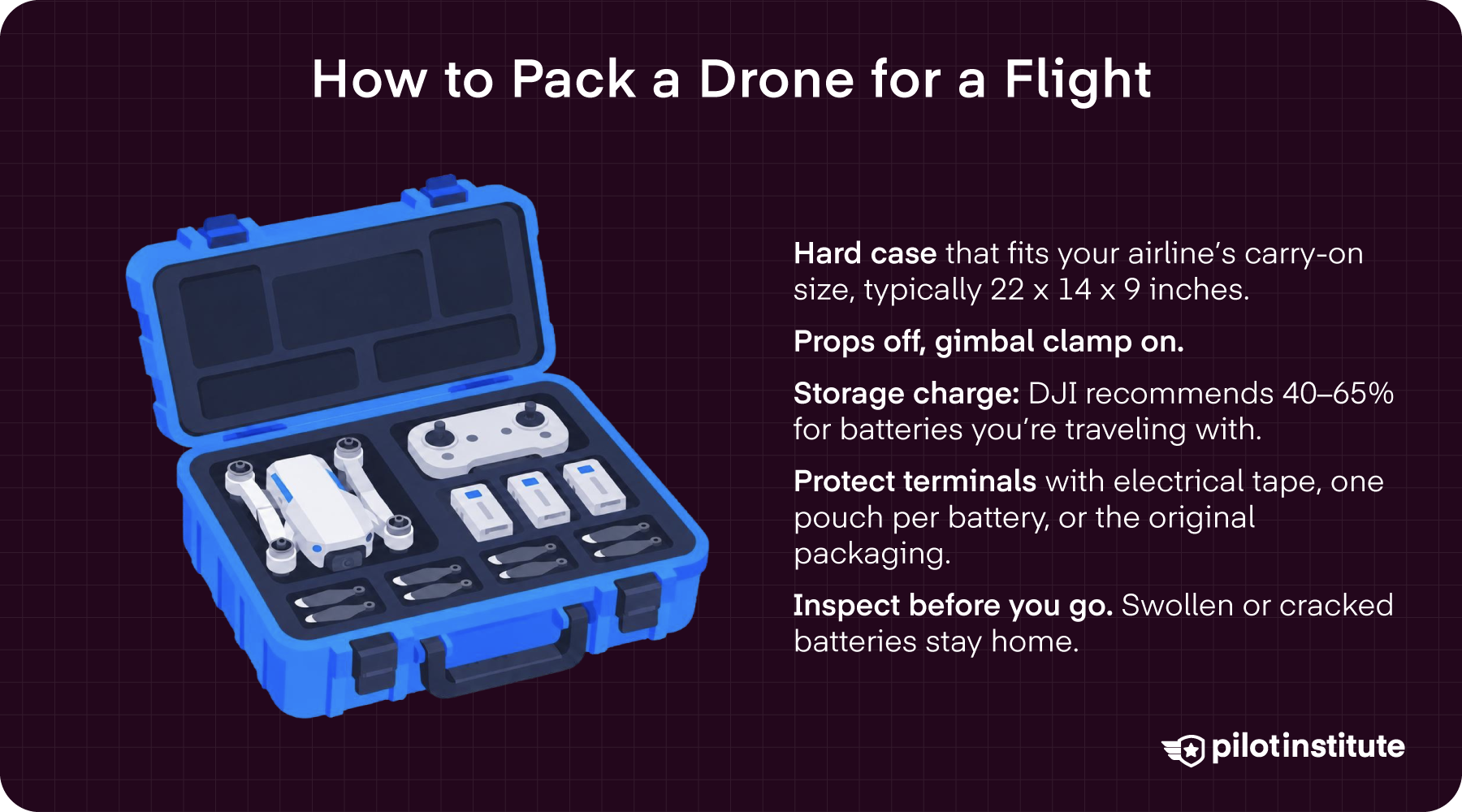
When taking your drone in carry-on luggage, pack it in a protective drone travel case that meets airline dimension requirements, keep batteries at a storage charge, and make sure your batteries are close by where you can grab them fast in case of an emergency.
- Pack your drone in a hard case that fits your airline’s luggage dimensions, typically 9 in x 14 in x 22 in for carry-on bags and 9 in x 10 in x 17 in for personal items.
- Keep this in an outer compartment that is easy to reach in case TSA needs to inspect it.
- Remove propellers and secure the gimbal with its clamp.
- Make sure all spare batteries are at a storage charge. DJI recommends a storage charge between 40% and 65% for its batteries. All spare batteries must be packed in carry-on luggage. Never check spare lithium-ion drone batteries.
- Keep all batteries protected by covering terminals with electrical tape, placing each battery in a separate protective pouch, or keeping them in their original packaging to prevent short circuits.
- Always check drone batteries for damage (cracks, swelling, etc) before taking a flight.
- Photograph the drone and battery serial numbers before leaving.
What Happens at the TSA Checkpoint?
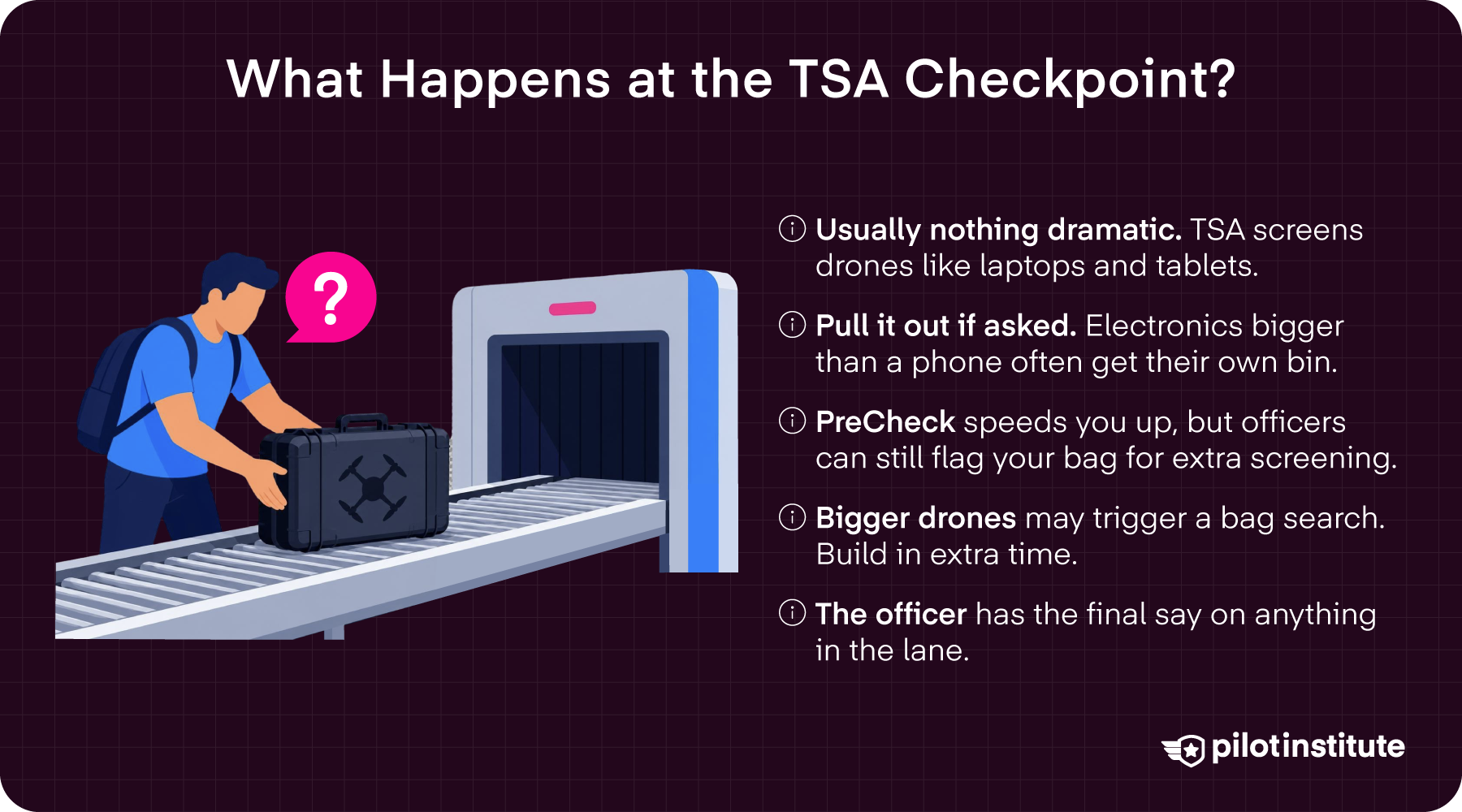
In most cases, nothing unusual will happen when taking a drone through airport security. A drone is screened like other personal electronics, like laptops and tablets. TSA agents may ask you to remove it from your carry-on to be screened in a separate bin.
Just be aware that larger drones may trigger a bag check, which could increase your time at TSA checkpoints. Plan your time accordingly so you’re not worried about missing a flight!
Ultimately, TSA agents have the final say on any item in the lane. Even if an item is generally permitted, an officer can require additional screening if it raises a security concern.
Can You Take a Drone on an International Flight?
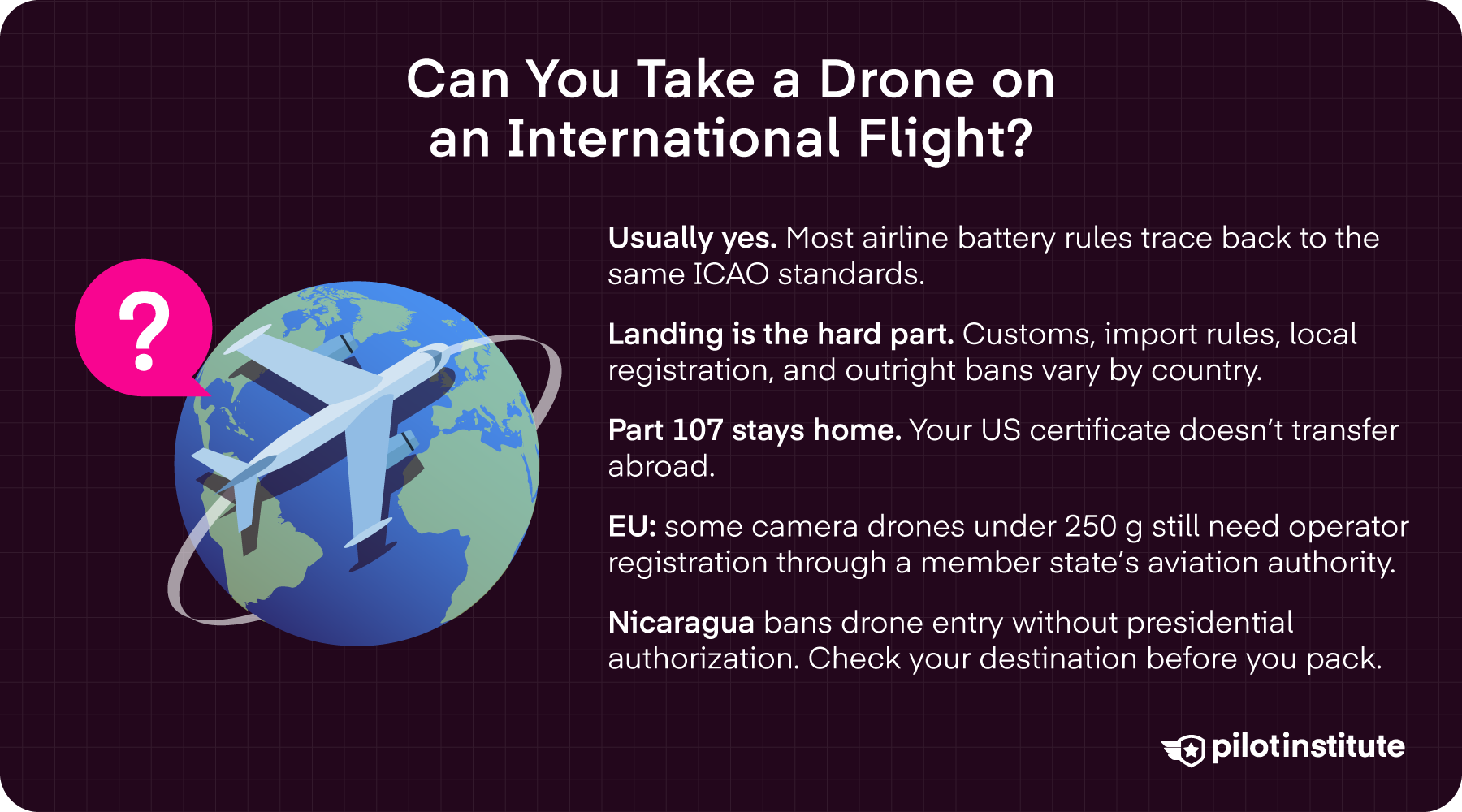
On most routes, yes, you can take a drone on an international flight. Most drone and battery rules are generally the same as the airlines here in the U.S. because many trace back to the same ICAO instructions. Still, individual countries and airlines can impose additional requirements.
However, there may be some stricter restrictions wherever you are landing. Customs requirements, local drone registration, import restrictions, and outright bans can all affect whether you can legally bring or fly your drone once you land.
Registering to Fly at Your Destination
Just like you may have to register your drone in the U.S., you may have to register as an operator or register your drone before you fly abroad. Unfortunately, your Part 107 certificate does not automatically transfer across borders.
In regions like the European Union, operator registration can be required even for some drones under 250 grams, including certain camera-equipped drones. Visitors can register through the National Aviation Authority of an EU Member State, which can be found on the EASA website.
Countries That Confiscate Drones at the Border
Some countries simply do not allow drones into their borders. Nicaragua, for example, has long restricted drone use, and under a 2024 law, the entry and use of drones is prohibited without presidential authorization. Violating the restrictions can carry administrative or criminal consequences.
Now, it would be easy to publish a nice, clean-cut list of import bans and permit suspensions. However, these change all the time, often with little or no notice. So, you must check directly with the civil aviation authority of the country you are visiting.
You can also visit the State Department’s country page for any entry requirements or increased regulations before packing.
Bringing Your Drone Home Through US Customs
Although uncommon, you may also have issues bringing your drone back home to the U.S. Customs requirements, import restrictions, or questions about the drone’s country of origin can create complications when you re-enter the country.
Registering the drone on CBP Form 4457 before departure gives you proof of prior possession so that you are not assessed duty on re-entry. This form is completely voluntary but can help you demonstrate that the drone was already in your possession before you left the U.S. and that you did not purchase it abroad. It must be signed by an officer before you leave the U.S.
Now, Customs and Border Protection (CBP) does not keep a copy of CBP Form 4457, so make sure to keep the signed original and bring it with you when you return. Also, snapping a picture of your drone’s serial number is a reasonable backup.
Frequently Asked Questions
Can You Put a Drone in Checked Luggage?
Yes, you can put the airframe in checked luggage, but you must remove the batteries. No drone batteries can be packed in checked luggage; they must be in your carry-on.
How Many Drone Batteries Can You Take on an Airplane?
The FAA and DOT do not limit the number of batteries under 100 Wh for personal use. On international itineraries, ICAO and IATA cap spare batteries at 20 per passenger, and several US carriers apply the same ceiling domestically. There is a limit of two spare batteries rated between 101 and 160 Wh.
However, individual airlines can be much stricter. Always check with your airline’s battery policies before packing.
Do You Have to Tell TSA You Have a Drone in Your Bag?
No, you do not have to declare your drone to TSA. However, volunteering may help speed up baggage checks.
Also, drones are treated the same as other personal electronics, like laptops. Without TSA PreCheck, you may be required to remove your drone from your luggage and place it in a separate bin for screening.
Does Your Part 107 Certificate Let You Fly at Your Destination?
It depends on whether you are traveling domestically or internationally. Your Part 107 Certificate does not transfer overseas. To fly legally abroad, you’ll need to follow the aviation authority’s rules in the country where you plan to operate. This may require local pilot registration, certification, or flight authorization.
Should You Charge or Discharge Drone Batteries before Flying?
You’ll want to keep your drone batteries at their recommended storage charge. DJI recommends storing Intelligent Flight Batteries between 40% and 65%.
Conclusion
That 5 a.m. TSA security line doesn’t have to trigger panic if you’re prepared and pack appropriately.
The batteries decide whether you have a smooth flight or face that last-minute scramble to ensure you make your flight. Keep your batteries in the cabin with you and check your airline’s battery policies before even heading to the airport.
Pack the batteries right, and you should be in for smooth flying.