
-
Key Takeaways
-
What Does Weight and Balance Mean for Drones?
- Drone Weight
- Drone Balance
-
How Does Maximum Takeoff Weight Affect Performance?
- Maximum Takeoff Weight
- Dangers of Exceeding the MTOW
-
What Is Center of Gravity and Why Does It Matter?
-
What Are the Four Forces Acting on a Drone in Flight?
- Lift
- Weight
- Thrust
- Drag
-
How Does Load Factor Apply to Drone Operations?
-
How Does Density Altitude Affect Drone Performance?
-
How Should You Check Weight and Balance Before Each Flight?
- Drone Preflight Weight-and-Balance Checklist
-
Frequently Asked Questions
- What Happens if I Fly My Drone Over Its Maximum Takeoff Weight?
- Who Is Responsible for Determining sUAS Performance Before a Flight?
- Does a Heavier Drone Fly Faster?
- Can I Add a Payload to My Drone Without Rechecking Weight and Balance?
- How Do I Know if Density Altitude Is Too High for My Drone?
-
Conclusion
You just spent nearly $12,000 on a new thermal camera for your DJI Matrice 350 RTK. It’s your first roof inspection with the pricey, new payload, and the takeoff should be uneventful. After all, the camera is well below the drone’s maximum payload capacity.
But seconds after liftoff, the drone tilts sharply to the left, motors howling. You’re forced to land fast. What just happened?
The problem isn’t the weight; it was where the weight sits. Even a super-light payload can affect your aircraft’s balance, stability, and control.
This article breaks down the key loading and performance concepts you need for safe flights and for the Part 107 knowledge test.
Key Takeaways
- Exceeding the maximum takeoff weight (MTOW) of your drone can result in reduced stability, motor strain, and potential system failure.
- A properly balanced center of gravity is crucial for drone stability.
- The balance between lift, weight, thrust, and drag affects a drone’s ability to climb, maintain altitude, maneuver, and operate safely.
- As load factor increases during banked maneuvers, a drone must generate more lift and thrust, increasing stress on its components and power consumption.
What Does Weight and Balance Mean for Drones?
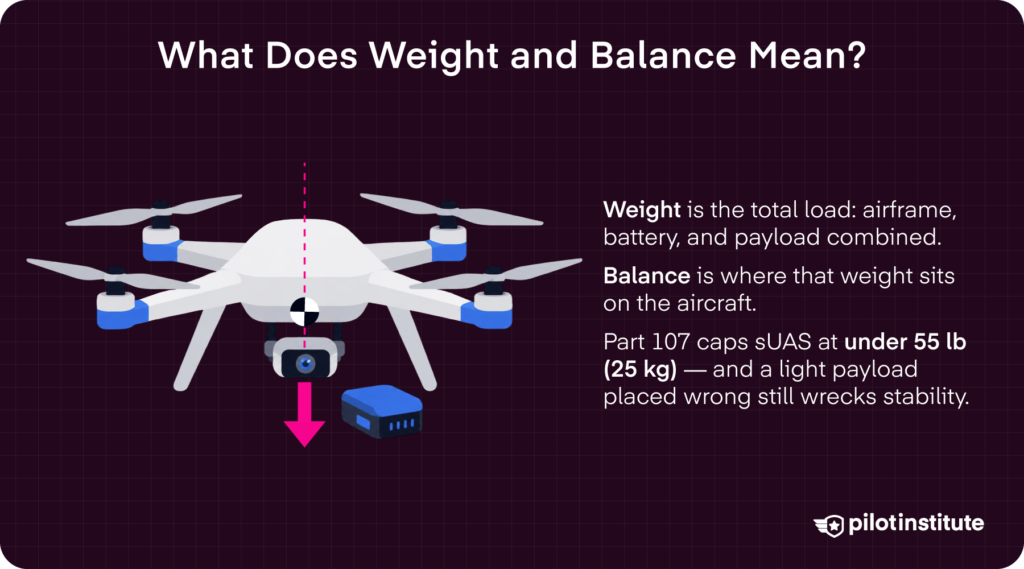
Simply put, weight and balance is the total weight of the drone (airframe, battery, and payload) combined with where that weight is positioned on the aircraft.
Drone Weight
Think of weight as the total load pulling your drone down toward the ground. The drone’s body and any payloads contribute to its weight. This determines how much lift the motors must generate to keep the aircraft aloft.
Part 107 dictates a maximum takeoff weight of less than 55 pounds (25 kg) for small unmanned aircraft (sUAS). That includes the weight of the drone and any payloads.
Heavier drones need to be registered under Part 47, file for a §44807 exemption, and obtain a Special Airworthiness Certification from the FAA.
Drone Balance
Balance refers to how that weight is distributed. See, your drone has that perfect sweet-spot center of gravity that equally distributes weight.
Your payload could be well within the drone’s maximum takeoff weight. Yet, if it is distributed unevenly, it can reduce stability and place stress on the motors.
Improper loading is a preventable cause of sUAS accidents, which is why the FAA tests weight and balance on the Part 107 exam.
How Does Maximum Takeoff Weight Affect Performance?
Maximum Takeoff Weight
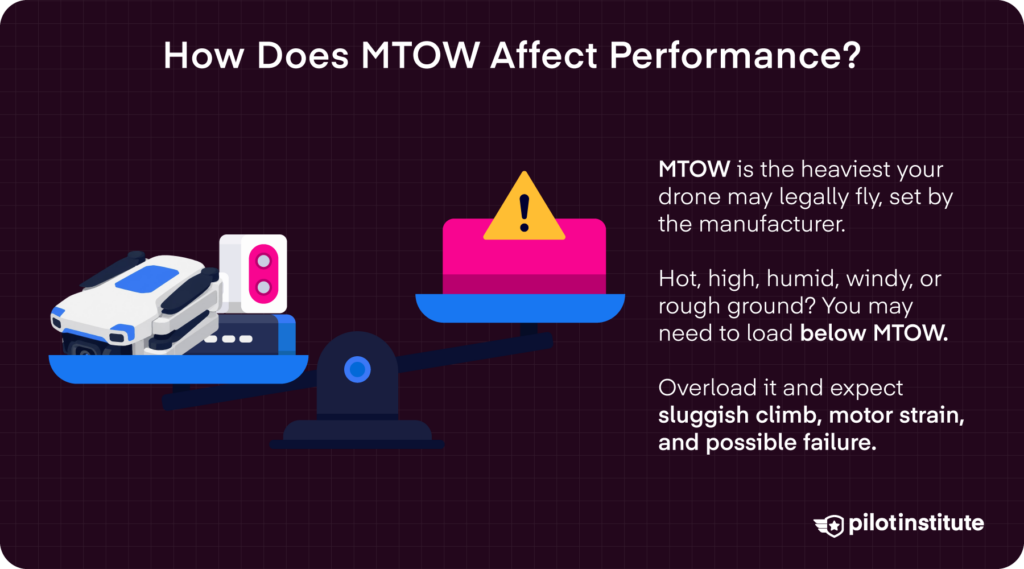
The maximum takeoff weight (MTOW) is the absolute heaviest your drone is permitted to fly, or your drone’s gross weight. This includes the drone’s body, batteries, and any attached payloads. Unlike fuel-burning aircraft, electric batteries keep a consistent weight throughout the flight.
Your drone’s manufacturer establishes the drone MTOW after extensively testing the aircraft’s motors, propellers, airframe, and flight control system. You can find the MTOW specs in your drone’s UAS flight manual or pilot’s operating handbook.
Still, the MTOW is not the end-all, be-all in terms of determining how much weight you can carry.
The AC 107-2A also reminds pilots that “although a maximum gross takeoff weight may be specified, the aircraft may not always safely take off with this load under all conditions.” High elevations, hot temperatures, and high humidity may all require you to lessen your drone’s load to fly safely. Uneven takeoff surfaces or high winds may also require you to reduce your drone’s weight even below the MTOW.
Not to mention, many drones have an MTOW exceeding the 55-pound drone weight limit for normal Part 107 operations. For example, a DJI FlyCart 100 has an MTOW of about 375 pounds (170 kg).
To carry this full MTOW, you would have to jump through the hoops of registering under Part 47 and obtaining a §44807 exemption.
Dangers of Exceeding the MTOW
Exceeding your drone’s MTOW drastically reduces performance and stability. It can increase the distance needed to stop your drone.
Overloaded drones can also result in reduced endurance and maneuverability. You may notice a reduced rate of climb or sluggish motor performance. Higher motor strain can even lead to potential structural failure.
Always calculate your total takeoff weight before every flight, especially when adding cameras, sensors, or other payloads. Stay within your drone’s MTOW to ensure safe flight operations.
What Is Center of Gravity and Why Does It Matter?
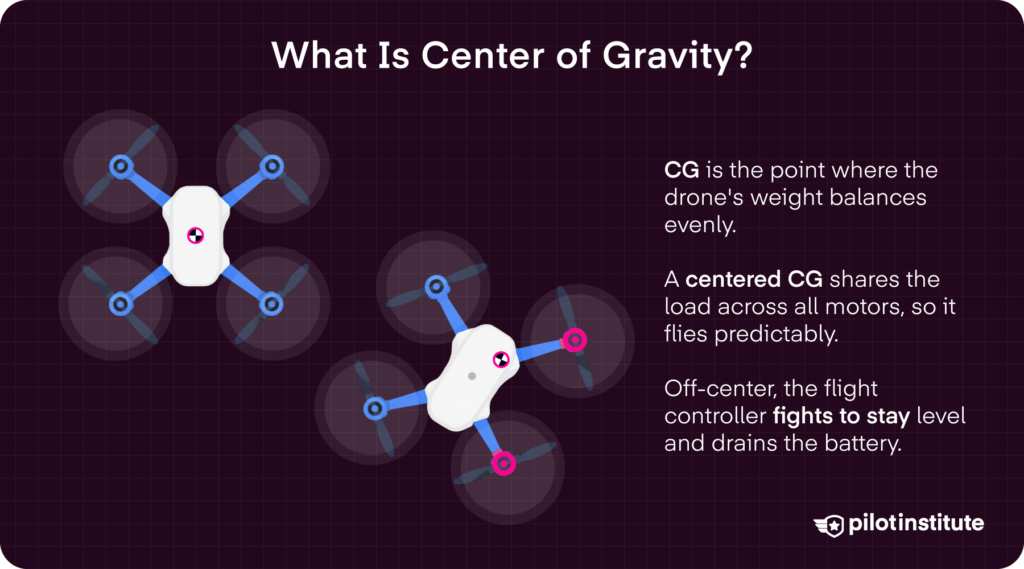
The center of gravity (CG) on your sUAS is where its weight is most evenly balanced. This point determines how the aircraft responds to control inputs and how the motors can effectively maintain stability during flight.
A centered CG is ideal. This is when the CG is at or near the geometric center of the airframe. A centered CG keeps the drone balanced. All the motors share the load equally, allowing the drone to fly predictably.
When the CG shifts off-center, the motors will try to compensate. On multirotor sUAS, even a small lateral CG imbalance forces the flight controller to work continuously to keep the aircraft level.
This increases power consumption and accelerates battery drain. The drone becomes less stable and responsive, leading to reduced overall flight control.
A forward CG improves stability but can increase drag, making the aircraft less responsive to control inputs.
An aft CG (towards the back of the aircraft) can increase maneuverability but reduces stability.
Your drone’s manufacturer will report CG data in the UAS flight manual or pilot’s operating handbook. Identify the acceptable CG range for your drone and read any guidance on approved payload configurations to ensure stability during flight.
What Are the Four Forces Acting on a Drone in Flight?
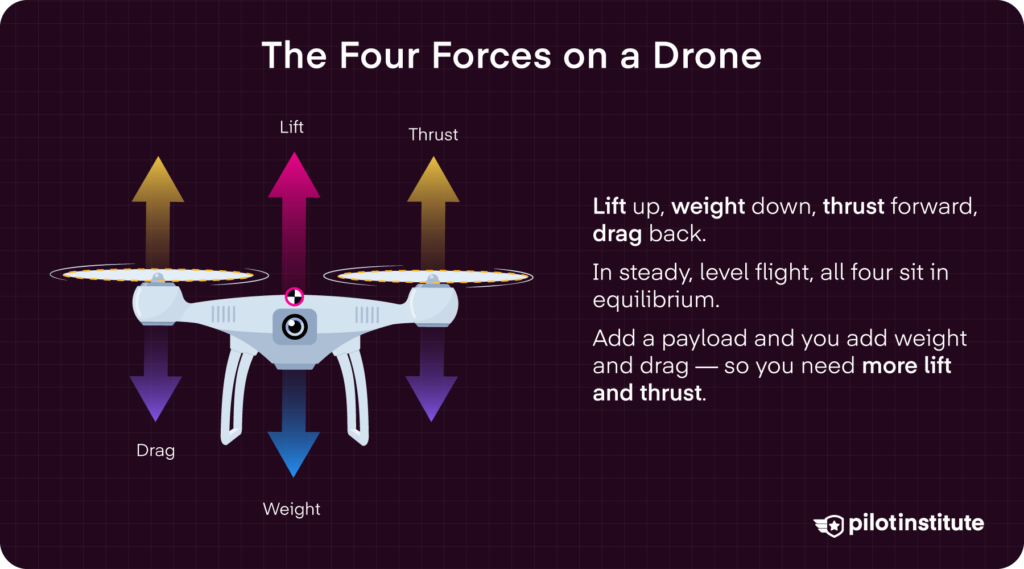
The four forces acting on an aircraft are lift, weight, thrust, and drag. In unaccelerated (steady, level) flight, these four forces are in equilibrium.
Lift
Lift is the upward force that keeps your drone in the air. On multirotors, propellers that spin and push air down generate lift, creating a lift that propels the drone upwards. To maintain your altitude, the lift must equal your drone’s weight.
Weight
Weight is the downward force caused by gravity. As weight increases, you need more lift to keep the drone in the air.
The heavier your drone is, the more power it needs to create this lift, which can drain batteries faster and reduce flight time.
Thrust
Thrust propels the drone forward. The motors and propellers spinning and pushing air backwards produce it. When you increase your thrust, your drone will climb, accelerate, or counteract any additional weight from added payloads.
Drag
Finally, drag is the force that opposes thrust. It is caused by air resistance against the aircraft’s airframe, propellers, and payloads.
Anything that adds additional surface area (extra payloads like cameras or sensors, for example) will increase the drag on your aircraft. You can counteract this added drag by increasing thrust.
How Does Load Factor Apply to Drone Operations?
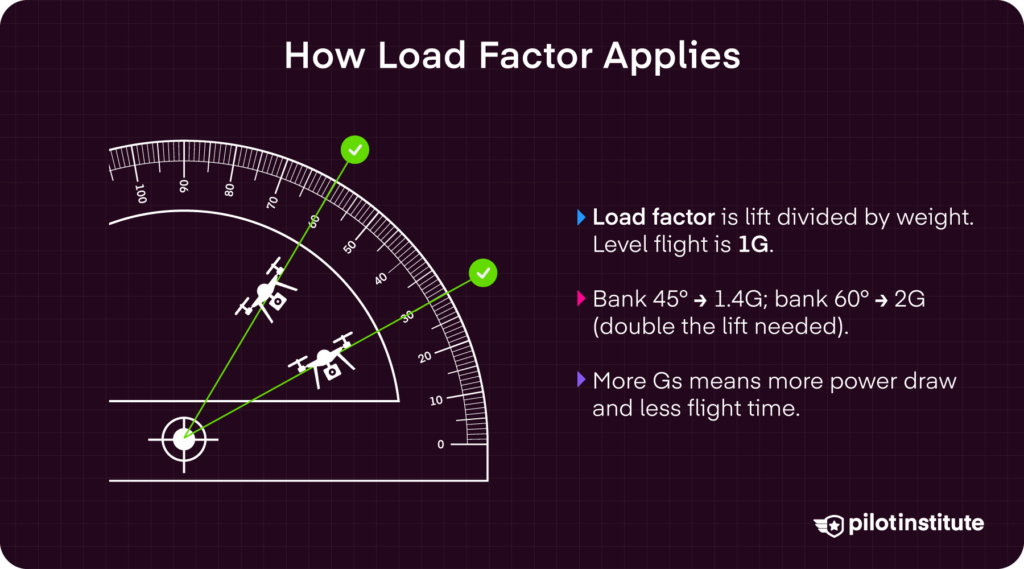
The load factor is the ratio of total lift to the aircraft’s weight. In level flight, the load factor is 1G.
Let’s do some math here. A drone in a 45-degree bank has a load factor of 1.4G (1/cosine of 45). In that turn, a 33-pound drone effectively weighs about 47 pounds (33 x 1.4). The drone must produce extra lift to maintain altitude. To maintain steady flight, the drone must support 47 pounds of lift, not 33.
At a 60-degree bank, the load factor doubles to 2G (1/cosine of 60), or twice the lift required to maintain level flight.
As the load factor increases, the drone experiences increasingly greater stress. Its motors need to generate more thrust to produce additional lift. This increases power consumption dramatically and can significantly reduce flight time.
While a typical multirotor sUAS can handle brief increases in load factor during maneuvers, repeated high-load levels can accelerate wear and tear.
How Does Density Altitude Affect Drone Performance?
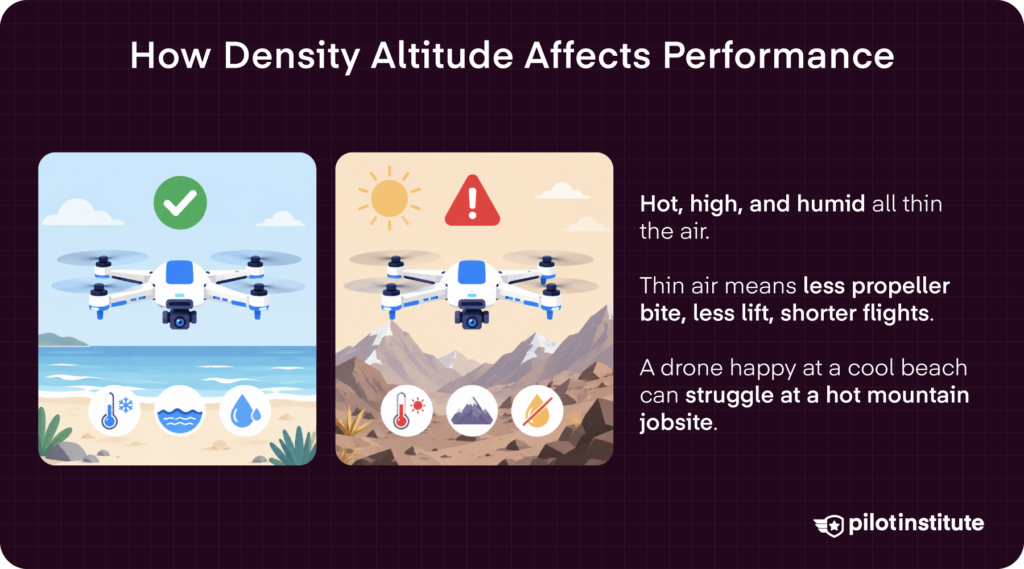
Density altitude refers to how air conditions affect your drone’s performance. This includes altitude (how high you are above sea level), but other factors too. Hot temperatures and humidity also play a role.
As altitude increases, the air becomes thinner. As temperatures rise, the air becomes less dense. As humidity intensifies, water vapor becomes lighter than dry air.
High density altitude means thinner air. Thinner air reduces propeller efficiency, decreases lift, and shortens flight time. The FAA shorthand is simple. Hot, high, and humid means bad performance.
A drone that hovers fine at a sea-level beach on a cool morning may struggle when flown at a mountain jobsite at noon on a super hot day.
How Should You Check Weight and Balance Before Each Flight?
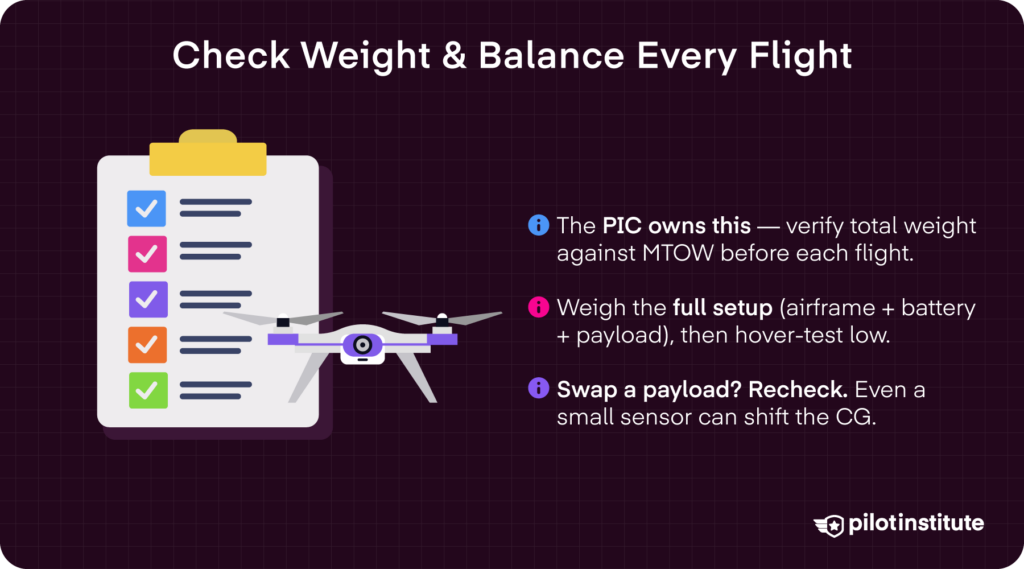
The drone’s manufacturer may establish center-of-gravity limits. Still, it is ultimately the PIC who is responsible for ensuring the aircraft is within those limits after any additional payloads are installed.
Before every flight, it is the pilot’s responsibility to verify the total weight against the manufacturer’s MTOW and confirm that any mounted equipment is balanced so it does not shift the CG outside acceptable limits.
Drone Preflight Weight-and-Balance Checklist
Here’s a practical drone preflight weight-and-balance checklist you can use in the field:
- Before flying, check environmental conditions like temperature, humidity levels, and altitude.
- Weigh the drone’s complete setup (airframe + battery + payload).
- Compare this gross weight against your drone’s MTOW published by the manufacturer.
- After taking off, hover at a low altitude to confirm stable handling.
- Any time you swap out payloads, recheck weight and balance using the above steps.
The Airman Knowledge Testing Supplement for Sport Pilot, Recreational Pilot, Remote Pilot, and Private Pilot (FAA-CT-8080-2H) also contains weight-and-balance charts, loading tables, and CG envelopes for manned aircraft. These can be useful for understanding the basic principles behind weight-and-balance calculations.

Label Your Drone the Right Way
Register with the FAA directly and get free stickers from us.
- FAA-ready marking.
- Looks professional.
- No card required.
- Quick request form.
Frequently Asked Questions
What Happens if I Fly My Drone Over Its Maximum Takeoff Weight?
Flying your drone over its MTOW will result in shorter endurance, reduced maneuverability, motor strain, and potential structural failure. Exceeding the manufacturer’s weight limits increases the risk of unstable flight and loss of control.
Who Is Responsible for Determining sUAS Performance Before a Flight?
The PIC is always responsible for determining sUAS flight performance before taking off. According to §107.49, the remote pilot in command must assess the environment, participants, control links, power supply, and any payloads to determine if the aircraft is safe to fly.
Does a Heavier Drone Fly Faster?
No, a heavier drone does not fly faster. It actually needs more power to maintain altitude, leaving less power for forward speed. Endurance and agility also decrease.
Can I Add a Payload to My Drone Without Rechecking Weight and Balance?
No. Every time you add or even change a payload, you need to conduct a new weight-and-balance check. Even a small camera or sensor can shift the CG enough to affect handling. Check your manufacturer’s manual for guidance.
How Do I Know if Density Altitude Is Too High for My Drone?
Check the temperature, elevation, and humidity against the manufacturer’s operating limits.
If temperature, elevation, and humidity are all high, expect reduced performance. Conduct a hover test at low altitude before starting your mission.
Conclusion
That $12,000 thermal camera was only two pounds. But putting those two pounds in the wrong spot was all it took to offset the drone weight balance.
Before every flight, conduct a drone preflight check that includes weight-and-balance. Ask yourself: how much does this weigh and where is that weight sitting? The smallest changes can create big problems in the air.
The math is simple. The consequences of ignoring it are not.