
- Key Takeaways
- Engine Classification at a Glance
- Generic Four-Stage Cycle
- 1. Reciprocating (Piston) Engines
- Enhancements & Variants
- 2. Gas-Turbine Engines
- Spool Arrangements & Shafts
- Start Sequence & Hot-Section Risks
- 3. Turboprop Engines
- Pilot & MX Considerations
- 4. Turbofan Engines
- Airflow Path Walk-Through
- Thrust Management & FADEC
- 5. Turbojet Engines
- Historical & Modern Uses
- Pros & Cons
- 6. Turboshaft Engines
- Key Applications
- Operating Issues
- High-Speed & Specialized Propulsion
- Ramjet & Scramjet
- Rocket Engines
- Engine Selection Matching Mission
- Speed, Altitude, Range
- Cost & Maintenance
- Environmental & Fuel Availability
- Future Trends in Aircraft Propulsion
- Sustainable Aviation Fuels (SAF) & Hydrogen
- Distributed Propulsion & Boundary-Layer Ingestion
- Conclusion
Last Updated:
The engines on a 777 and a Piper Cub both push air backward to push air backward to overcome drag and create airspeed. Understanding what’s happening inside these engines only makes you a safer pilot.
In this article, we’ll walk through every major engine type, from the reciprocating engines that still dominate flight training to high-bypass turbofans.
We’ll also take a glimpse of the hybrid-electric and hydrogen technologies that seem to be shaping tomorrow’s aviation.
Key Takeaways
- Air-breathing aircraft engines follow the same four stages: intake, compression, combustion, and exhaust.
- Piston engines remain the most affordable and practical choice for general aviation training.
- Gas turbine engines usually power helicopters, airliners, and military fighters.
- Aviation propulsion is evolving, with hybrid-electric and hydrogen propulsion leading the way.
Engine Classification at a Glance
Every aircraft engine has one job: generate the force needed to move through the air. But depending on the engine’s type, it can produce that force in different ways.
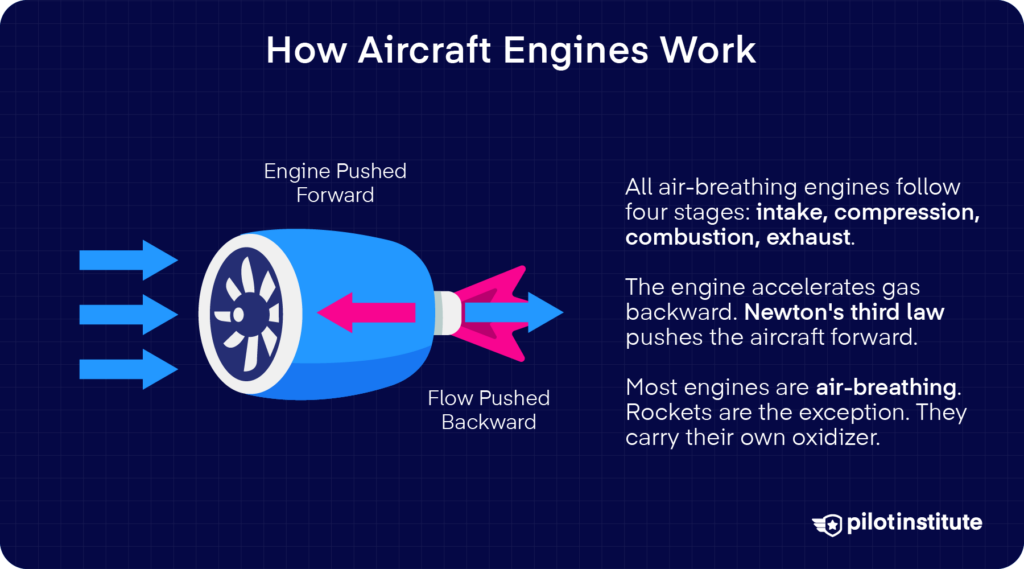
Some engines create thrust by accelerating air. Newton’s second law says force depends on mass and acceleration, so an engine can move a large mass of air more slowly or a smaller mass much faster. Newton’s third law explains the equal and opposite reaction that pushes the aircraft forward.
“For every action, there’s an equal and opposite reaction.”
Let’s start with something basic, like the propeller on a propeller-driven airplane. The propeller spins and throws air backward.
The moment it does that, the air pushes back on the propeller. The reaction force then travels through the propeller and into the aircraft, which moves the aircraft forward.
How does that look in a jet aircraft? Generally speaking, the engine accelerates a stream of hot gases and blasts them out the back.
That fast-moving exhaust leaves the engine in one direction, so an equal and opposite reaction force pushes back on the engine. The result you get is forward thrust.
There’s also the question of where the engine gets its oxygen. Most aircraft engines are air-breathing, meaning they draw oxygen directly from the atmosphere to burn fuel.
Air-breathing engines use ambient air as the oxidizer for combustion. But rocket engines, which reach altitudes with little to no oxygen, are self-oxidizing. That means they carry their own oxygen along with their fuel.
Generic Four-Stage Cycle
Piston and turbine engines use the four-stage engine cycle, and powering your aircraft boils down to four stages.
It starts with intake: fresh air enters the engine. Then, compression, where the air gets squeezed to raise pressure and temperature.
What happens next? Fuel sprays into the compressed air and ignites, releasing energy that expands the gases and accelerates them. We call this combustion.
Finally, exhaust expels the spent gases so the cycle can repeat.
1. Reciprocating (Piston) Engines
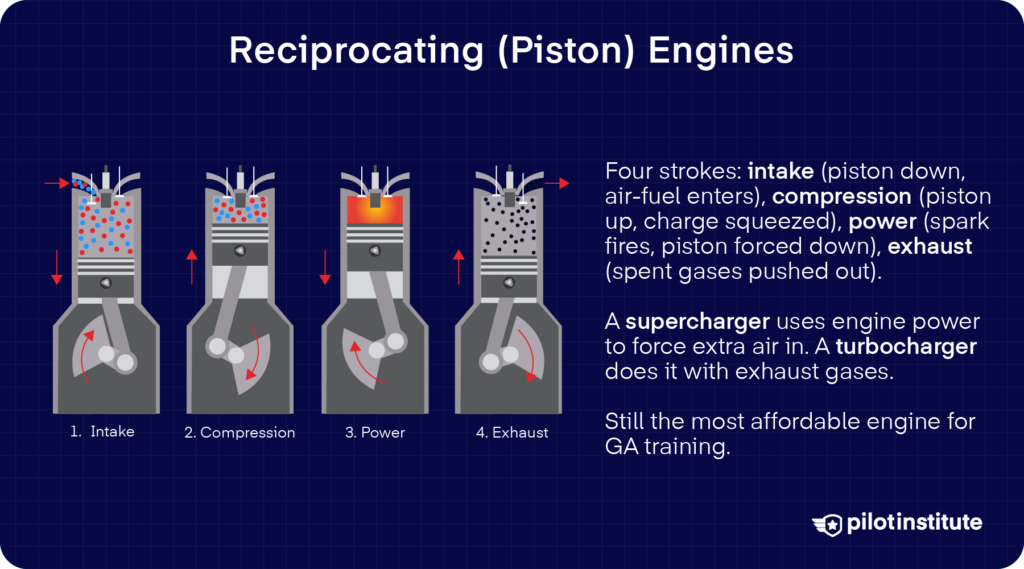
If you’ve ever driven a car, you already have a rough sense of how a piston aircraft’s four-stroke engine works. The intake stroke begins as the piston moves downward. The intake valve opens, and the fuel-air mixture gets drawn into the cylinder.
Then, the piston squeezes that charge tight. It gives the fuel-air mixture much greater power output once ignited.
Then, the spark fires. There’s a tremendous pressure increase that forces the piston downwardon the power stroke. And finally, the exhaust valve opens, and the spent gases get pushed out.
Enhancements & Variants
With air getting thinner as you go higher, you can see how altitude can be a problem for a normally aspirated engine.
How do you compensate for that? This is where forced induction comes in, and it takes different forms.
A supercharger runs on mechanical power from the engine itself.
The engine drives a compressor that forces additional air into the intake system. The process raises the air density before it reaches the cylinders.
A turbocharger works differently. It pulls its power from the exhaust stream.
Exhaust gases leaving the engine spin a turbine wheel. That turbine connects to a compressor on the intake side.
The spinning compressor squeezes the incoming air, increasing its density and pressure before sending it deeper into the engine.
2. Gas-Turbine Engines
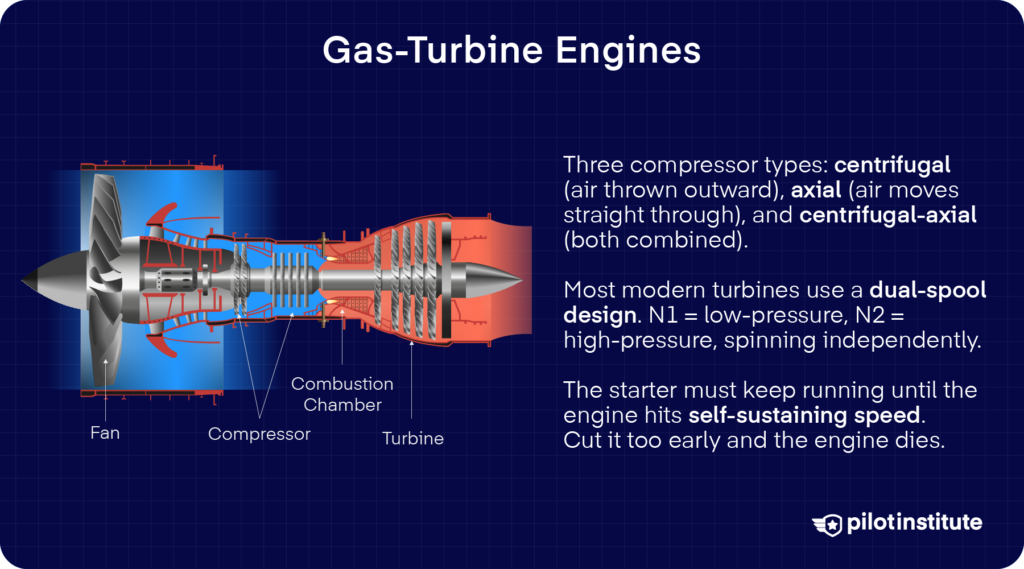
Gas turbines compress incoming air using one of three main compressor designs. Three main types are encountered in practice: centrifugal, axial, and centrifugal-axial.
A centrifugal compressor raises pressure using a spinning impeller and diffuser vanes. The impeller accelerates air outward, then the diffuser slows the airflow and converts that velocity into higher static pressure.
An axial-flow compressor takes a different approach. Air moves straight through the engine while rows of rotating and stationary airfoils gradually compress it.
Can both designs work together? Yes. A centrifugal-axial compressor combines the two. The system uses both airflow patterns to achieve compression.
Spool Arrangements & Shafts
In a single-spool engine, one shaft links everything together.
Most modern engines, though, use a dual-spool design. N1 represents the low-pressure compressor speed, and N2 represents the high-pressure compressor speed,each spinning independently on concentric shafts.
Rolls-Royce takes this further with the three-spool design. It scales each spool individually to get the best performance across a wide thrust range.
Start Sequence & Hot-Section Risks
A gas turbine engine can’t start on its own. How do you get it running? With a starter, which accelerates the compressor.
What happens next? Ignition turns on, then fuel is injected into the combustion chamber.
The mixture lights off, but the starter can’t stop here yet. The engine still lacks enough power to keep itself turning.
The starter has to keep supplying torque until combustion creates enough gas flow through the turbine to keep the compressor spinning at a self-sustaining speed. Until then, the starter helps maintain the compressor speed needed for stable airflow through the engine.
Cut the starter too early, and the engine could slow down or fail to reach idle. Let it assist long enough and the engine accelerates smoothly.
At the proper point, the system should automatically shut off the starter and ignition.
3. Turboprop Engines
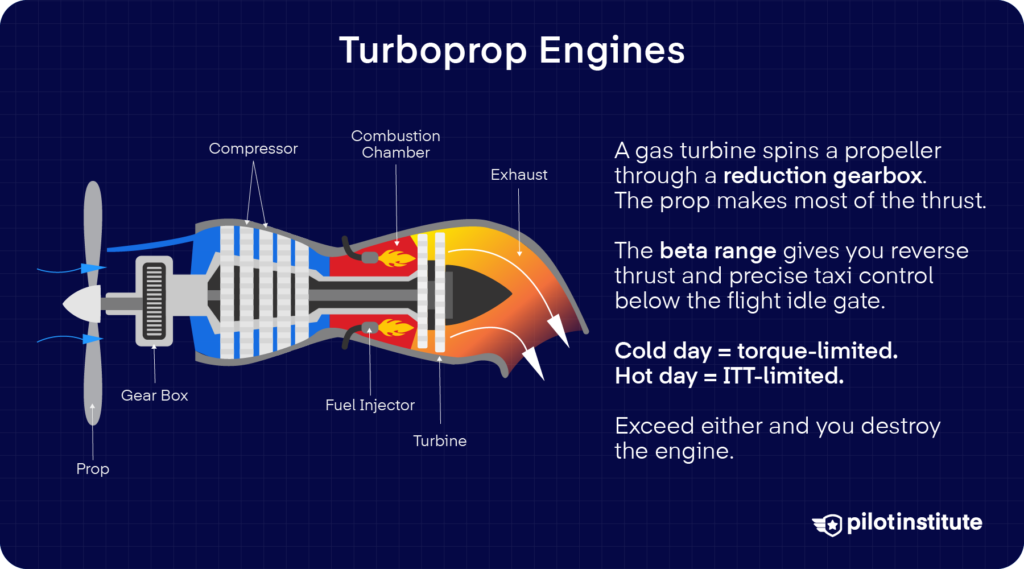
A turboprop works by spinning a propeller through a reduction gearbox. They’re a compromise between turbojet engines and reciprocating powerplants.
Turboprops have the power of a jet, but also the efficiency of a propeller aircraft.
The propeller does the heavy lifting, which generates the vast majority of the thrust, while the exhaust contributes only a small fraction.
What really sets turboprops apart on the ground is the beta range.
What does that mean? Well, in a reverse pitch, air is pushed away from the aircraft rather than drawn over it. You get a braking action instead of forward thrust.
Below the flight idle gate, the power lever directly controls blade angle rather than letting the governor manage it. This gives you precise control during taxi and dramatically shortens your landing roll.
Pilot & MX Considerations
Flying a turboprop means juggling torque and temperature simultaneously.
On a cold day, torque is usually the first limit you’ll hit. The air is dense, so the engine can produce a lot of mechanical force before temperatures climb to the red line.
On a hot day, it’s the opposite. Inter-Turbine Temperature (ITT) will reach its limit well before you max out on torque.
And the consequences of ignoring them? An overtemperature or overtorque condition lasting more than a few seconds can damage your engine’s internal components.
ITT also tells you something about engine health. Mechanics pay close attention to it during inspections and trend monitoring.
Internal wear slowly reduces efficiency inside the compressor and turbine sections. Clearances increase, and airflow becomes less effective.
Rising or abnormal ITT trends can signal that the engine is working harder than it once did, suggesting internal wear or degradation.
4. Turbofan Engines
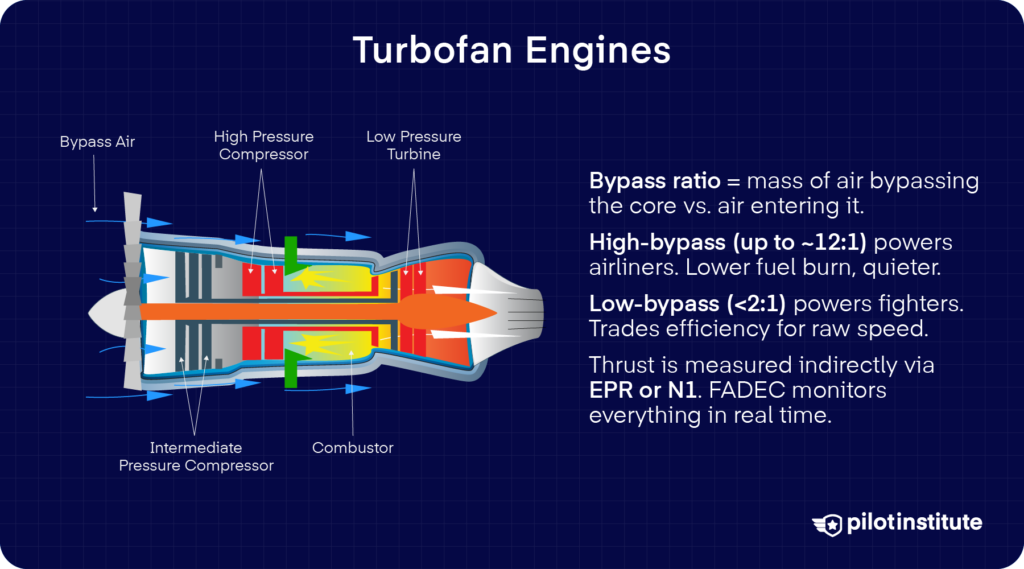
Turbofan engines have a feature called the bypass ratio. It’s the ratio between the mass flow rate of the bypass stream and the mass flow rate entering the core.
In a high-bypass turbofan, the kind powering most airliners, ratios can reach up to ~12:1. That means the vast majority of air never touches the combustion chamber.
What difference does the bypass ratio make? A high-bypass fan accelerates a larger mass of air at a lower speed, producing thrust more efficiently. Because the fan doesn’t need to spin as fast, the engine burns less fuel and produces less noise.
Low-bypass turbofans, with ratios below about 2:1, trade that efficiency for raw speed. That’s why you’ll usually find them on fighters and military aircraft.
Airflow Path Walk-Through
The inlet air that passes through a turbofan engine separates into two streams. The cold stream bypasses the core entirely and exits through the fan duct.
The hot stream passes through the compressor, combustion chamber, and turbine before exiting through the exhaust nozzle.
Variable stator vanes in the compressor adjust airflow angles depending on the operation to avoid a compressor stall.
And on some military low-bypass engines, adjustable exhaust nozzles change their geometry to get the best thrust across a wide speed range.
Thrust Management & FADEC
Jet engines do not measure thrust directly in the cockpit. What you have are a couple of indirect indicators instead. Two common ones are Engine Pressure Ratio (EPR) and fan speed, usually shown as N1.
Engine manufacturers choose the indicator that best matches the engine’s design, so you’ll typically see either EPR or N1.
Modern engines also rely on FADEC to watch over performance. The system continuously analyzes engine data. If there’s even a small irregularity, the FADEC can often spot it.
When it comes to stopping, high-bypass engines typically use cascade-type reversers. A set of cascade vanes, like louvered grills, is hidden around the circumference of the engine nacelle.
Anytime you need reverse, the blocker doors deploy to force fan air out through the vanes in a forward direction rather than backward.
In older or low-bypass designs, they often use bucket-type doors that swing into the exhaust stream.
5. Turbojet Engines
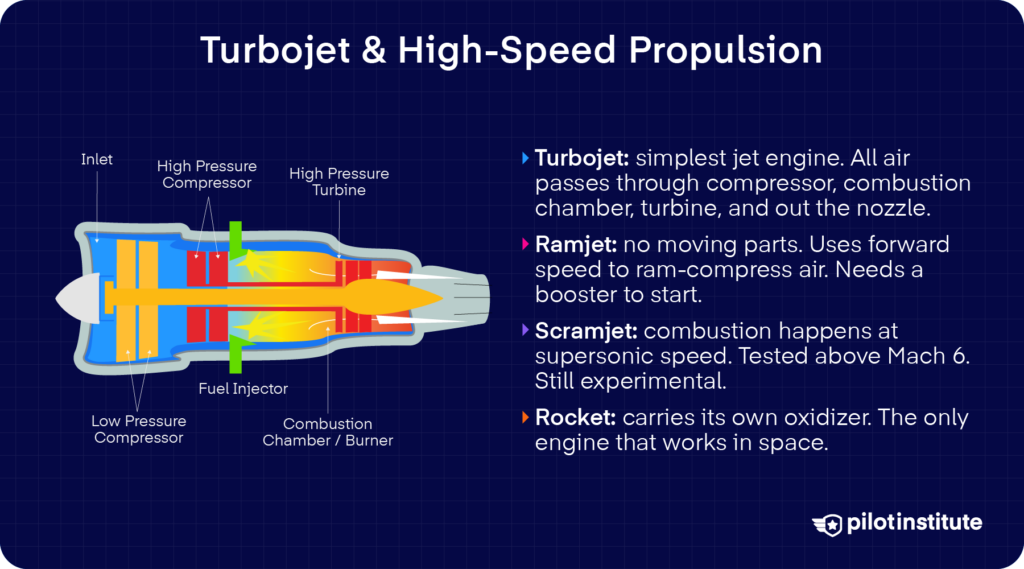
The turbojet is one of the simplest forms of jet engines, and maybe the easiest to understand.
The turbojet engine consists of four sections: compressor, combustion chamber, turbine section, and exhaust. Every bit of air that enters the engine passes through the full cycle.
The compressor section compresses the incoming air, raising its pressure before it enters the combustion chamber.
Then, the expanding gases spin the turbine to keep the compressor running, and everything left over blasts out the back as thrust.
Historical & Modern Uses
Turbojets launched the jet age. They revolutionized commercial air travel. But as bypass technology matured, turbofans came to dominate the airline market almost entirely.
So, where can you see turbojets today? Pure turbojets are rare to find these days. You’ll still find them on some older military platforms and certain cruise missiles.
Pros & Cons
The turbojet’s biggest advantage is its smaller frontal area and strong high-speed performance, making it well-suited to supersonic aircraft. Modern turbofans can also reach very high speeds, so speed alone is not a unique turbojet advantage.
The design is also mechanically straightforward, as it has fewer components than a turbofan.
That said, turbojet engines are limited in range and endurance. They’re also slow to respond to throttle applications at slow compressor speeds.
They burn considerably more fuel than turbofans at subsonic cruise speeds. Also, a turbofan makes less noise, is more efficient at lower airspeeds, and uses less fuel.
6. Turboshaft Engines
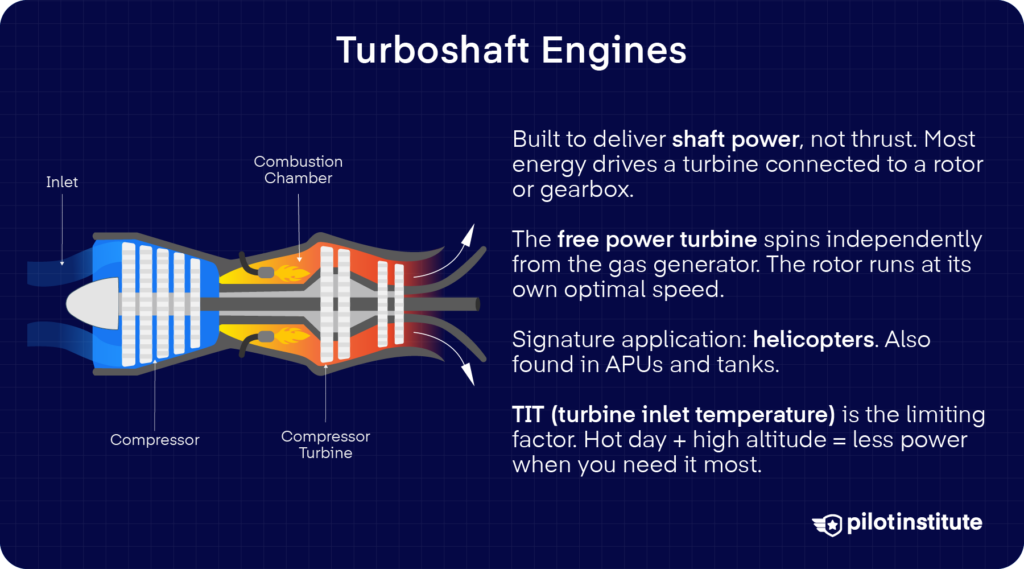
A turboshaft engine is built to deliver shaft power. It powers a shaft that drives something other than a propeller.
Most of the energy produced by the expanding gases drives a turbine rather than producing thrust.
The engine typically splits into two major assemblies: the gas generator and the power section. And in most designs, they’re mechanically separate.
They can each rotate at different speeds appropriate to the conditions, referred to as free power turbines.
It lets the rotor system operate at its optimal speed regardless of what the gas generator is doing, and that’s essential for helicopters.
Key Applications
Helicopters are the turboshaft’s signature application. When turboshaft engines became available in the 1950s, they quickly appeared in new designs and as replacements for piston engines.
These engines delivered high power in a compact, lightweight package, making them well-suited to helicopters. You’ll also find turboshafts powering auxiliary power units on large aircraft and even main battle tanks.
Turboshaft engines are commonly used in flights that require a sustained high power output, high reliability, small size, and light weight.
Operating Issues
But like all turbine engines, turboshafts are governed by strict temperature and speed limits. The highest temperature in any turbine engine occurs at the turbine inlet.
That’s why the turbine inlet temperature (TIT) is usually the limiting factor in turboshaft operation.Go past those limits even briefly, and you risk serious internal damage.
Also, remember that available power varies directly with air density. Because air density decreases with rising temperature, hot conditions mean less power when you need it most.
At high density altitude, the rotor can’t simply spin faster to compensate. Rotor RPM is limited to keep blade-tip speeds below about Mach 0.7, so reduced air density means less lift and lower overall performance.
High-Speed & Specialized Propulsion
Ramjet & Scramjet
If you strip away all the moving parts from a jet engine, you get a ramjet.
These engines have neither a compressor nor a turbine. Instead, they rely entirely on the aircraft’s forward speed to ram air into an inlet, where it’s slowed, mixed with fuel, and ignited.
Around Mach 3, turbomachinery is no longer useful, and ram-style compression becomes the preferred method.
However, ramjets can’t produce thrust from a standstill, so they need a booster to reach operating speed first.
The scramjet takes this even further. A scramjet is a variant of a ramjet in which combustion takes place in supersonic airflow.
In testing, scramjets have operated above Mach 6, but the technology is still experimental. No crewed aircraft has flown with a scramjet engine.
Rocket Engines
A rocket engine produces thrust by burning propellants under very high pressure and temperature. These propellants include both a fuel and an oxidizer.
A rocket cannot rely on atmospheric oxygen like an air-breathing engine. The engine has to bring its own oxidizer so combustion can occur even in space.
Combustion releases energy very quickly. That energy creates a stream of extremely hot, fast-moving gas.
The engine then directs that gas through a nozzle, where it expands and accelerates to very high Mach numbers. The result is a strong thrust that pushes the rocket forward.
Engine Selection Matching Mission
Speed, Altitude, Range
So which engine belongs on which aircraft? It depends entirely on what you’re asking the aircraft to do.
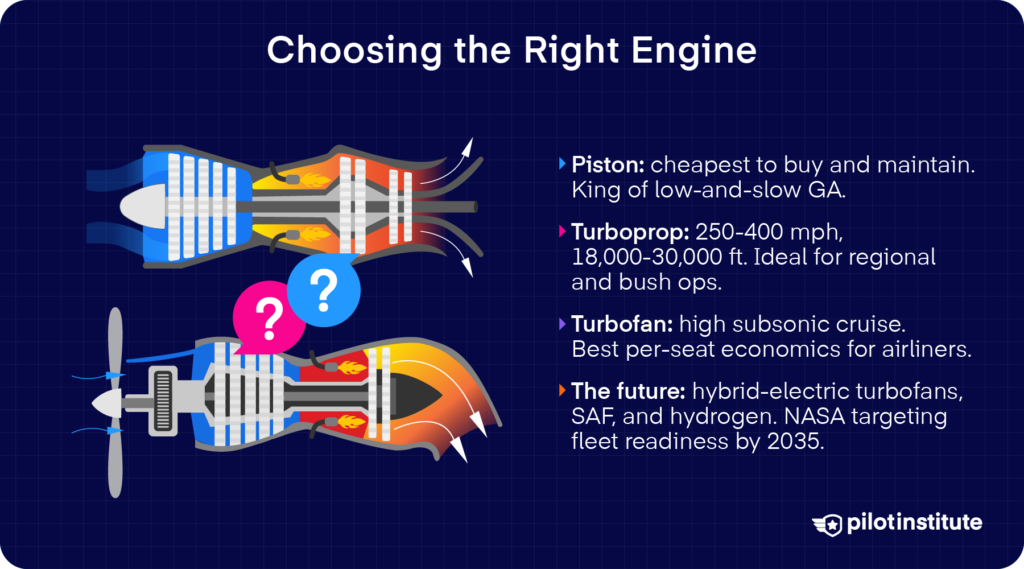
Turboprop engines are most efficient at speeds between 250 and 400 mph and altitudes between 18,000 and 30,000 feet. That makes them ideal for regional hops and bush operations.
Need to go faster and farther? High-bypass turbofans are everywhere in the airliner world. That’s because they deliver excellent fuel efficiency at high subsonic cruise speeds. Also, they’re much quieter.
Turbojets were once favored for very high-speed flight, but modern turbofans can match them at those speeds while offering better efficiency. Today, turbojets are mostly limited to specialized or legacy applications.
And for low-and-slow general aviation flying, the piston engine remains king. It’s simple and less costly, which turbines simply can’t match at those speeds.
Cost & Maintenance
Engine choice has enormous financial implications beyond the initial price tag.
Piston engines are the cheapest to buy and maintain, but their time between overhauls is shorter, and parts wear faster.
Now, turboprops cost more upfront, but they usually have longer overhaul intervals. And in many cases, they also have lower overall maintenance costs per hour of operation.
Turbofans on large aircraft have the highest costs across the board. But when you’re moving hundreds of passengers thousands of miles, the per-seat economics usually works itself out.
Environmental & Fuel Availability
The FAA is pushing toward an unleaded aviation fuel future by 2030. That effort directly affects piston aircraft that still rely on leaded Avgas.
What about turbine engines? They avoid that issue entirely. Turbines run on Jet-A, which contains no lead and is widely available worldwide.
Operators flying in remote regions often struggle to find Avgas, but Jet-A is usually readily available. That reality explains why turboprops remain popular for work in isolated areas.
Emissions regulations continue to tighten. Engine designs that burn less fuel will likely become more attractive. You should expect fuel efficiency to play an even larger role going forward.
Future Trends in Aircraft Propulsion
In fact, aircraft engines may not rely entirely on fuel in the future. Engineers are exploring hybrid systems that combine traditional turbine power with electric propulsion.
NASA is already testing that idea. The agency partnered with industry on the Electrified Powertrain Flight Demonstration program.
They’re working to accelerate the development of electrified aircraft propulsion. The goal is to make these technologies mature enough for use in the U.S. fleet by about 2035.
What would that look like? A conventional turbine core would still produce power, but electric motors would assist during certain phases of flight.
Those phases include taxi, climb, and descent. Electric assistance during those segments could reduce overall fuel burn.
NASA and GE Aerospace completed ground testing of an integrated hybrid-electric turbofan in 2025 using a modified Passport engine. The test exceeded NASA’s performance benchmarks.
Sustainable Aviation Fuels (SAF) & Hydrogen
What if you could keep the engines you already have but change the fuel? That’s the promise of sustainable aviation fuels.
There are eleven ASTM-approved SAF production pathways, each with a specific conversion process and blending limitation.
SAF can reduce carbon emissions significantly compared to conventional jet fuel and requires no engine modifications at approved blend levels. Hydrogen is the longer-term play.
Distributed Propulsion & Boundary-Layer Ingestion
Rather than hanging two big engines under the wings, what if you spread many smaller electric motors across the airframe?
Combined with other technologies such as distributed propulsion and boundary-layer ingestion, these systems could potentially reduce fuel burn by up to 20 percent or more compared to today’s aircraft.
Boundary-layer ingestion places a propulsor at the aft fuselage. It re-energizes the slow-moving air clinging to the aircraft’s skin. You get less drag in a way that conventional engine placement can’t.
Conclusion
From the first sputtering piston engines to experimental detonation rockets, aircraft propulsion has never stopped evolving.
We’ve seen that engines are far more diverse than most people realize. But even so, the fundamentals stay the same.
What changes is how cleverly each engine type executes those steps.
As the industry moves toward cleaner, more efficient propulsion, the pilots and professionals who understand these systems will be best equipped to adapt. Make sure you’ll be one of them.