
- Key Takeaways
- How Aircraft Icing Forms
- Supercooled Clouds
- Rime Ice: What It Is and How to Spot It
- How Rime Ice Is Formed
- The Dangers of Rime Ice
- Clear Ice: What It Is and Why It Is More Dangerous
- Clear Ice Formation
- Hazards With Clear Ice
- Mixed Ice
- Where Mixed Ice Comes From
- Mixed Ice Warning
- Rime Ice vs. Clear Ice: Side-by-Side Comparison
- What to Do If You Encounter Icing
- 1. Avoid It In the First Place
- 2. Know Your Escape Procedure
- 3. Deicing and Anti-icing
- 4. Let Others Know
- Frequently Asked Questions
- “What is the difference between rime ice and clear ice?”
- “Which type of aircraft icing is more dangerous?”
- “At what temperature does icing typically occur?”
- “Can you fly through icing conditions?”
- “What is the difference between deicing and anti-icing?”
- Conclusion
You’re flying through an overcast layer, and your airspeed starts dropping for no obvious reason. You look at the leading edge of the wing and see ice slowly building.
But what kind?
Rime ice and clear ice look and behave differently from each other in flight. Mixed ice combines features of both.
Let’s talk about the three types of aircraft icing. We’ll walk you through how to tell them apart and what to do about each one.
Key Takeaways
- Aircraft icing forms when supercooled water droplets strike your cold airframe and freeze on contact.
- Rime ice is the rough, milky-white deposit formed from small droplets in cold conditions.
- Clear ice is smooth and glossy, but the most dangerous, forming from larger droplets.
- Mixed ice combines features of rime and clear ice on the same surface.
How Aircraft Icing Forms
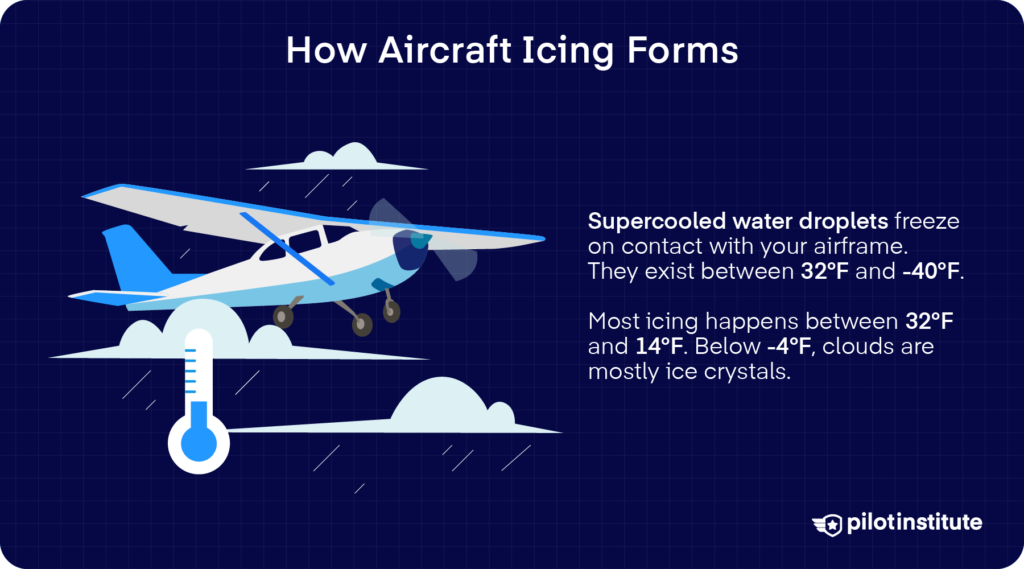
Aircraft icing comes down to two ingredients coming together at the wrong time.
First, you need visible moisture in the air. Second, you need temperatures cold enough to keep that moisture in a supercooled state.
Your wing leading edge, propeller, and even tiny protuberances become collection points the moment you fly into visible moisture.
Supercooled Clouds
The vast majority of aircraft icing forms inside supercooled clouds. Here, droplets stay liquid even at outside air temperatures below 32°F (0°C).
But if the freezing point of water is 32°F (0°C), how can water still be liquid below that?
The atmosphere lacks those solid particles the droplets “latch on to” to become ice. Water stays liquid even when it should be ice.
But the catch is that these droplets are unstable. The moment they strike a surface cold enough to disturb that balance, they freeze on contact.
How much supercooled water a cloud holds depends on temperature. Between 32°F and 14°F (0°C and -10°C), you’re looking at mostly supercooled water droplets.
Between 14°F and -4°F (-10°C and -20°C), liquid droplets share space with ice crystals.
Below -4°F (-20°C)? Clouds are usually all ice crystals.
That said, strong vertical currents like those in a cumulonimbus can hurl supercooled water up to altitudes where temperatures hit -40°F (-40°C).
Rime Ice: What It Is and How to Spot It
That brings us to the first kind of ice we’ll talk about, and it’s the one that pilots report most often.
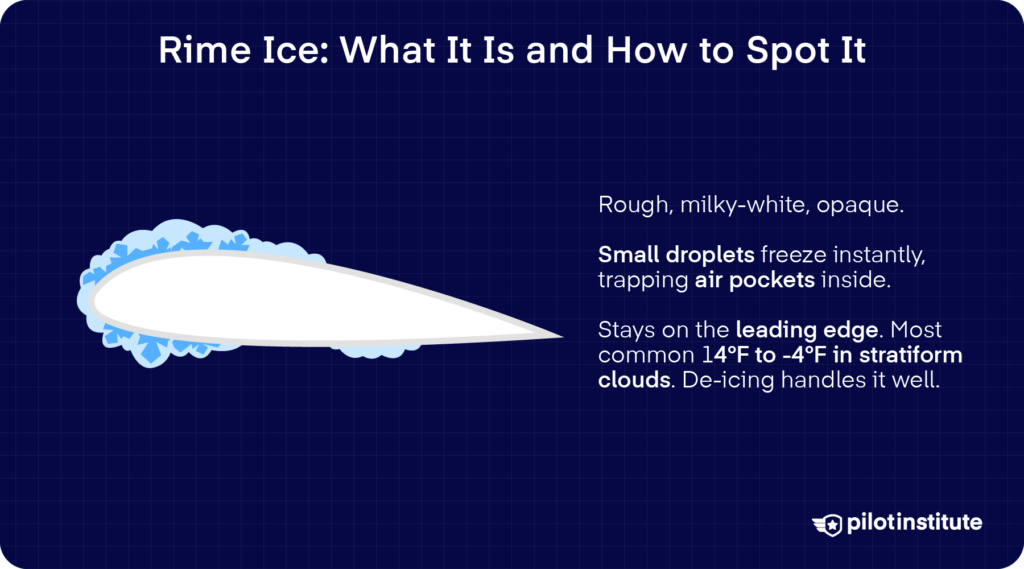
What does rime ice look like? You’ll see a rough, milky-white deposit clinging to the leading edges of an aircraft after a flight through supercooled clouds.
How Rime Ice Is Formed
Rime ice forms when small supercooled water drops freeze the moment they strike the aircraft.
That rapid freeze is what creates air pockets inside the ice, which is exactly why it looks opaque and rough, and feels porous and brittle to the touch.
Larger accretions of rime can actually form a streamlined extension of your wing.
Low temperatures, smaller amounts of liquid water, low velocities, and small droplets all create the perfect conditions for rime ice to form.
Because this ice freezes so quickly, it usually stays confined to the leading edge of your wing.
You can run into it anywhere between 32°F and -40°F (0°C and -40°C), but it shows up most often between 14°F and -4°F (-10°C and -20°C) in stratiform clouds.
You’re definitely not safe from cumuliform clouds either, and especially at temperatures below 14°F (-10°C).
The Dangers of Rime Ice
Rime ice can build up on the leading edges of your airfoils and engine inlets. It messes with the aerodynamic characteristics of your wings and disrupts the airflow heading into your engines.
And remember, all that accreted ice will add significant weight to your aircraft.
The good news is that you can clear much of it with de-icing. Better yet, you can keep it off in the first place with anti-icing.
Clear Ice: What It Is and Why It Is More Dangerous
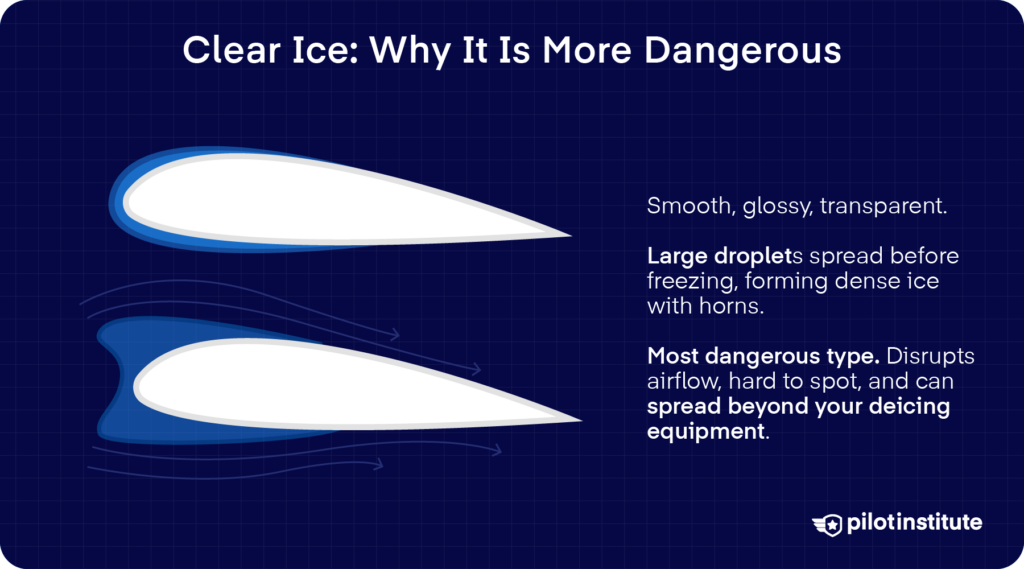
Clear ice, sometimes called glaze ice, is a glossy, clear, or translucent type of ice. It forms when large supercooled water droplets freeze relatively slowly.
And with larger accretions, clear ice can even form “horns.”
It can appear as a thin, smooth coating or show up as rivulets, streaks, and bumps across your aircraft’s surfaces.
Clear Ice Formation
Clear ice favors warmer conditions with higher liquid water content and larger droplets.
It forms most readily between 32°F and 14°F (0°C and -10°C), though it can still occur at temperatures as low as -13°F (-25°C), just with reduced intensity.
Pay particular attention to areas with high concentrations of large supercooled water droplets. These are usually in cumuliform clouds and freezing rain.
So, what’s actually happening when it forms?
When a large supercooled droplet strikes your aircraft, only a small portion freezes on impact.
The rest flows or smears across the surface and freezes gradually as it spreads.
Because that process is slow, very few air bubbles get trapped. That’s why clear ice ends up denser and glossier than rime ice.
Hazards With Clear Ice
Clear icing is the more hazardous type, and for good reason.
It tends to form horns near the top and bottom of the airfoil’s leading edge, which seriously disrupts airflow and reduces lift.
Because it’s clear and tough to spot, you may not catch it happening until it’s a problem.
It’s also stubborn to remove since it can spread beyond your deicing or anti-icing equipment. Though in most cases, deicing devices clear it off nearly completely.
Mixed Ice
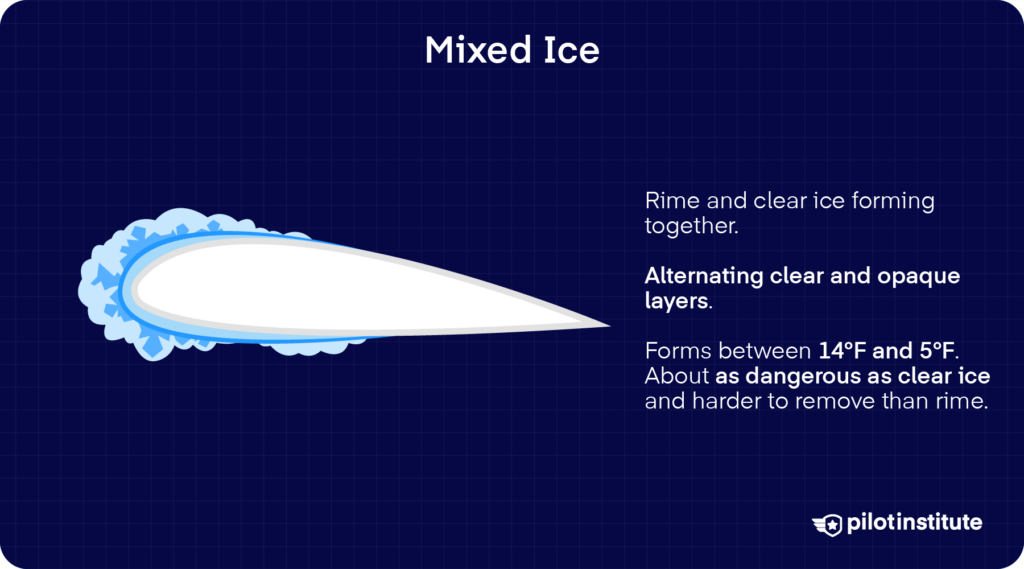
Mixed ice is exactly what it sounds like. It’s a combination of clear ice and rime ice forming on the same surface at the same time.
Variations in droplet size, liquid water content, and temperature across even short distances mean your aircraft often encounters the conditions for both ice types.
Where Mixed Ice Comes From
Mixed ice forms most readily between 14°F and 5°F (-10°C and -15°C). It can include a mix of supercooled droplets, snow, ice pellets, or small hail.
What does it look like? Viewed from the side, mixed ice appears as alternating layers of relatively clear and opaque ice.
The opaque sections form where ice builds up quickly. It traps air pockets, which gives it that cloudy appearance. That’s why you’ll sometimes hear mixed ice referred to as “cloudy ice.”
Mixed Ice Warning
From an aerodynamic standpoint, mixed ice is roughly as dangerous as clear ice.
It can form horns or irregular shapes that disrupt airflow. Plus, it tends to spread across more of the airframe than rime ice alone.
That spread can carry it beyond the area covered by your anti-icing or deicing equipment. That means any unprotected surface is exposed.
Ice forming further aft on the airfoil is especially problematic. It triggers flow separation and turbulence over a large portion of the wing.
It directly reduces the lift that keeps your aircraft in the air. The further back it creeps, the worse the aerodynamic penalty.
Mixed ice is also harder to remove than rime ice. Its layered, irregular structure makes it more stubborn.
If your deicing equipment can’t shed it cleanly, you’re dealing with an accumulation that gets less predictable the longer it stays on.
Rime Ice vs. Clear Ice: Side-by-Side Comparison
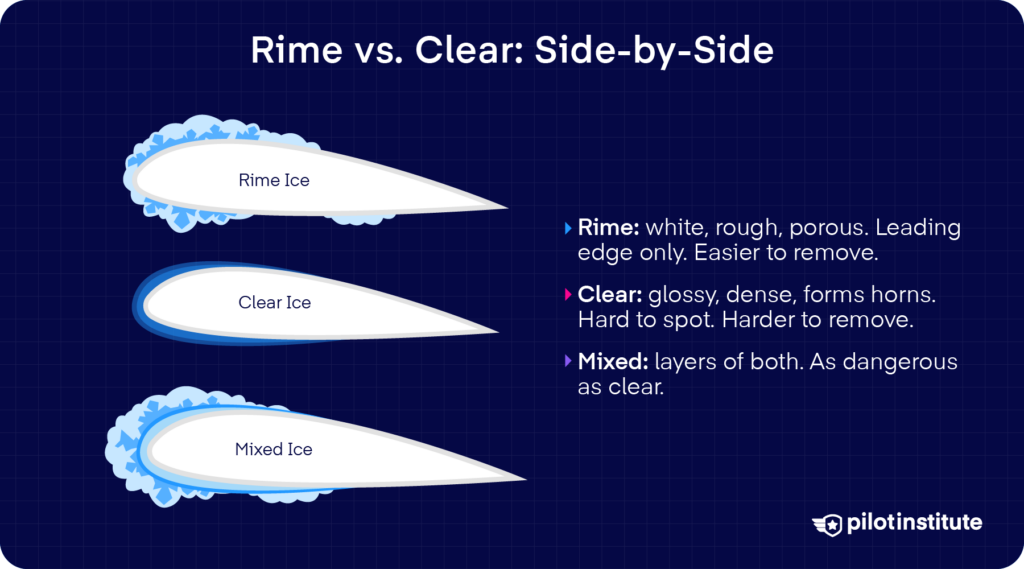
Definitions only get you so far. When you’re actually flying, you need a way to tell them apart at the drop of a hat.
So how can you quickly identify rime ice and clear ice? Which icing conditions should you watch for, and which ice will they bring?
We’ve written it all down in this handy table.
| Characteristic | Rime Ice | Clear Ice |
|---|---|---|
| Appearance | Rough, milky-white, opaque deposit that looks porous and feels brittle | Glossy, clear, or translucent; can show up as a thin smooth surface or as rivulets, streaks, or bumps |
| Temperature range | Forms anywhere from 32°F to -40°F (0°C to -40°C), most often between 14°F and -4°F (-10°C and -20°C) | Most significant between 32°F and 14°F (0°C and -10°C), but can still form at temperatures as low as -13°F (-25°C) |
| Droplet size | Small supercooled water droplets | Large supercooled water droplets |
| Cloud type | Most often stratiform clouds; also cumuliform clouds, especially below 14°F (-10°C) | Cumuliform clouds and freezing rain, anywhere with a high concentration of large supercooled droplets |
| Density | Lower density; rapid freezing traps air pockets inside the deposit | Denser than rime ice because few air bubbles get trapped during the slower freeze |
| Shape | Usually confined to the leading edge; larger accretions can form a streamlined extension of the wing | Tends to form horns near the top and bottom of the airfoil’s leading edge |
| Danger level | The icing type pilots report most often, but less hazardous aerodynamically | The more hazardous type; horns seriously disrupt airflow and reduce lift, and it is tough to spot because it is clear |
| Ease of removal | Much of it can be cleared away with de-icing and kept off with anti-icing | Stubborn to remove and can spread beyond your deicing or anti-icing equipment, though in most cases deicing devices clear it off nearly completely |
What to Do If You Encounter Icing
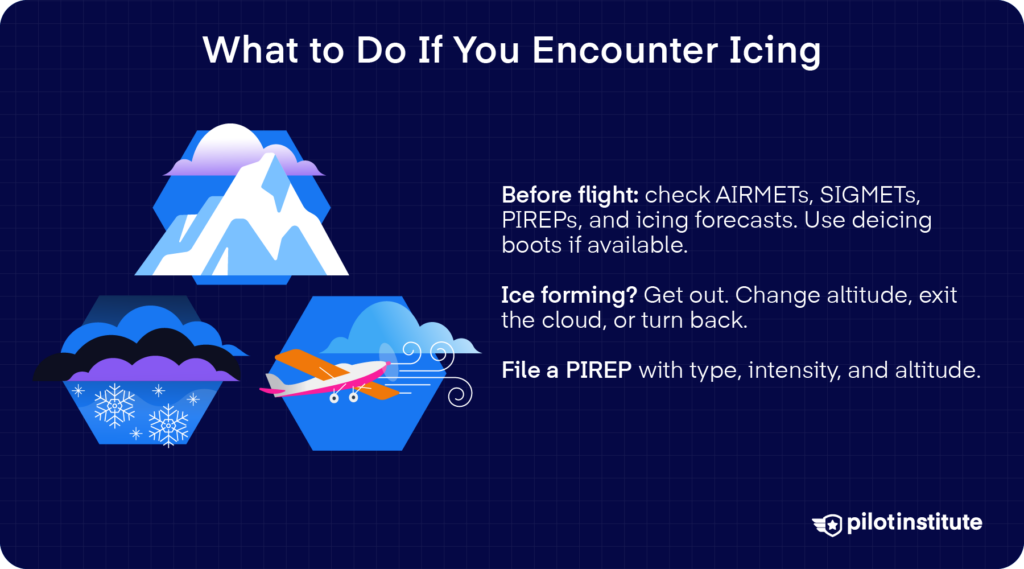
So, how do you deal with icing in flight? The honest answer is that prevention beats response every time.
The FAA published AC 91-74B to help you avoid icing conditions in the first place. It also talks about your exit options if ice does form.
The bottom line is this. If your aircraft is not approved for known icing conditions, your job is to stay out of them.
1. Avoid It In the First Place
What counts as “known icing conditions”?
These are circumstances where a reasonable pilot would expect a substantial likelihood of ice formation on the aircraft based on all the information available to that pilot.
So before launching, check AIRMETs and SIGMETs. Don’t forget Icing PIREPs, the Forecast Icing Potential, and the Current Icing Potential.
2. Know Your Escape Procedure
What if ice still finds you? It’s simple. Get out of the icing layer as quickly and safely as possible.
That usually means changing altitude. If you’re in or coming from stratiform clouds, climbing can take you into colder cloud layers made up of ice particles.
Those pose little threat in structural icing since they’re unlikely to stick to unheated surfaces.
You can also fly out of the cloud entirely, where ice will gradually sublimate or shed from the airframe.
Descending into warmer air, either within or below the cloud, can melt any accumulated ice.
Sometimes, a 180-degree turn back into known good conditions is the safest option. Coordinate with ATC, and don’t hesitate to declare an emergency if you need priority handling.
3. Deicing and Anti-icing
On the ground, you’ll typically see trucks or carts fitted with sprayers. Those trucks apply anti-icing or deicing fluid directly to your aircraft’s surfaces.
But when you’re in the air, your savior will be the deicing and anti-icing equipment fitted to your aircraft.
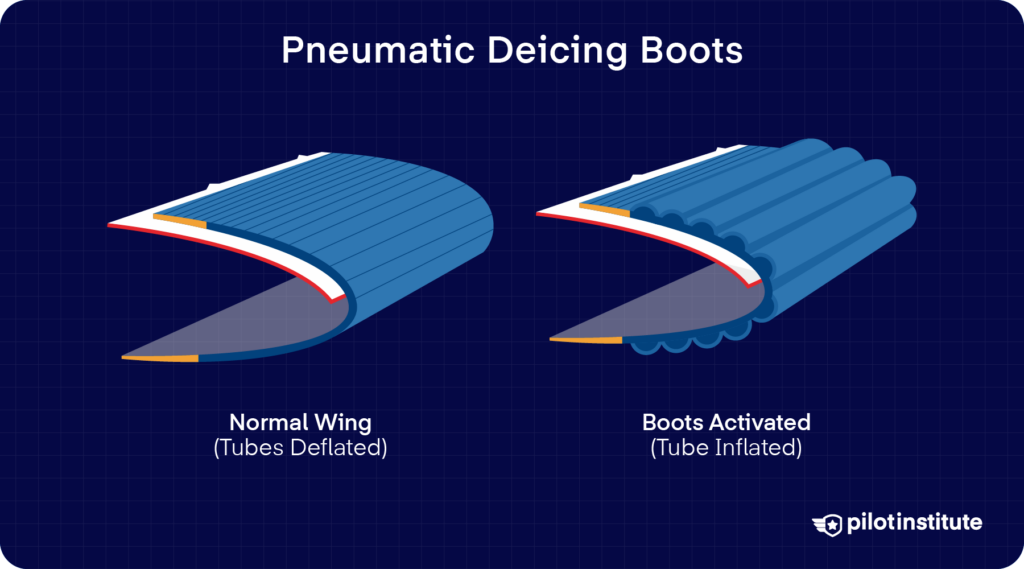
Pneumatic boots inflate on the leading edges to crack off accumulated ice. Heated leading edges, whether powered by hot bleed air or electric mats, do the same job with thermal energy.
Pitot heat protects your airspeed indicator from blocked pressure ports.
In piston aircraft, carburetor heat counters the venturi-induced icing that can slowly choke off your engine.
4. Let Others Know
One more thing. File a PIREP.
The currently accepted icing intensity definitions appear in the Aeronautical Information Manual (AIM). You can report yours as trace, light, moderate, or severe.
State whether the ice is rime or clear, and note “mixed” if you spot both. Don’t forget to mention the altitude.
Your icing PIREP feeds forecast models and helps ATC route others away from trouble.
Frequently Asked Questions
“What is the difference between rime ice and clear ice?”
Rime ice is the rough, milky-white deposit that forms when small supercooled droplets freeze the instant they strike the aircraft.
Air gets trapped inside the structure, which creates a porous, brittle feel.
Clear ice, on the other hand, is smooth and glassy. It forms when larger droplets spread out before freezing on the aircraft surface.
The result is a dense, transparent layer that’s much harder to spot and to remove.
“Which type of aircraft icing is more dangerous?”
Clear ice is particularly dangerous because it tends to form horns near the top and bottom of the airfoil’s leading edge. It disrupts a much larger area of airflow than rime ice does.
It’s also transparent, so you may not notice it forming until it’s already affecting your aircraft’s performance.
And while deicing equipment can usually handle it, clear ice can spread beyond the protected area. That’s why removing it completely can be a tough job.
“At what temperature does icing typically occur?”
Rime ice forms across a wide temperature range, anywhere from 32°F down to -40°F (0°C down to -40°C), though it’s most common between 14°F and -4°F (-10°C and -20°C).
Clear ice, on the other hand, favors warmer conditions with higher liquid water content and larger droplets. The range between 32°F and -4°F (0°C and -20°C) is its prime territory.
Here’s the catch, though: the temperature of your aircraft skin also plays a hand in ice formation. Cold-soaked wings can collect ice even when your OAT reads a few degrees above freezing.
“Can you fly through icing conditions?”
It depends on your aircraft’s certification.
If your aircraft is approved for flight into known icing (FIKI) and equipped with the required ice protection systems, then yes, within published limits.
If it is not, the FAA requires immediate exit from icing conditions under regulations, including under 14 CFR 91.13(a) and 91.9(a).
For large and turbine-powered multiengine airplanes, 14 CFR 91.527 adds additional requirements.
“What is the difference between deicing and anti-icing?”
Anti-icing is proactive. You apply it to clean aircraft surfaces before departure to create a protective layer that resists frost, ice, snow, or slush from bonding in the first place.
Deicing, on the other hand, is reactive. If frost, ice, slush, or snow has already accumulated on the aircraft, deicing is how you get rid of it before you depart.
On the ground, you’ll typically see trucks or carts fitted with sprayers. Those trucks apply anti-icing or deicing fluid directly to your aircraft’s surfaces.
In the air, your savior will be your aircraft’s deicing and anti-icing systems.
Conclusion
Remember that airspeed drop you noticed back at the start? It’s trying to tell you something.
Knowledge about the difference between rime ice and clear ice tells you how fast the situation is getting worse. It also tells you how much time you have before things turn ugly.
So before you get in the cockpit, check the latest PIREPs along your route and know your escape plan.
When it comes to aircraft icing or anything else in flying, this one principle stays true: prevention always beats response.