
-
Key Takeaways
-
Know Your Audience & Radio Environment
- Quick Radio Map: Who You’ll Talk To
-
Try Our Free VFR Radio Call Student Pilot Sheet
-
Radio Fundamentals You Can’t Skip
- The 5 C’s of Effective Comms
- The “4 Ws” Structure
- Phonetic Alphabet & Number Technique
- Radio Etiquette Do’s & Don’ts
-
Script Library: VFR Scenarios Step-by-Step
- 1. Non-Towered Airport – Departing
- 2. Non-Towered Airport – Arriving
- 3. Towered Field: Ground → Tower → Departure
- 4. Picking Up / Canceling Flight Following
- 5. Class B Transition
- 6. Practice Instrument Approach in VFR
- 7. Special VFR
- 8. Emergency & Unusual Situations
- 9. Student Pilot Pro Tips
-
Customizing & Memorizing Your Scripts
- Building a Personal Kneeboard Cheat Sheet
-
Common Mistakes And How To Fix Them
-
Beyond the Script: Developing Real-World Comms Skill
- Understanding Controller Expectations
- When & How to Deviate From the Script
-
Frequently Asked Questions
- How Do Beginners Talk on the Radio?
- What Are the 5 C’s of Radio Communication?
- How Do You Start a Radio Call?
- What Is the Aviation Phonetic Alphabet?
-
Conclusion
Your thumb hovers over the push-to-talk switch, and the cockpit goes quiet. Passengers stare. Your instructor waits.
Then ATC breaks in with, “Last aircraft, say again.”
That moment hits almost every pilot. Radio work feels chaotic, but it doesn’t have to be. And with practice, it never will be again.
This guide shows you those patterns you need to stay one step ahead. We’ll give you ready-to-use scripts and teach you how to make your radio comms sound calm and confident from day one.
Key Takeaways
- Most radio calls follow predictable patterns you can memorize and reuse.
- Clear, concise calls reduce workload and stress for everyone more often.
- Scripts, kneeboard cues, and practice loops are habits that build confidence and competence.
- Safety comes first, so use plain English when needed and standard phraseology when able.
Know Your Audience & Radio Environment
Have you ever gotten mic fright before you pushed that transmit button? That’s totally normal. You might be new to talking on the radio, or maybe you’ve already had some hours, but nerves still get the best of you.
If you fly in controlled airspace around larger airports, you likely communicate with air traffic control a lot.
Do you usually fly in a non-towered airport? Then you probably already know that things go a little differently there.
You might still get nervous, but if you know who’s on the other side and what they need to know about your flight, radio communications become less of a guessing game.
Quick Radio Map: Who You’ll Talk To
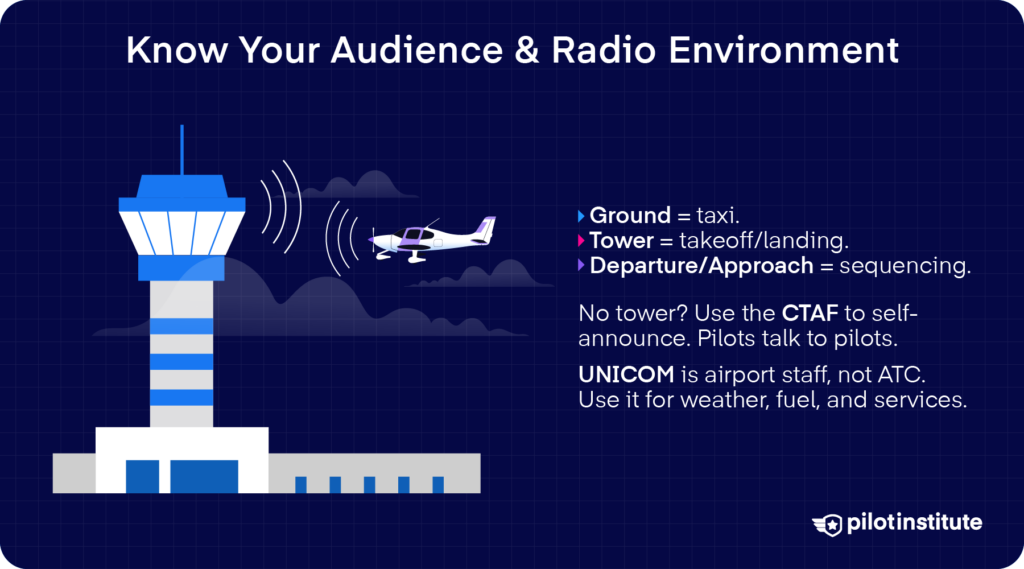
Ground control is usually the first person you talk to at a towered airport when you are still on the ground. They clear you to taxi and tell you which route to use to the runway.
Once you are ready for takeoff, tower control takes over. Tower announces clearances for takeoff and landing.
After takeoff, if the airport has an approach and departure controller, you’ll tune into that facility.
Approach and departure provide sequencing and separation with other traffic as you climb or descend. They help you safely transition between climbing out of an airport and heading toward cruise.
When you’re flying long distances, typically under Instrument Flight Rules (IFR) or receiving VFR flight following, an en route center, often called Center or ARTCC (Air Route Traffic Control Center), could be your next contact.
They handle high altitude traffic and coordinate flights between airports over wide regions. They use radar and radio to provide traffic advisories and clearances.
But not all airports have a control tower available. So, where do you tune in? You could use the Common Traffic Advisory Frequency (CTAF).
CTAF is a shared frequency where pilots communicate their positions and intentions so others nearby know where everyone is and what they plan to do.
You essentially talk with other pilots rather than to someone watching you.
Don’t get this mixed up with UNICOM, which is also often found at non-towered airports. UNICOM is a nongovernment service run by airport staff or businesses.
You can use UNICOM to ask about weather, runway conditions, services like fuel, or other airport info.
Sometimes, the UNICOM frequency is the same as the CTAF, but it is still called UNICOM when you are talking to a person on the ground.
Now, where do you find the frequencies you’ll need to tune into on your flight? Look into official sources like the FAA Chart Supplement and aeronautical charts. Every airport entry will list the frequencies of different facilities in the area.
| Facility | Phrase to Call | Why You Call | When You Leave |
| Ground | “Addison Ground” | Request taxi clearance, advising you have the current ATIS information. | Hold short or switch to Tower |
| Tower | “Addison Tower” | Takeoff or landing clearance | Frequency change approved |
| Approach / Departure | “Dallas Departure” | Flight following, Class B entry | Hand-off or radar service terminated |
| Center | “Fort Worth Center” | En-route advisories | Next sector or VFR switch-off |
| FSS | “Fort Worth Radio” | Open or close flight plans | After acknowledgement |
| CTAF / UNICOM | “Georgetown Traffic” | Self-announce | Entering controlled airspace |
Try Our Free VFR Radio Call Student Pilot Sheet
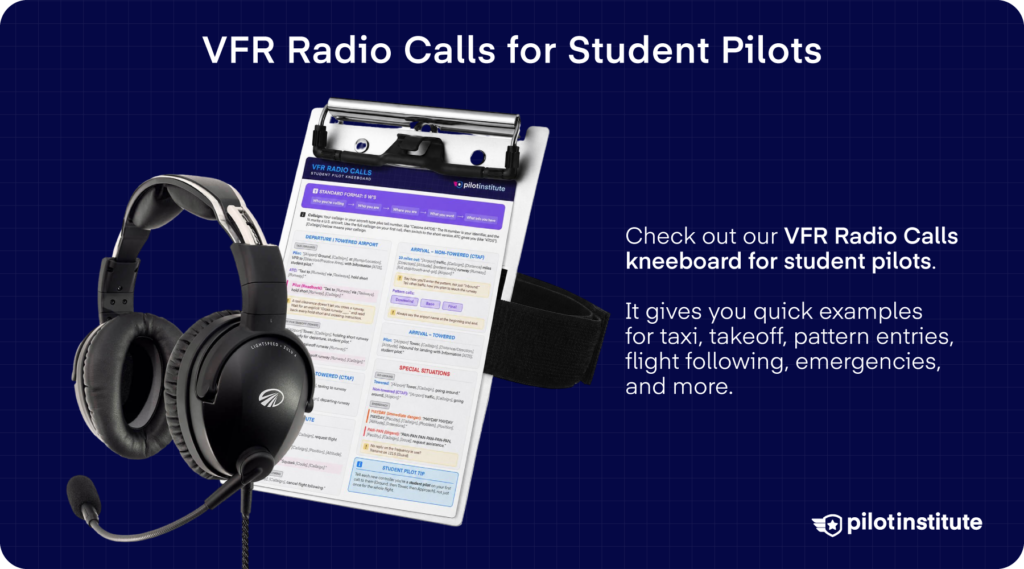
Check out our VFR Radio Call sheet. It provides quick examples for taxi, takeoff, pattern entries, flight following, emergencies, and more.
Radio Fundamentals You Can’t Skip
The 5 C’s of Effective Comms
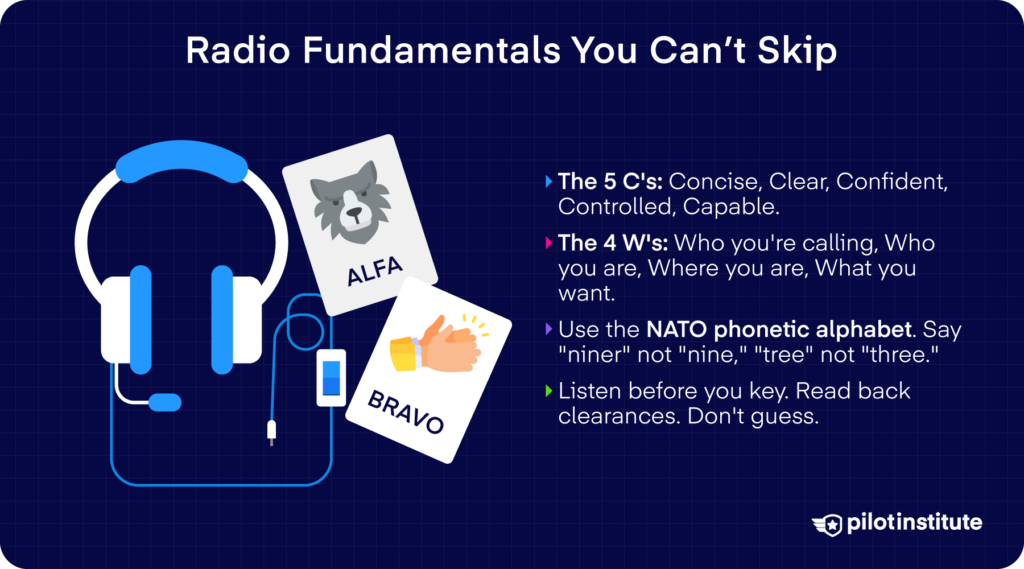
Radio calls can make you feel like a nervous wreck, especially at first, but just practice these five habits, and you’ll hear a massive difference in how you sound.
Start with being concise. Extra chatter only slows things down. Get to the point in as few filler words as possible.
Why is that so important? Well, first, controllers need to grasp your request quickly. Efficient yet accurate radio calls help move things along more quickly, especially in an emergency.
And second, remember that you’re sharing the frequency with other pilots. The shorter you relay your transmission, the sooner they can get theirs across as well, which you’ll appreciate when it’s you waiting for your turn.
Being clear comes next. And yes, we did say to keep it brief, but you should still speak at a pace where every word lands, especially runway numbers and altitudes.
You can tell when someone on the radio sounds confident. More than an ego boost, it’s one of the makings of a real professional.
You sound like you belong on the frequency. That feeling grows with practice, so early flights should focus on the proper cadence and how you modulate your voice.
This ties into making sure your transmissions are controlled, especially when the radio gets busy. Your voice stays steady even if several calls stack up ahead of yours.
What brings it all together? Being a truly capable pilot. The most important thing is that you know the status of your flight, and what to expect from other people in the frequency. You should understand what you need to read back.
The “4 Ws” Structure
To make every call make sense, here’s a simple structure that experienced pilots use all the time. Start with these four things in this order:
- Who you are talking to.
- Who you are.
- Where you are.
- What you want.
Phonetic Alphabet & Number Technique
You’ll also use a special set of words to spell letters and numbers on the radio. That set is called the NATO phonetic alphabet, and the FAA expects you to use it when spelling letters that might be confusing to understand.
Here’s the whole alphabet you should learn and use:
| Character | Telephony | Phonic (Pronunciation) |
| A | Alfa | (AL-FAH) |
| B | Bravo | (BRAH-VOH) |
| C | Charlie | (CHAR-LEE) or (SHAR-LEE) |
| D | Delta | (DELL-TAH) |
| E | Echo | (ECK-OH) |
| F | Foxtrot | (FOKS-TROT) |
| G | Golf | (GOLF) |
| H | Hotel | (HOH-TEL) |
| I | India | (IN-DEE-AH) |
| J | Juliett | (JEW-LEE-ETT) |
| K | Kilo | (KEY-LOH) |
| L | Lima | (LEE-MAH) |
| M | Mike | (MIKE) |
| N | November | (NO-VEM-BER) |
| O | Oscar | (OSS-CAH) |
| P | Papa | (PAH-PAH) |
| Q | Quebec | (KEH-BECK) |
| R | Romeo | (ROW-ME-OH) |
| S | Sierra | (SEE-AIR-RAH) |
| T | Tango | (TANG-GO) |
| U | Uniform | (YOU-NEE-FORM) or (OO-NEE-FORM) |
| V | Victor | (VIK-TAH) |
| W | Whiskey | (WISS-KEY) |
| X | Xray | (ECKS-RAY) |
| Y | Yankee | (YANG-KEY) |
| Z | Zulu | (ZOO-LOO) |
| 1 | One | (WUN) |
| 2 | Two | (TOO) |
| 3 | Three | (TREE) |
| 4 | Four | (FOW-ER) |
| 5 | Five | (FIFE) |
| 6 | Six | (SIX) |
| 7 | Seven | (SEV-EN) |
| 8 | Eight | (AIT) |
| 9 | Nine | (NIN-ER) |
| 0 | Zero | (ZEE-RO) |
Radio Etiquette Do’s & Don’ts
The radio frequency is something you share with other pilots. In that sense, everyone, including you, is responsible for keeping it smooth and orderly.
How can you do your part?
- Do listen for a few seconds before you key your mic. You want to make sure nobody else is talking at that moment.
- Do read back what the controller requires you to repeat. Echo back your instructions exactly as given.
- Do identify yourself as a “student pilot” on your first call when appropriate. It helps identify you so controllers and other pilots have the right expectations.
- For example, you could say, “Dayton tower, Fleetwing One Two Three Four, student pilot.”
- Don’t use slang or radio phrases that do not belong in aeronautical communications. Words like “Gotcha” or “Over and out” are not part of official phraseology. Controllers and other pilots expect standardized wording.
- Don’t hog the frequency. After you transmit, let the channel sit quiet for about ten seconds before you call again if you have no immediate reply.
Script Library: VFR Scenarios Step-by-Step
1. Non-Towered Airport – Departing
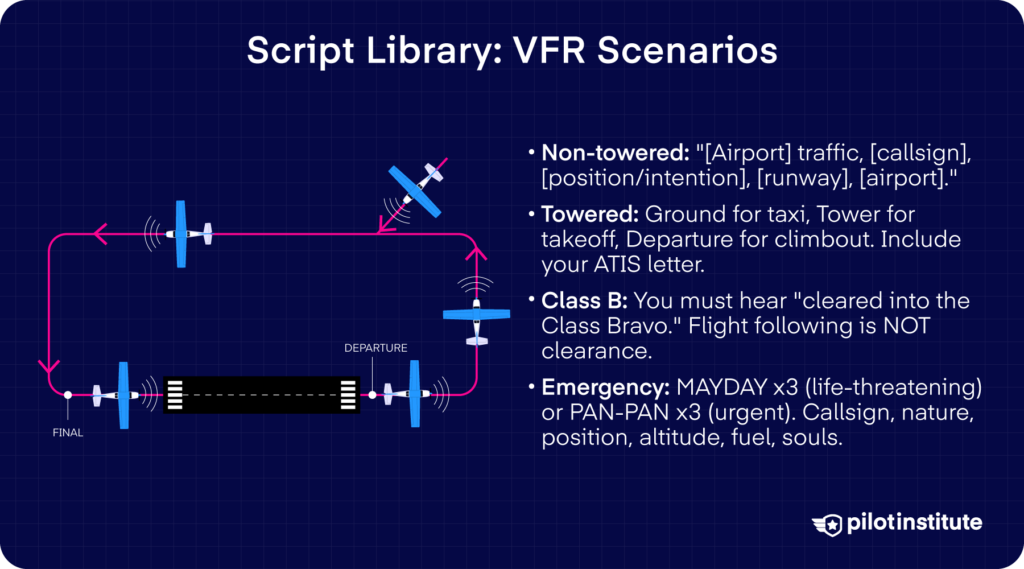
When you’re at a non-towered airport and ready to go, you use the CTAF so other pilots in the area know what you plan to do. Start by listening to make sure nobody else is talking, then call with your position and intentions.
Right before you start your takeoff roll, you might transmit:
“Midwest National traffic, Cessna One Two Three Bravo departing the pattern to the southwest, runway Two Eight, Midwest National.”
Keep transmitting your status and intentions through every leg, and once you reach downwind, mention how you plan to leave the pattern. You can say:
“Midwest National traffic, Cessna One Two Three Bravo, on left-downwind, Runway Two Eight, departing the pattern to the southwest. Midwest National.”
Please use the published airport name instead of the town name to avoid confusion.
What difference does it make? Think about how multiple airports can sit near the same city. Local nicknames are not always obvious on the radio.
Take KGPH as an example. The charted name is Midwest National. That is why you say “Midwest National traffic,” not “Mosby traffic” or “Clay County traffic.”
2. Non-Towered Airport – Arriving
As you come in toward an airport that has no tower, start talking once you’re about ten miles out. An example call is:
“Midwest National traffic, Cessna One Two Three Bravo, ten miles east at two thousand five hundred feet, inbound landing runway Two Eight, Midwest National.”
Then, as you get into the pattern, continue to share updates like:
“Midwest National traffic, Cessna One Two Three Bravo, left downwind, runway Two Eight, Midwest National.”
Notice how we didn’t include the phrase “any traffic in the area, please advise”? It doesn’t belong on the radio. It is not a recognized self-announce call and should not be used at any time.
That call doesn’t tell anyone where you are or what you plan to do. Other pilots already know to speak up if they are nearby and able to use the radio.
Do you need to ask them first? No, because radio procedures require all air traffic to announce themselves without being prompted.
3. Towered Field: Ground → Tower → Departure
When you’re still on the ground, if there’s a ground control facility, you need to contact them before you taxi. Don’t forget to include the ATIS information letter and departure clearance so the controller knows you have the latest weather and airport info.
A normal taxi call might sound like:
“Greenwest Ground, Cessna One Two Three Bravo, at the ramp, request taxi for VFR departure to Springfield with information Charlie.”
As you reach the hold-short point and switch to tower, you announce your position again so the tower knows exactly where to expect you. This is how you say it:
“Greenwest Tower, Cessna One Two Three Bravo holding short runway Two Eight on Alpha, ready for departure.”
After takeoff, the controller might hand you off to departure frequency, and you would check in with something like:
“Midwest Departure, Cessna One Two Three Bravo passing two thousand five hundred climbing to four thousand five hundred.”
4. Picking Up / Canceling Flight Following
What is flight following for? It gives you traffic advisories from air traffic control as you fly, which comes in extremely handy even on VFR trips. To pick it up after departure or while en route, contact the appropriate approach or center frequency with a simple initial request.
You might call:
“Greenwest Approach, Cessna One Two Three Bravo, request flight following.”
Wait for the controller to reply with a go-ahead before giving your full position, altitude, and destination request for flight following.
Once the controller agrees to provide flight following, they will assign you a transponder code which could sound like, “Cessna One Two Three Bravo, squawk 4521, Midwest altimeter 2992.” Enter the squawk code into your transponder, and adjust your altimeter to the given setting.
Respond with the transponder code and your callsign so the controller knows you have set it correctly.
What if you decide to cancel flight following? You would tell the controller something along the lines of:
“Greenwest Approach, Cessna One Two Three Bravo has the field in sight and would like to cancel flight following.”
The controller will confirm cancellation and instruct you to “squawk VFR,” which means return your transponder to the standard VFR code of 1200.
5. Class B Transition
Remember that VFR flights need a specific clearance to enter and operate within Class B airspace before you cross its boundary.
Simply being on flight following or hearing traffic advisories does not count as clearance by itself, so you must request it and hear the controller give you the clearance.
For example, as you approach the edge of the Los Angeles Class B from the south along a shoreline route, you might call on the SoCal Approach frequency when you’re about 15 to 20 miles out.
Your radio call could be:
“SoCal Approach, Cessna One Two Three Bravo, three zero miles south of Seal Beach at two thousand five hundred feet, request Bravo transition along the shoreline.”
6. Practice Instrument Approach in VFR
There’ll be times when you’re flying under VFR but want to practice an instrument approach with radar vectors. What do you say to the controller?
Start by contacting the appropriate approach control. Then, make it clear that you’re flying VFR and practicing the instrument procedure rather than flying a real instrument flight plan.
For example, you might call:
“Greenwest Approach, Skyhawk One Two Three Bravo, five miles east of the VOR at three thousand, request vectors for practice RNAV Two Three with missed, VFR.”
7. Special VFR
Special VFR is a clearance you have to request from air traffic control if you want to operate inside the controlled airspace surface area of an airport when the weather is below normal VFR minimums.
Under 14 CFR 91.157, you must:
- Have at least one statute mile of flight visibility.
- Remain clear of clouds while you can still see the surface.
- Operate between sunrise and sunset.
ATC won’t just offer this clearance on its own. You have to ask for it.
Special VFR only applies below 10,000 feet MSL and inside a surface control area like Class B, C, D, or Class E down to the surface.
These limitations must also apply to a student pilot, right? Not so fast.
According to 14 CFR 61.89, if you’re a student pilot, SVFR or not, you will always need at least three statute miles of visibility in daylight and five statute miles at night.
A typical Special VFR script for a departure could be something like:
“Greenwest Tower, Cessna One Two Three Alpha Bravo request Special VFR departure to remain in pattern.”
8. Emergency & Unusual Situations
If you’re facing an emergency or distress situation, how can you clearly let everyone know?
If your aircraft is in a distress situation that threatens life or safety, you begin your call with MAYDAY, MAYDAY, MAYDAY.
Urgency situations that are serious but not immediately life-threatening begin with PAN-PAN, PAN-PAN, PAN-PAN.
The FAA treats distress calls with absolute priority on the frequency. Urgency calls take priority over all but distress, so be precise with your keywords.
Your transmission should have as many of these elements, preferably in order:
- If distress, MAYDAY, MAYDAY, MAY-DAY; if urgency, PAN-PAN, PAN-PAN, PAN-PAN.
- Name of station addressed.
- Aircraft identification and type.
- Nature of distress or urgency.
- Weather.
- Pilot’s intentions and request.
- Present position, and heading; or if lost, last known position, time, and heading since that position.
- Altitude or flight level.
- Fuel remaining in minutes.
- Number of people on board.
- Provide any other helpful information.
A simple MAYDAY example might go like this:
“MAYDAY, MAYDAY, MAYDAY, Boston Center, Cessna One Two Three Bravo, engine failure at ten miles south at four thousand feet, will attempt forced landing, request vectors.”
A PAN-PAN transmission could be:
“PAN-PAN, PAN-PAN, PAN-PAN, Boston Approach, Skyhawk Four Five Six Juliet, lost navigation, request assistance and traffic advisories.”
9. Student Pilot Pro Tips
There’s a lot you’re learning for the first time as a student pilot. As such, there will be mistakes, and they happen even to the most experienced among us. But what can you do to keep them to a minimum?
Practice before a flight on the ground. Say the calls out loud, and remember the basic template.
Controllers can be great teachers, too! Don’t be shy to announce that you’re a student pilot on your first calls. They understand that you are still learning and that you may speak slowly or need to ask them to repeat information.
Avoid trying to guess what controllers want if you are unsure. It’s perfectly okay to ask them to repeat or clarify.
Customizing & Memorizing Your Scripts
Building a Personal Kneeboard Cheat Sheet
You talk on the radio in chapters, and each phase of flight has its own rhythm. Each facility asks for different calls, so it helps to arrange your scripts the same way.
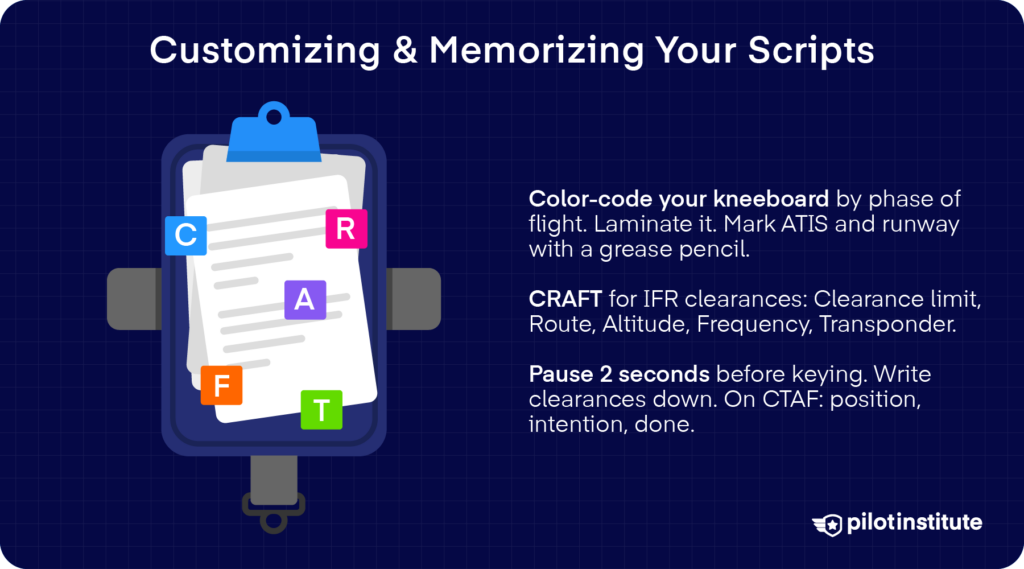
Why don’t you try color-coding your kneeboard? Yellow might catch your eye for taxi and departure. Green can flag en route calls. Another color can handle arrival and landing.
If you have a cheat sheet, laminate it so it’s always ready in every flight, instead of having to make a new one every time. You can use a grease pencil to add changing details like the ATIS letter or the active runway.
Clearances can feel fast and heavy, especially under IFR, and that is where having a system can save you.
Did you know that there’s also a pattern to it? Commit the CRAFT acronym to memory and break your clearance into manageable pieces.
It stands for:
- Clearance Limit
- Route
- Altitude
- Frequency
- Transponder Code
Common Mistakes And How To Fix Them
Stepping on someone else’s transmission is one of the most common radio mistakes. You start talking and realize too late that someone else was already mid-sentence.
Thankfully, the fix is all too simple. Just pause and listen for at least two seconds before you speak. It also gives you a beat to line up your words so the next call sounds deliberate instead of hurried.
Readback errors come from a similar place. You hear a clearance, but you don’t repeat it exactly as given.
Controllers expect certain items back every time. Struggling to remember it all? Write it down as you hear it, word for word, then read it back.
Many traps can be found in the CTAF. Long, rambling calls clog the frequency and hide the information other pilots actually need.
You state your position and intention, then stop. If nothing new comes up, you wait about ten seconds before speaking again.
Beyond the Script: Developing Real-World Comms Skill
Understanding Controller Expectations
Many controllers will tell you that their favorite pilots are the ones who listen before they talk. They use standard phraseology and give accurate readbacks.
Those behaviors help the controller keep traffic flowing safely and smoothly, which naturally reduces stress for everyone involved.
When & How to Deviate From the Script
Safety always trumps a memorized script. The FAA’s guidance on radio communications notes that standard phraseology is important but not absolute if something unsafe is happening.
Imagine you suddenly experience a bird strike on climb out and lose airspeed. Following a script word-for-word is not your priority. It’s perfectly acceptable to say something like, “Mayday, Skyhawk One Two Three Bravo, bird strike, losing airspeed, request priority return.”

Free Private Pilot Study Sheet
Grab a printable PDF that highlights must-know PPL topics for the written test and checkride.
- Airspace at-a-glance.
- Key regs & V-speeds.
- Weather quick cues.
- Pattern and radio calls.
Frequently Asked Questions
How Do Beginners Talk on the Radio?
Listen to the frequency for a few seconds before you transmit. Use the same order on every call: who you’re calling, who you are, where you are, and what you want.
Speak slowly, read back what the controller tells you, and add “student pilot” on your first call so they know to help.
What Are the 5 C’s of Radio Communication?
The 5 C’s are concise, clear, confident, controlled, and capable. Keep calls short, say each word clearly (especially runway numbers and altitudes), and stay steady when the frequency gets busy.
Above all, know your flight status and what you need to read back.
How Do You Start a Radio Call?
State the facility you’re calling, then your full call sign, your position if you’re on the ground, and your request.
The FAA lays out this order in the Aeronautical Information Manual. For example: “Greenwest Ground, Cessna One Two Three Bravo, at the ramp, request taxi.”
What Is the Aviation Phonetic Alphabet?
It’s the ICAO phonetic alphabet, also called the NATO phonetic alphabet. It gives each letter a code word, like Alpha for A, Bravo for B, and Charlie for C. Pilots use it on initial contact and anytime letters could be confused, so N123AB becomes “November One Two Three Alpha Bravo.”
Conclusion
Radio communication gets easier when you stop treating it like a performance and start treating it like a skill you train.
Scripts give you structure, but practice gives you confidence. Listen first, then speak with purpose. That’s all you need to stay safe on any frequency.
You don’t need a perfect voice. You just need clear intent and steady habits.
Take these scripts to your kneeboard, and try them on quieter days. Growth comes one call at a time. Speak up and trust that you belong there.