
-
Key Takeaways
-
Commercial Pilot Timeline: Private → CPL
-
Step 1 — Private Pilot Certificate
-
Step 2 — Instrument Rating
- Training for Your IR
-
Step 3 — Build Time Intentionally
- Flight Experience (Part 61, Airplane Single-Engine CPL)
- Smart Time Building
-
Step 4 — Choose Your Training Path: Part 61 vs Part 141/142
- Part 61
- Part 141
- Part 142
- Comparison Table: Hour Minimums & Structure
-
Step 5 — The Tests: Knowledge (CAX) → Practical
- Knowledge Test
- Practical Test
-
Timeline Scenarios
- Part 61
- Part 141
- Part 142
-
Medical & Administrative Checklist
- Medical: Second-Class Medical to Exercise Commercial Privileges
- FAA Test Documents
-
Frequently Asked Questions
- "How many flight hours does it take to get a CPL?"
- "How long does it take to become a commercial pilot?"
- "What is the shortest path to becoming a commercial pilot?"
-
Conclusion
There comes a point in many a pilot’s journey where flying stops being just a personal achievement. Instead, it becomes a qualification for a career.
When you work towards a commercial pilot certificate, hours of flight come together into something that can open doors to professional flying. You can get paid for doing what you love.
But how long does it actually take? What steps come first, and what training paths can you choose from?
FAA requirements and training milestones will define your timeline. But once you understand the sequence, the process becomes predictable.
Let’s go step by step from private to commercial pilot. We’ll tell you what to expect and how you can choose a training plan that works best for you.
Key Takeaways
- A commercial pilot certificate allows you to fly aircraft for compensation or hire legally.
- Parts 61, 141, and 142 define FAA training structures and certification pathways.
- You need a minimum of 190 or 250 total flight hours, depending on your training path.
- Your timeline depends on the training structure and how efficiently you complete the required milestones.
Start with the Right Study Plan
Use the sheet as your roadmap, then reinforce with lessons and quizzes.
- Fits any ground school.
- Find weak spots.
- Test-day essentials.
- Extra resources.
Commercial Pilot Timeline: Private → CPL
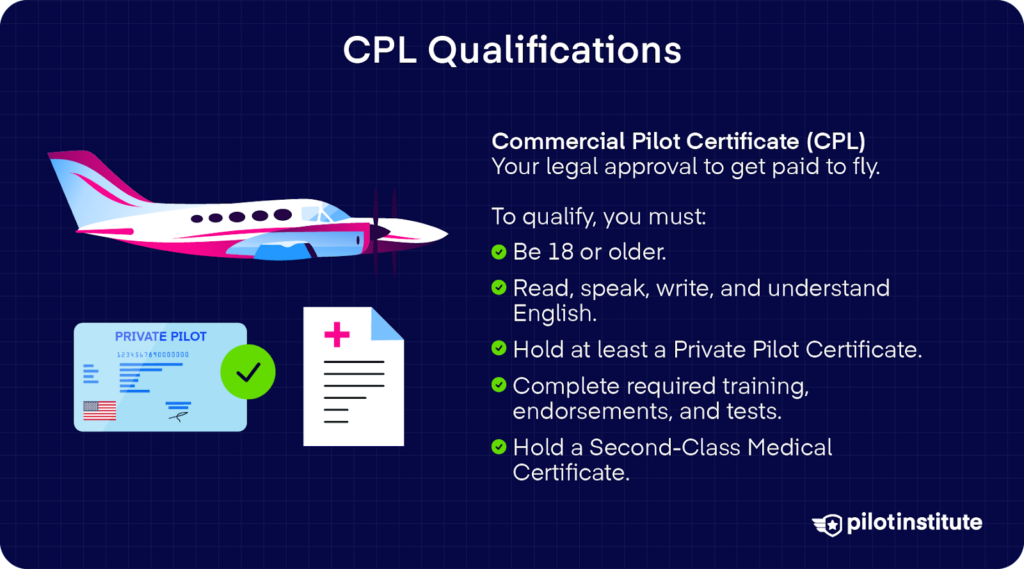
A commercial pilot certificate (CPL) is your legal permission slip to get paid for flying. It’s your license to act as pilot in command of an aircraft carrying people or property for compensation or hire.
Do you qualify in the world of employed pilots? First, check the eligibility requirements in 14 CFR 61.123:
- You must be at least 18 years old.
- You must be able to read, speak, write, and understand English (unless the FAA issues a limitation for medical reasons).
- You must hold at least a private pilot certificate.
- You must complete the required training, endorsements, and tests for the rating you’re applying for.
You also can’t exercise commercial privileges without the right medical. And this time around, you’ll need at least a second-class medical certificate.
Step 1 — Private Pilot Certificate
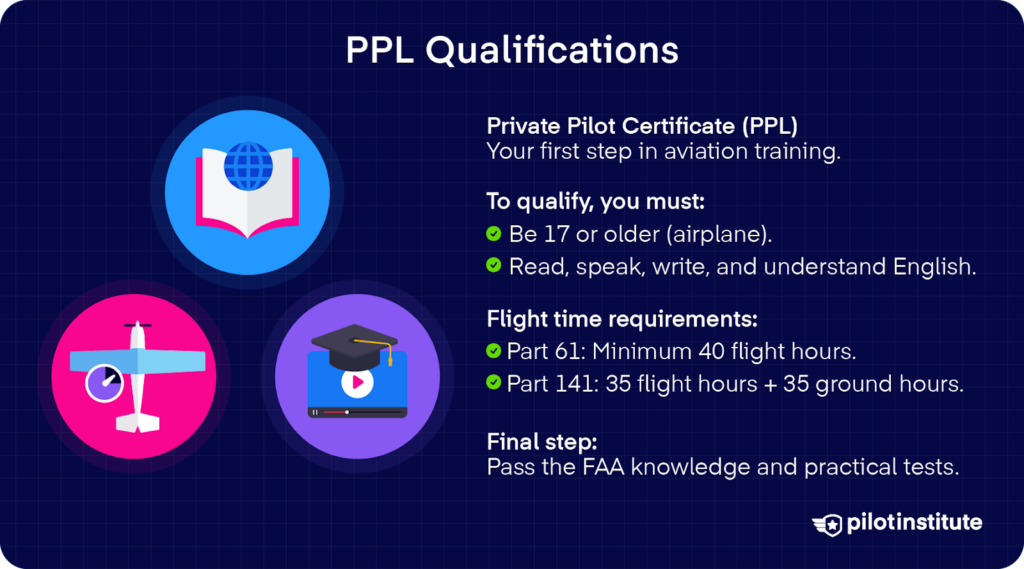
Your private pilot certificate (PPL) is square one in your career. It’s where you learn how to safely operate an aircraft and build habits that will stick with you all the way to the commercial level.
Don’t have a PPL yet? You have to meet basic eligibility first. You need to be at least 17 years old (for airplane ratings), and you need to read, speak, write, and understand English.
As for flight experience, it’ll depend on your chosen training path.
For a single-engine land (SEL) private pilot certificate, you must log at least 40 hours of flight time under Part 61. For Part 141, you’ll need at least 35 hours of flight training plus a required 35 hours of ground training.
You can complete all that in as little as three months if you take an accelerated program.
Okay, what are these “Parts” even all about? They’re essentially different rules on pilot training and certification. We’ll dive deeper into them later on.
After training, you’ll have to take the FAA private pilot knowledge and practical tests. Once you pass, you’ll have that plastic with your name on it—the first of many.
Step 2 — Instrument Rating
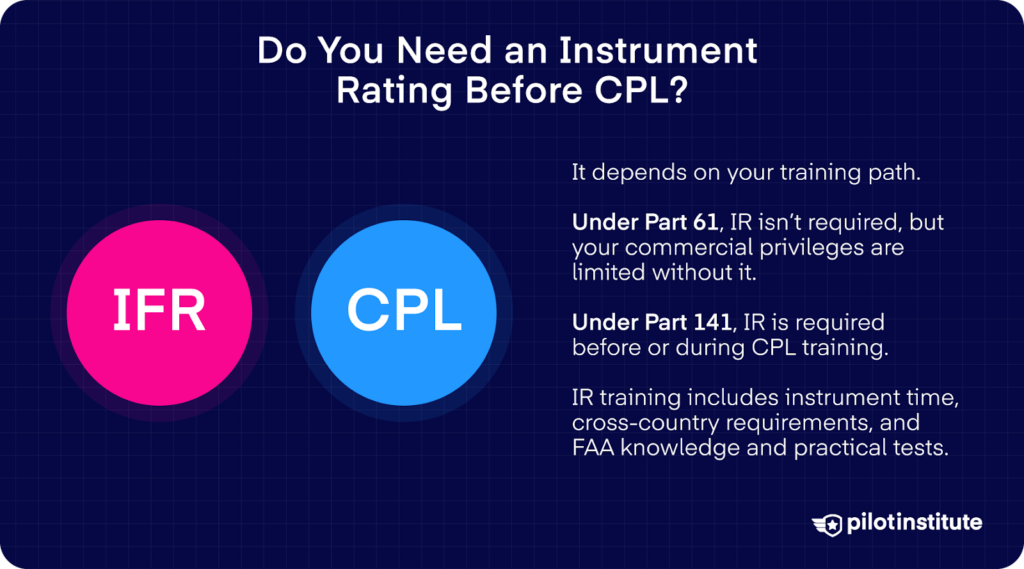
Do you need an instrument rating (IR) before commercial training? The short answer is: it depends.
IR is technically not required for CPL training under Part 61. Just know that your license will be quite handicapped without it.
For the airplane or powered-lift category, you can’t carry passengers for hire at night or on cross-country flights beyond 50 nautical miles without an instrument rating in that same category and class. And, of course, you can’t operate under IFR without the appropriate rating.
But on the plus side, you can begin working in general aviation as soon as you earn your CPL. You’ll have a way to fund your instrument training and build experience at the same time. You could even work toward your IR on your days off.
Part 141 is more structured. If you’re pursuing the reduced 190-hour minimum under §61.129(i), your training must follow an FAA-approved commercial course under Appendix D, which includes instrument training requirements within the syllabus.
Many Part 141 programs require you to hold an instrument rating or complete instrument training as part of the commercial course. That means you’ll need to either already have an IR or train for it at the same time as your CPL.
Training for Your IR
So, what’ll your IR training look like? Under Part 61, you’ll need to log at least 50 hours of cross-country flight time as pilot in command.
You must also complete at least 40 hours of actual or simulated instrument time. 15 hours of that must be instrument flight training from an authorized instructor. You’ll also need a long IFR cross-country as part of your prep.
Training under Part 141 follows a rigorous FAA-approved curriculum. You’ll need 30 hours of ground training and at least 35 hours of instrument flight training for an initial IR.
And as with every stage, you’ll need to pass the FAA knowledge and practical tests.
The whole process of getting an IR can take 3 months if you’re consistent. If you only train occasionally, expect that timeline to stretch longer.
Step 3 — Build Time Intentionally
Flight training will take up a big chunk of the path to your CPL. That said, you can’t rush the commercial certificate through sheer willpower alone.
You need the right flight time, and you need it logged in the right categories.
Flight Experience (Part 61, Airplane Single-Engine CPL)
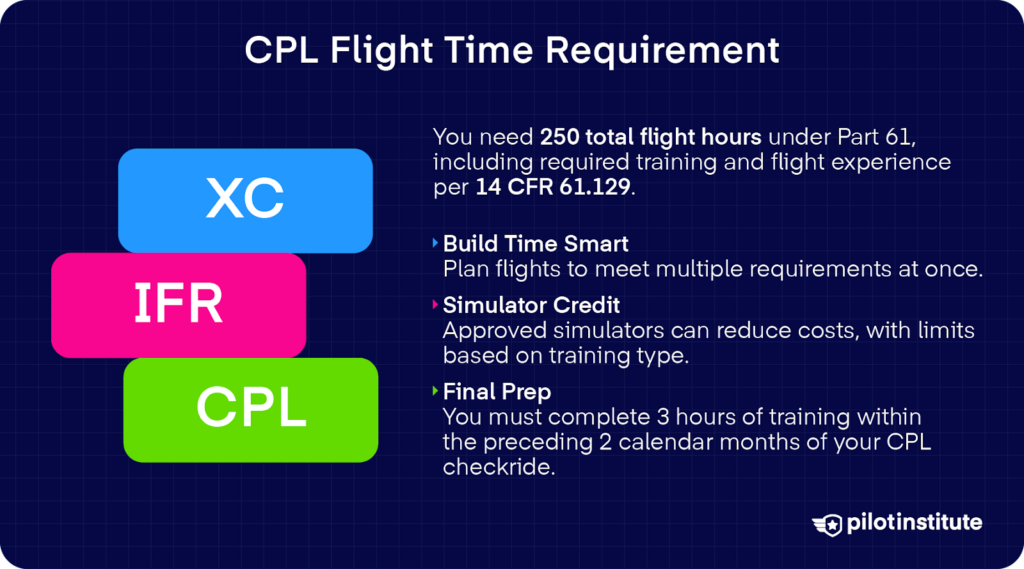
You will need at least 250 hours of total flight time. From there, you’ll build time that checks off specific boxes.
More importantly, though, you’ll need 20 hours of CPL training. That should cover the commercial areas of operation, which include flight categories that’ll shape your training plan. Check out the full list in 14 CFR 61.129(a)(3).
Smart Time Building
You’ll build commercial time faster when every flight has a purpose. So, how can you tick the most boxes in the least hours?
It’s completely acceptable to bundle some requirements into one well-planned flight.
You can fly the required 100 NM cross country, and you can work in view-limiting device time along the way with your instructor. You get real travel experience plus the required instrument training in one flight.
Simulator Credits
You can also count some simulator time toward your required hours, where the cost won’t be nearly as much as renting an aircraft. The easier you can fund your training, the faster you’ll finish.
But the amount of simulator time you can credit depends on your training path and the FAA-approved curriculum you’re following.
You can credit up to 50 hours if you did not complete the required training through a Part 142 training center.
You have to log that sim time with an authorized instructor. Also, it must be in a full flight simulator or flight training device that matches the airplane class or powered-lift category and type you’re pursuing.
But if you did complete the required training at a Part 142 training center, you can credit double that time. In that case, you can count up to 100 hours toward your total experience.
What about Part 141? You can credit a full flight simulator for up to 30% of the total flight training hours required. You can also credit hours in a flight training device (FTD), but the cap is lower at 20%.
Want to combine both? You can do that too, but the total credit from the full flight simulator and the FTD together still can’t exceed 30% overall.
One more catch: even in a combined setup, the FTD portion still can’t go beyond that 20% limit.
Save Three Hours
We also ought to warn you, finishing your training early isn’t always a good thing.
Why is that? You’ll still need three hours of training with an authorized instructor two months before the month of your CPL checkride.
You should spend that time on review and polishing, so don’t use up your flight tokens too soon.
Step 4 — Choose Your Training Path: Part 61 vs Part 141/142
You’ve got the hours ahead of you. Now you decide how you’ll earn them.
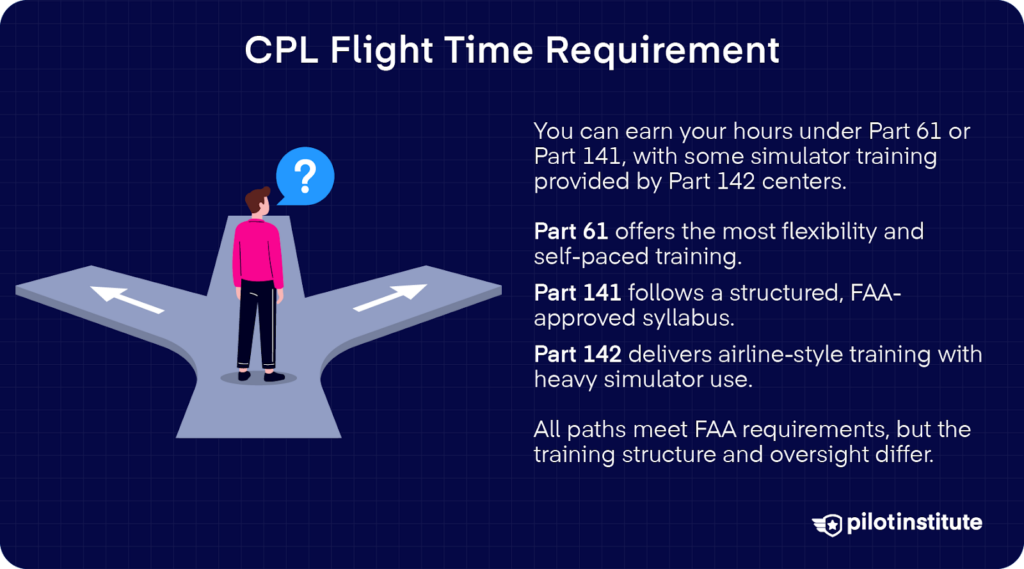
Your options boil down to three training paths: Part 61, Part 141, and Part 142. Which one should you go for? Let’s find out.
Part 61
Part 61 is the flexible route. You aren’t locked into a school syllabus, so you and your instructor can move at your pace.
That’s a big deal if you’re juggling other responsibilities. And if you’re flying somewhere with unpredictable weather, scheduling will be less of a hassle.
Did you know you can take your ground training at home? Some online CPL ground schools are complete with instructor endorsement for your FAA exam. They could even offer lifetime membership, plus access to study and support groups.
Part 141
Part 141 training feels more like a college course. And sometimes, it actually is. The school uses an FAA-approved curriculum with stage checks and completion standards. That can help a lot if you thrive on clear milestones and structure.
These programs are usually offered in Part 141 flight schools or as part of a college degree. They’ll cover your PPL and IR on top of your CPL, and sometimes even further.
Part 142
Part 142 training centers are a different world. Training feels more like going to a professional training center than to a local flight school. Airlines and operators typically use it as a training pipeline for their student pilots.
Expect rigorous training and testing. This is corporate or airline-style simulator training, after all. There’ll be a lot of evaluation, and that’s baked into the system from the start.
But despite their differences, the underlying training areas for Part 142 still come from Part 61. You’ll meet the same FAA requirements regardless of which path you choose.
Comparison Table: Hour Minimums & Structure
| Path | Total Time Min (Airplane CPL) | Curriculum Basis | Notes |
| Part 61 | 250 hr | §61.129 | Flexible; meet all line-item tasks & time. |
| Part 141 (school) | Program often targets ~190 hr | Part 141 Appendix D syllabus | Total time including PPL and IR is 190 hr minimum. |
| Part 142 (training center) | 190 hr allowed by rule | §61.129(i)(3) | Requires completion of an approved commercial pilot course at a Part 142 training center. |
Step 5 — The Tests: Knowledge (CAX) → Practical
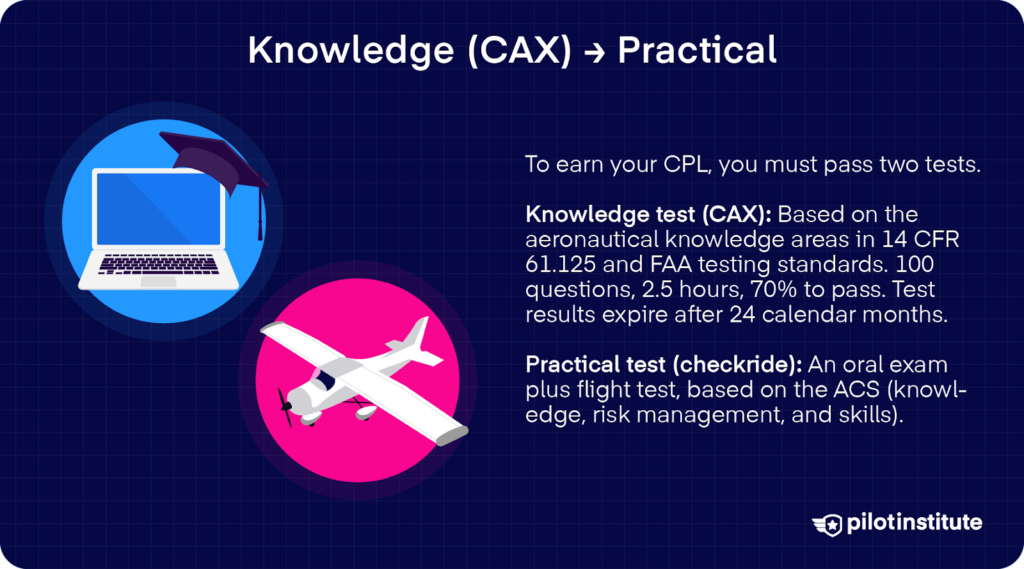
You can have the hours and endorsements, but you’ll still have to prove your commercial piloting chops. That’ll come in the form of two tests: the commercial knowledge test (CAX) and the practical test.
Knowledge Test
Most people take the CAX after they’ve finished a solid chunk of ground prep and before they get deep into checkride polishing. That timing helps keep your memory fresh for both tests.
The knowledge test covers the aeronautical knowledge areas in 14 CFR 61.125.
How high do you need to score? Out of the 100 questions in the Commercial Pilot Airplane exam, you need to answer at least 70 correctly. You’ll have two and a half hours to take the test.
You also need to pay attention to your timing. Your knowledge test result has a validity window, and you must take your practical test before it expires.
The FAA sets this window at 24 calendar months for most pilot certificate knowledge tests.
Practical Test
The checkride is your last hurdle to earning that certificate. It’s divided into two parts: the oral examination and the practical flight test.
The oral exam is the ground portion of the checkride. This is a one-on-one discussion with your evaluator.
After passing the oral exam, you’ll head to the aircraft for the flight portion of your exam. The evaluator will assess your ability to perform the flight maneuvers you practiced in training.
What’ll be the coverage of your checkride? It’s all written down in the Airman Certification Standards (ACS).
The ACS tells you the exact evaluation guidelines under three elements:
- Airman knowledge (what you know).
- Risk management (how you think).
- Flight proficiency (what you can do).
Timeline Scenarios
Part 61
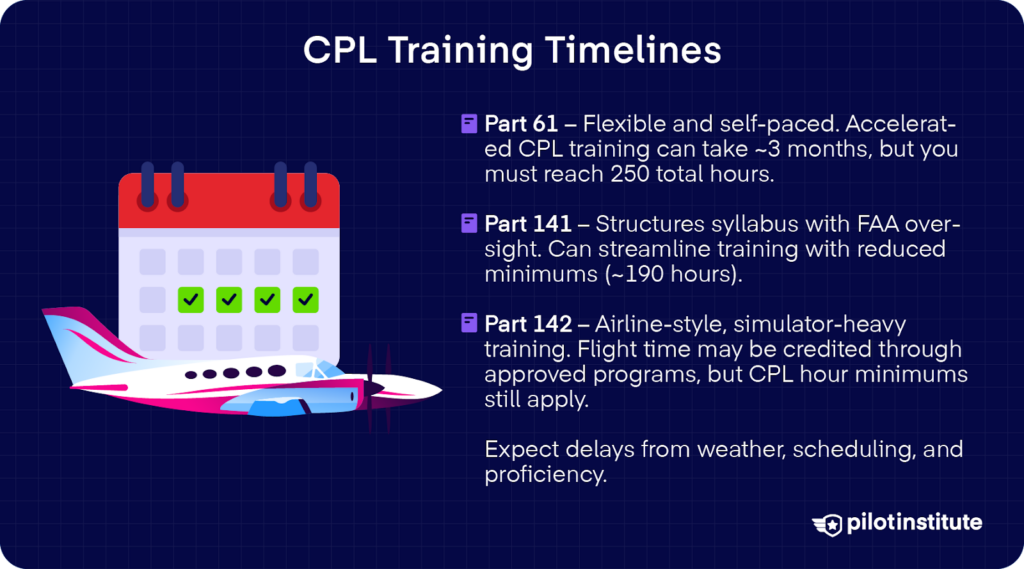
So, how long will your CPL training take? Under Part 61, it’s up to you!
If you commit full-time, you can complete an accelerated program in just 3 months. That typically covers ground training, 20 hours of CPL flight training, and FAA testing.
But if you train part-time, expect to stretch that timeline. That’s assuming you’re training around your job or other responsibilities. Progress also slows down since building skills takes repetition.
Keep in mind that this doesn’t include the remaining flight hours to 250. You’ll have to do that in your own time, either by cost-sharing, renting, or flying your own airplane. Just make sure you stick to the required operations, so you’re not burning through cash.
Part 141
You’ll find the commercial course requirements for Part 141 schools in Appendix D to Part 141.
Unlike Part 61, where you need 250 total hours, approved Part 141 programs can qualify you for a commercial certificate at 190 total hours under 14 CFR 61.129(i).
That reduction is allowed because you complete your training under a tightly structured, FAA-approved syllabus.
Most Part 141 schools bundle private, instrument, and commercial training into one continuous program. When you complete all required stages, your total time typically meets that 190-hour minimum.
Yes, it’s fewer hours than Part 61, but the structure is more rigid. You’ll follow defined stage checks and completion standards from day one.
How long is Part 141 training? It’s a lot more streamlined since you’re training under a fixed syllabus. Some training centers advertise zero to CPL in just 7 months.
If you already have a PPL, commercial plus instrument training can be as short as 4 months.
Just one important heads-up: Don’t be surprised if you log a couple extra hours, or take longer than planned.
That goes for whichever training route you take. You’ll have to account for the unexpected, like weather delays and refresher flights.
You can also kill two birds with one stone if you fly as part of a degree. University Part 141 programs usually take four years. But hey, you’ll have your certificates plus a diploma once you’re done!
Part 142
Because Part 142 programs are tightly structured and closely monitored, they’re also more efficient. You can meet the total aeronautical experience requirement with 190 hours instead of 250 in Part 61.
Medical & Administrative Checklist
This part of your timeline makes sure you have all the paperwork and official steps done before you walk into a testing session.
Medical: Second-Class Medical to Exercise Commercial Privileges
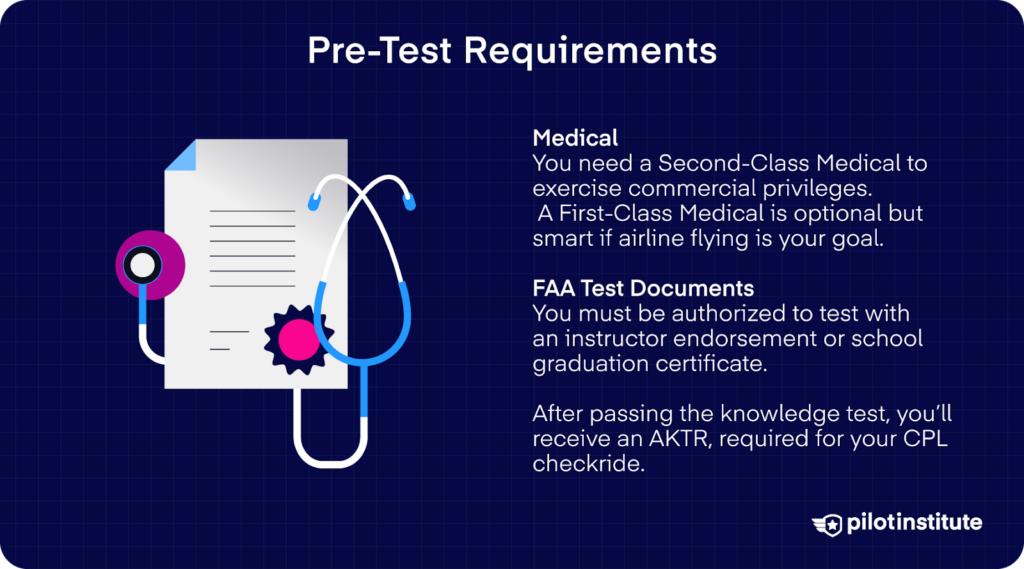
You must hold at least a second-class medical certificate when you want to exercise the privileges of your commercial certificate.
But if your dream is to fly for an airline someday, it could be a smart move to get a first-class medical as early as now.
How come? It can reveal any health issues that a second-class exam might miss. You wouldn’t want to discover any disqualifying conditions only after having invested so much.
FAA Test Documents
You should also gather all the necessary paperwork before you step into the exam room.
The FAA Airman Knowledge Testing Matrix gives all the requirements for you to take your knowledge test.
For instance, you need proof that you’re authorized to take the test. One option is a certificate of graduation or a statement of accomplishment.
No formal school? That’s fine too. You can use a written statement or logbook endorsement from an authorized ground or flight instructor.
That endorsement confirms you completed the required ground training or home study and that you’re ready for the knowledge test.
Once you pass, you receive an Airman Knowledge Test Report (AKTR). You’ll use this AKTR later for the practical test application.
Frequently Asked Questions
“How many flight hours does it take to get a CPL?”
Part 61 training gives you flexibility. The FAA balances that freedom with a higher experience requirement of 250 total hours.
Many Part 141 schools build their commercial courses around a 190-hour minimum. That’s because you do private, instrument, and commercial training under one continuous syllabus.
Under Part 142, you’ll train under a highly structured program usually run by large training organizations. It has the same aeronautical experience requirement with just 190 total hours.
“How long does it take to become a commercial pilot?”
If you take Part 61 training, you can move as fast or as slow as your schedule allows. You can finish in as little as three months if you train full-time in an accelerated CPL program. If you train part-time, expect your training to take longer.
That pace usually covers ground training, the required 20 hours of commercial flight training, and the FAA tests.
Also note that accelerated programs often focus on the commercial flight training itself, not the full 250 total hours. You still need to build the remaining flight time on your own.
Want more structure and clear milestones? Part 141 has a more predictable style. Some schools advertise “zero to commercial pilot” in about seven months. That timeline assumes full-time training with steady progress.
You finish even faster if you already hold a private pilot certificate. Part 141 CPL and IR training can take as little as four months.
If you’re taking your training as part of a Part 141 university program, it could take around four years. That’s because you’re studying for a commercial pilot certificate, an instrument rating, and a college degree.
“What is the shortest path to becoming a commercial pilot?”
The real answer is that it depends. There’s no singular route that can guarantee the shortest timeline to a commercial pilot certificate.
If we’re talking about the least required ratings, you can earn your CPL without an IR under Part 61.
In that scenario, you move from private pilot training straight into commercial training. And once you’re done, you can start working as a pilot right away.
Just know that you’ll need at least 250 total flight hours. That’s about 60 hours more than Part 141 or Part 142 requirements.
Your privileges and career options will also be limited. For example, you won’t be able to fly in instrument conditions or under IFR without the appropriate rating.
Now, if we’re talking about the least required hours, you can go for Part 141 training. You’ll only need 190 total flight hours, but you’ll also need an IR before getting your CPL.
That adds another round of FAA testing, which you’ll need to account for.
With all that said, whichever path you choose, the best way to shorten your timeline is to train consistently. Full-time trainees get to focus their time and energy on earning their certificates.
You’ll build your skills more efficiently with fewer distractions and downtime. That strategy will help you build proficiency faster and finish training sooner.
Conclusion
Your commercial pilot certificate is the result of steady progress. It’s something you earn step by step.
You start with your early certification. Then, you put in the hours to hone your skills further. You’ll build your skills and your confidence in each flight. When you’re ready, you’ll prove your airmanship through testing and training.
You may have different options ahead of you, but it’ll all end one way: with that commercial certificate in the palm of your hand.
You control how fast you move. Just remember to train with purpose and protect your momentum. Commit to the process today, and you’ll make a career out of flying sooner than you think.