
- Key Takeaways
- What Is a Restricted Radio Operator Permit?
- Steps to Get Your FCC Restricted Radio Operator Permit
- Step 1: Create Your FCC Username in CORES
- Step 2: Register Your FRN
- Step 3: Apply in ULS License Manager
- Step 4: Pay the $35 Fee Within 10 Days
- Eligibility Requirements
- What If You Aren’t Eligible to Work in the U.S.?
- How Much Does the Permit Cost and How Long Does It Take?
- How to Download, Print or Replace Your Permit
- Why Do You Need a Restricted Radiotelephone Operator Permit?
- Do Private Pilots Need a Restricted Radiotelephone Operator Permit?
- Do Drone Pilots Need One?
- Which FCC Radio Operator License Do Pilots Need?
- Frequently Asked Questions
- Do I Need an RR Permit to Fly to Canada, Mexico or the Bahamas?
- Does the FCC Restricted Radiotelephone Operator Permit Expire?
- What’s the Difference Between an FRN and a CORES Account?
- Can Non-U.S. Citizens Get a Restricted Radiotelephone Operator Permit?
- Conclusion
 Up to 50% off airplane classesShop the sale →
Let’s say you’re planning your first hop down to the Bahamas. Somewhere in the preparations, you find out you need an FCC radio license before you can legally communicate on the other side of the border.
In those cases, at least one pilot on board must hold an FCC Restricted Radiotelephone Operator Permit.
In this post, we’ll answer all your questions about getting your restricted radio operator permit, with the full 2026 steps described below.
Key Takeaways
- You need the RR for international flights, foreign stations, or HF radios below 30 MHz.
- The RR permit costs a one-time fee of $35. It requires no exam, and it never expires.
- You will need to apply online through CORES and ULS. Then, make your payment within 10 calendar days.
- Pilots who can’t legally work in the U.S. must apply for the RL instead, which covers aircraft radio stations only.
Up to 50% off airplane classesShop the sale →
What Is a Restricted Radio Operator Permit?
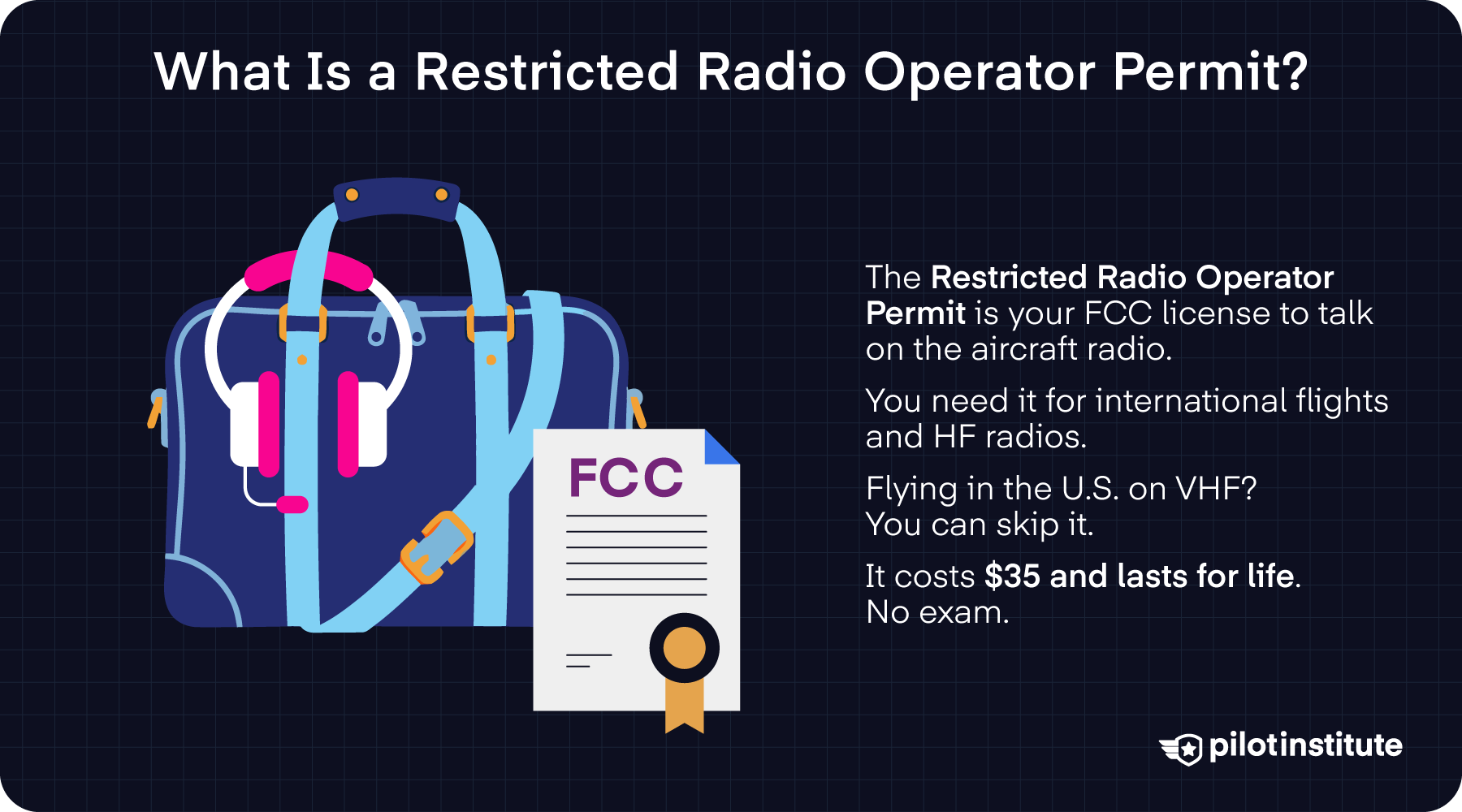
A restricted radiotelephone operator permit (RR) is an FCC credential that allows you to operate an aircraft’s radios. It’s separate from the aircraft station license, which covers the radio equipment itself.
You need this FCC radio operator license to operate on international flights. The same applies to operating aircraft HF radios, which run below 30 MHz.
But when it comes to everyday domestic flying on VHF, you aren’t going to need one. FCC rules exempt those kinds of operations.
Also called the restricted radio operator permit, it’s one of the easiest aviation credentials to earn. There’s no knowledge test to pass.
You just file the application with the FCC and pay a fee. As of 2026, an RR costs $35. It does not expire and will be valid for the holder’s lifetime.
| RR Permit Questions | Details |
|---|---|
| Issued by? | FCC (the FAA does not issue radio licenses). |
| Fee? | $35 application fee, no regulatory fee (as of 2026). |
| Exam? | None. |
| Valid for? | Your lifetime. |
| Where to apply? | Online in ULS, after you set up your CORES account and create an FRN. |
| Payment deadline? | 10 calendar days after you file, or the application is dismissed. |
| How to get it? | Download from ULS, plus an email link if you gave an email. It is no longer mailed. |
| Who needs it? | Pilots flying internationally and anyone using HF radios in a moving airplane. |
Steps to Get Your FCC Restricted Radio Operator Permit
You’ll create an FCC username in CORES and register your FCC Registration Number (FRN). Then, you’ll file the restricted radiotelephone operator permit application in the Universal Licensing System (ULS) and pay the application fee.
Now, let’s talk about how to get your FCC radio license as a pilot in 2026 in full detail.
Step 1: Create Your FCC Username in CORES
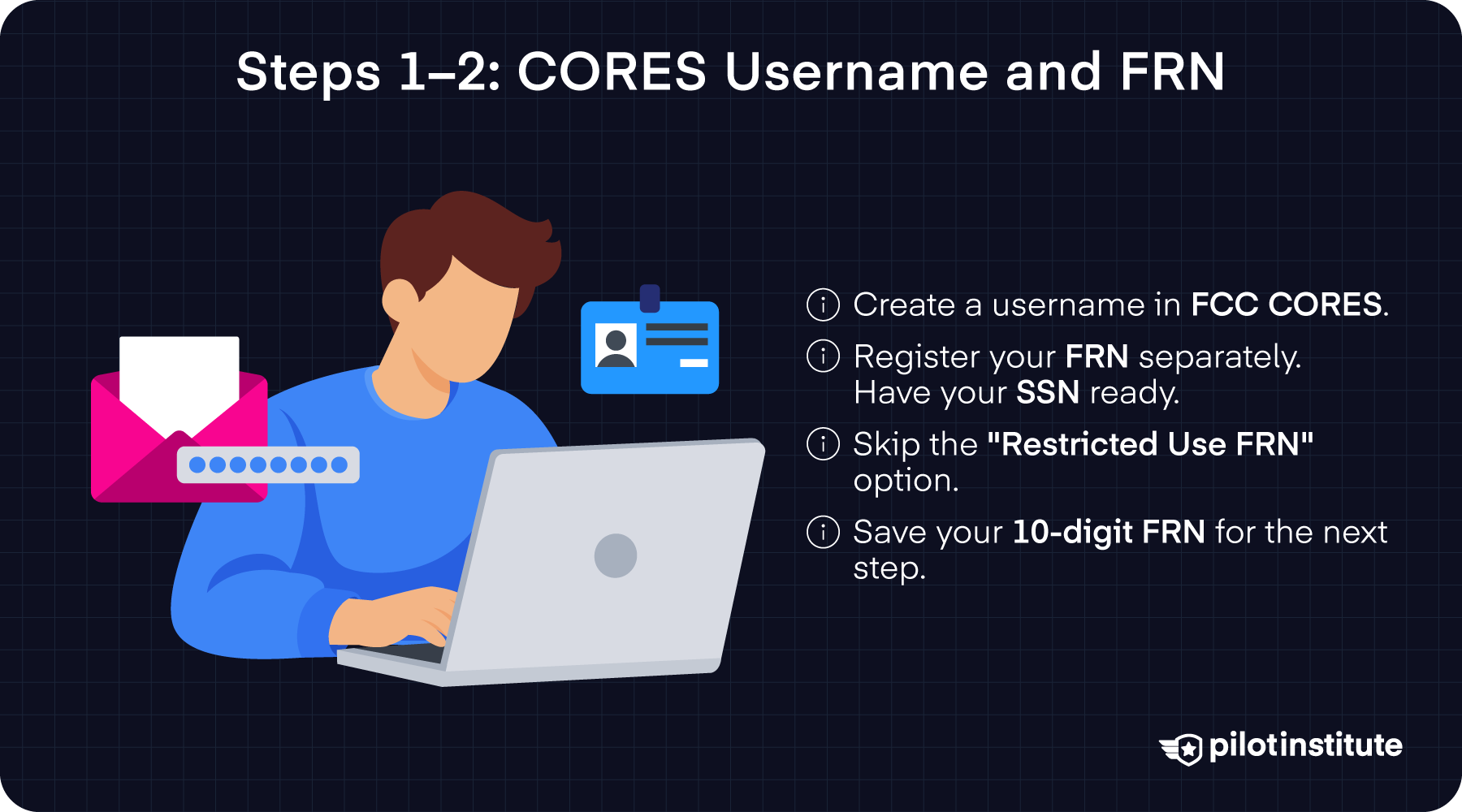
First, visit the FCC’s CORES website and click “Register” in the “Need a Username?” box in the middle of the page.
It will set up an FCC Username Account tied to your email address, which you’ll use for some of the following steps.
The FCC then emails you a verification link to activate it. Also, since March 2024, every CORES login requires a six-digit code sent to that same email. Keep your inbox tab open each time you sign in.
Step 2: Register Your FRN
Be aware as well that creating your username does not hand you an FRN. You will need to register one separately.
Once you’re logged in, choose “Register New FRN” and pick the individual option to run the standard registration. You’ll need your Social Security number for this.
Do not select the “Restricted Use FRN” option, which only works for individuals listed on broadcast ownership reports and does nothing for an operator permit.
When you’re finished, save the 10-digit FCC CORES FRN somewhere safe. You’ll need it for the next step.
Step 3: Apply in ULS License Manager
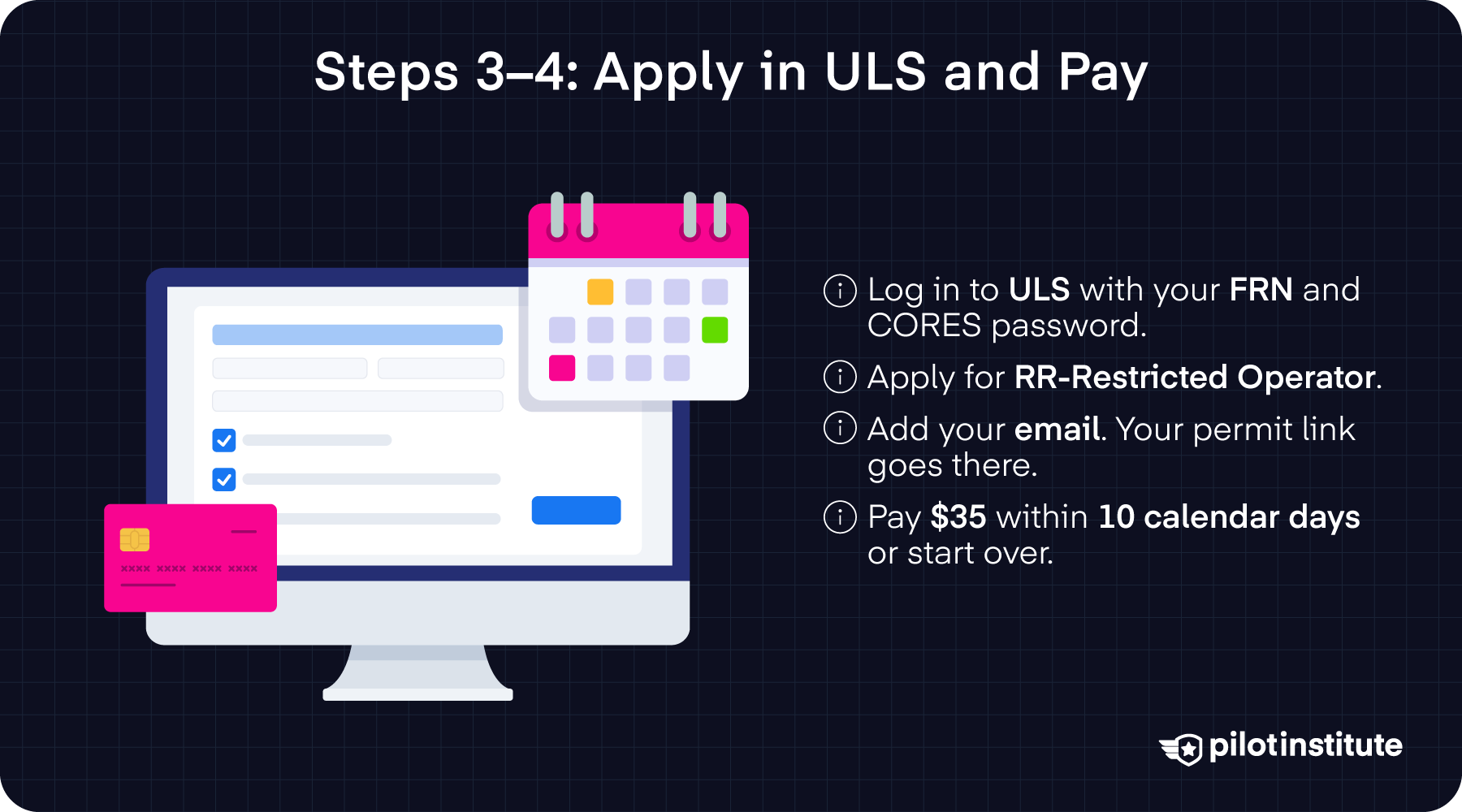
Now, you will move to another webpage. Go to the license manager page and sign in with your FRN and the same password you set in CORES.
But once again for emphasis, you’ll need to enter your FRN in the required field, NOT your username. The password, though, will be the same.
Afterward, you’ll see the “Apply for a New License” link on the left side of the screen. This will be the actual ULS restricted operator application.
Select the RR-Restricted Operator and continue.
On the applicant questions page, leave everything as it is. It should say Regular on type. Select no for exemption from application or license fees and continue.
On the next screen, fill in your details, and be sure to add an email address (even though it’s optional for the RR). The FCC sends your permit link to that address, so leaving that field blank will just make your permit harder to retrieve later.
When asked, confirm that you’re eligible for employment in the United States and continue.
Now, if you aren’t eligible to work in the U.S., stop here and file for the RL instead, as we mentioned earlier.
From there, review the Summary page and click “Continue to Certify.” Type your name to sign the application, and click “Submit Application.” Then, select “Continue for Payment Options” to move to the fee.
Step 4: Pay the $35 Fee Within 10 Days
After you submit, ULS hands you off to CORES to pay. The fee is $35, and you can cover it with a card or an ACH bank transfer.
If you accidentally close the window before paying, don’t worry. You can simply log back into CORES and head to “Manage Existing FRNs,” then “FRN Financial,” and select “Bills and Fees” to finish up.
Just know that there’s a time limit. The FCC has to receive your $35 within 10 calendar days of filing. Otherwise, it will dismiss your application, and you start over.
The old Form 159 is only needed if you’re mailing a paper check or money order.
Once your payment goes through, you’re all set. If you entered an email address, the FCC will send you a link to download your official permit.
The FCC no longer mails paper licenses, which was an old practice that ended on February 17, 2015. Nowadays, downloading online is how you get your copy. We’ll discuss the steps to download and print it shortly.
Eligibility Requirements
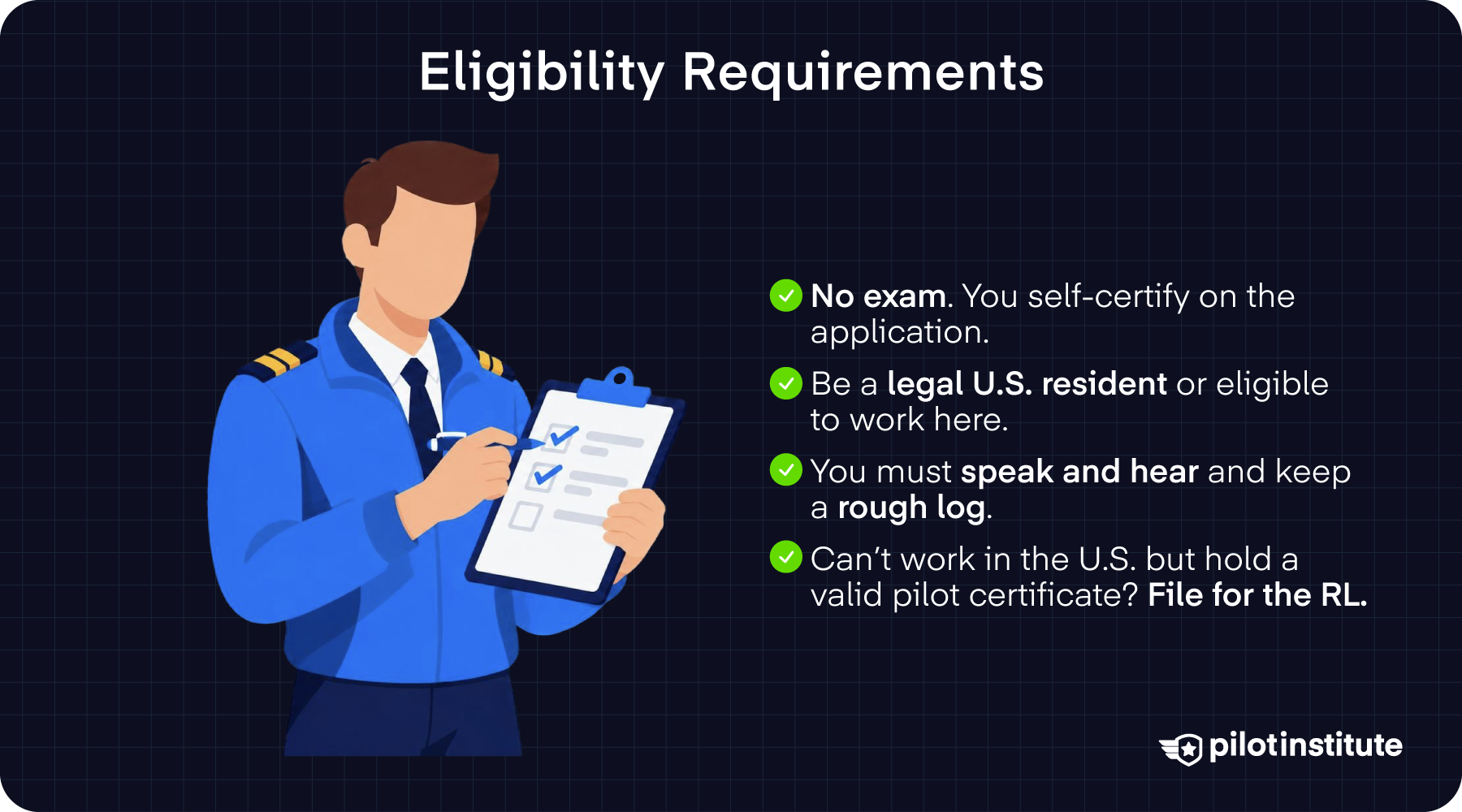
Qualifying for a restricted radiotelephone operator permit is about as simple as FCC credentials get. An RR permit is issued without examination. However, you must meet a few requirements to be eligible for one. They are:
- Be a legal resident of (or otherwise eligible for employment in) the United States.
- Be able to speak and hear.
- Be able to keep at least a rough written log.
- Be familiar with provisions of applicable treaties, laws, and rules which govern the radio station you will operate.
There’s also no minimum age to earn a restricted radio operator permit under FCC rules.
What If You Aren’t Eligible to Work in the U.S.?
If you hold an FAA pilot certificate, or a foreign license valid in the United States, but you can’t legally work here, the credential you want is the restricted radiotelephone operator permit limited use (RL).
An RL permit issued on that basis authorizes aircraft radio stations only. It gives foreign pilots the same privileges as the restricted radiotelephone operator permit.
And just a word of caution, you shouldn’t check the “employment eligibility” box on a regular RR application when it isn’t true for you. Doing so would be a false certification to the FCC, so instead, you should file for the RL.
For more details on flying in the U.S. as a foreign pilot, you can check out our guide on foreign pilot license conversion.
How Much Does the Permit Cost and How Long Does It Take?
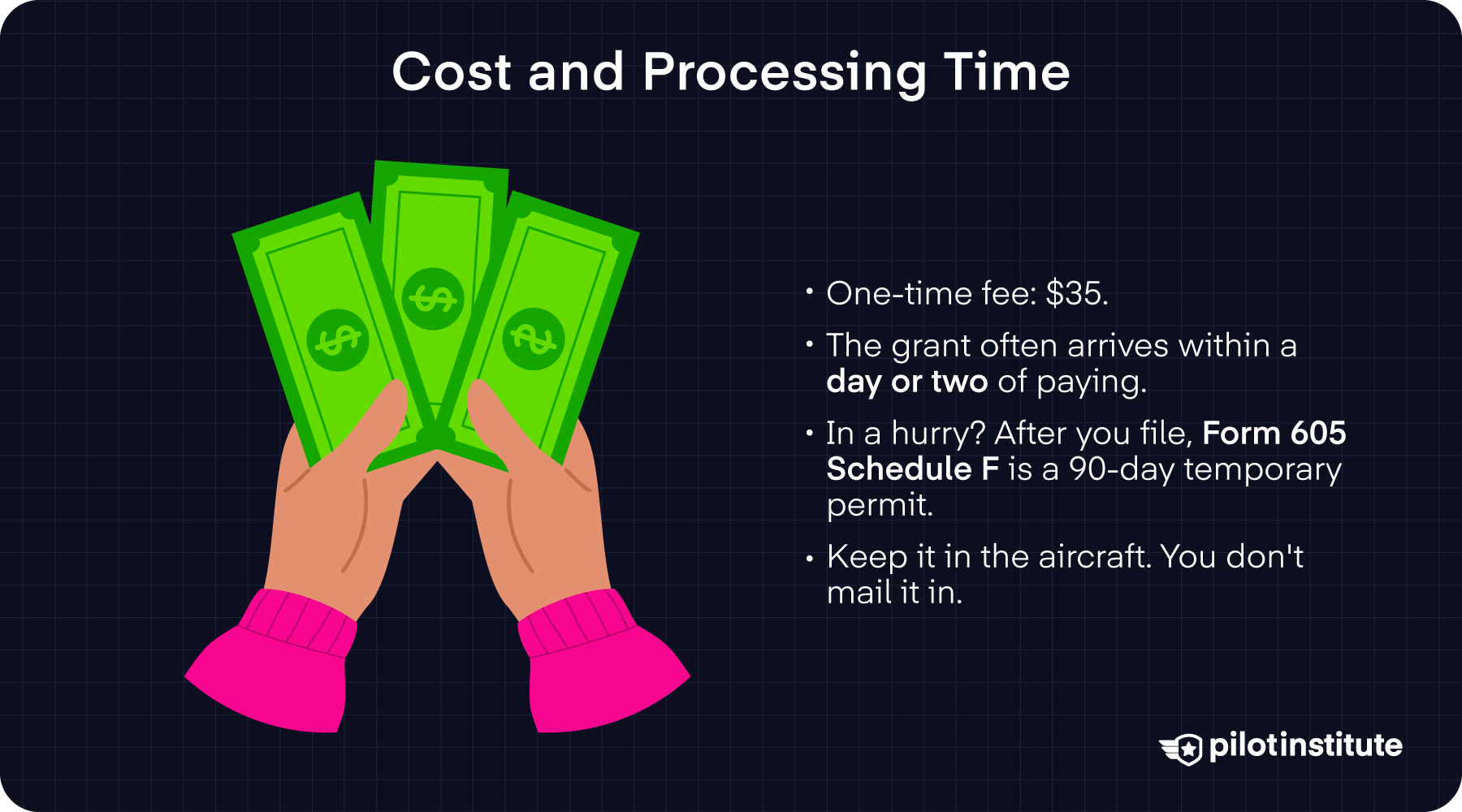
All things considered, the restricted radiotelephone operator permit cost is quite light on the wallet. It’s only a one-time $35 application fee, with no separate regulatory fee on top.
Next to the price of flight training, the FCC radio license fee barely measures up, as you can see in our discussion about the pilot license cost.
As for how long it takes to get your FCC radio license, please know that the FCC doesn’t publish a processing time guarantee.
Your application usually appears in ULS the next business day, and pilots commonly see the grant email within a day or two of paying.
If you need your permit in a hurry, the FCC lets you use a temporary operator permit while your application is being processed.
You’ll need to fill out FCC Form 605 Schedule F and keep it in your aircraft. You do not send it to the FCC.
The temporary permit is valid for 90 days from the date you submitted your application.
How to Download, Print or Replace Your Permit
To download your FCC license, log in to ULS License Manager with your FRN and password, then click “Download Electronic Authorizations” in the left menu.
Add your RR permit to the download list, then click “Download.”
You will see a PDF stamped with the FCC logo and an “Official Copy” watermark on every page. It’s free, and you can view and download your permit any time.
Then print your FCC restricted radiotelephone operator permit for the flight bag, and keep the PDF on your phone as a backup.
If you can’t find an older permit in ULS, call the FCC Licensing Support Center at 877-480-3201, and they can help you track it down.
Also, if you move or change your name, make sure it’s reflected in the system. You’ll want to update the license record in ULS, and your FRN contact information in CORES.
Why Do You Need a Restricted Radiotelephone Operator Permit?
Under Article 30 of the Chicago Convention, an aircraft’s radios must be licensed by its country of registration, and only crew members licensed by that country may use them.
For an N-registered aircraft, both the station license and that aviation radio license come from the FCC. At least one person on board must possess the RR on any international flight.
There’s also a career-related reason to get it early, especially if you plan to become a commercial pilot.
Many airlines and Part 135 operators require the FCC restricted radiotelephone operator permit for pilots.
There isn’t any regulation that makes it a “hiring requirement,” but regardless, it’s a relatively inexpensive box to check on the way to a flying career.
Do Private Pilots Need a Restricted Radiotelephone Operator Permit?
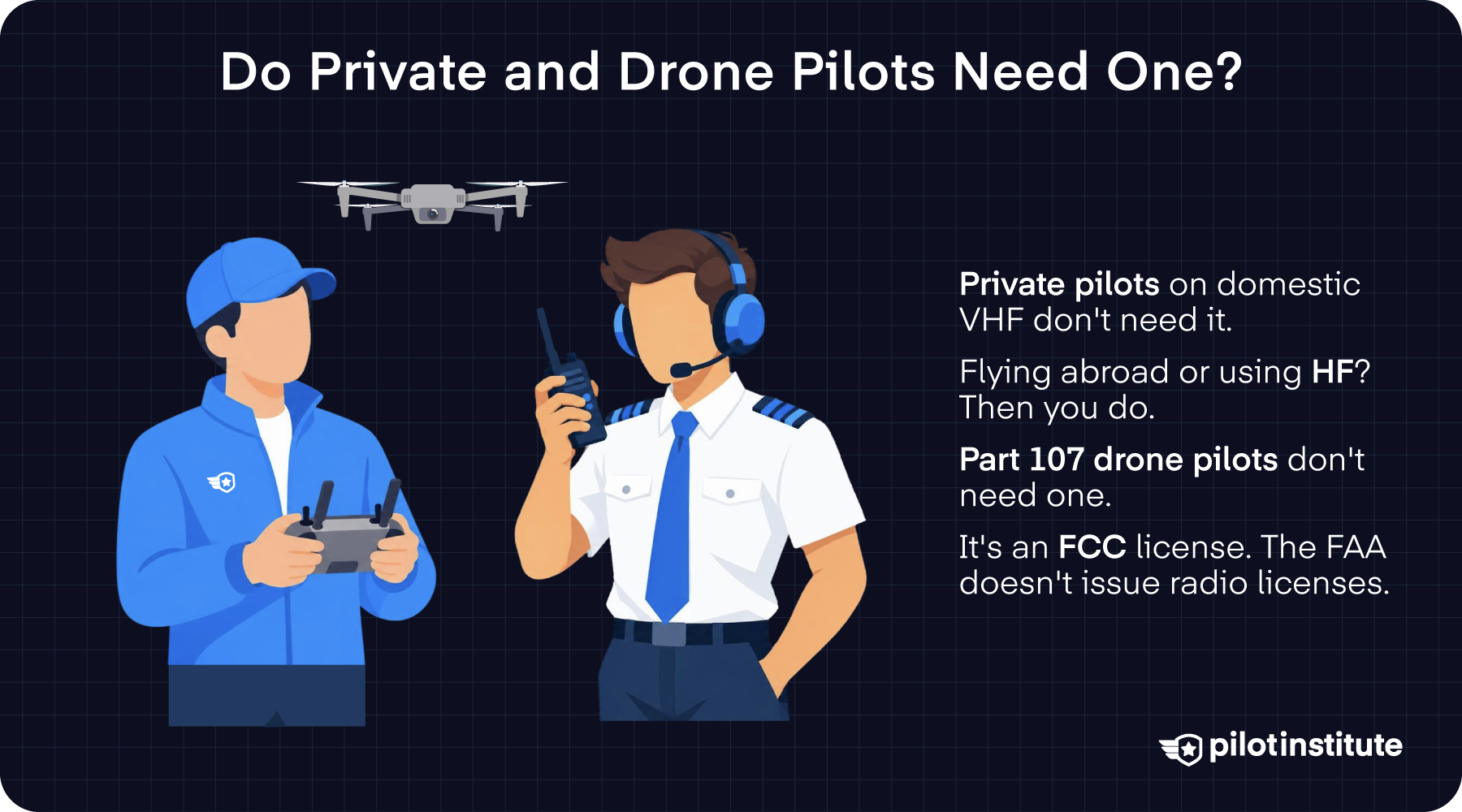
Not for everyday flying and ATC communication inside the U.S. on VHF. Your private pilot certificate is all you need on the radio.
But once you do fly internationally or if you switch to HF radios, then you’re going to need an FCC restricted radiotelephone operator permit for pilots.
You may hear others call it an “FAA radio operator license” or a radio operating license “from the FAA,” but do not let them mislead you. The radio license actually comes from the FCC, not the FAA.
Also, radio communications are something you learn during training, and the FCC paperwork is only one step in that process.
Do Drone Pilots Need One?
For standard Part 107 operations, no. There’s no such thing as a “Part 107 radio license.” The FCC operator permit applies to aircraft radio stations, which a Part 107 drone isn’t.
On the matter of handheld aviation radios, the FCC calls them aeronautical mobile services when they’re used to communicate between aircraft, or an aircraft and a ground station. In that case, the FCC views them the same way as a radio in an airplane. An RR is only required if the handheld radio is operated below 30 MHz in the HF band.
Which FCC Radio Operator License Do Pilots Need?
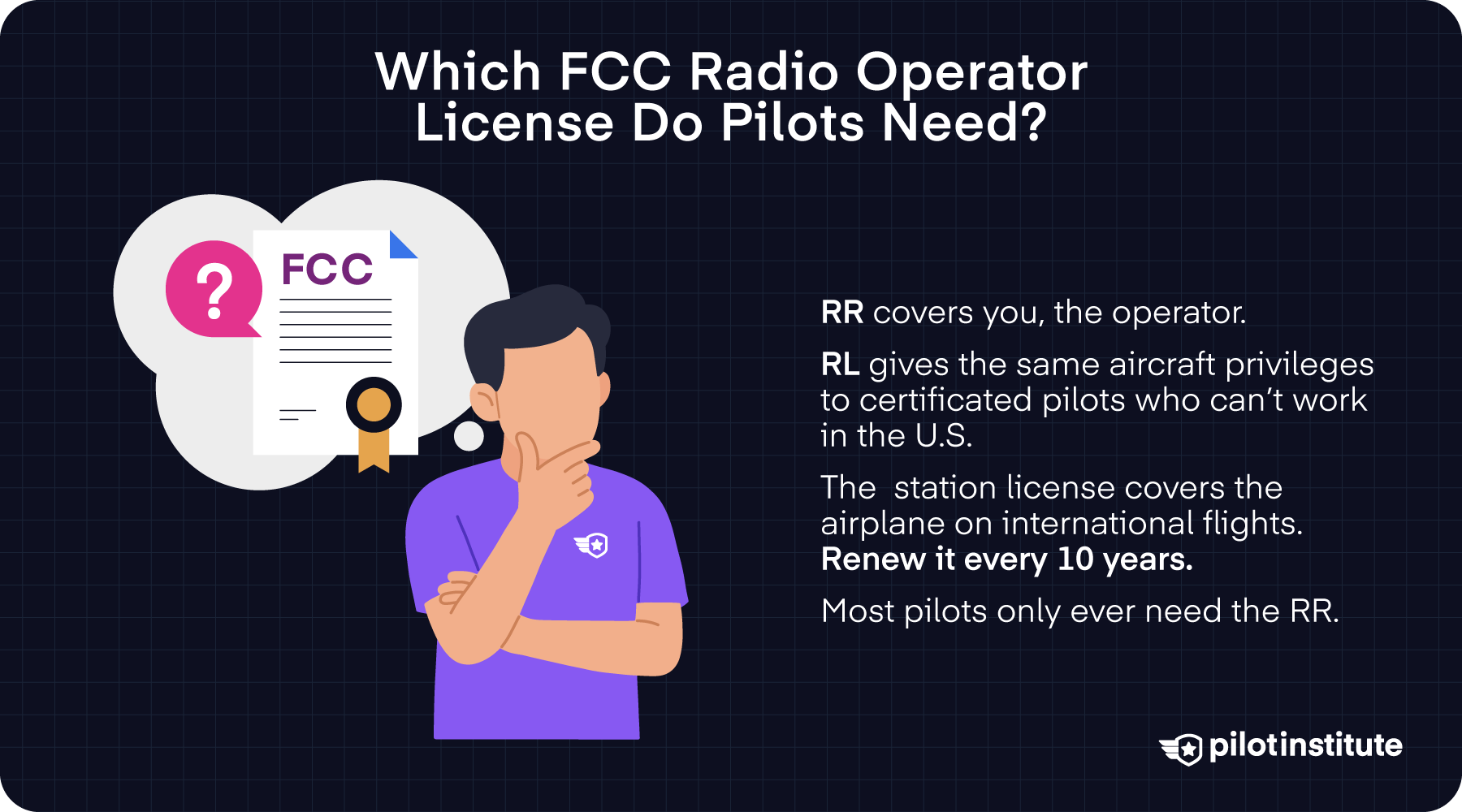
The Restricted Radiotelephone Operator Permit (RR) is the only radio operator license most pilots ever need for flying.
You may sometimes hear it called an “FCC radio license” or an “aviation radio license.” Some sources also abbreviate it as “RP.” Regardless, the RR is the one that covers international and foreign-station flying, as well as HF radios below 30 MHz.
Pilots who can’t legally work in the U.S. file for the RL instead, which covers aircraft radio stations only.
| License | Who/What It Covers | Exam | When Pilots Need It |
|---|---|---|---|
| RR (Restricted Radiotelephone Operator Permit) | You, as the radio operator. | None. | International or foreign-station flying, plus HF radios. |
| RL (Restricted Radiotelephone Operator Permit-Limited Use) | Pilots not eligible to work in the U.S., on aircraft radio stations only. | None. | International or foreign-station flying, plus HF radios. |
| Aircraft radio station license | The aircraft, renewed every 10 years. | None. | International or foreign-station flying. |
Frequently Asked Questions
Do I Need an RR Permit to Fly to Canada, Mexico or the Bahamas?
Yes. At least one person on board needs the RR for any international flight, and the aircraft needs its own FCC station license too.
Does the FCC Restricted Radiotelephone Operator Permit Expire?
No. FCC commercial operator licenses, which include the RR, normally last for the holder’s lifetime.
What’s the Difference Between an FRN and a CORES Account?
Your CORES account is the email login you use for fees and registrations, while your FRN is the 10-digit FCC Registration Number tied to you.
You should create the account first and register your FRN under it. Then, sign in to ULS with that FRN and password.
Can Non-U.S. Citizens Get a Restricted Radiotelephone Operator Permit?
Citizenship is not a requirement. What you need is legal residence or eligibility to work in the U.S. Pilots who can’t work in the country will have to apply for the RL instead.
Conclusion
The paperwork behind your flight to the Bahamas, as it turns out, was the easy part. It only takes about 15 minutes and $35 to apply for a restricted radiotelephone operator permit, with no test and no expiration.
We can’t think of a reason to put it off until the week of your airline interview, or your first international flight.
It’s best to get the FCC radio license sorted now. Then, focus your energy on the radio work itself.
And when it comes to sharpening your mic and headphone skills, Pilot Institute’s radio communications course will help you at every stage of your training, and even beyond.