
- Key Takeaways
- Aircraft Dispatcher Salary: How Much Do Dispatchers Make?
- What Is an Aircraft Dispatcher?
- Flight Planning
- Flight Monitoring
- Communications
- How Do You Become an Aircraft Dispatcher?
- Required Skills
- Ability to Work Under Pressure
- Flexible
- Problem Solver
- FAA Aircraft Dispatcher Certificate
- Requirements
- School
- Exams
- Benefits of Becoming an Aircraft Dispatcher
- Career Progression
- Union Representation
- Airline Benefits
- Frequently Asked Questions
- How Much Do Delta Dispatchers Get Paid?
- How Stressful Is Being a Flight Dispatcher?
- What Does It Take To Become an Airline Dispatcher?
- Conclusion
Before an airliner pushes back from the gate, someone on the ground has already planned its route, checked the weather, and worked out how much fuel it needs. That person is the aircraft dispatcher, also called a flight dispatcher or airline dispatcher, and you’ll probably never meet them.
So what does a job like that pay? An aircraft dispatcher salary can run anywhere from about $35,000 a year in an entry-level role to $150,000 or more for an experienced dispatcher at a major airline. Where you land in that range comes down to who you work for and how long you’ve been there.
Below, we break down pay by employer, walk through what the job looks like day to day, and show you how to earn your FAA aircraft dispatcher certificate.
Key Takeaways
- Dispatchers earn from about $35,000 to $150,000 or more a year.
- Employer and seniority drive most of the pay difference.
- Dispatchers share legal responsibility for each flight with the captain.
- You need to be 23 and complete a 200-hour FAA-approved course.
Aircraft Dispatcher Salary: How Much Do Dispatchers Make?
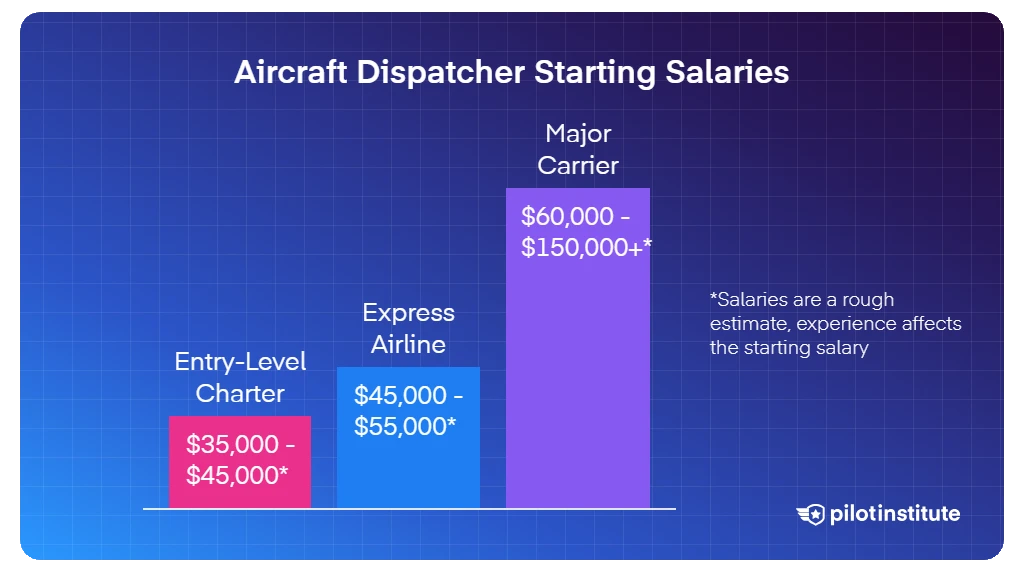
Flight dispatcher salaries vary widely. Your pay depends on which carrier you work for, your years of service, and your collective agreement.
The U.S. Bureau of Labor Statistics groups airline dispatchers under Dispatchers, Except Police, Fire, and Ambulance (SOC 43-5032). In May 2025, that group earned a median of $50,340 a year.
The lowest 10% earned under $36,030, and the top 10% earned more than $78,140. That category also covers truck, taxi and service dispatchers, so it runs well below airline pay. The most recent air-industry figure BLS published, from May 2020, put the average for dispatchers in scheduled air transportation at $66,100.
If you start in an entry-level role, such as flight following at a smaller charter operator, you can expect to earn around $35,000 to $45,000 per year.
If you are a new hire for an express airline, you can expect to earn around $45,000 to $55,000 per year. With seniority and overtime, experienced regional dispatchers can earn $70,000 or more.
Self-reported pay on Glassdoor for SkyWest dispatchers with one to three years of service runs about $22 to $26 an hour. Union contracts keep pushing regional pay up. PSA Airlines dispatchers won an immediate 11.5% raise in 2025.
Airline dispatcher pay is highest at the major carriers. New hires usually start at $60,000 or more, and experienced dispatchers can earn $150,000 or more.
Back in 2016, American Airlines’ new dispatcher contract already paid around $140,000 a year at 20 years of service, according to Forbes. Southwest’s dispatchers ratified a contract in 2023 that included a 17.1% raise on ratification and 3% annual raises.
At both express and major airlines, you can earn extra qualifications, such as international, oceanic or ETOPS dispatch. Some contracts pay premiums on top of base pay for these roles.
American’s dispatcher agreement, for example, pays monthly premiums to dispatchers who are qualified on international divisions or who work as check dispatchers or ATC liaisons.
What Is an Aircraft Dispatcher?

An aircraft dispatcher works behind the scenes to keep the schedule running effortlessly. They are in charge of planning and supervising the operation. They ensure that the passengers and aircraft arrive in the right place.
It’s also a role with legal responsibility. On domestic airline flights, the pilot in command and the aircraft dispatcher are jointly responsible for preflight planning, delays and the dispatch release (14 CFR § 121.533). The same joint responsibility applies to international flag operations under 14 CFR § 121.535.
The aircraft dispatcher must perform three main jobs while a flight is taking place. Let’s review them.
Flight Planning
Thorough flight planning is important for any airline operation. Dispatchers have to plan a safe route based on multiple factors. These factors include weather conditions, airspace restrictions, and aircraft performance.
Most airlines have preset flight plans for each route. Dispatchers allow for extra fuel when flights can anticipate poor weather conditions. This allows for extra time to divert around the weather. The dispatcher may choose to change the route to avoid weather altogether.
Dispatchers use the same logic regarding airspace restrictions and aircraft performance. They also check the aircraft’s Minimum Equipment List (MEL) items before they release a flight.
Flight Monitoring
Dispatchers monitor the flight, ensuring everything runs in a safe manner. They use computer screens to track current aircraft positions.
They stay updated with any relevant changes relating to the current flights. These changes include information about airspace, weather, or anything affecting operations.
Communications
Good communication is fundamental for safety. A dispatcher will spend a lot of time communicating with pilots throughout the day. So they have to be clear and concise with their messages.
Dispatchers will update pilots with any important changes to the operation. There are two ways to do this. The first is by using a company radio frequency to talk over HF or VHF channels. The other, more modern way is using ACARS.
ACARS stands for Aircraft Communications Addressing and Reporting System. This system allows dispatchers to send and receive text messages over VHF and HF radio datalinks, or by satellite when the aircraft is out of radio range. You can read more in our guide to how ACARS works.
How Do You Become an Aircraft Dispatcher?

You now know what an aircraft dispatcher is, so what do you need to become one?
Required Skills
Before starting any training, you should evaluate whether you have the right skills. What does it take to be a good aircraft dispatcher?
Below we have summarized a few fundamental skills you will need.
Ability to Work Under Pressure
On a good day, being an aircraft dispatcher is an easy job. But as soon as disruptions start to happen, it can become stressful and demanding fast.
You should be able to handle your nerves when working in a high-pressure environment.
Flexible
Working in a constantly evolving environment means things change fast. A last-minute weather or engineering disruption may require changes to the original plan.
You should be flexible and able to keep calm to work through these problems methodically.
Problem Solver
Due to the nature of the industry, you will face constant problems. Often, many issues occur all at once.
Being a good problem solver will help you find unique solutions to fix these problems.
FAA Aircraft Dispatcher Certificate

Like many other positions in aviation, you will need to obtain a qualification. So how do you go about becoming certified?
Requirements
To be eligible for an FAA aircraft dispatcher certificate, you must be at least 23 years old and able to read, speak, write and understand English (14 CFR § 65.53). You can take the knowledge test from age 21. The FAA sets no education requirement beyond that, though some schools ask for a high school diploma or equivalent.
If you meet these requirements, you can start looking for a school. You can learn more about these requirements in our article about aircraft dispatcher requirements.
School
First, you must decide whether you want to complete the course in person or online. The FAA’s list of approved Part 65 dispatcher courses (August 2025) names 51 of them, including Sheffield, Embry-Riddle, Jeppesen and Ohio State. So it’s best to do some research and find a school that best suits your learning style.
Most courses last between three and ten weeks, depending on how much is done online, and tuition usually runs from about $3,000 to $5,000. Sheffield School of Aeronautics, for example, lists $4,800 for its five-week residential course in 2025.
Pilot Institute’s own 10-week dispatcher program combines online study with in-person training in Prescott, Arizona. An FAA-approved course must include at least 200 hours of instruction (14 CFR § 65.61). For the full budget, including exam fees and living costs, see our breakdown of FAA dispatcher license cost.
After you have finished the course you are able to sit the written and practical exam.
Exams
The written exams cover many topics that will be relevant to the job. The FAA’s list of topics includes regulations, meteorology, navigation, air traffic control procedures, aircraft performance, and weight and balance.
For your practical exam, you’ll have to create a manual flight plan. They will provide you with a weather package and any relevant information.
Once complete, the examiner will ask you questions relating to the flight plan. They will also ask questions about the FAA rules, regulations, and emergency procedures. The FAA’s Aircraft Dispatcher Practical Test Standards list every task the examiner can test.
If you pass the exams, they will issue you an FAA Aircraft Dispatcher Certificate. Now, you can start working as an aircraft dispatcher! Our guide on how to get an aircraft dispatcher job covers the next steps.
Benefits of Becoming an Aircraft Dispatcher

Career Progression
The longer you spend as an aircraft dispatcher, the more sought-after you become. Once you have valuable experience, you will be able to work for major carriers. The major carriers tend to pay more and have better staff benefits.
Union Representation
Many airline dispatchers belong to a union that negotiates their pay and working conditions. At Southwest, dispatchers are represented by Transport Workers Union (TWU) Local 550. At United, they’re represented by the Professional Airline Flight Control Association (PAFCA), and at American, by the TWU.
Delta’s dispatchers are also represented by PAFCA. According to Atlanta Civic Circle, they and Delta’s pilots are the airline’s only unionized employees.
The Airline Dispatchers Federation (ADF) is a separate group. It’s a volunteer organization that speaks for the dispatch profession before Congress and the FAA. Its bylaws define it as an advocacy organization for working dispatchers, and it has no role in contract bargaining.
Having a union and a professional group backing your career means you will always have support.
Airline Benefits
When you join an airline, you will get all the staff benefits you normally get as an employee. This generally includes staff travel, insurance, jumpseat authority, and retail discounts.
Frequently Asked Questions
How Much Do Delta Dispatchers Get Paid?
Delta’s job posting lists a starting salary of $96,576 a year for its entry-level dispatcher role, called Assistant Flight Superintendent. Pay goes up with seniority under the dispatchers’ union contract.
How Stressful Is Being a Flight Dispatcher?
It can be very stressful. Under federal rules, dispatchers share legal responsibility for every flight with the captain. A dispatcher at a major airline may track 30 to 45 flights in one shift, and on bad-weather days the phone barely stops ringing.
What Does It Take To Become an Airline Dispatcher?
You need an FAA Aircraft Dispatcher certificate. Most people get one by finishing an FAA-approved course of at least 200 hours, then passing a written test and a practical exam. You can take the written test at 21, but you must be 23 to hold the certificate.
Conclusion
It takes a lot of hard-working people to run an airline. Aircraft dispatchers are one job among the many that keep it running efficiently.
Becoming an aircraft dispatcher is a very rewarding career. There’s no greater sense of achievement than ensuring people reach their destinations safely. Not to mention the great benefits and salary that come with it.
But maybe you prefer to work on the frontline, flying people from A to B? If this interests you, check out our latest article, How to Become a Pilot. If you want to compare pay, see how much pilots earn.