
-
Key Takeaways
-
Helicopter Pilot Salary
-
Factors for Helicopter Pilot Pay
- Total Flight Hours
- Aircraft Type
- Certifications and Ratings
- Location
-
Helicopter Pilot Salary by Sector
- Tours
- EMS (Emergency Medical Services)
- Utility and Firefighting
- Offshore (Oil and Gas)
- Corporate and VIP
-
Helicopter Pilot Salary Progression
-
How to Increase Your Helicopter Pilot Earnings
-
Frequently Asked Questions
-
Conclusion
Asking “how much do helicopter pilots make?” is a bit like asking “how much do doctors make?” A tour pilot flying sightseers over the Grand Canyon and an EMS captain running night medevac missions in a turbine helicopter live in completely different worlds. Their paychecks reflect that.
What you probably want to know is, what will you actually earn in your first paid flying job? What can you make after a few years? And what experience, ratings, and hours unlock each pay tier?
This guide breaks it all down by sector. You’ll see what EMS, utility, tour, and offshore pilots earn at every stage. You’ll learn which factors drive pay the most. And you’ll get a practical plan for moving up.
If you’re still early in the process, check out our guide on how to become a helicopter pilot first.
The biggest takeaway is that your salary follows responsibility, training, and schedule tradeoffs, more than the word “commercial” on your certificate.
Key Takeaways
- Entry-level helicopter pilots (CFIs and tour pilots) typically earn $25,000 to $65,000 per year.
- EMS, offshore, and utility pilots with 1,000+ hours commonly earn $70,000 to $130,000+.
- The BLS reports the median annual wage for commercial pilots at $122,670 as of May 2024.
- Certifications like IFR, NVG, and turbine time are the fastest ways to jump pay tiers.
Helicopter Pilot Salary
Here’s a quick look at what helicopter pilots earn across different sectors and experience levels. These ranges reflect base salary and don’t always include per diem, bonuses, or overtime.
| Sector | Entry Level (200–1,000 hrs) | Mid-Career (1,000–2,500 hrs) | Senior (2,500+ hrs) |
| Flight Instruction (CFI) | $25,000–$65,000 | $65,000–$85,000 (Chief CFI) | $85,000–$100,000+ |
| Tours | $40,000–$70,000 | $70,000–$85,000 | $85,000–$100,000 |
| EMS | $60,000–$80,000 | $80,000–$110,000 | $100,000–$150,000 |
| Utility / Firefighting | $55,000–$75,000 | $75,000–$110,000 | $100,000–$150,000+ |
| Offshore (Oil & Gas) | $60,000–$80,000 | $80,000–$120,000 | $100,000–$175,000+ |
| Corporate / VIP | $65,000–$90,000 | $90,000–$140,000 | $120,000–$175,000+ |
Sources: U.S. Bureau of Labor Statistics, ZipRecruiter, industry salary surveys.
Factors for Helicopter Pilot Pay
Your paycheck as a helicopter pilot depends on a handful of specific things. Understanding them helps you plan your career moves.
Total Flight Hours
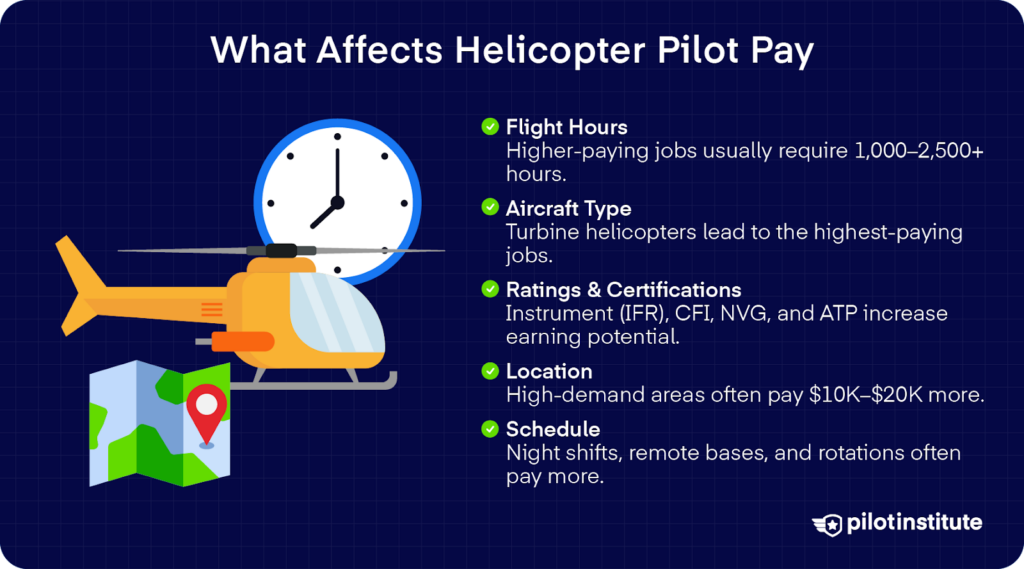
Total flight hours are the single biggest factor. Employers use hours as a shorthand for experience. Most good-paying jobs require at least 1,000 hours. The highest-paying positions want 2,500 or more. Every hour you log moves you closer to the next pay tier.
Aircraft Type
Aircraft type changes everything. Piston helicopters (like the Robinson R22) are entry-level machines. Turbine helicopters (like the Bell 206, Airbus H125, or Bell 412) are what you fly in EMS, offshore, and corporate work. Turbine time on your resume opens doors that piston time alone won’t.
Certifications and Ratings
Certifications and ratings act as multipliers. An instrument rating (IFR) is pretty much required for EMS and offshore work, and recommended for most other positions. Employers will also look for a flight instructor (CFI) rating, even if you’re not applying for a teaching position. Earning your CFI demonstrates a higher aptitude for task management, communication skills, and industry commitment.
Night Vision Goggle (NVG) certification is standard in EMS. An Airline Transport Pilot (ATP) certificate qualifies you for the biggest, highest-paying aircraft. Each one you add bumps your earning potential. You’ll also need to maintain a valid FAA medical certificate throughout your career.
Location
Location is something to consider as well. Pilots in Alaska, Texas, the Gulf Coast, and California tend to earn more because of high demand, remote assignments, or the elevated cost of living. Moving to where the jobs are can add $10,000 to $20,000 to your annual salary, or encourage an employer to prioritize you over another candidate who is unwilling to relocate.
Some positions within your region, like EMS, will operate on a rotating schedule and offer a ‘geo-modifier’ for a particular area. In other words, if you’re willing to commute to a less desirable place, your geo-modifier acts like a bonus in your salary.
Schedule and lifestyle tradeoffs also factor in. Night shifts, on-call duty, remote base assignments, and rotational schedules (like 14 days on, 14 days off in offshore work) usually come with higher pay or stipends. The harder the schedule, the better the compensation.
Helicopter Pilot Salary by Sector
Tours
Tour flying is where many pilots land their first or second job, between finishing training and about 1000 hours. You fly sightseeing routes in cities or over a unique landmark or natural area, often in piston helicopters like the R44.
At the 1000-hour mark, you are eligible for tours in turbine helicopters in places like Alaska, Hawaii, Las Vegas, New York, or the Grand Canyon.
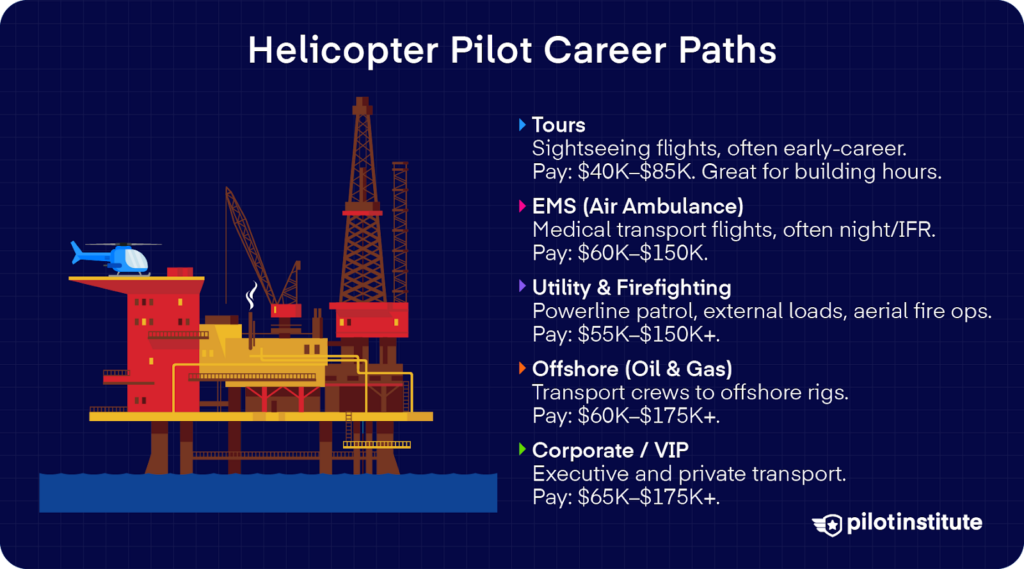
Pay typically ranges from $40,000 to $85,000 depending on the company, type of aircraft, and location. Peak season means more hours and more money, and these jobs are often seasonal.
Off-season can mean reduced hours or temporary layoffs. The work is pretty fun, but the pay ceiling is lower than in other sectors. Some pilots opt to fill in with flight instruction or non-flying work during the off-season.
Tour jobs are great for building hours fast. Many tour pilots log 300 to 600+ hours per year, which gets you to the experience minimums for EMS or offshore work much quicker.
EMS (Emergency Medical Services)
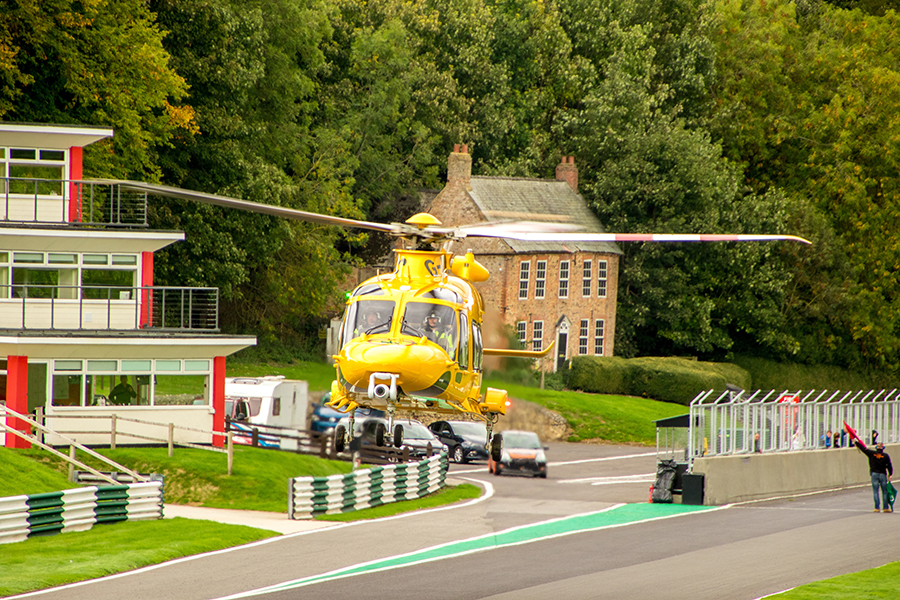
EMS is one of the most popular career goals for helicopter pilots. You fly patients to hospitals from the scene of an accident or between two hospitals, often at night, and under serious time pressure. It is also referred to as Helicopter Air Ambulance, or HAA.
Entry-level EMS pilots with around 1,500-2000 hours can expect $60,000 to $80,000. With a few years of experience, IFR currency if applicable, and NVG proficiency, that climbs to $80,000 to $110,000. Senior EMS captains and base leads at major operators like Air Methods or Metro Aviation can earn $100,000 to $150,000.
The schedule typically involves on-call shifts. You might work 7 days on, 7 days off, or 14 days on, 14 off. It’s typical to work a 12-hour shift at a base and switch between day and night shifts.
The operator will train you for the specific aircraft and NVG currency. If you’re interested in flying IFR in helicopters, many exist in the EMS world in non-mountainous places like California and the Midwest.
Utility and Firefighting
Utility work covers a broad range: powerline inspections, external load (long-line) operations, agricultural spraying, construction support, and aerial firefighting.
Pay varies a lot depending on the specific mission. Entry-level utility pilots earn $55,000 to $75,000. Experienced pilots doing long-line work or aerial firefighting can earn $100,000 to $150,000+, especially during fire season when overtime and hazard pay kick in.
Firefighting is seasonal in many regions. You might earn a large portion of your annual income during a few intense months. Some pilots combine utility work with other jobs during the off-season.
Offshore (Oil and Gas)
Offshore helicopter pilots transport workers and supplies to oil rigs and platforms, primarily in the Gulf of Mexico.
This sector pays well because of the harsh conditions, overwater flying requirements, and rotational schedules. Entry-level offshore pilots start around $60,000 to $80,000. With ATP certification, IFR proficiency, and multi-crew experience, experienced offshore pilots earn $100,000 to $175,000+.
Most offshore jobs use 14/14 or 21/21 rotational schedules, meaning you work two or three weeks on, then get the same amount of time off. That structure creates predictable income and a lot of time at home between rotations.
The downside: oil prices affect this sector directly. When prices drop, companies cut flights and lay off pilots. When prices are strong, jobs are plentiful, and pay goes up.
Corporate and VIP
Corporate flying means transporting executives, VIPs, or high-net-worth individuals. This is where some of the highest helicopter salaries live.
Pay ranges from $65,000 at the entry level to $175,000+ for senior pilots managing flight departments. Corporate employers value discretion, polished customer service, and the ability to handle last-minute schedule changes.
You’ll often fly twin-engine turbine helicopters and need strong IFR skills. The work can be unpredictable, with on-call requirements and short-notice departures. But the pay and working conditions are often among the best in the industry.
Helicopter Pilot Salary Progression
Your career as a helicopter pilot follows a pretty predictable path when it comes to earnings.
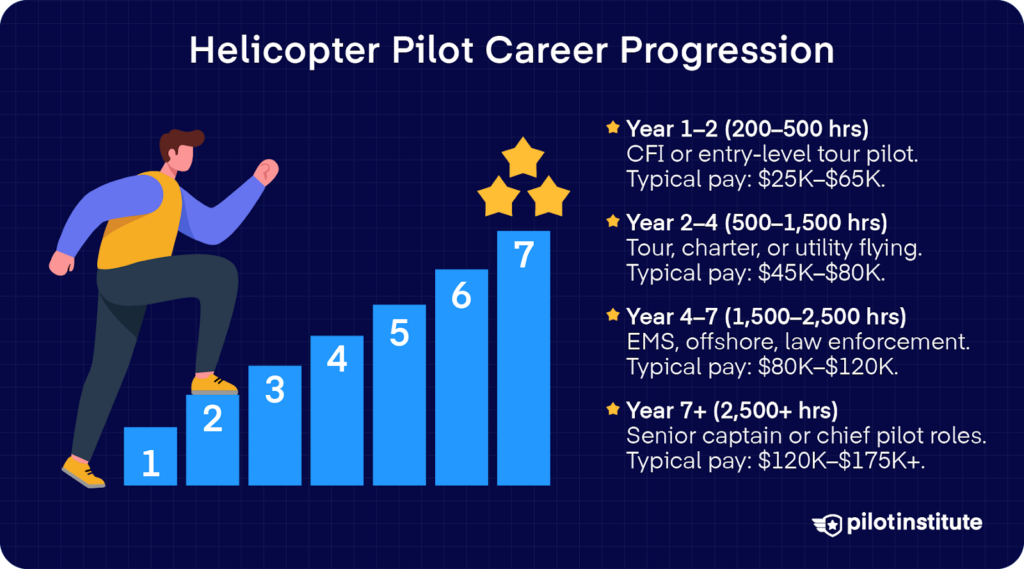
- Year 1 to 2 (200 to 500 hours)
You’ll work as a CFI or entry-level tour pilot earning $25,000 to $65,000. The goal here is to gain valuable experience as an aviator in an environment where you have oversight and guidance. You’re also building the flight time that qualifies you for other jobs.
If you work as a CFI, many flight schools have a tour and/or charter operation built into their company, which allows for an easy transition into those positions. You can also consider Second-In-Command (SIC) positions for larger aircraft requiring two pilots.
- Year 2 to 4 (500 to 1,500 hours)
You are continuing work as a flight instructor, moving into tour/charter operations, or entry-level utility work like pipeline patrol. Pay bumps to $45,000 to $80,000. If you enjoy flight instruction, being a career flight instructor as the Chief Instructor, Chief Pilot or Check Airman at a school is a great option.
You should consider completing your instrument rating if you don’t already have one, and have a plan for your next 500 hours, including a turbine transition around 1000 hours during this phase.
- Year 4 to 7 (1,500 to 2,500 hours)
This is where the real money starts. With enough turbine PIC time, IFR currency, and maybe NVG certification, you qualify for mid-level utility, entry-level EMS, law enforcement, and offshore or corporate positions. Expect $80,000 to $120,000.
- Year 7+ (2,500+ hours)
Senior captain seats, chief pilot roles, and high-demand specialty positions. Top earners in offshore, corporate, and EMS make $120,000 to $175,000+. Some chief pilots at large operations earn even more.
How to Increase Your Helicopter Pilot Earnings
If you want to move up the pay ladder faster, focus on these things.
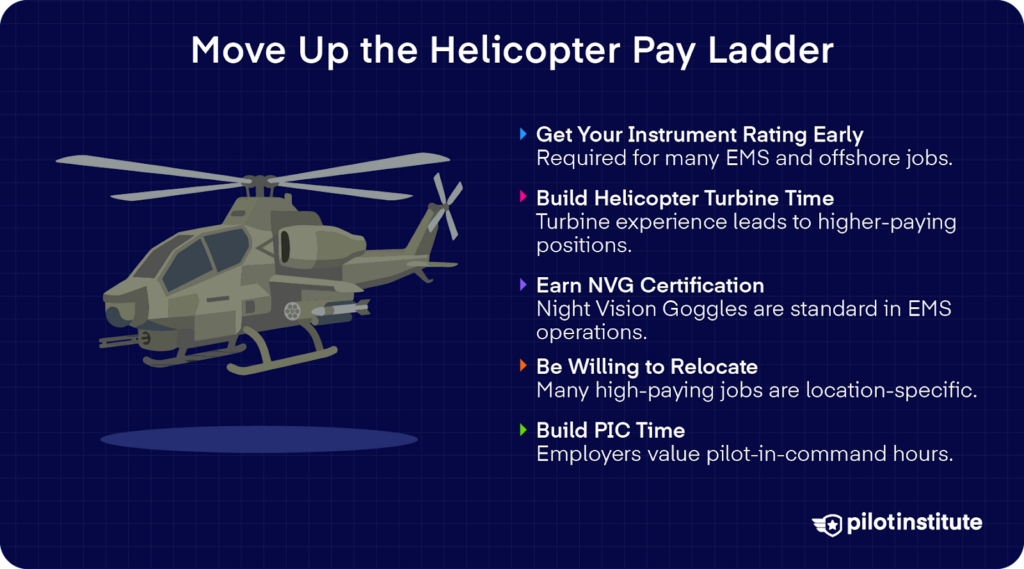
Add your instrument rating early. IFR capability is a requirement for EMS and offshore work. Ideally, you finish this while in school, between your private and commercial certificates. If not, getting it done before you hit 1,000 hours puts you ahead of pilots who wait.
Get turbine time. Piston hours get you started. Turbine hours get you paid. Transition to turbine helicopters as soon as you can, which is usually around 1000 hours due to insurance requirements. Some opportunities to transition early do exist.
Earn NVG certification. Night Vision Goggle proficiency is standard in EMS. Having it on your resume makes you a more competitive applicant for the jobs that pay $80,000+. If you do not have NVG experience (for example, from the military), an EMS operator will typically train you for it.
Be willing to relocate. The best-paying jobs cluster in specific areas. The Gulf Coast is for offshore. Texas, Alaska, and the western states for utility and firefighting. Major metro areas for corporate work. Moving to where the demand is can boost your salary by $10,000 to $20,000.
Build PIC time, not just total time. Employers care about pilot-in-command hours, especially in turbine aircraft. If you have been flying SIC, prioritize moving into a PIC position, or supplement your SIC time with something like flight instruction
Frequently Asked Questions
- What is the average helicopter pilot salary?
According to the Bureau of Labor Statistics, the median annual wage for commercial pilots (which includes helicopter pilots) was $122,670 in May 2024. ZipRecruiter puts the average helicopter pilot salary at about $106,000 per year, with a range of $64,000 to $141,000 depending on role and experience. Keep in mind that it will take several years of experience to reach this salary.
- How much do EMS helicopter pilots make?
EMS helicopter pilots typically earn between $60,000 and $150,000 per year. Entry-level EMS pilots with around 2,000 hours start at the lower end. Experienced captains with NVG, IFR, and several years of service at major operators earn toward the top.
- Do helicopter pilots make more than airplane pilots?
Generally, no. Airline pilots at major carriers earn a median of $226,600 per year, according to the BLS. That’s significantly more than most helicopter pilots. However, helicopter pilots in certain specialties like offshore, corporate, or senior EMS roles can earn competitive six-figure salaries.
- What is the highest-paying helicopter pilot job?
Corporate/VIP transport and offshore oil and gas work typically pay the most, with senior pilots earning $120,000 to $175,000+. Some chief pilot and flight department manager positions exceed $200,000 when you include bonuses and benefits.
- How long does it take to start earning good money as a helicopter pilot?
Most pilots hit the $80,000+ range after about 3 to 5 years and 1,500-2,000 flight hours. Getting to six figures usually takes 5 to 7 years with the right certifications and sector choices.
- Is a helicopter pilot a good career financially?
Yes, once you get past the initial investment. Training costs $70,000 to $90,000 to go from zero to a commercial pilot. But with a median salary over $100,000 for experienced pilots and strong job demand driven by a global pilot shortage, the long-term return is solid.
Conclusion
Helicopter pilot salaries vary a lot depending on where you fly, what you fly, and how much experience you bring. Tour pilots and CFIs start out around $25,000 to $65,000. EMS, offshore, and corporate pilots with the right hours and certifications earn $100,000 to $175,000+.
The path to higher pay is pretty straightforward. Build your hours. Add your instrument rating, turbine time, and NVG certification. Move into sectors that reward specialized skills and tough schedules.
The BLS reports a median of $122,670 for commercial pilots, and the industry is dealing with a real shortage that’s pushing salaries up across the board. If you invest in the right training and stay strategic about your career moves, the earning potential is definitely there.