
-
Key Takeaways
-
Why 2026 Is the Best Time to Fly for Pay
-
Pick Your Earning Model
- Freelance/Gig
- Staff Pilot
- Drone-First Entrepreneur
-
The Big List: 25+ High-Paying Drone Jobs
- Salary Snapshot Table
-
Visual Media & Marketing
- 1. Real-estate photo/video
- 2. Cinematic FPV
- 3. Stock photography
- 4. Drone light shows
- 5. Events coverage
- 6. Tourism and travel advertising
-
Inspection & Infrastructure
- 7. Roof/insurance
- 8. Construction progression
- 9. Power line, telecom, and pipeline inspection
- 10. Solar panel inspection
-
Mapping, Survey & Data
- 11. Mining and quarry surveys
- 12. Archaeological site documentation
- 13. Crime scene mapping
- 14. LiDAR or photogrammetry mapping
- 15. Mining operations
-
Agriculture & Natural Resources
- 16. NDVI crop scouting
- 17. Precision spraying (Part 137)
- 18. Forestry & wildlife preservation
-
Public Safety & Humanitarian
- 19. Search and rescue
- 20. Wildfire mapping
- 21. Disaster relief assessment
- 22. Medical supplies or vaccine delivery
-
Education & Consulting
- 23. Drone instructor
- 24. Educational videos
- 25. Corporate Drone-Program Consultant
- BONUS: Corporate drone-program consultant
-
Skills & Certifications That Boost Your Rate
- Premium Add-Ons
- Equipment ROI Table
-
Pricing
- Outcome-Based Packages
- Anchoring & Tiered Offers
- Handling Discount Requests
-
Landing Clients Consistently
- High-ROI Platforms & Networks
- Local Partnerships
- Showcasing Credibility
-
Future-Proofing Your Drone Career
- Continuous Upskilling
- Tracking Regulations & Tech
- Scaling: Solo to Team
-
Common Pitfalls & How to Avoid Them
-
Conclusion
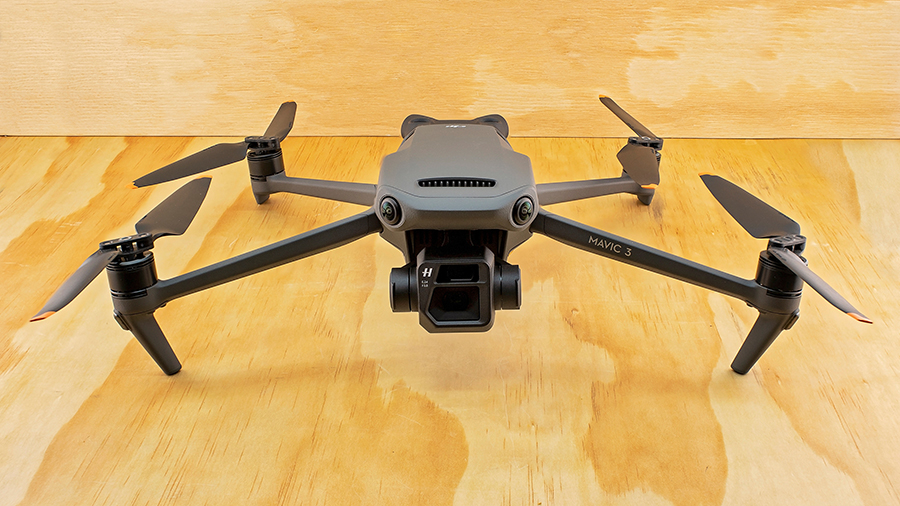
Imagine two local drone pilots. They use the same type of DJI Mavic drone, a Mavic 4 Pro for instance. They both offer commercial drone services, but one earns $150 for a day’s worth of work while the other earns $1500 by selling a “Roof Health Report.”
How can two drone pilots using the same hardware have such different revenue models? In this article, we will tell you why positioning, certifications, and catering to a nice industry matter more than the drone model you are using.
According to the FAA, there are more than 450,000 registered drones for commercial drone use and more than 480,000 certified remote pilots as of November 2025. It’s becoming a more crowded market out there.
Read on to learn about 25+ income streams to explore as a drone pilot, pay ranges, skill checklists, and tips on acquiring clients.
Key Takeaways
- There are still plenty of opportunities for commercial drone pilots, particularly in niche industries.
- Keeping your skills, knowledge, and technology updated is key to being competitive.
- Offer a range of rates and packages to appeal to a wider range of clients.
- Join networks and broadcast your work to consistently land clients.
Why 2026 Is the Best Time to Fly for Pay
Do you feel like the commercial drone industry has already reached its peak, and that it’s too late for you to join it?
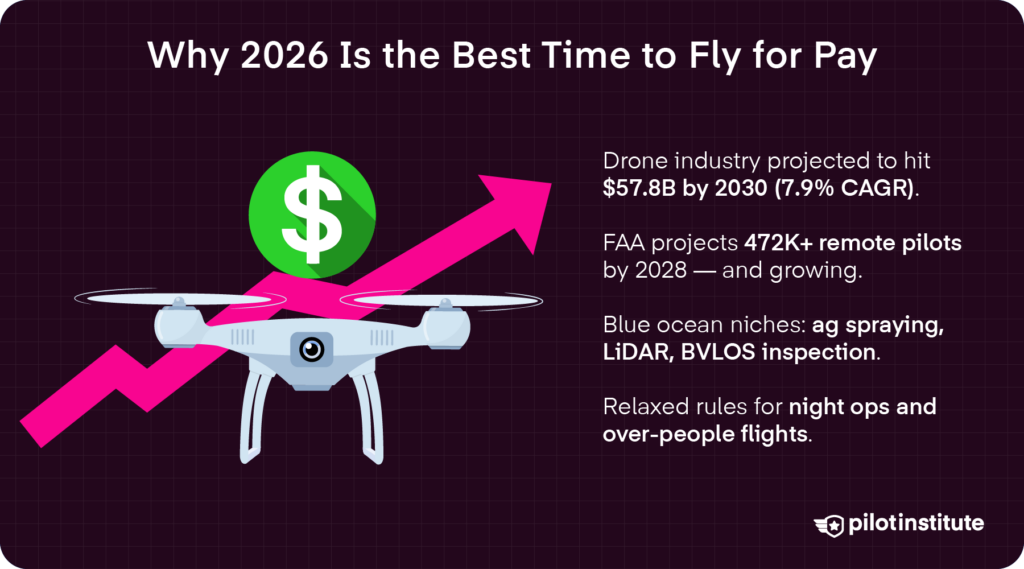
Industry studies indicate that this is not the case at all. According to the forecast of Drone Industry Insights, the industry is projected to hit $57.8B by 2030 (7.9% CAGR).
There are currently 428K+ active remote pilots as of 2025, and it’s growing. The FAA projects 472K remote pilots by 2028.
Specific “blue ocean” sectors remain ripe for plenty of opportunities for commercial drone services, like precision agricultural spraying, LiDAR mapping, and BVLOS power line inspection.
If those aren’t enough to convince, reading around will point to several tailwinds for the sector.
The FAA has relaxed drone flight rules for night operations and flying over people. The BEYOND program and the BVLOS ARC roadmap are making progress towards concessions for advanced drone operations. At the state and municipal levels, more government units are adopting drone programs for public safety and infrastructure work.
Still, the question remains – what are the best ways to start earning money with your drone? In this article, we will go through the most lucrative drone careers and some of the best practices in maintaining a successful drone business.
Pick Your Earning Model
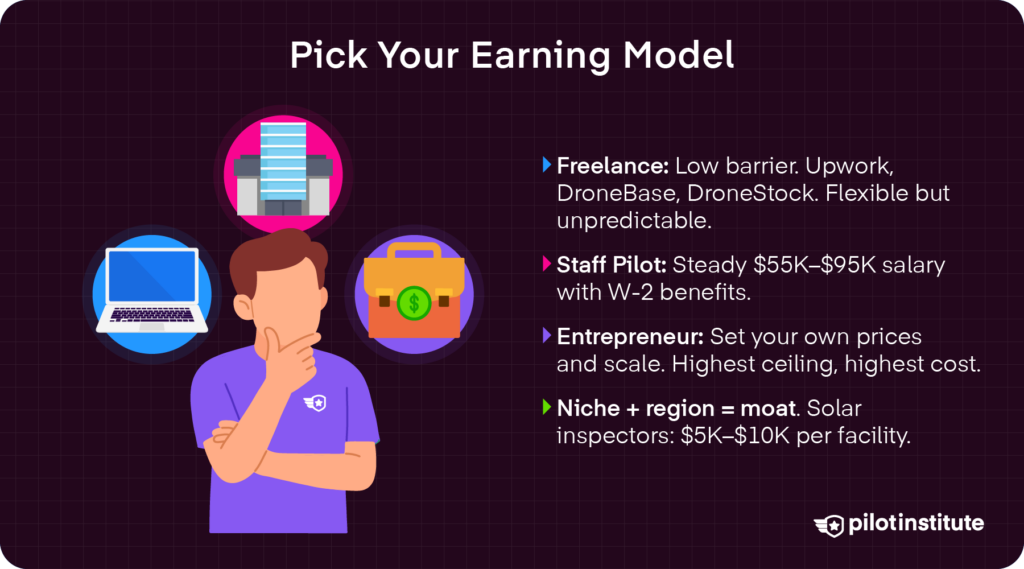
How would you like to offer your drone services? Depending on how much time you can commit or the degree of flexibility you want, there are several earning models you can choose from. Take note that earning potential also varies across these options.
Freelance/Gig
The easiest way to get into the commercial drone market is to offer your services as a freelancer. It is the cheapest option and now has a low barrier to entry because of all the freelance platforms available. You can either use a general freelancing platform like Upwork or more specialized sites like DroneBase or DroneStock.
A freelance gig is great for flexibility. It’s perfect if you still want to keep a day job while doing drone gigs on the side. However, the earnings and the pipeline for projects can be unpredictable, and you may have to be constantly looking for new clients.
Staff Pilot
You can also be hired to be a drone pilot for companies or organizations that have a constant need for drone services. Examples include construction firms, utility companies, media corporations, and police and fire departments.
The biggest advantage of this model is that you earn a steady salary as part of regular staff, as well as standard W-2 benefits. The salary for such positions can range from $55,000 to $95,000. The biggest downside is that your earning potential is limited by the salary that the company is willing to pay.
Drone-First Entrepreneur
Potentially the most lucrative option is for you to create your own branded service specializing in drone services. This gives you the authority to set the prices for your services, set the equity value of your company, and scale your operations.
This option also has the biggest barrier to entry. You will need substantial capital for hardware, hiring, and skills training. The expenses for regular operations such as advertising and administrative work can also be substantial.
- Call-out Box: “Niche and Region = Moat”
- A good way to stand out as a drone professional is to offer services to a niche market. For instance, Virginia-based I Fly Drones quotes rates of $50 to $100 per acre for drone-based inspection of solar farms. This can translate to between $5000 to $10,000 for a 10-MW solar power facility. The company also offers per-day rates of $1000 to $1800.
Label Your Drone the Right Way
Register with the FAA directly and get free stickers from us.
- FAA-ready marking.
- Looks professional.
- No card required.
- Quick request form.
The Big List: 25+ High-Paying Drone Jobs
Salary Snapshot Table
| Niche | Snapshot |
| LiDAR Corridor Mapping | Avg $115K; Top 10% $165K; Add-on: LiDAR workflow cert |
| Solar Farm Thermography | Avg $100K; Top 10% $150K; Add-on: Level I Thermal |
| BVLOS Power-Line Patrol | Avg $110K; Top 10% $215K; Add-on: BVLOS waiver |
Visual Media & Marketing
1. Real-estate photo/video
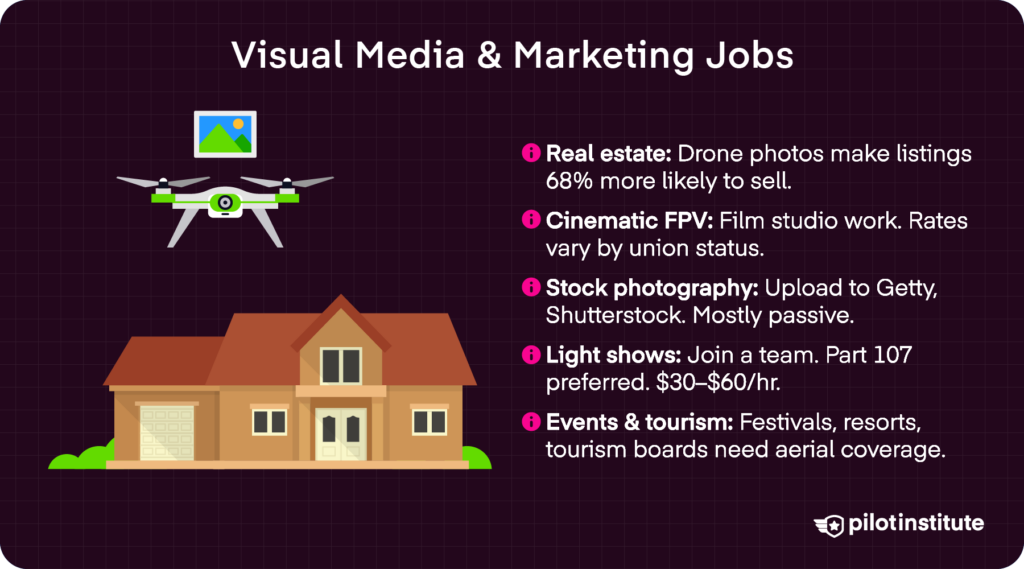
Real estate agencies now know that drone footage helps sell properties. According to some industry data, properties with drone photographs are up to 68% more likely to sell than those without.
You can offer your services at a discount at the start while building up a clientele. Get in touch with local real estate agencies or look for realtors via Zillow.
2. Cinematic FPV
If you’re excellent at taking cinematic shots, then you can try to get a drone pilot job at a filmmaking studio. Note that rates can vary significantly between getting hired as an independent worker or as a member of a union of film workers. Drone flight in films may involve having to prepare a safety declaration as part of compliance with safety regulations.
3. Stock photography
One of the easiest ways to make money with drones is to simply upload your drone photos on stock photo sites. Users can then purchase the rights to use your photos, whether for personal or commercial use. Sites like GettyImages, Shutterstock, and 123RF can be used for this model. The best part of doing this is that the income is mostly passive.
4. Drone light shows
This is an easy one because drone light shows are always looking for team members, with a preference for Part 107 pilots. Join an existing LRO team, learn something, and earn $30–$60/hr.
5. Events coverage
Just about every sporting event, festival, or concert nowadays is documented from the skies. If you want to cover such events with your drone, just reach out to your local events organizer or venue.
6. Tourism and travel advertising
Do you live in a place with nice aerial views? Your local tourism authority or tourist destination may need your help in capturing nice aerial photos for advertising. You can also try to contact beach resorts or hotels to ask if they can use your skills for their marketing needs.
Inspection & Infrastructure
7. Roof/insurance
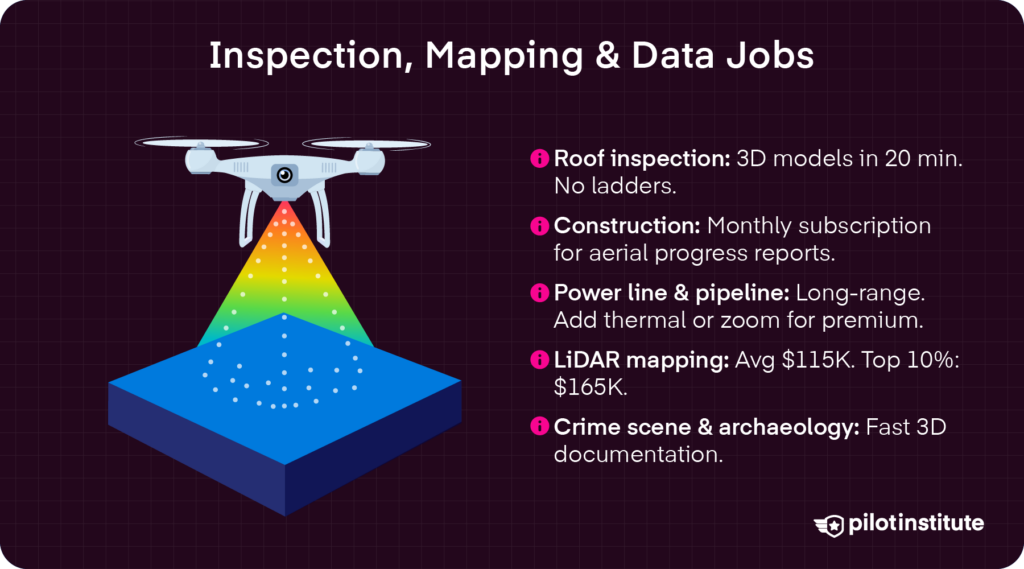
Whether it’s for a roofing company or an insurance adjuster, roof inspection jobs can be done much faster and safer with a drone. Drones can take photos or create a 3D model of a roof in 20 minutes, and you don’t even need to bring out a ladder to do the job.
8. Construction progression
What better way to monitor a large construction project than with a regular drone flyby? Drones can help simplify reporting with aerial images or 3D models. If you’re interested in this business, then pitch a monthly subscription package for your services.
9. Power line, telecom, and pipeline inspection
Inspection jobs of structures that span several miles, like pipelines, power lines, or solar farms, can be made a lot easier with drones. This would also be a good chance to upgrade your services by using thermal cameras or zoom lenses.
Take note that high-voltage structures can create electromagnetic interference on your drone, so some special precautions may be needed.
10. Solar panel inspection
If your drone has a camera, you can start offering your services to solar power or utility companies. A thermal camera can detect when a solar panel is not working properly. With a drone, inspection of solar panels can be done faster and more efficiently.
Mapping, Survey & Data
11. Mining and quarry surveys
Drones with 3D mapping capabilities can be useful for calculating stockpiles or creating terrain models. You can apply for this kind of job with mining companies or third-party surveying firms.
12. Archaeological site documentation
3D mapping provides unequaled levels of documentation in archeological dig sites without causing any damage. This is also a good chance to work with research organizations or universities. There is a lot more to archeology than flying drones, so you will also learn a lot with this job.
13. Crime scene mapping
Law enforcers are now using drones to quickly and accurately map crime scenes and vehicle crash sites. This method is faster and safer, and even allows for the reconstruction of scenes for investigation. Get in touch with your local law enforcement to explore such an opportunity, but you may need a drone in the Blue UAS list.
14. LiDAR or photogrammetry mapping
Whether it’s for pre-construction work or just topography monitoring, there is a wide range of mapping needs that can be served with drone technology. Take note that accuracy requirements may vary across clients, so keep track of the hardware that you have. You may need a LiDAR sensor or equipment to establish GCPs.
15. Mining operations
Most of the drone applications in mining companies typically involve mapping surveys and inventory of stockpiles. They can, however, also be used for progress monitoring and remote inspection of hazardous areas. This is potentially a very high-paying job, so check for any nearby mining operations.
FAA Note: State licensure may be required for “survey” title.
Agriculture & Natural Resources
16. NDVI crop scouting
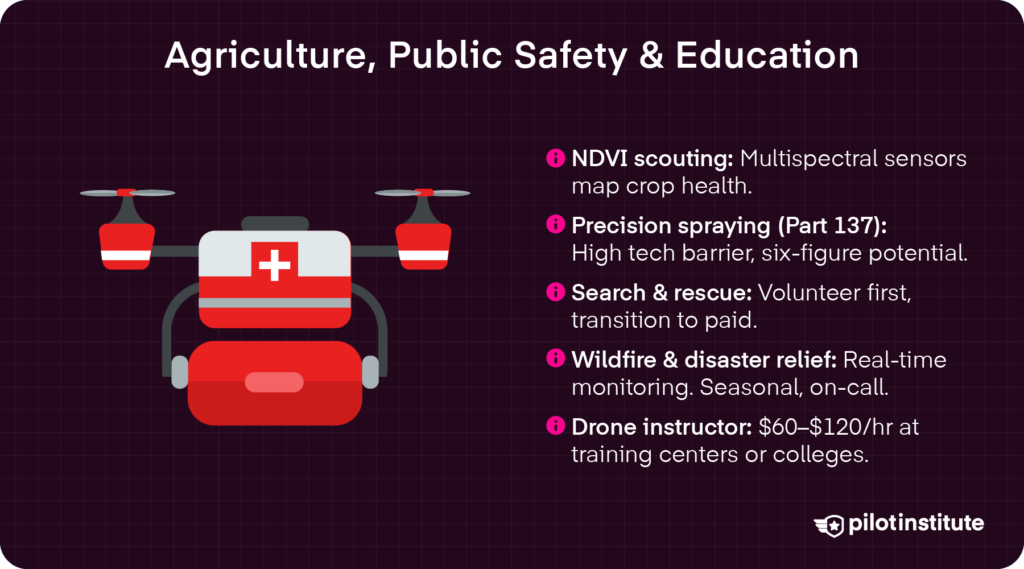
Through multispectral sensors, drones can be used to quickly generate NDVI maps of farms. This can then be interpreted to analyze crop health trends. This is gaining popularity in the agriculture industry and will be worth exploring for professional drone pilots. You will need some specialized equipment but this can be a very lucrative field.
17. Precision spraying (Part 137)
Drones can also be used for accurate and targeted delivery of farm chemicals like fertilizers or pesticides. The technology barrier for this niche is higher, but there is potential for six-figure earnings. There is an even bigger premium if you can provide drone swarm capabilities.
18. Forestry & wildlife preservation
Agencies involved in wildlife and forestry preservation use drones in different ways – to maintain count of animal populations, monitor forest fires, or detect poachers. This is a specialized field but a role here can be very fulfilling.
Public Safety & Humanitarian
19. Search and rescue
You can literally save lives with your drone when you volunteer for search and rescue operations. Get in touch with your local sheriff’s office or local authority to offer your services. This is potentially a very rewarding pathway from volunteering to a paid position.
20. Wildfire mapping
During wildfire season, your local fire department may need your help in monitoring wildfires in real-time. This is important work, but take note that it may be seasonal and on-call by nature. Make sure to do this only with the coordination and guidance of a fire department.
21. Disaster relief assessment
After a wildfire or hurricane, emergency response activities will need quick information on the extent of damage and which areas need aid. This is information you can collect as a drone pilot. Get in touch with your local disaster response agency, or Red Cross or FEMA organizations, for such opportunities.
22. Medical supplies or vaccine delivery
When it comes to delivering medical supplies over short distances, there is nothing faster than a drone. Many medical facilities now use delivery drones for emergency response. This is a worthwhile job where you can earn while also help in saving lives.
Education & Consulting
23. Drone instructor
If you know your stuff, you can also get a job as a drone flight instructor in training centers (like Pilot Institute and Unmanned Safety Institute) or colleges. This is a great idea for a part-time gig on top of your other drone pilot jobs. Drone instructors can get paid $60 to $120 per hour.
24. Educational videos
There is a growing demand for instructional videos on basic and advanced lessons in drone flight. You can record your own videos and either sell them to companies or upload them on YouTube for monetization.
25. Corporate Drone-Program Consultant
With corporations now increasingly using drones, they typically hire consultants to get started on a proper drone program. This mostly has to do with creating procedures and systems, and advising on permitting requirements. There will be a lot of paperwork, but this could be a high-paying gig.
BONUS: Corporate drone-program consultant
With corporations now increasingly using drones, they typically hire consultants to get started on a proper drone program. This mostly has to do with creating procedures and systems, and advising on permitting requirements. There will be a lot of paperwork, but this could be a high-paying gig.
Skills & Certifications That Boost Your Rate
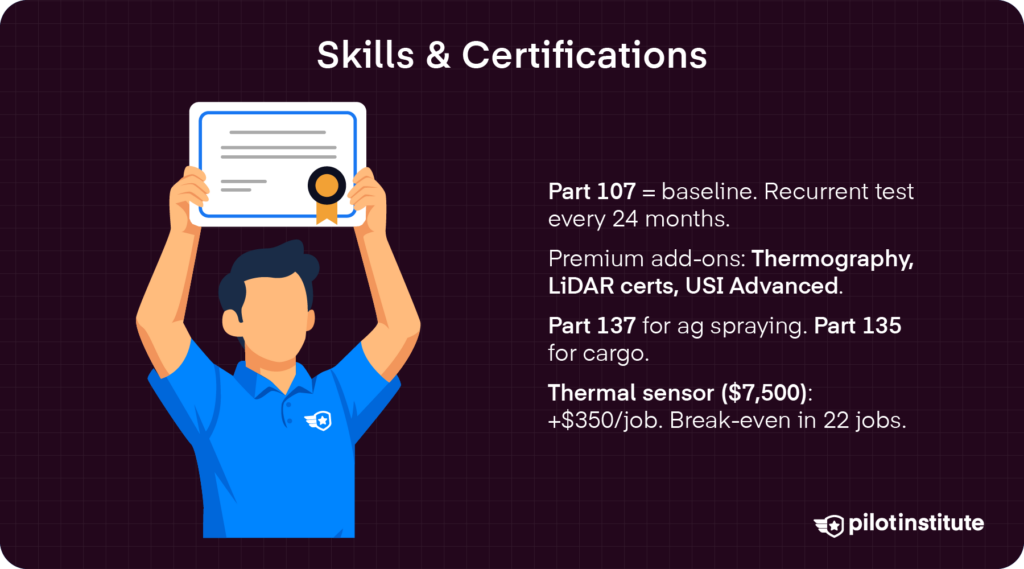
Before you can start offering commercial drone services, make sure to get an FAA Part 107 certification first. This is a federal requirement for all professional drone pilots.
Passing a knowledge test is a major part of the certification process. You will also need to take an online recurrent test every 24 months.
If you want to fly in controlled airspace, you will also need to apply for airspace authorization. This is a lot easier now with the LAANC system, which is accessible via most drone flight planning apps.
Premium Add-Ons
Beyond the basics, you can also earn certifications that will allow you to offer more premium and high-paying services. Some of these certifications are more general in nature, such as the Advanced Unmanned Safety Certification from USI.
There are also more specialized certifications, like the Level I/II Thermography from the Infrared Training Center, or a LiDAR processing certification from companies like Pix4D, GeoCue, or LP360.
For certain applications, a special certification is a legal requirement. For instance, you will need an agricultural aircraft operator certification under FAA Part 137 if you plan to use your drone for the spraying of agricultural or chemical products.
If you plan to fly for a company transporting cargo, that company must be certified as a Part 135 air carrier. As the remote pilot for these operations, you will be required by the FAA to hold a commercial pilot certificate, which is a more advanced certification than Part 107.
Equipment ROI Table
| Upgrade | ROI Snapshot |
| XT2 Thermal Sensor | Cost: $7,500 · Avg bump/job: +$350 · Break-even: 22 jobs |
| LiDAR Payload | Cost: $28,000 · Avg bump/job: +$1,800 · Break-even: 16 jobs |
Pricing
Setting a price for your services is always a challenge at first, especially if you’re in the freelance market. It would be best to keep your options open and offer flexible prices depending on the type of services you can provide.
Outcome-Based Packages
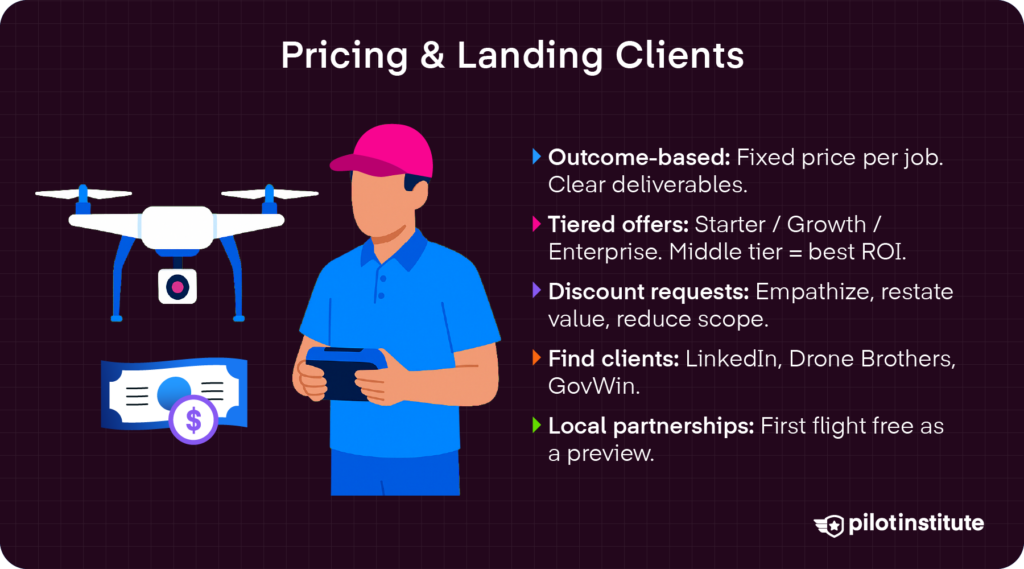
The simplest model would be to charge a fixed price for any single job, like a roof health report or a topography survey. This does away with the complexity of a per-hour rate.
When offering an outcome-based package, make sure that you and the client have agreed on a list of deliverables and a turnaround time. This is ideal for clients that are working with a tight budget and cannot afford cost overruns.
Anchoring & Tiered Offers
If you want to attract a wide range of clients, then you can consider offering several tiers of services. This will allow you to offer lower prices to a “Starter” tier, slightly higher prices to a “Growth” tier, and premium services to an “Enterprise” tier.
The usual business strategy for this model is to set the middle tier to have the highest ROI. This is a great way to maximize your earnings since most clients tend to gravitate towards the middle tier.
Handling Discount Requests
Inevitably, potential clients will negotiate for discounted rates. As a business owner, you need to be prepared for such scenarios and have viable alternatives to offer.
There are 3 steps to responding to a discount request: empathize, restate value, and offer a scope reduction. Be flexible, set your non-negotiables, and think about the long-term benefits of landing clients.
Landing Clients Consistently
Once you have your drone business up and running, how will you get clients? There are several smart ways to do this, depending on the services you are offering and the type of clients you are targeting.
High-ROI Platforms & Networks
The first method is the old-fashioned way of scouring networks to look for potential clients or contracts. Good options include doing a Boolean search on LinkedIn, joining a drone pilot network like Drone Brothers, or looking for contracts being offered in GovWin.
This method requires constant effort but gives you better control over the types of drone jobs that you will be getting.
Local Partnerships
You can also tie up with local businesses that might need your drone services. This can include construction companies, roofers, or utility companies.
The biggest challenge of this approach is convincing them to use your services for the first time. A good strategy would be to offer them your first flight for free just to give a preview of what you have to offer.
Showcasing Credibility
All the effort of securing clients won’t give results if you don’t consistently showcase your credentials. Make sure to keep records and logs of your flight, maintain an updated portfolio, and highlight testimonials from your past clients.
Another way to consistently attract high-profile clients is to maintain a certificate for UAV liability insurance with a value between $1 to 5 million.
Future-Proofing Your Drone Career
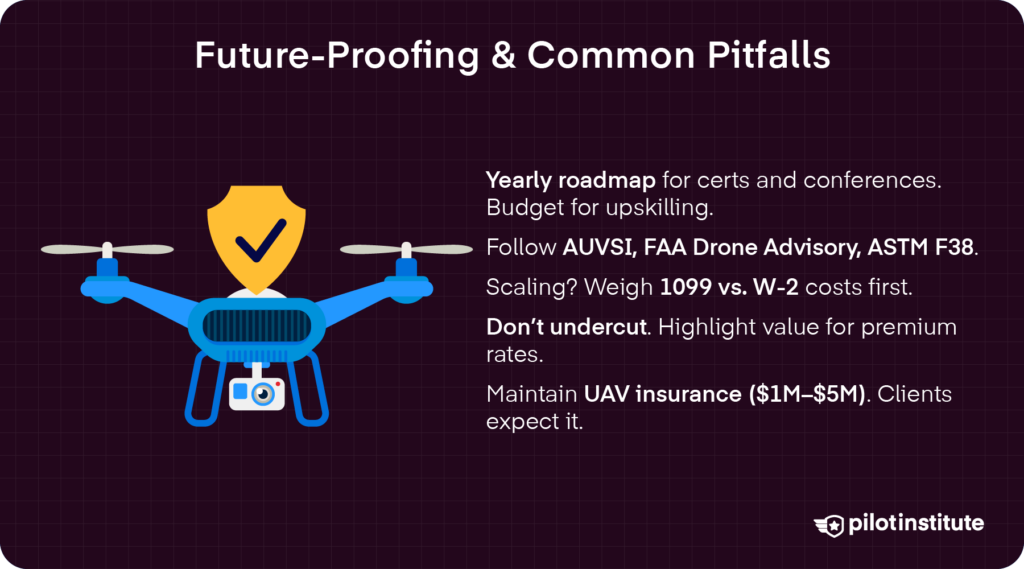
The commercial drone market is already very competitive. This trend will almost certainly continue, so there is a pressure to constantly keep your skills, knowledge, and technology updated to continue the success of your business.
Continuous Upskilling
The skills of a drone pilot are far more important than the technology. Keep your skills updated by making a yearly roadmap for new certifications and conferences to attend. You will also want to keep your simulation hours updated.
There will be significant costs that go toward these upskilling work, so make sure to consider this in your operating budget.
Tracking Regulations & Tech
Another important part of being competitive is ensuring that you are updated with the latest changes in drone regulations and technology standards.
There are a few entities to follow to keep yourself updated – the Association for Uncrewed Vehicle Systems International (AUVSI), the FAA Drone Advisory Committee, and the ASTM F38 Committee on Unmanned Aircraft Systems. You should also subscribe to the Federal Register notices from the FAA.
Scaling: Solo to Team
When your business becomes successful, you will eventually run into the question of whether you want to scale up. This will allow you to take on bigger and more projects, but you will need to hire more remote pilots, visual observers, or editors.
When making this decision, you will also need to consider the difference in taxes and benefits between 1099 and W-2 workers. Make sure that scaling up will be sustainable given the financial implications of hiring a team.
Common Pitfalls & How to Avoid Them
As a commercial drone pilot, achieving success means focusing both on your drone flight skills and your skills in business management. Luckily for you, many drone pilots have already learned from these pitfalls so you don’t have to.
As more drone pilots join the commercial space, a common pitfall is to start undercutting your prices. This is a bad move because you will end up doing the same work for less earnings. Instead, highlight the high value of the services you offer to justify premium rates.
Another common mistake is to not maintain an insurance policy. Clients will always want to work with insured drone pilots. Consider it a business expense and set your rates accordingly.
Establish standard procedures for all aspects of your business, from client engagement to field activities and output delivery. This will make it a lot easier to execute on projects, especially as your business scales up.
Conclusion
If the thought ever crossed your mind that you might be able to use your drone to earn money, then take this as your sign to go for it. The demand for commercial drone services is on the upswing, with some niche industries potentially giving you six-figure earnings.
Our best advice for you would be to pick a high-value niche that aligns with your skills. Build a 3-tier package with specific rates and deliverables. Then start with sending just five outreach emails to potential clients. It may not work the first time, but this is a good start to refine your process.
In 2026, the drone isn’t the product – you are. Elevate your value, and the sky becomes your workplace.