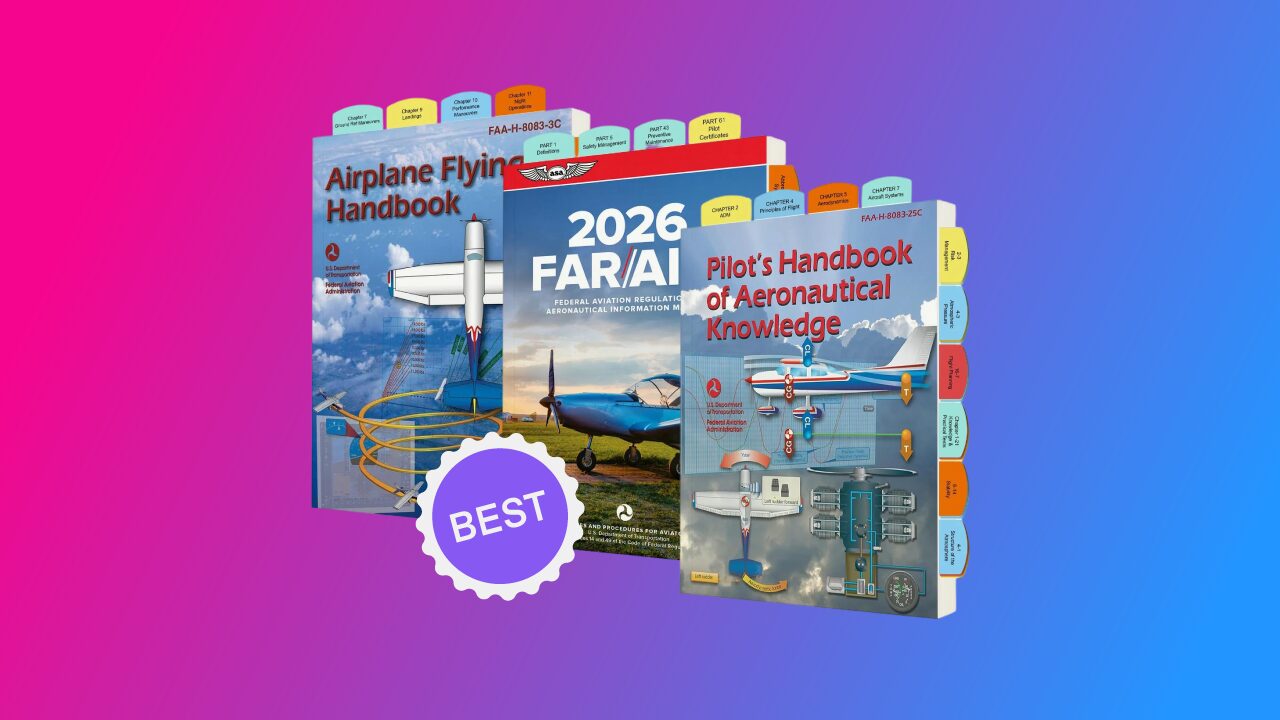

- Key Takeaways
- How We Picked These Books
- 1. Pilot’s Handbook of Aeronautical Knowledge (PHAK)
- 2. Airplane Flying Handbook
- 3. FAR/AIM 2026 (ASA Edition)
- 4. ASA Private Pilot Test Prep 2025-2026
- 5. Private Pilot Oral Exam Guide (ASA)
- 6. The Pilot’s Manual: Ground School (7th Edition)
- 7. Stick and Rudder by Wolfgang Langewiesche
- 8. The Student Pilot’s Flight Manual by William Kershner
- 9. Everything Explained for the Professional Pilot by Richie Lengel
- 10. Aviation Weather Handbook (ASA/FAA)
- 11. Becoming A Pilot: What Every New Pilot Needs To Know To Save Time And Money In Flight School
- How to Use These Books During Training
- Ground School
- Flight Training
- Exam Prep
- Further Training
- Frequently Asked Questions
- What is the best book for a student pilot just starting out?
- Are the free FAA handbooks enough to pass the written test?
- Do I need to buy a new FAR/AIM every year?
- What is the best book for checkride oral exam prep?
- Is Stick and Rudder still relevant?
- Conclusion
You signed up for flight lessons, and your instructor just handed you a reading list. Half of it is FAA publications with names like FAA-H-8083-25B. The other half is books you’ve never heard of.
Which ones will actually make a difference? Which ones will collect dust on your bookshelf while you’re cramming for checkride prep?
We’ll talk about 11 books worth your time and money, organized by when you’ll actually need them during training.
Some are free FAA publications you absolutely can’t skip. Others are commercial books that explain things better than the official manuals.
Heads up: Some links in this article are affiliate links. As an Amazon Associate, we earn from qualifying purchases. This helps support the site so we can keep creating content for readers like you.
Key Takeaways
- Different books can serve you throughout each phase of your flight training.
- Test prep books give you exam-focused practice questions.
- The FAR/AIM has the regulations you’ll reference throughout your training.
- Alternative texts can give you a different perspective when manuals don’t click.
How We Picked These Books
Choosing the right books for your flight training can feel overwhelming, especially as a curious beginner. But how do you separate the useful from the pretty (and not much else)?
We narrowed our picks down to three core criteria.
First, the book has to align directly with FAA standards. Your examiner will test you against FAA publications, so any study material must be consistent with current regulations and procedures.
Second, the content must be practical for student pilots. You don’t need to go through an entire textbook on advanced aerodynamics to pass your checkride. The right one has everything you need to know as a student pilot.
Third, we focused on resources that work together as a system (rather than a redundant, incohesive pile).
The books below will guide you from fundamental aeronautical knowledge all the way to test prep.
1. Pilot’s Handbook of Aeronautical Knowledge (PHAK)
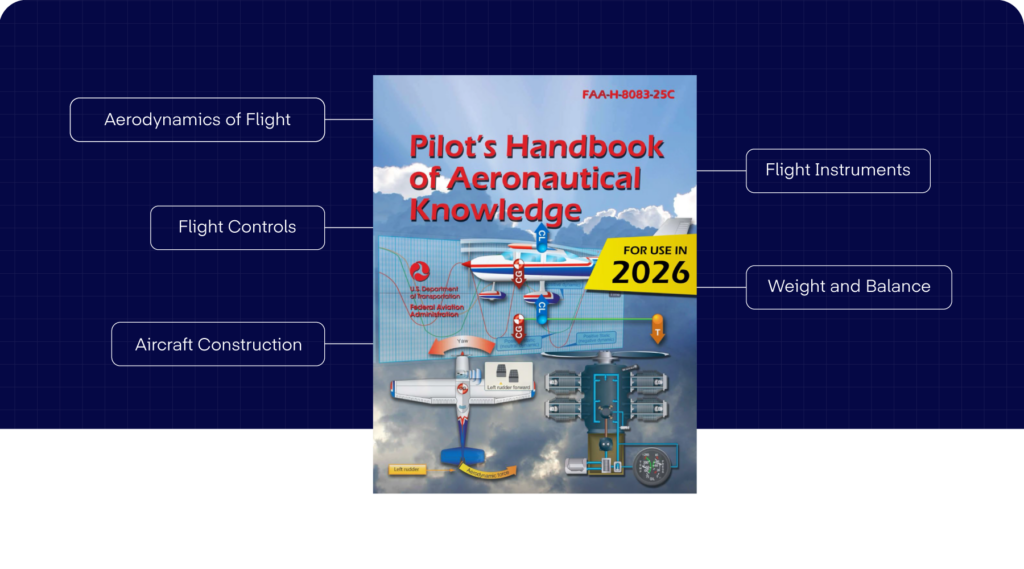
This is the foundation. The holy grail. The pilot’s bible.
The Pilot’s Handbook of Aeronautical Knowledge is the FAA’s official guide to aeronautical knowledge. It’ll teach you everything from basic aerodynamics to weather theory to aircraft systems.
But you’ll see its real value on your written exam and oral checkride. When your examiner asks about lift and drag or how a constant-speed propeller works, you’ll find the answers in this book.
The FAA updates it regularly, so make sure you’re learning exactly what the FAA expects you to know.
It’s a pretty heavy book, so most student pilots use it as a reference rather than reading it cover to cover. Your ground school instructor will assign relevant chapters as you progress through different topics.
2. Airplane Flying Handbook
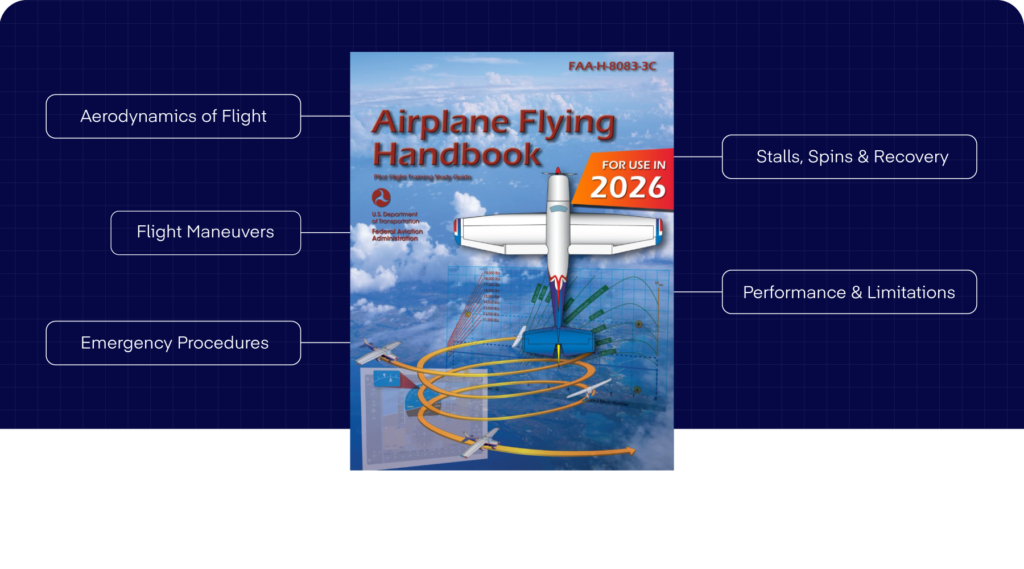
If the PHAK covers knowledge, the Airplane Flying Handbook focuses on doing. This FAA publication explains how to actually fly the aircraft. It’s the practical companion to the PHAK’s theory.
Every maneuver you’ll perform during training appears in this handbook. Takeoffs, landings, stalls, steep turns, and ground reference maneuvers are all here.
You’ll read about the step-by-step procedures and explanations for common errors.
The handbook also has sections on emergency procedures and aeronautical decision-making. It’s valuable stuff that most students miss, but it’ll definitely show in your checkride performance.
How so? Your examiner will evaluate you against the standards in this book. Understanding both the How and the Why will be your foundation for consistent, safe flying.
3. FAR/AIM 2026 (ASA Edition)
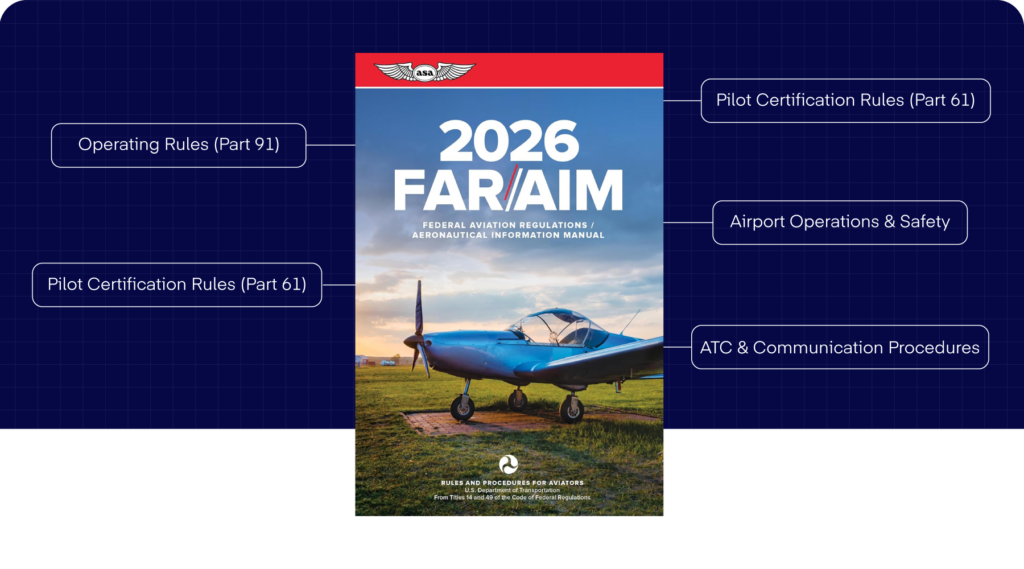
Nope, this isn’t “optional reading.”
You need to know the rules that govern your flying, and you’ll find them in the Federal Aviation Regulations (FARs).
The Aeronautical Information Manual (AIM), on the other hand, is where you can read FAA guidance for operating in the National Airspace System.
The ASA edition combines both into one volume.
Can you just use the free versions on the FAA website? Absolutely.
However, many pilots prefer the ASA edition. It has handy features like color coding, a comprehensive index, and study question references.
But how do you stay current when regulations change so often? Well, the ASA edition gives you free online access and an email subscription service that sends you updates the moment they’re released.
4. ASA Private Pilot Test Prep 2025-2026
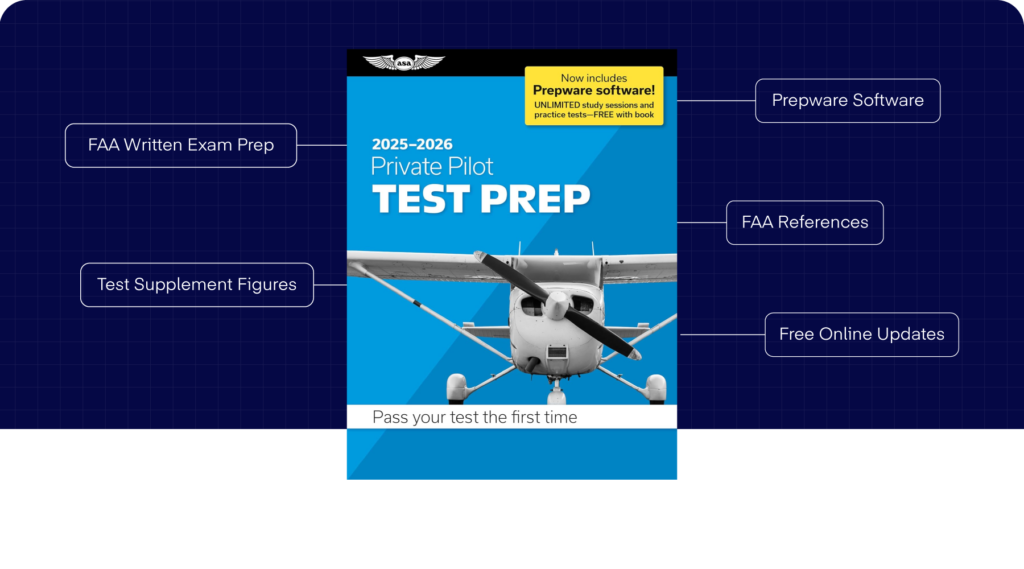
Your FAA written exam consists of 60 multiple-choice questions covering all areas of aeronautical knowledge. You’ll need an effective study system, and the ASA Private Pilot Test Prep 2025-2026: Paperback plus software gives you just that.
It includes Prepware software for your computer and a 24-month subscription to Prepware Online. You can access your test prep materials from any device with an internet connection!
You’ll also find FAA references for deeper study and airman test report codes that identify weak areas after you take the actual exam.
The book includes all the figures from the FAA Airman Knowledge Testing Supplement, so you’re practicing with the exact materials you’ll see on test day.
But how do you even navigate hundreds of practice questions, realistically? ASA includes test-taking tips and quick cross-references that help you find specific questions.
And like their FAR/AIM, you’ll get free online updates throughout the book’s lifecycle to keep you current with any test changes as they happen.
5. Private Pilot Oral Exam Guide (ASA)
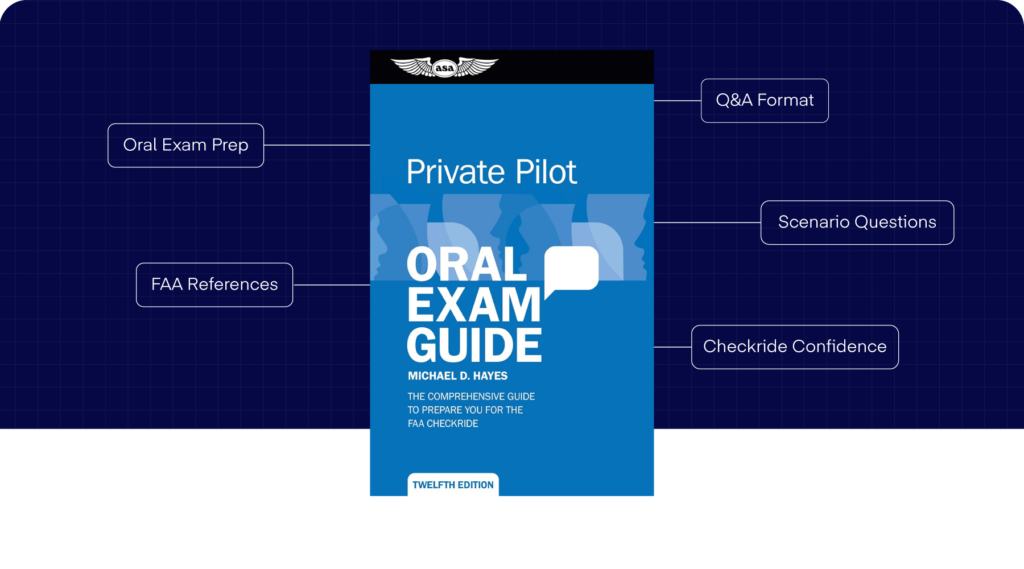
The Private Pilot Oral Exam Guide from ASA works as both a study tool and a confidence builder when you’re preparing for your checkride. The entire guide is arranged in question-and-answer format, which means you’re not hunting through dense paragraphs to find what examiners actually care about.
And while it’s most valuable when you’re gearing up for the oral exam, it’s also an excellent general refresher throughout your flying career.
Each answer includes FAA references so you can dig deeper into topics that need more study.
There’s one chapter that stands out. The scenario-based questions section asks open-ended questions that require you to demonstrate understanding of the bigger picture.
How do examiners evaluate these responses? They’re looking for practical application of knowledge. Your answers to these scenarios will reveal if you understand what’s important and how you can apply it to real-world flying.
6. The Pilot’s Manual: Ground School (7th Edition)
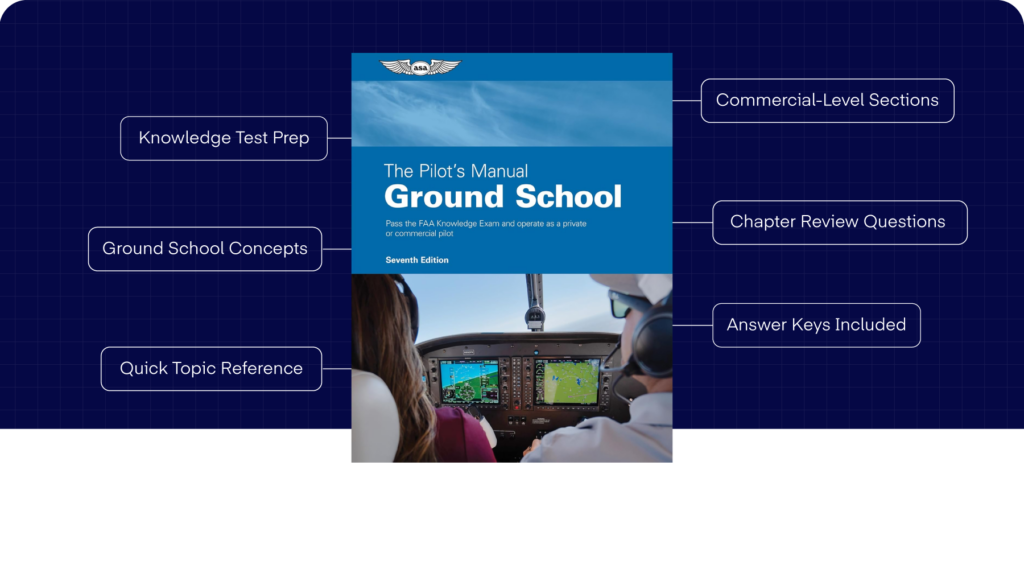
The Pilot’s Manual: Ground School gives you everything you need to pass your knowledge test.
What makes this effective? As you make progress through the material, you’re building on previous concepts. You’re not fighting to connect disconnected topics or backtracking to fill gaps the book should’ve addressed earlier.
It’s perfect if you’re planning to train for the commercial certificate later. You’ll find clearly labeled sections on commercial-level flying.
Every chapter has review questions with answer keys to really lock in what you’re supposed to learn.
The index lets you quickly locate a certain topic. When you need to check a regulation or refresh on weight and balance calculations, you can find it right away.
7. Stick and Rudder by Wolfgang Langewiesche
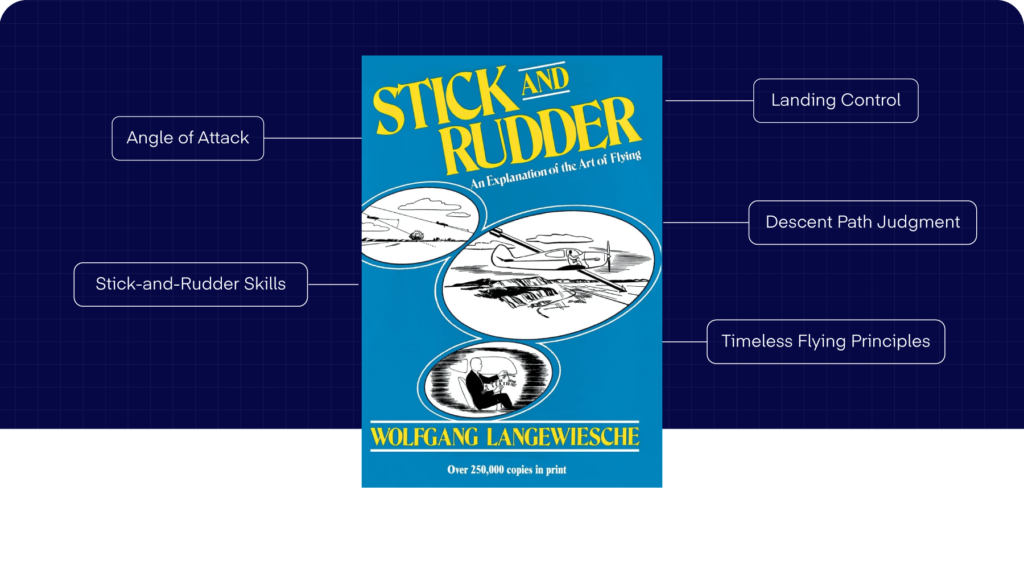
You can immediately tell that this thing is vintage as soon as you see the cover. But there’s a reason student pilots still stand by Stick and Rudder, even after eight decades in print.
So, why is it still relevant? Physics and pilotage don’t go out of style. The explanations apply even if you’re flying a brand-new Cessna.
Some of its content was pretty controversial when it first came out. Today, its principles are widely accepted. It’s been proven to work, and it still works.
One thorough reading gives you the equivalent of many hours of practice. For example, you’ll learn about the invisible secret behind all flight: the angle of attack.
You’ll work through landing approaches with detailed explanations of how your eye judges the descent path.
The book also talks about “the spot that does not move.” It’s a foolproof method for making an approach across obstacles.
All of that and more are here, in this 82-year-old book!
8. The Student Pilot’s Flight Manual by William Kershner
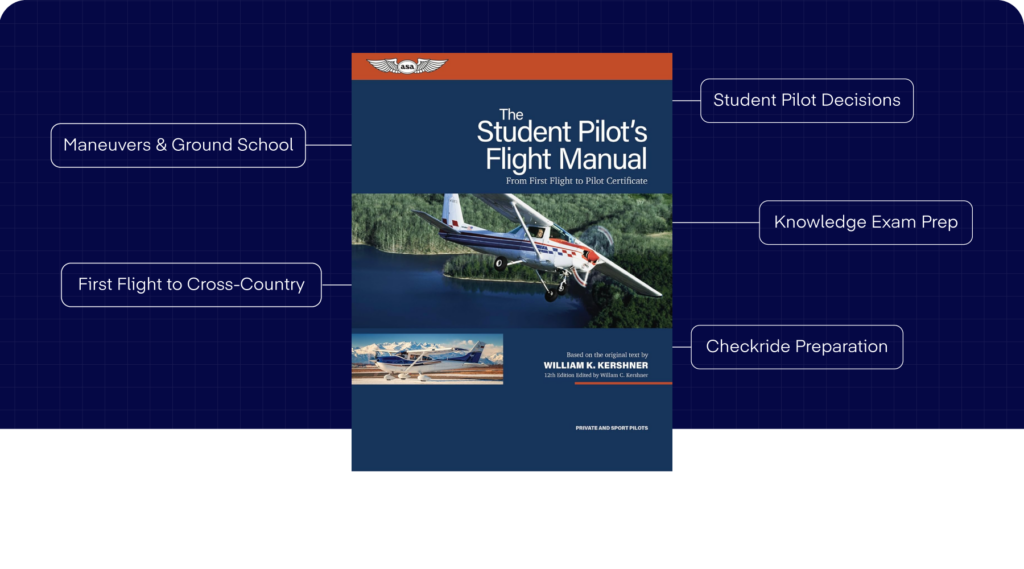
The Student Pilot’s Flight Manual combines a ground school textbook, maneuvers manual, and syllabus into one. Written by legendary flight instructor William K. Kershner and edited by his son, this book takes you step-by-step from your first flight to cross-country.
What makes this different from other books? Kershner encourages student pilot decision-making. Plus, the casual language will be a breath of fresh air after grinding through the monotone of other manuals.
You’ll find the author’s original drawings throughout, which help visualize concepts that are hard to grasp from text alone.
You’re getting material used in actual preflight and postflight briefings. The book also walks you through what to expect for your knowledge exam and checkride, which should help ease your anxiety as you approach that milestone.
You’ll find essential information you’ll use throughout your flying career, and that makes it a reference you’ll return to long after earning your certificate.
9. Everything Explained for the Professional Pilot by Richie Lengel
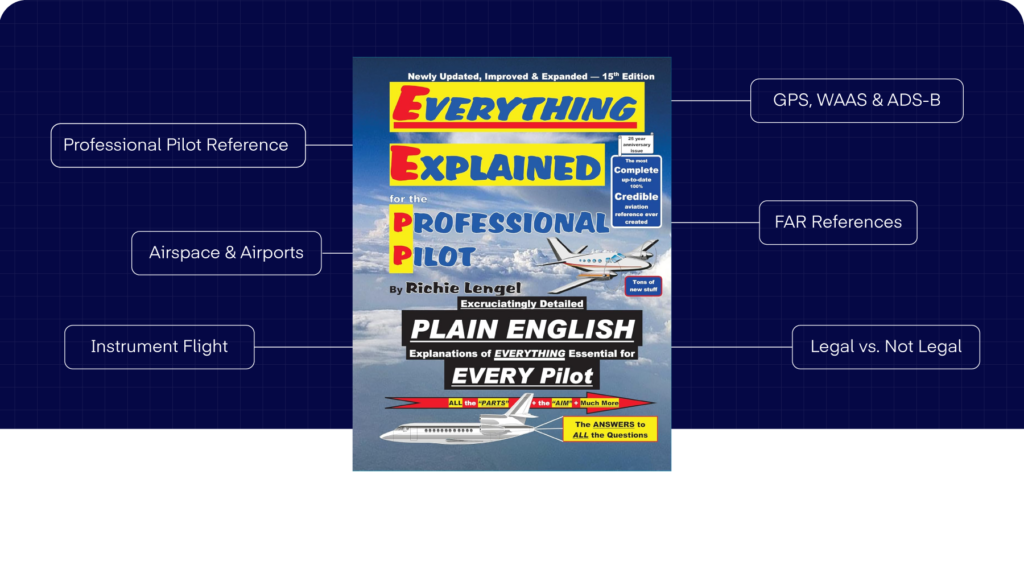
It’s exactly what the title promises. Everything Explained For The Professional Pilot is a comprehensive book that covers all aspects of aviation (and by that, we mean from props to heavy jets).
You’ll find detailed explanations of airspace and airports, instrument flight from beginning to end, and navigation systems including GPS, WAAS, ADS-B, and HF radios.
It gives you quick information at your fingertips, plus FAR references when you need to dig into the details. The author tosses in occasional humor to help you remember the material, making complex topics more digestible.
The book works as a reference for your entire career. You’ll return to it repeatedly as you advance through ratings and encounter new aircraft systems. Talk about return on investment.
It’ll help you navigate the regulatory environment with confidence. That’s because it covers what’s legal and what’s not in practical language.
10. Aviation Weather Handbook (ASA/FAA)
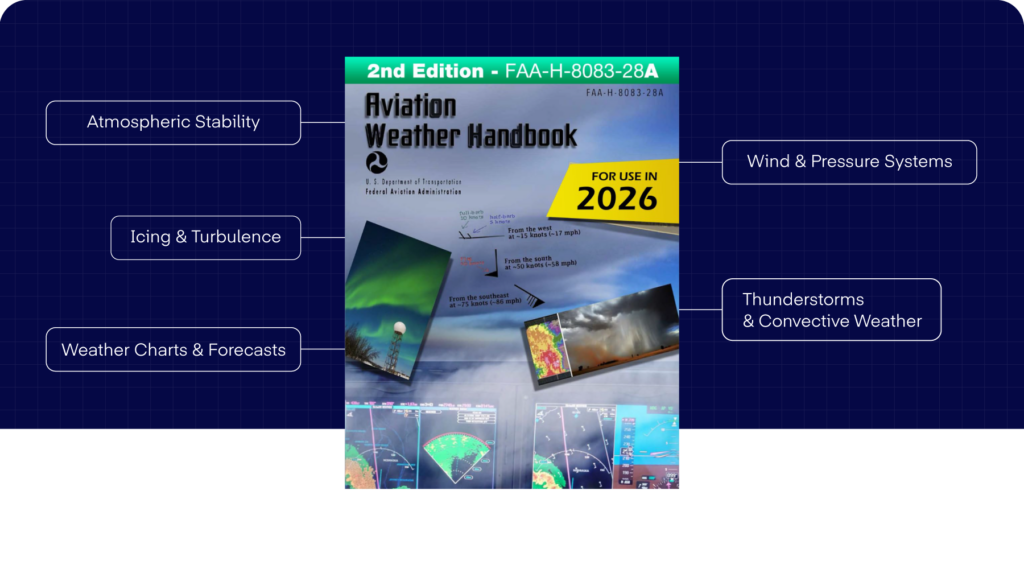
This will be your main reference for meteorology and weather services in your exams, but it’s more than just that. The Aviation Weather Handbook applies to everyone, from student pilots to experienced instructors.
Inside, you’ll find comprehensive explanations of the U.S. aviation weather service program, weather briefings, weather theory, and aviation hazards.
The book covers observations including ASOS, AWOS, METAR, PIREP, and radar data. You’ll work through weather charts, advisories like AIRMET and SIGMET, and forecasts including TAF and area forecasts.
The handbook also deals with specialized topics like mountain weather, tropical weather, and arctic conditions. For the curious, you can even read about space weather!
The examples throughout are illustrated with full-color drawings and pictures.
You’ll also find references to online weather resources and flight planning tools, plus links to related FAA publications for deeper study.
11. Becoming A Pilot: What Every New Pilot Needs To Know To Save Time And Money In Flight School
Book eleven is the odd one out on this list. It’s not a maneuver manual, a ground school textbook, or an FAA publication.
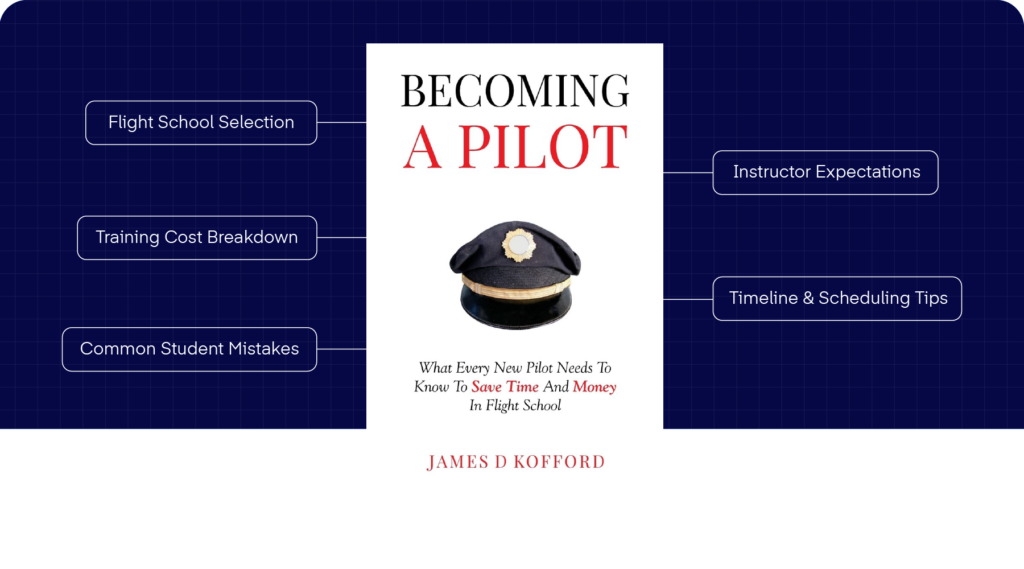
Becoming a Pilot: What Every New Pilot Needs To Know To Save Time And Money In Flight School covers the side of training most books skip entirely: how to choose a flight school, what to expect from your instructor, and how to avoid the missteps that quietly drain your budget and add months to your training.
Flight training is expensive. It can also take a lot longer than it needs to if you go in without a clear picture of how the system works. New student pilots often lose time not because they lack ability, but because they didn’t know what questions to ask or what to watch out for. This book fixes that.
Read it early. The sooner you understand how training actually works, the more control you have over how it goes.
How to Use These Books During Training
So, you’re ready to become a pilot. Your training divides naturally into phases, and different books serve different purposes at each stage.
You might be asking, What books do I need for flight school? When should I use them?
Let’s organize thebest books for private pilot training.
Ground School
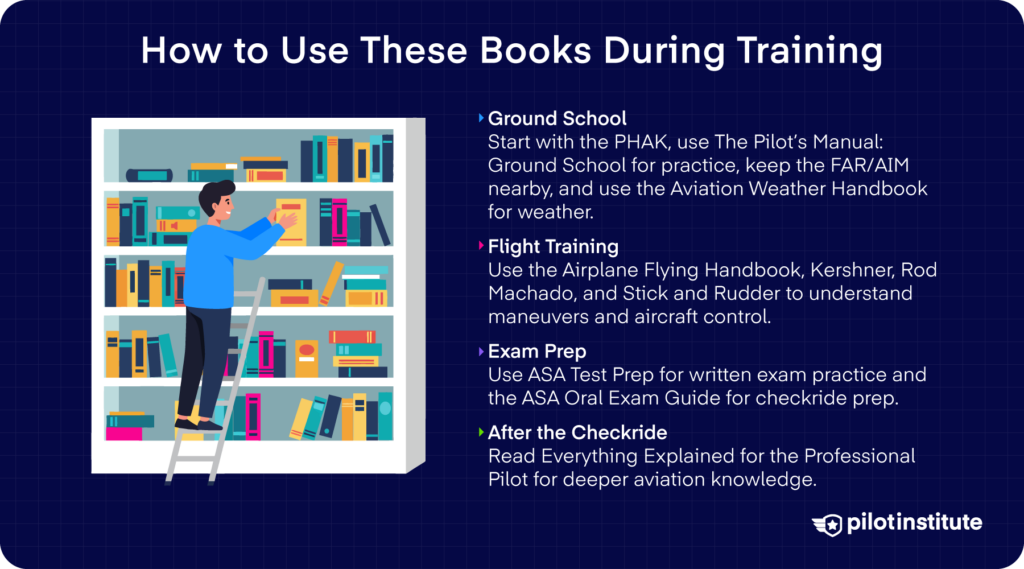
Ground school is the foundation of your training, so you’ll want to start with the fundamentals in the Pilot’s Handbook of Aeronautical Knowledge. Work your way through each chapter as you go through your lessons.
Then, test yourself with the practice questions in each section of The Pilot’s Manual: Ground School. This is the best time to catch your weak spots, and not right before the big test.
Make sure the FAR/AIM is always nearby for quick reference when regulations come up. You’ll be looking up specific rules constantly, and having it within reach saves you from breaking your study flow.
The Aviation Weather Handbook supports your weather theory ground instruction with detailed explanations and practical applications.
Flight Training
Ready to get in the cockpit? Then make sure to keep the Airplane Flying Handbook close by. Read up on the chapter you’ll practice before each lesson.
But what if you’re struggling with a maneuver? You’ll want someone to hold your hand and talk to you in plain English. That’s why you should supplement flight training with The Student Pilot’s Flight Manual by Kershner and Rod Machado’s Private Pilot Handbook.
Stick and Rudder by Langewiesche takes on a different style that you’ll find refreshing. It focuses on the feel of flying rather than procedures.
Exam Prep
When you’re about halfway through your training and the FAA tests are in sight, the ASA Test Prep will be an essential.
Work through practice questions as you complete each knowledge area rather than cramming at the end. The ASA Oral Exam Guide will help you prepare for the verbal portion of your checkride.
Further Training
Everything Explained for the Professional Pilot by Lengel bridges private pilot knowledge to commercial operations. Save this one for after your checkride when you’re ready to understand aviation at a deeper level.
Frequently Asked Questions
What is the best book for a student pilot just starting out?
The PHAK is the foundational book of aeronautical knowledge (hey, it’s in the name!). But if you want a more structured study strategy with built-in practice questions, The Pilot’s Manual: Ground School organizes the same material into lessons.
Either option works well as your main resource.
Are the free FAA handbooks enough to pass the written test?
Yes, the PHAK and other FAA publications contain all the information tested on the written exam.
Now, with that said, most students still find a dedicated test prep book helpful. A good one will organize your study and help spot your weaknesses.
The test prep format mirrors the actual exam, which will build your confidence before test day.
Do I need to buy a new FAR/AIM every year?
Not necessarily every year, but you need a current edition that reflects active regulations.
The FAA typically makes regulatory changes annually, though not all of them affect private pilot operations. Just make a habit of checking the amendment date in your copy and verifying the regulations haven’t changed since publication.
What is the best book for checkride oral exam prep?
The ASA Oral Exam Guide organizes questions by Airman Certification Standards (ACS). It’ll make your life easier as it arranges your prep systematically.
You can also make your own study guide, of course. Review the ACS and outline your answers using your FAA handbooks.
Both of these techniques should work if you cover all the required knowledge areas.
Is Stick and Rudder still relevant?
Does a book published in 1944 still matter today? Absolutely! The fundamental principles of how aircraft respond to control inputs haven’t changed since Langewiesche wrote Stick and Rudder.
Many pilots find it very helpful for understanding the “feel” of flying. The physics of flight haven’t changed, and the way this book explains it really helps you internalize those principles.
Conclusion
Remember that overwhelming reading list from your first lesson? You don’t need all 11 of these best aviation books on day one.
Start with the PHAK and Airplane Flying Handbook. Add the test prep book when you’re halfway through ground school and the FAR/AIM when regulations start showing up in your lessons. Pick up the Oral Exam Guide a month before your checkride.
The best books for student pilots are the ones you actually use. Build your collection as your training progresses. You’ll watch your bookshelf grow as you move through flight training.