
-
Key Takeaways
-
1. Know the Numbers
- Estimated Active Airmen Certificates Held (as of December 31, 2024)
- Myths vs. Reality
-
2. Four Hidden Forces That Derail Student Pilots
- Unrealistic Expectations
- The Training Grind
- System Blind Spots
- Financial Drag
-
3. Spot the Red Flags Early
- Emotional & Physical Clues
- Logbook & Billing Clues
-
4. Build a Training Resilience Mindset
- What
- So What
- Now What
-
5. Choose (or Change) the Right Environment
- Flight School Vetting Checklist
- CFI Compatibility Tests
-
6. Master the Money Equation
- Honest Cost Planning
- Scholarships
- Loans
-
7. Study & Skill Hacks That Accelerate Progress
- Blended Learning Strategy
- Scenario-Based Practice Flights
-
8. Recovering From a Setback Without Quitting
- Long Training Gaps
-
9. Your Personal Finish-Line Toolkit
-
Conclusion
You’ll likely spend thousands of dollars and hundreds of hours working towards your private pilot certificate.
Here’s the uncomfortable truth, though: many student pilots never finish.
They don’t fail checkrides, nor do they lack the skills. They just gradually stop showing up for lessons.
Now, their logbooks gather dust somewhere between their first solo and the finish line.
If you’re in the thick of training right now, take a moment to consider the journey so far. Are you setting yourself up to become another statistic?
We’ll talk about the hidden obstacles that derail training, but we’ll also teach you how to navigate them.
You’ll learn how to stay consistent when motivation fades, and how to recover from setbacks without giving up entirely.
Key Takeaways
- Many students quit silently in the middle of training, not from failing checkrides.
- Flying twice weekly cuts training time in half compared to once-weekly schedules.
- Budget 20% above minimum hours and itemize all costs before your first lesson.
- Scenario-based practice accelerates progress more than repetitive maneuver drills.
Private Pilot
Study Sheet

Grab a printable PDF that highlights must-know PPL topics for the written test and checkride.
- Airspace at-a-glance.
- Key regs & V-speeds.
- Weather quick cues.
- Pattern and radio calls.
1. Know the Numbers
Flight training dropout rates aren’t something the industry likes to advertise, but the numbers tell a concerning story.
We surveyed 1,196 pilots to understand where they stand in their training journey. 55% were actively working on their private pilot license, and 30% had completed it.
Those who had stopped training altogether count for 15%.
Why is there a gap between those who start and those who finish? We’ll keep it real with you: one of the most frequently mentioned issues was cost.
So, if you’re thinking of getting into flying, we suggest that you mentally prepare for these challenges:
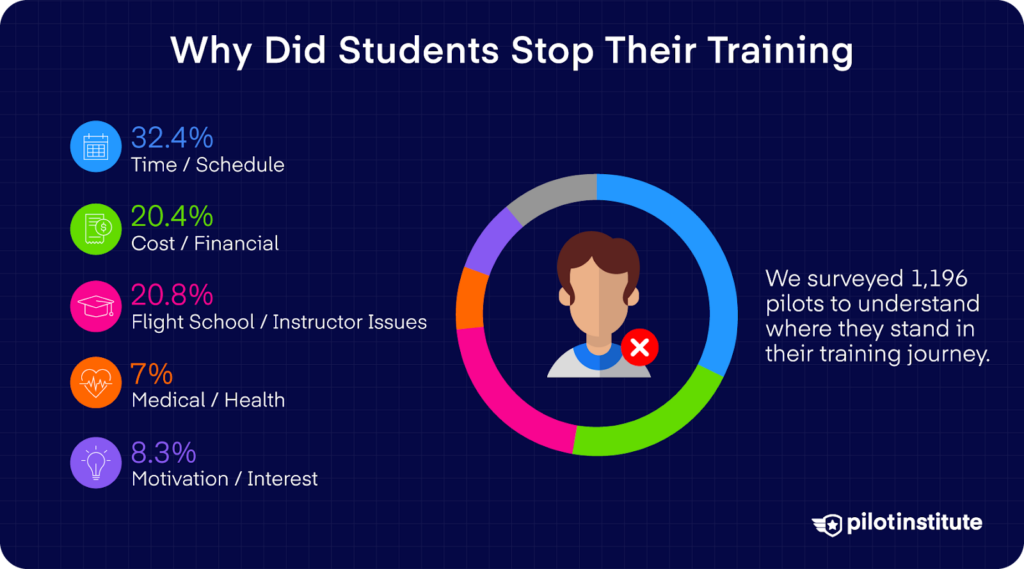
Private pilot training today runs anywhere from $8,000 to $30,000. It could vary for a lot of reasons, like your location, aircraft type, and how efficiently you make progress.
That’s not pocket change for most people! You’re looking at the cost of a decent used car or a semester of college.
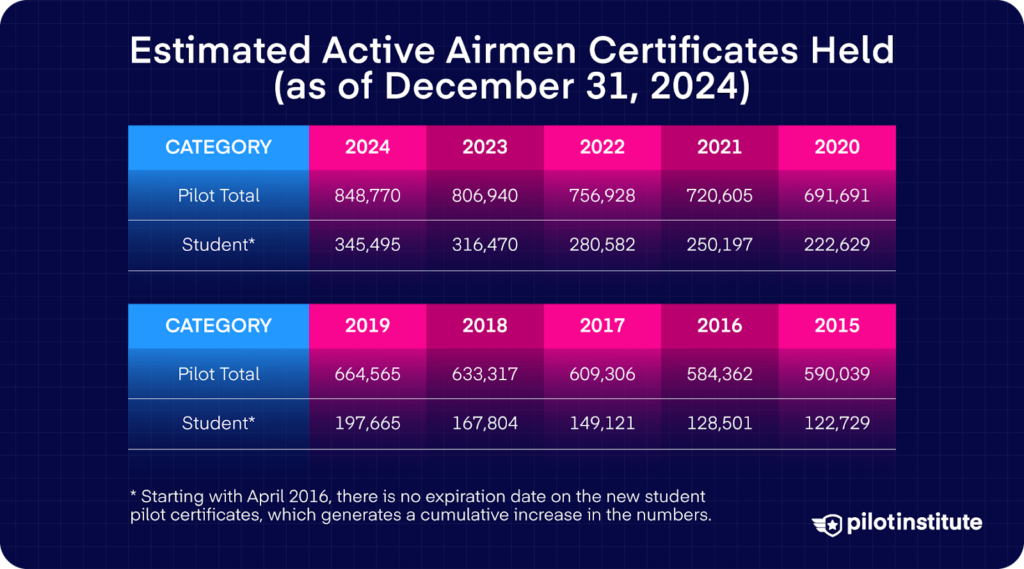
But here’s what’s interesting. According to FAA data, more people are entering flight training than ever before. The dream of becoming a pilot clearly outweighs the sticker shock for many.
Estimated Active Airmen Certificates Held (as of December 31, 2024)
The question now becomes: Will you be among those who will stay the course?
Myths vs. Reality
You’ve probably heard that most student pilots fail their practical tests (checkrides). It’s one of those pervasive myths that gets repeated so often it starts to feel like truth.
But what do the actual numbers show? For the private pilot checkride, the pass rate sits at 73.9% when tested by designated pilot examiners. And when tested by FAA inspectors, it’s a 65.7% pass.
The real attrition happens long before anyone schedules a checkride. Students slowly pull back during training, their logbooks idle with 10, 20, or 40 hours logged but never completed.
The invisible dropout doesn’t show up in checkride statistics because these pilots never even get that far. They just stop showing up for lessons, and eventually stop returning their instructor’s calls.
2. Four Hidden Forces That Derail Student Pilots
Unrealistic Expectations
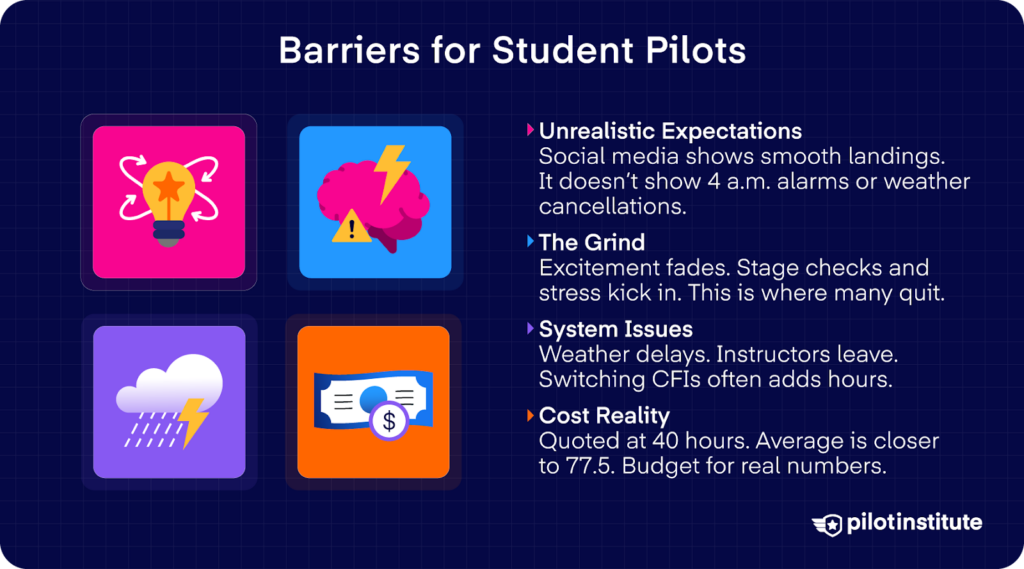
You start flight training with a picture in your head built for you, in part, by social media. Scroll through Instagram or YouTube, and you’ll see nothing but smooth landings and pilots looking effortlessly cool in aviators.
That’s great and all, but what don’t they show you? Those 0400 alarms for morning lessons when the air is smooth. You don’t see the maintenance cancellations that blow a carefully planned schedule.
Flight training goes differently for everyone. Believe us when we say that the timeline you follow says nothing about the pilot you’ll become.
The Training Grind
You start with pure excitement when everything is new and fascinating. You’re learning to taxi, feeling the yoke in your hands. This is awesome, you think.
But sooner than you expect, the excitement fades into a chore. And before the novelty of flying even sinks in, you’re dealing with stage checks and progress evaluations.
What if you fail? What if your instructor recommends more dual time before signing you off? As you realize how much you still don’t know, the stress gets worse.
Right here, in this grinding middle phase, is where too many students break.
System Blind Spots
There are also those issues that aren’t so much about your dedication, but seem to be built into flying. The first and most obvious one is, of course, cost. We’ll dig deeper into that in a moment.
Scheduling is another beast, and it’s got two heads.
First, there’s the weather. You can’t control it, and you can’t train through it during your early lessons.
That perfect Saturday morning slot you reserved three weeks ago? Cancelled because of low ceilings. The makeup lesson? Two weeks out because your instructor’s schedule is packed.
Then there’s instructor availability, and the dreaded handover situation. Your instructor leaves for an airline job halfway through your training.
Congratulations, you’re starting over with someone new, and they do things “a little differently.”
Students with more instructors report having more total hours than those who switch around less. Try to stick to only a handful of CFI’s that match your learning style.
Financial Drag
Now, let’s talk about cost. Not the number on that flight school website, but the ones you might not have budgeted for.
Maybe a flight school quoted you $10,000 for a private pilot certificate based on the FAA minimum of 40 hours.
Sounds like a bargain, right? Not until you learn that the average student pilot takes almost twice as long to finish, at 77.5 hours.
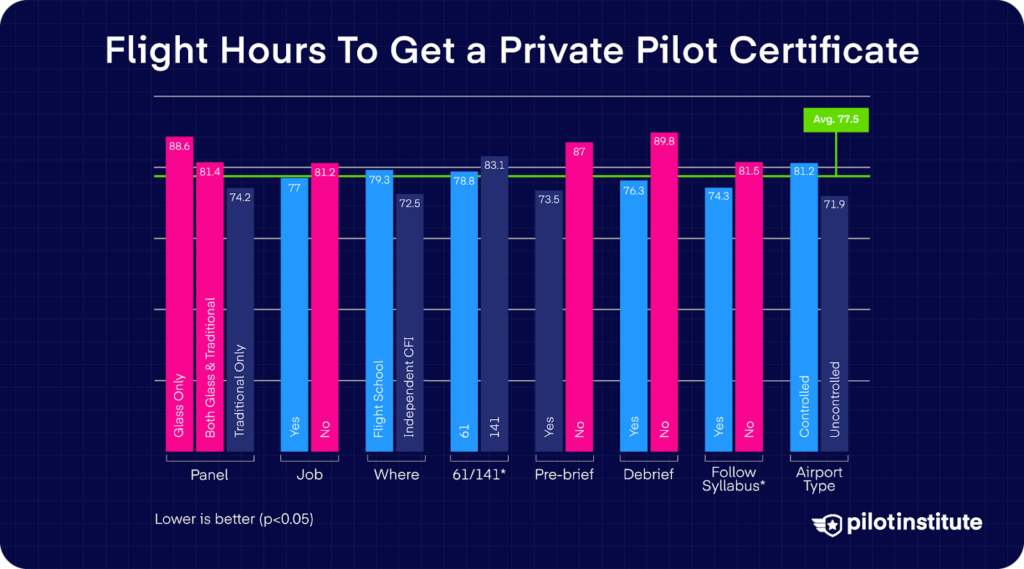
The reality is that most students need extra time to master certain skills. Maybe your landings need work. Maybe the weather kept cancelling lessons, and your skills degraded between sessions.
Whatever the reason, those extra 20-30 hours add thousands to your bill.
Then come the surprise costs that nobody mentions upfront.
Headset? You can rent the school’s beat-up pair or invest $150 to $1,000 on your own. Ground school materials and study guides? That’ll be $200, please. Medical certificate exam? That’s $75 to $200 out of pocket.
The list goes on, and it grows fast. You might have budgeted $12,000 and find yourself at $15,000 with no end in sight. The financial pressure mounts with each passing month.
3. Spot the Red Flags Early
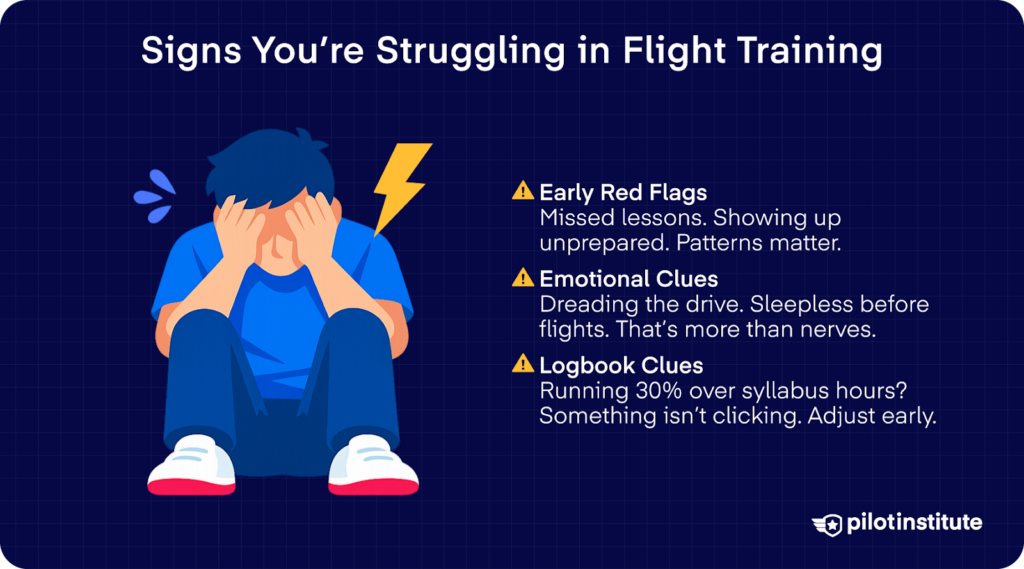
Missing scheduled lessons without explanation is often the first indicator of trouble. You might rationalize it as scheduling conflicts or financial pressures, but a pattern usually means there’s more beneath the surface.
Did you actually “forget” your headset, or is there something more? If you’re showing up unprepared for basic equipment, you’re not mentally engaged with the training.
Emotional & Physical Clues
Your body knows before your brain admits it. If you’re dreading the drive to the airport, that’s a signal worth examining.
Insomnia before checkride prep is common, but there’s a difference between healthy anticipation and debilitating anxiety.
If you can’t sleep for days leading up to practice sessions, you’re carrying stress that’ll mess with your performance.
Talk to your instructor. Take a break if you need one. Address the underlying issue before it grows into something that grounds your training entirely.
Logbook & Billing Clues
You can dismiss these other signs all you want, but numbers don’t lie. If you’re trending beyond 30% of the syllabus hours for any given phase, something isn’t clicking.
Maybe the weather hasn’t cooperated. Maybe you need more repetition on certain maneuvers. But whatever the reason, recognize it early so you can adjust.
4. Build a Training Resilience Mindset
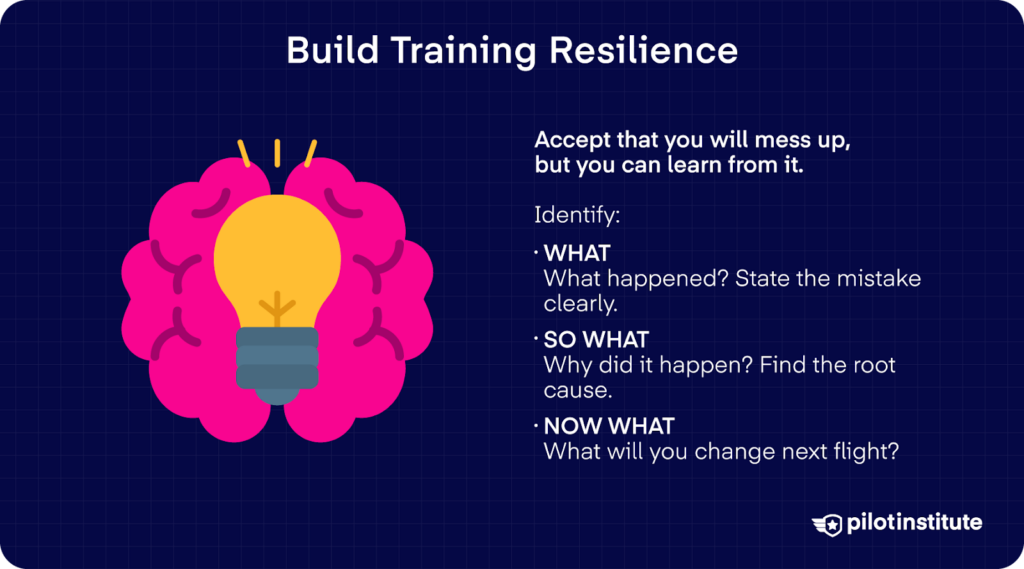
You’re going to mess up. A lot. But are you going to learn from them? Or will you let them define you?
Most students approach failure wrong. They either brush it off with, “Oh well, I’ll get it next time,” or they spiral into self-criticism about being terrible at flying.
Either way, you won’t get any better. What you need is a clear way to draw out wisdom from every mistake.
Try this three-step process:
What
First, ask yourself, “What happened?” Describe the mistake objectively, as it happened. You may have come in too fast on final approach, floated halfway down the runway, and had to go around.
So What
Next, dig past the surface symptom to find the actual problem. Ask yourself, “What does that mean?”
This is where you analyze the root cause. Why did you come in fast? Were you mismanaging your power? Were you fixated on something else and forgot to check your airspeed?
Now What
Now that you know your mistake and why it happened, what’ll you do about it? It’s time to map out a course of action.
Maybe you need to practice power-off approaches at altitude. Maybe you need to add an airspeed check to your downwind checklist.
This is one of those moments where the art of flying comes in. You’re bringing in your own style to a technique that works for you.
5. Choose (or Change) the Right Environment
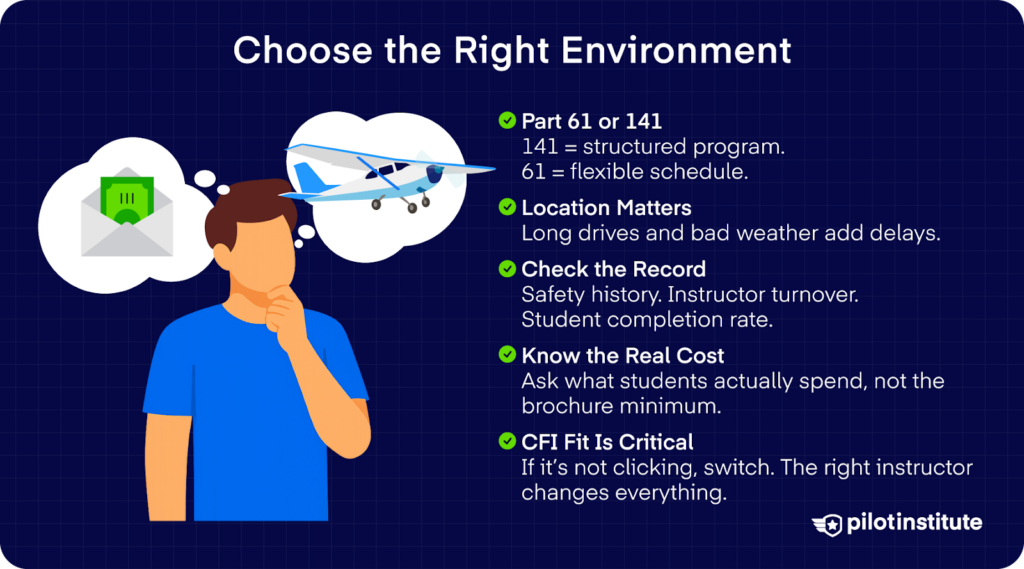
The right flight school can carry you through the tough stretches. The wrong one can quietly drain your money, your time, and your motivation until quitting feels like the only reasonable option.
So, how do you find the right fit before you’ve already committed?
Flight School Vetting Checklist
The first question to ask about any school is whether it’s FAA-certified, and which regulatory framework it runs on.
Which Part?
Part 141 schools work under a structured, FAA-approved curriculum. Because of their structure, Part 141 students can meet lower minimum flight hour requirements for their license.
Are you juggling other responsibilities like work or school? Part 61 training may be the better fit for you. Your instructor can tailor your training to your pace and learning style, which works for students with irregular schedules.
Location and Weather
You should also consider location. An airport that’s 45 minutes from your house seems feasible until you’re making that drive three times a week while working full-time.
Also, think about weather patterns at your local airport. A school located in an area with frequent low ceilings will likely see more cancellations.
Track Record
Reputation takes a little digging, but it’s worth the effort. How does the safety record look? What’s the instructor turnover rate, and student completion rate?
A school with six students and two aircraft sounds fine until two of those aircraft are grounded for maintenance and your instructor just took a leave of absence.
Cost
Budget conversations need to happen before you commit. Ask for a full cost breakdown that includes aircraft rental, instructor fees, ground instruction, written exam preparation materials, and examiner fees.
Then ask what the school’s average student actually spends to reach their checkride, not the minimum-hour estimate on the brochure.
If a school is reluctant to answer that question honestly, that tells you something important about how they run things.
CFI Compatibility Tests
Whether you train under Part 141 or Part 61, none of it matters more than one thing: the quality of your CFI.
So what makes a good CFI? They need to genuinely understand how people learn and have a solid grasp of teaching fundamentals.
The FAA’s preferred approach is scenario-based training, and your CFI is the one steering that ship.
Here’s something worth knowing: if your CFI’s teaching style isn’t clicking with you, or your schedules just don’t line up, you can absolutely find another one.
There’s no shame in it. The fit between you and your instructor matters more than most student pilots realize. The knowledge and habits you build during training follow you through your entire flying career.
6. Master the Money Equation
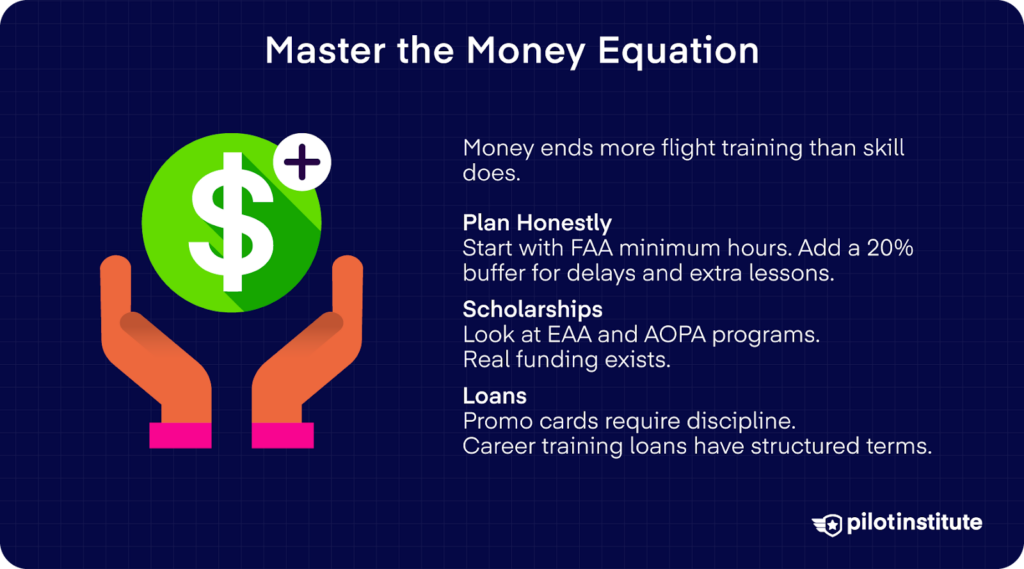
Money is the most notorious career-ender.
So if you’re going to finish your training, you need to take the financial side just as seriously as learning steep turns and crosswind landings.
Honest Cost Planning
Start with the FAA minimum. Under Part 61, a private pilot certificate requires at least 40 hours of total flight time, including 20 hours of flight training with an instructor and 10 hours of solo flight time.
So here’s what you should actually do. Write down the minimum required hours for your certification and add a 20% buffer on top. That should cover weather cancellations and the occasional remedial lesson.
Scholarships
The cost is real, but so are the resources available to help you cover it. The EAA Ray Aviation Scholarship is one of the most well-known options for student pilots pursuing a private pilot certificate.
It awards up to $12,000 and is specifically designed for young aviators between 16 and 19 years old. If you fit that description, it’s worth every minute of the application process.
The AOPA Foundation also has plenty of scholarship programs for students from different backgrounds.
Award amounts and eligibility criteria vary by program, so check the current cycle directly on their website.
We also have an article on how to get flight scholarships, where you can get further details.
Loans
But what if scholarships don’t cover your gap?
A zero percent promotional credit card can work well if you’re disciplined. You borrow essentially for free during the promotional period.
The catch is that if you carry a balance past that window, you might have to pay a hefty backdated interest on your loan.
Sallie Mae’s Career Training Loan works differently. It’s made specifically for non-degree career training programs. If you’re training in a professional pilot career program, you might just qualify!
Interest accrues from the start, but repayment terms are more predictable. Plus, you’re not racing a promotional clock.
7. Study & Skill Hacks That Accelerate Progress
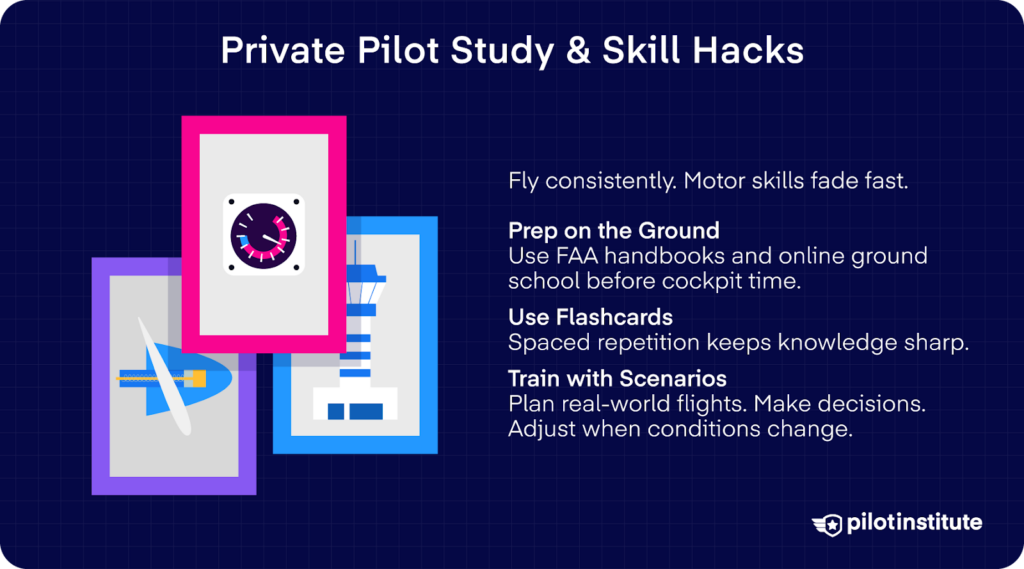
Full-time students usually wrap up their PPL training in about six months. Students who fly less than once a week are looking at six to twelve months or longer.
Why such a huge difference? Remember that flight training takes motor skills, and motor skills fade fast without practice.
Blended Learning Strategy
You don’t have to learn aerodynamics for the first time in the cockpit at hundreds of dollars an hour. Not when you can read about it beforehand in the FAA’s free publications.
The Pilot’s Handbook of Aeronautical Knowledge and the Airplane Flying Handbook are both available as free PDFs directly from the FAA website.
Online ground schools are another excellent way to earn more for less money. You could even get your instructor endorsement for the FAA exam.
Pilot flashcard sets cover the essential knowledge items organized by topic. Plus, the spaced repetition keeps information fresh.
Scenario-Based Practice Flights
You get a feel for real-life high-stakes airmanship in scenario-based learning.
Let’s say you’re planning a cross-country flight to visit a friend at a nearby airport.
During your preflight planning, you notice the weather is marginal but legal. So, you file your flight plan and take off.
But along the way, the weather deteriorates more than forecast. Now what do you do?
The scenario just keeps evolving based on your choices. If you choose to divert, where will you go? How will you navigate there? What communication procedures do you need to follow?
If you decide to continue, what’s your backup plan if conditions worsen? These are just some of the choices a real pilot has to make, and your examiner could even ask them on your checkride.
8. Recovering From a Setback Without Quitting
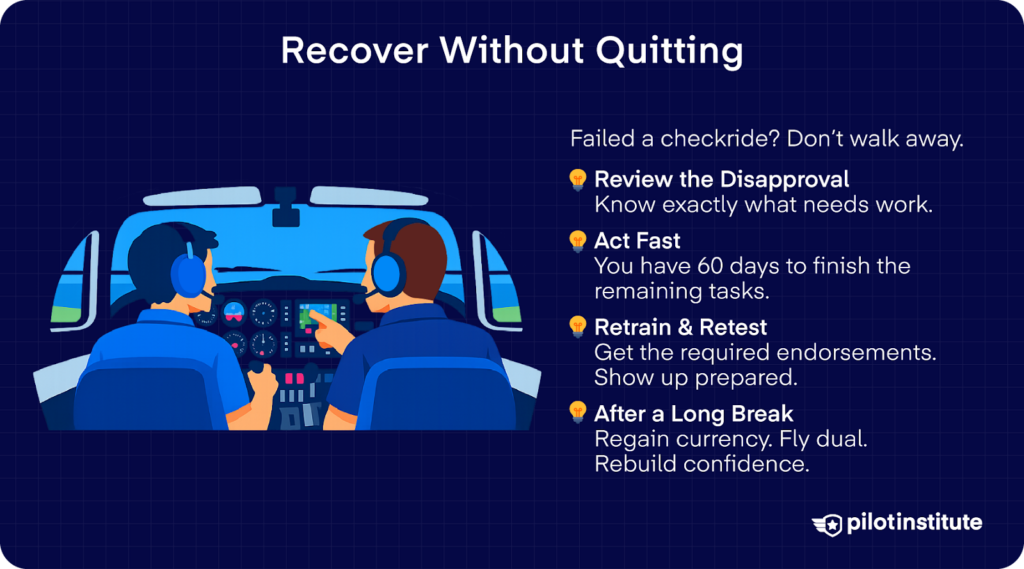
Too many student pilots have completely given up after failing a checkride. They walk away from the examiner’s debrief and never schedule another flight lesson.
But how do you actually bounce back?
First, get the official notice of disapproval from the designated pilot examiner. It’s where you’ll find the areas you need to work on.
Schedule a debrief with your instructor as soon as possible. Walk through what happened during each task that resulted in a disapproval.
According to 14 CFR 61.43(f)(1), you have 60 calendar days from the date of discontinuance to complete the remaining portions of your checkride. Miss that window, and you’re retesting everything, even the areas you already passed.
When you show up for your retest, bring your original documentation. That means either your Notice of Disapproval form or your Letter of Discontinuance, whichever the examiner issued.
Did the discontinuance show any lapses in your training? If your instructor determines you need additional training before retesting, you need to take it and secure the appropriate endorsements.
Then, your instructor will sign you off for that next try once you’re good to go!
Long Training Gaps
Life happens. Maybe you took a break for financial reasons. Maybe work got overwhelming. Maybe something happened in the family.
Regardless of why you stopped, you’re looking at your logbook now and realizing it’s been six months since your last lesson. Can you even pick up where you left off?
Yes, absolutely. You just need to be realistic about where your skills are. The longer you’ve been away, the more rust you’ve likely accumulated.
So, where do you start? If it’s been more than 90 days since your last flight, then you should first work on being current. Check out 14 CFR 61.57 for the full requirements.
Then, try to book at least one hour of dual instruction. Go over basic aircraft control and normal procedures.
Spend one to two hours in a simulator if your school has one. Work through emergency procedures and navigation.
Follow that with another two hours of dual instruction. That’s where you refine the weak spots you identified on that first flight.
Cap it off with one hour of supervised solo flight time if your instructor signs you off for it. You’re proving to yourself that you can handle the aircraft by yourself again.
9. Your Personal Finish-Line Toolkit
Keep these resources bookmarked or saved somewhere you can access them quickly when you need specific information or support.
Free Pilot Training Resources
Regulations
Training Resources
Scholarship Portals
Conclusion
Many students never make it to the checkride. They just stop showing up halfway through training.
What gets you to the finish line usually comes down to planning and refusing to let setbacks feel permanent.
You’ve already started this journey, which means you’ve got what it takes to see it through.
Fly as often as you can manage, and remember that slow progress still beats no progress. Every lesson gets you closer, even the frustrating ones.
Your license isn’t reserved for the naturally gifted or those with unlimited resources. It’s waiting for anyone willing to stay in the fight long enough to earn it.