
-
Key Takeaways
-
What Are Spoilers?
- Compare to Other High-Lift / Drag Devices
- Where Spoilers Live
-
Spoilers: Anatomy and Types
- Flight Spoilers
- Ground Spoilers (Lift Dumpers)
- Spoilerons (Roll Spoilers)
-
Aerodynamics Behind “Spoiling” Lift
- Force-Balance Changes
-
Using Spoilers Throughout a Flight
- Roll Control & Turbulence Damping
- Approach & Landing
- Rejected Takeoff (RTO)
-
Operating Techniques And Limitations
- Asymmetry & Fail-Safe Logic
- Crew Alerting
-
Lessons From The Accident Record
- Air Canada 621
- United 553
- American 1420
- Elmina Premier I
-
Frequently Asked Questions & Misconceptions
- Can an Airplane Land Without Spoilers?
- Spoilers vs. Airbrakes—Aren’t They The Same?
- When Can Flight Spoilers Be Used?
- Will Spoilers Pop Up In Flight By Mistake?
-
Practical Tips For Student Pilots & Spotters
- Spotting From The Cabin
- Home Simulator Practice
- Pre-Landing Flow
- Ramp-Side Clues
-
Conclusion
You hear it just seconds after touchdown. The cabin fills with a sudden whoosh, and the wing seems to change shape. Inside the cockpit, that moment came with a calm call: “Speed-brakes up.”
What are those popping panels, and what are they for? They’re spoilers, and they’re far more versatile than most people realize.
Now, let’s talk about how spoilers are designed and how pilots use them in every phase of flight.
Key Takeaways
- Spoilers are wing-mounted panels that reduce lift and increase drag by disrupting airflow.
- Aircraft can use flight spoilers, ground spoilers, and spoilerons.
- Pilots use spoilers during flight, roll control, landing, and rejected takeoffs to manage lift.
- Use spoilers properly and stay situationally aware to prevent loss of control and stay safe.

Become a Private Pilot!
Train fast with bite-sized lessons and real test-style practice.
- 540+ videos; average lesson ~3 minutes.
- Several practice exams and 800+ questions.
- Study groups, fast instructor support.
- 30-day money-back + pass guarantee.
What Are Spoilers?
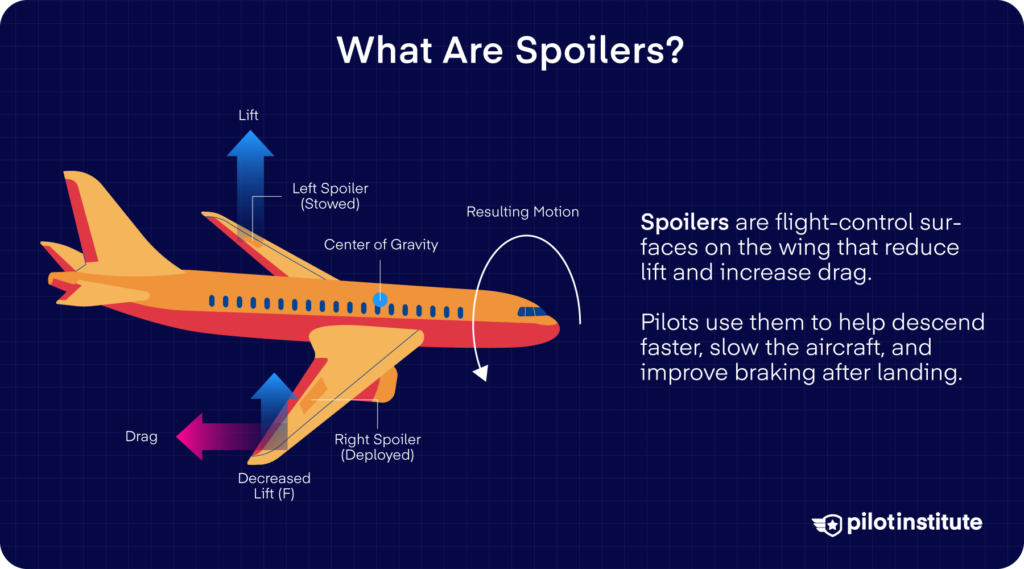
To put it in simple terms, spoilers are panels on the wing designed to mess up, or spoil, the smooth airflow on purpose.
But why would anyone want that on their aircraft? Well, these spoilers work so the wing stops making as much lift and creates more drag.
And in some aircraft, the term “spoileron” also pops up. What do you think it does?
That’s a spoiler used not just to spoil lift, but to help roll the aircraft to the left or to the right.
Compare to Other High-Lift / Drag Devices
What about the other control surfaces in your aircraft? They all affect airflow, but they do it in very different ways.
Flaps are mounted on the trailing edge of the wing and are meant to increase both lift and induced drag. It lets your aircraft fly slower with more lift available.
Slats and Krueger flaps sit on the leading edge of the wing. They open up a gap that keeps airflow attached at low speeds, which also increases lift.
Airbrakes are another type of drag device, like the tailcone plates on aircraft such as the BA146.
Unlike spoilers on the wing, airbrakes can be mounted on other parts of your aircraft, and not just the wings. That gives you another tool when you need to slow the aircraft quickly or control descent.
Where Spoilers Live
You’ll see spoilers as those long rectangular panels built into the top of the wing on a typical airliner. They sit perfectly flush when stowed, so the airflow stays undisturbed.
But when they’re deployed, they go up into the relative wind. What happens next? They disrupt that smooth airflow and add drag.
Spoilers are usually installed forward of the flaps but not in front of the ailerons so as not to interfere with roll control. They’re about parallel to your airplane’s lateral axis and are hinged along the leading edges.
Spoilers: Anatomy and Types
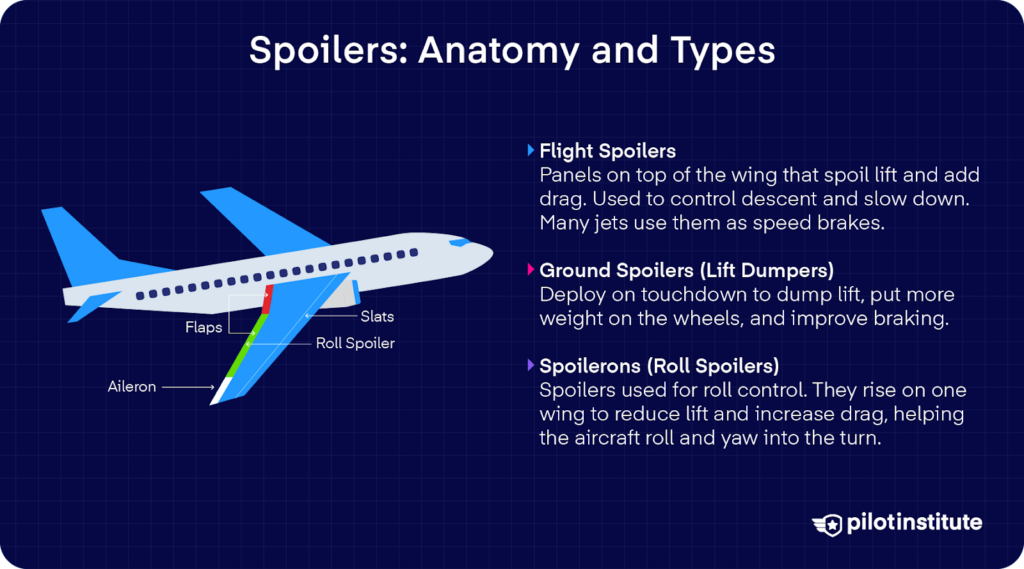
Flight Spoilers
Flight spoilers are panels on the top of the wing that you use while the aircraft is flying. When you raise them, they interrupt the smooth airflow over the wing’s surface, so lift falls off and drag goes up.
When do they come in handy? You could use these to manage your rate of descent without picking up speed or fumbling around with the throttle.
You’ll often hear pilots mention “speed-brake” in everyday conversation, even during flight. That term includes spoilers, because they’re one of the control surfaces that slow the airplane without adding lift.
Ground Spoilers (Lift Dumpers)
After touchdown, you can deploy the ground spoilers to destroy any more unnecessary lift. These are often called lift dumpers because of how thoroughly they remove lift right when you need traction and drag the most.
How do they help on the ground? They push the aircraft’s full weight onto the wheels, which makes the brakes much more effective and helps shorten the landing roll.
Ground spoilers usually deploy upon touchdown, sometimes with the help of the flight spoilers. But you might also need to manually select them on other aircraft after landing or in case of a rejected takeoff.
Spoilerons (Roll Spoilers)
Spoilerons are spoilers that work as roll control surfaces. So, instead of popping up on both wings, a spoileron rises on just one wing to reduce lift on that side. That reduced lift also adds drag, which helps the aircraft yaw slightly into the turn.
Spoilerons are most commonly found on transport-category jets and some high-performance or fly-by-wire aircraft, especially those with long, flexible wings where large aileron deflections would cause excess drag or structural loads. In many of these airplanes, spoilerons either supplement the ailerons or replace them at higher speeds.
Many aircraft rely heavily on spoilers for roll control because they cut down adverse yaw. How do they achieve this? You turn right, for example, and the right-wing spoiler rises.
Lift decreases on the right wing. Drag increases on that side at the same time. The right wing drops, and the aircraft banks and yaws to the right.
Aerodynamics Behind “Spoiling” Lift
Force-Balance Changes
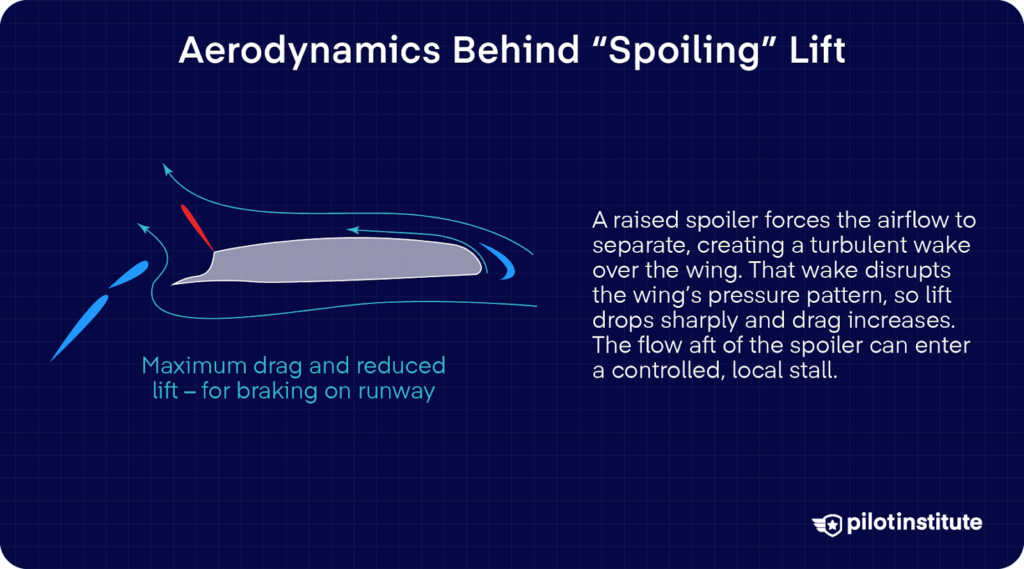
The boundary layer separates almost immediately on both sides of the panel. Two shear layers peel away and roll into strong vortices behind them. That swirling, turbulent region is the wake.
It forms right behind the spoiler and grows quickly. That near wake does most of the damage.
It pushes the main airflow away from the wing surface and reshapes the pressure distribution over the airfoil.
What happens next? Lower pressure on top of the wing cannot be sustained anymore. The wing section aft of the spoiler enters a controlled stall.
But the thing is, the spoiler does not reduce lift just by sticking up into the air. It reduces lift because the wake it creates dominates the airflow over that part of the wing.
Using Spoilers Throughout a Flight
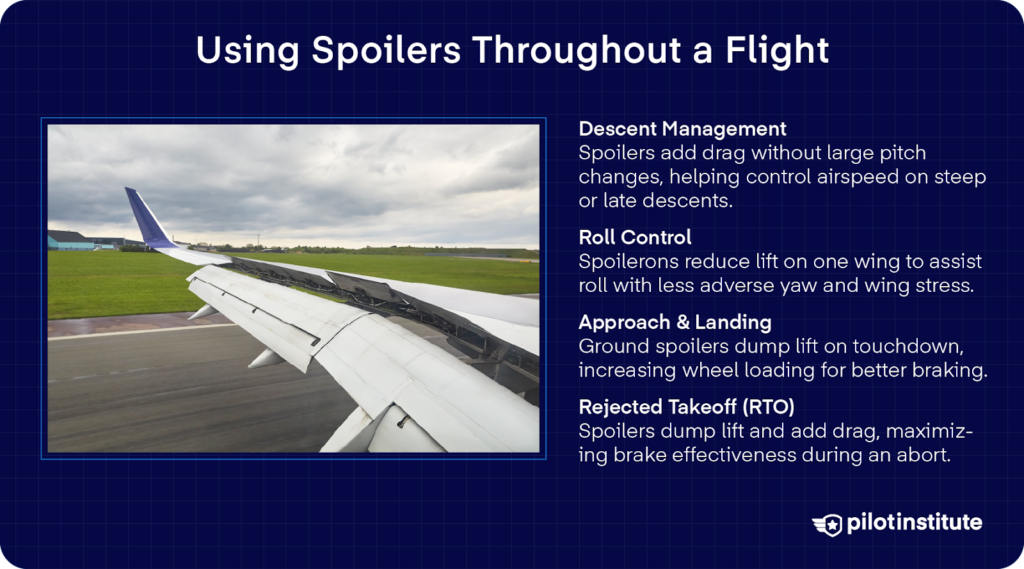
ATC can sometimes put you in a hurry. Ever heard of a slam-dunk arrival? The ATC tells you to stay high and fast on approach, and that’s going to take a steep, rapid descent and slow down.
Or, you’re cruising alone, then the controller gives you a late descent clearance. They expect you to be on profile fast. You need to lose altitude without letting the airspeed run away.
So, what do you do? This is where spoilers come in to help.
You extend them to add drag, and the aircraft comes down steeper without a big pitch change. You’re not chasing the throttle or bobbing the nose up and down. Instead, you’re managing your descent rate, cool as a cucumber.
Spoilers also make sense in piston aircraft with turbocharged engines. You might worry about pulling the power back too far during a long or steep descent. Rapid cooling is a big concern, but it’s one of the situations where the spoilers come in handy.
You keep a reasonable power setting to maintain engine temperature, then use drag to come down at the rate you need. You stay comfortable, and the engine stays happy!
Roll Control & Turbulence Damping
Traditional ailerons can produce large twisting loads on the wing structure and create adverse yaw when you’re flying fast. That’s because the rising wing generates extra lift and drag.
But when a spoileron raises on the down-going wing, it reduces lift and adds drag on that side, which rolls and yaws the aircraft in a coordinated direction.
You’ll also need less rudder input, and your aircraft suffers from less wing twist loads compared to using ailerons alone.
Approach & Landing
On approach and landing, you normally keep your spoilers armed before touchdown so they can deploy on their own as soon as the weight on wheels and other conditions are met.
When these ground spoilers lift up on touchdown, they quickly destroy any remaining wing lift and greatly increase aerodynamic drag.
And with less lift, the aircraft’s full weight presses down on the wheels and brake pads. That increases the friction force you can apply through the brakes.
The greater wheel normal force helps keep the aircraft from bouncing. It also lets you use braking energy more effectively to slow down and stop.
Rejected Takeoff (RTO)
A rejected takeoff happens when you decide to stop the aircraft and cancel the departure before liftoff. You’re still on the runway, but something clearly isn’t right.
What might call for a rejected takeoff? An engine fails. A warning light flashes. ATC calls out a serious issue.
Whatever the trigger, the decision has to be immediate. Boeing estimates that about one out of every 2,000 takeoffs ends this way. That sounds rare, but it is common enough that crews train for it constantly.
Modern transport aircraft procedures and manuals call for moving the thrust levers to idle, slowing down, and deploying spoilers and reverse thrust.
Why the spoilers? Remember that they dump lift and add drag, which puts more weight on the wheels. More weight means the brakes can work at full effectiveness.
Operating Techniques And Limitations
Most transport aircraft use hydraulically powered spoilers, which make use of pressure. On the A320 and B737, hydraulic servo valves translate lever movement into precise movement of the panels.
Even the Bombardier Learjet’s spoilers worked the same way. They’re controlled electrically and powered hydraulically. You send the command with an electrical signal, and hydraulic pressure does the heavy lifting.
Each of the Learjet’s spoiler panels is hinged at four points along its base, which keeps it evenly supported. A single hydraulic actuator extends and retracts each panel.
Asymmetry & Fail-Safe Logic
Worried about a spoiler malfunction? They can be catastrophic at the worst time, but that’s why designers built failsafes with that exact scenario in mind.
On many aircraft, if a spoiler on one wing fails to extend, the matching spoiler on the other wing will inhibit extension.
What if the spoilers or ailerons get jammed? In aircraft like the Boeing 737, you can use the control wheel to figure out what still works.
Apply force on the captain’s control wheel first. Does the aircraft roll normally? Then that means the ailerons are still doing their job.
In that case, the spoiler system is jammed, so the spoilers do nothing and the first officer’s control wheel will not give you roll control.
But if the captain’s wheel feels dead, try the first officer’s control wheel. Does the aircraft respond now?
This time, it means the ailerons are jammed and the spoilers are still available. Roll control now comes from the spoilers, and the first officer’s wheel is the one that works.
Crew Alerting
The flight deck in some aircraft can also alert you when spoilers or speed brakes are up when they normally shouldn’t be.
On Boeing types like the 737, you get an amber “SPEEDBRAKE EXTENDED” alert if the speedbrakes are extended while the thrust levers are advanced or when the aircraft is in a landing configuration (e.g., flaps extended or below 800 feet).
That’s your reminder to retract the speedbrakes before applying more power, such as in a go-around.
On Airbus A320 family jets, a green speed brake memo shows up on the ECAM when extended. And if your thrust isn’t idle, it flashes amber.
Why does it warn you when you have throttle in? It’s your reminder to stow the spoilers before advancing power for a missed approach.
Lessons From The Accident Record
| Flight | Year | Spoiler Issue | Outcome | Key Lesson |
| Air Canada 621 | 1970 | Ground spoilers deployed in flight | Break-up on landing | Never “ARM” by lifting handles in flare |
| United 553 | 1972 | Speed brakes left out at low altitude | CFIT | Verify retraction before go-around |
| American 1420 | 1999 | Spoilers not deployed | Runway overrun | Include spoiler check in “PM callouts” |
| Atlantic Airways 670 | 2006 | Failure to deploy on wet, short runway | Overrun | Maintenance rigging & auto-deploy logic |
| Elmina Premier I | 2023 | Deployment of the lift-dump spoilers before touchdown | Stall/spin crash | Train on spoiler modes and when to deploy them |
Air Canada 621
Air Canada 621 is known as Canada’s second-deadliest aviation accident. So, what went wrong?
The crew disagreed on when to arm the ground spoilers, even though the procedure called for arming them before landing.
Then, during the landing flare, the first officer deployed the spoilers when he was supposed to just arm them. That single action spoiled lift while the aircraft was still flying.
The aircraft’s sink rate increased instantly. Thrust and pitch came in too late to undo the loss of lift.
You don’t need to hear about the gruesome details of the crash to get the lesson. Ground spoilers are meant to deploy after touchdown.
You use them too early, and they do exactly what they are designed to do, whether you want them to or not.
United 553
United Flight 553 was high on approach, and the captain used spoilers to increase the descent rate and get back on profile.
At first, that choice seemed to work. The aircraft came down rapidly and leveled off at minimum descent altitude. The problem came next. The spoilers stayed extended.
Remember that level flight needs lift and thrust to balance drag. Spoilers kill lift and add drag at the same time. The captain added power, but not enough to overcome both effects.
Airspeed bled off. The stick shaker fired only seconds later. With the wing already compromised by extended spoilers, the aircraft stalled.
What’s the lesson here? Always keep your situational awareness. Spoilers are effective for getting down. You leave them out too long, and they quietly set you up for disaster.
American 1420
Spoilers can decide the outcome of a bad landing, and that’s exactly what American Airlines Flight 1420 warns us.
The flight continued an approach in severe weather with gusty winds, windshear alerts, and rapidly dropping visibility.
Touchdown happened fast and long on a wet runway. The thrust reversers came out, but the flight spoilers never deployed.
Without spoilers, you can’t spoil lift and dump the weight onto the wheels. That set off a disastrous domino effect.
Braking suffered right when it was needed most. The aircraft was rolling too fast, and it crashed.
That’s how much of a difference spoilers can make after touchdown, especially in a risky situation like in bad weather. If they don’t deploy, stopping performance drops sharply, especially on a contaminated runway.
Elmina Premier I
A Beechcraft 390 Premier I, a business jet, was cleared to land. But witnesses saw the aircraft flying erratically moments later. The airplane banked, then descended steeply and struck the ground, exploding on impact.
The crash killed everyone on board and a motorist on the ground. A motorcyclist also died after being caught in the post-impact fire.
So, what happened?
Investigation points to pilot error, specifically the inadvertent deployment of the lift-dump spoilers.
You see, those spoilers are designed for use after touchdown, not in flight. And when they were deployed, lift vanished instantly. At low altitude, there was no time to recover.
You have to know exactly which spoiler mode you’re using, and when it’s allowed. Spoilers are helpful tools, but they do not forgive confusion.
Used correctly, they help you control energy. Used at the wrong time, they can end the flight instantly.
Frequently Asked Questions & Misconceptions
Can an Airplane Land Without Spoilers?
Yes, an aircraft can technically land without spoilers. Just remember that without them, the wing continues to produce lift longer after contact with the runway.
That means less weight on the wheels, which reduces how well your brakes work and lengthens your rollout. Since you lose the benefit of quickly dumping lift and adding drag, you can expect hotter brakes and longer stopping distances.
In most general aviation airplanes, spoilers aren’t installed at all. GA pilots rely on proper touchdown speed, aerodynamic braking, and wheel braking instead. In those aircraft, landing performance assumes no lift-dumping devices, so technique matters even more.
If you’re flying an aircraft equipped with spoilers and they’re inoperative or not armed, plan for a noticeably longer rollout than normal and adjust braking accordingly.
Spoilers vs. Airbrakes—Aren’t They The Same?
No, spoilers and airbrakes are not the same, even though both increase drag.
Spoilers are on the wing’s upper surface and disrupt the lift distribution across the wing while increasing drag.
On the other hand, airbrakes are often fuselage-mounted panels designed mainly to increase drag without significantly affecting lift.
But don’t get that term confused with speed brakes. In many jets, the wing spoilers also serve as speed brakes, but they still reduce lift while adding drag. True airbrakes add drag with little change to the wing’s lift distribution.
When Can Flight Spoilers Be Used?
You can use flight spoilers any time in flight when your aircraft’s procedures and speed limits allow them. As for ground spoilers, they’re usually armed before landing so that they will extend by themselves when the aircraft touches down.
But if you ever stall or approach a stall and spoilers are out, retract them quickly because you want to regain lift and control. That’s why you normally keep the spoilers stowed to maintain lift and keep your descent or speed under control.
And after touchdown, they destroy lift right when you need it. They put the full aircraft weight onto the wheels so you can brake more effectively.
Will Spoilers Pop Up In Flight By Mistake?
Worried about inadvertent deployment? Modern designs make that very unlikely.
It is extremely rare for spoilers to extend in flight by mistake because aircraft systems are designed with multiple safeguards in place.
Some aircraft have weight-on-wheel switches that prevent ground spoilers from deploying in flight. They tell the system the aircraft is still airborne, so spoilers won’t pop up by accident at altitude.
Many aircraft also use mechanical detent springs or control lever gates that give tactile feedback so the spoiler lever stays in the intended position and isn’t bumped accidentally.
Practical Tips For Student Pilots & Spotters
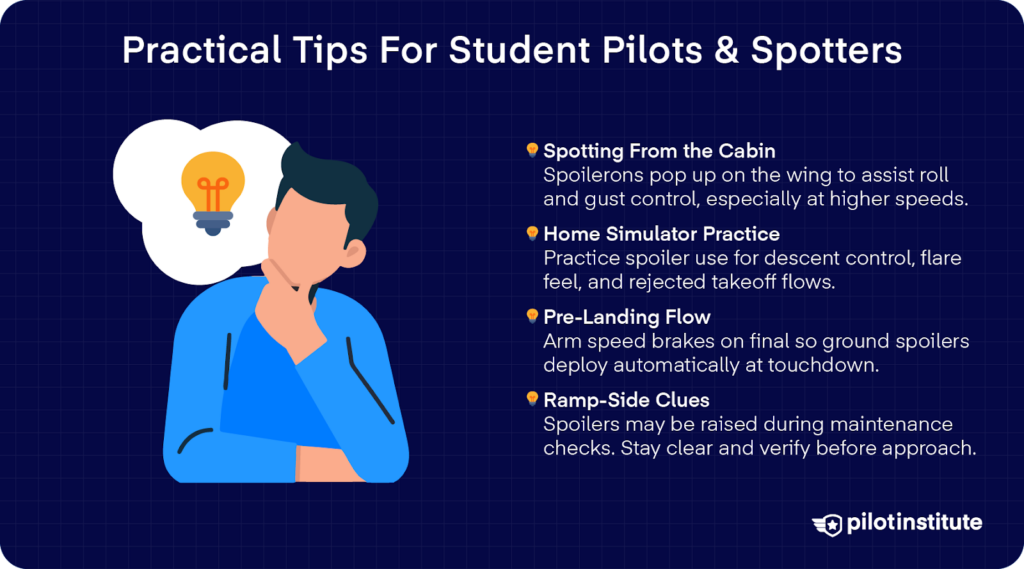
Spotting From The Cabin
You can learn a lot just by looking outside during taxi or the takeoff roll. You look outboard of the engines and watch the wing surface.
You might notice small, quick up-kicks of panels near the top of the wing. What are those? Those are spoilerons. They help with roll control or gust response, especially as speed increases and ailerons become less effective.
That motion is easy to spot from the cabin. A spoiler panel pops straight up into the airstream, so your eye catches it right away.
Home Simulator Practice
Try to map a dedicated spoilers axis or button so you can arm them and fully extend in one motion.
Practice the flare with incremental spoiler inputs to feel how a small spoiler deployment changes sink rate. You can also rehearse rejected-takeoff cues.
How does it go again? Throttle idle, autobrake RTO, and spoilers armed/extend and reverse.
Pre-Landing Flow
Make the “Speed-brake ARM, green light” call a habit on final. In fact, big airline SOPs require arming speed brakes during landing checks so ground spoilers will extend at touchdown.
You’ll lessen crew confusion during a go-around and make sure the spoilers will work when you want them to.
Ramp-Side Clues
If you see spoilers not fully stowed while an aircraft is parked, do not walk under them. Maintenance built-in tests or functional checks, and ground test positions are common after servicing.
Technicians could leave panels in test mode or run powered checks before flight. Keep clear and alert ground staff so test sequences finish safely before passengers or ramp crews approach.
Remember, if you’re in doubt, ask ground personnel rather than assume the aircraft is ready.
Conclusion
By now, we hope you’ve understood how much authority spoilers carry, even though they might look simple.
You saw how they manage lift, add drag, control your banks, and improve braking. You also saw how small mistakes with spoilers can have serious consequences.
Keep practicing good habits, whether you’re flying, simming, or watching from the cabin or on the ground.
And if you ever notice a unique spoiler design, drop a comment or send us a photo! Let’s learn together.