
-
Key Takeaways
-
What Is MOSAIC and Why Now?
- Timeline
-
New Sport-Pilot Privileges (Effective 22 Oct 2025)
- Equipment Now Allowed
- What Stays the Same
-
Legacy Aircraft That Now Qualify
- Checking Your Aircraft’s Stall Speed
-
Medical Pathways Under MOSAIC
- Driver’s-License Medical: Rules & Red Flags
- When BasicMed or 3rd-Class Still Required
-
Transition Scenarios for Existing Pilots
- Private/Commercial/ATP
- Current Sport Pilots
-
Training & Flight-School Opportunities
- CFI-Sport (CFI-S) Pathway
-
Maintenance, Insurance, and Legal Fine Print
- Insurance Market Snapshot
-
Implementation Checklists
- Sport Pilots Limits
- Aircraft Owners
- Flight Schools
-
FAQs & Common Misconceptions
- “Does a C-172 become an LSA?”
- “Can I fly IFR on a driver’s license?”
- “My medical was denied in 2018; can I use MOSAIC?”
- “Will insurers accept driver’s-license pilots?”
-
Conclusion
October 22, 2025, might feel like “Driver’s License Day.” You show up at the airport with a wallet in your pocket, you climb into a Cessna 172, and you go fly on your sport pilot certificate.
That single idea would’ve sounded absurd under the old sport pilot world, where a 1,320-pound limit stood as a barrier to many pilots.
MOSAIC changes the game. A 2,450-pound 172 can fit the new Sport Pilot rules, even though it never becomes an LSA.
MOSAIC means Modernization of Special Airworthiness Certification. This guide breaks it down in plain English. We’ll give you the timeline and a checklist for your next steps.
Key Takeaways
- MOSAIC expands sport pilot flying using performance limits over weight-based aircraft restrictions.
- Sport pilots can operate more sport-pilot-eligible aircraft (not just traditional LSAs).
- Driver’s license medical still has strict red flags, especially after FAA medical denials.
- You’ll need logbook endorsements for new privileges like night VFR or complex operations.
What Is MOSAIC and Why Now?
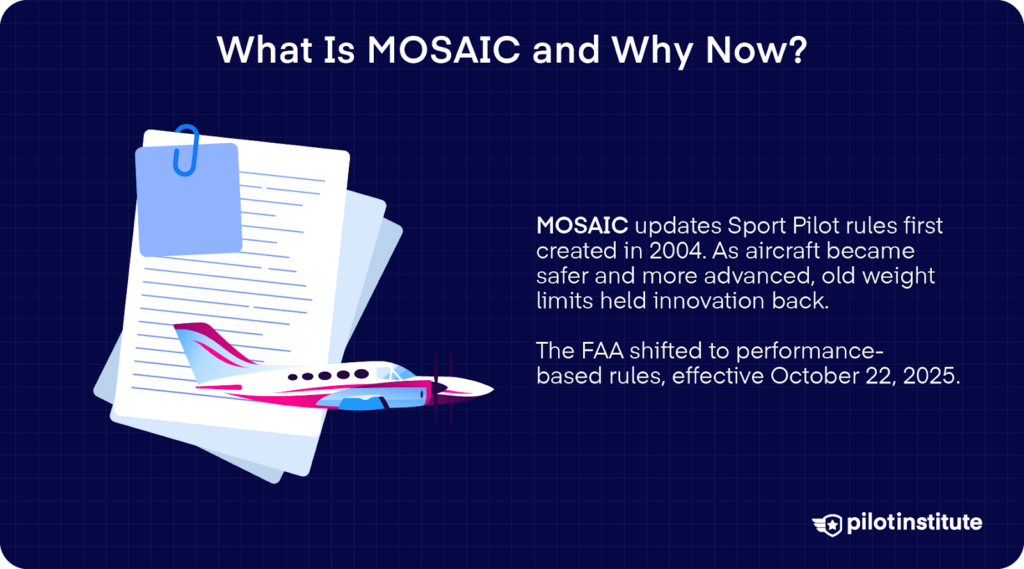
We’re getting a major update to an old set of rules that’s been around since 2004.
Back then, the FAA created the Sport Pilot rule and the Light-Sport aircraft category to let people fly small, simple aircraft. You get to be a pilot without all the training and certification burden of bigger GA airplanes.
Those 2004 rules capped how heavy the aircraft could be and how fast it could fly. Of course, it’s all to lessen the risk to pilots and the public.
But today’s industry looks unrecognizable from decades ago. Aviation continues to evolve past old rules. Electric and hybrid propulsion systems are taking off. New materials make airframes lighter and stronger.
Aircraft designs have also become more capable. More people were getting interested in flight training and personal travel, too.
And all of that made one thing clear: the old weight-based limits and rigid design definitions were starting to hold innovation back.
The answer? MOSAIC, which stands for Modernization of Special Airworthiness Certification.
Timeline
| Date | Milestone |
| 24 Jul 2025 | Final rule published. |
| 22 Oct 2025 | Subpart J pilot privileges live. |
| 24 Jul 2026 | Part 22 manufacturing standards live. |

Free Private Pilot Study Sheet
Grab a printable PDF that highlights must-know PPL topics for the written test and checkride.
- Airspace at-a-glance.
- Key regs & V-speeds.
- Weather quick cues.
- Pattern and radio calls.
New Sport-Pilot Privileges (Effective 22 Oct 2025)
When the new sport-pilot privileges under the MOSAIC rule kicked in on October 22, 2025, you may have noticed some of the biggest changes to your certificate since 2004.
The FAA now lets you operate aircraft with up to four seats under sport-pilot privileges. That means the aircraft itself may have four places to sit, but you can still carry only one occupant besides you when flying under sport pilot rules.
The rule also replaces the old strict weight limits with performance-based criteria. Under MOSAIC, there is no specific maximum takeoff weight for aircraft you can fly, as long as it meets the performance/design criteria in §61.316 (especially the 59-knot V_S1 CAS requirement).
Instead, the FAA determined that performance-based standards are more appropriate based on the safety continuum concept. Your aircraft’s clean stall speed, vS1must be 59 knots calibrated airspeed or less.
Can you fly at night now? The answer is yes, night VFR becomes allowed under MOSAIC. But as with most things in flying, it’s only if you have the required training and endorsement.
On top of that, there are medical requirements beyond just a driver’s license. We’ll talk more about this later on.
Equipment Now Allowed
Now the regulations let you operate aircraft with constant-speed propellers, which means props that automatically or manually adjust their blade pitch for efficiency and performance.
You can also fly complex aircraft or those with a retractable landing gear. But this is limited to land aircraft and requires proper training and an instructor’s endorsement.
MOSAIC also allows you to fly aircraft with new types of propulsion systems (like electric) and any number of engines.
What Stays the Same
But don’t rush back to that cockpit too quickly. You still cannot fly as pilot in command (PIC) under instrument flight rules (IFR) using just a sport pilot certificate.
MOSAIC may allow sport-eligible aircraft to have up to four seats, but your privileges don’t change. You’re still limited to you plus one other person anytime you’re acting as PIC under sport rules.
You can also fly complex aircraft or those with a retractable landing gear, including both landplanes and seaplanes. This requires proper training and an instructor’s endorsement.
You still can’t fly for compensation or hire, either. Sport pilot privileges still prohibit you from acting as PIC while carrying passengers or property for compensation.
So there’s no way to get paid at all? Well, there are narrow exceptions, like working as a sport pilot instructor. But paid transport or business flying under sport privileges is still off the table.
Altitude limits also mostly stay the same. You’re still generally restricted from operating above 10,000 feet MSL or 2,000 feet AGL, whichever is higher.
Legacy Aircraft That Now Qualify
| Model | VS1 (KIAS) | Seats | Notes |
| C-152 | 40 | 2 | Already popular trainers |
| C-172 | 57 | 4 | Meets 59 kt limit |
| PA-28-140 | 55 | 4 | Watch gear-door mods |
| Maule M-4 series | 52 | 4 | Constant speed propeller |
This is where it gets exciting. Plenty of older, familiar training and utility airplanes can qualify as sport pilot aircraft under MOSAIC, as long as the specific model and configuration meet the sport-pilot performance rules, especially the 59 KCAS vS1 limit and the four-seat cap.
Here are common legacy examples newly reachable under MOSAIC:
- C-152 (some models/configurations).
- Cessna 172 (some models/configurations).
- Piper PA-28 Cherokee family (some models/configurations).
- Cessna 182 (at least some configurations based on published vS1 discussion).
- Maule M-4 series (commonly cited as likely qualifying, pending exact stall-speed confirmation by model).
- Cessna 185 (some versions may qualify, some may not, depending on published clean stall speeds).
Checking Your Aircraft’s Stall Speed
Do you know where you can find your aircraft’s stall speed? You’ll usually find this in the aircraft’s AFM or POH, and the fastest way is to go straight to the performance section. You’re looking for the published stall speeds, especially the clean stall speed.
A good cross-check is your airspeed indicator. The lower limit of the green arc is commonly marked at vS1, meaning the clean stall speed in the normal configuration. That’s not a legal substitute for the AFM/POH number, but it helps you cross-check what you’re seeing.
What if your aircraft doesn’t have a clean, neatly published value you trust? This is typically the case if it’s experimental or heavily modified. That’s where flight test data comes in, and you can refer to AC 90-89C as a guide.
Modifications are where people get tripped up.
A set of vortex generators or a STOL kit can change the actual stall behavior and the speed you see during a real stall. But that doesn’t automatically mean the aircraft is MOSAIC-eligible.
Remember, the eligibility question is tied to stall-speed criteria and how the aircraft is documented. You should always verify your aircraft’s specs without making any assumptions.
Medical Pathways Under MOSAIC
Driver’s-License Medical: Rules & Red Flags
The rules give you flexibility, but they still put the responsibility for safety on you.
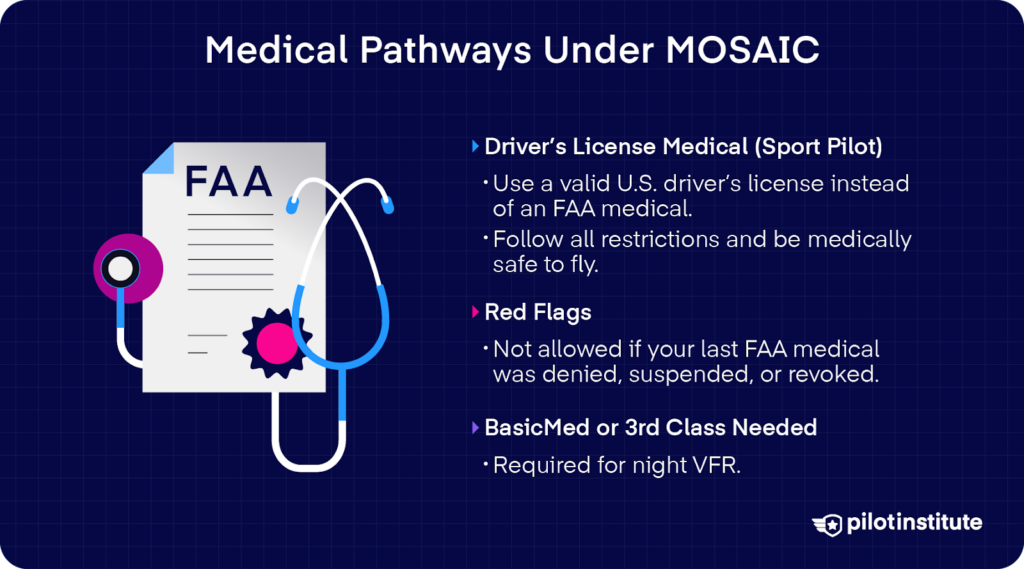
Don’t have an FAA medical certificate? You can still use a U.S. driver’s license instead of an FAA medical certificate for sport pilot operations.
Just make sure you meet the rule’s conditions, and you stay honest about your health. Follow every restriction printed on that driver’s license.
What if your most recent FAA medical certificate was denied, suspended, or revoked? Sadly, you cannot go the driver’s license route. That record is one of the biggest red flags in your medical pathway.
You also cannot use it if you know, or have reason to know, that you have a medical condition that would make you unsafe in the aircraft.
You must obey any limits that apply to driving privileges, too. That includes restrictions that come from a court or an administrative action. That means limitations are not only about what’s printed on the card.
When BasicMed or 3rd-Class Still Required
What about night flying? You can’t fly night VFR as a sport pilot on a driver’s license alone. You need either BasicMed or at least a third-class medical to use that privilege. Keep in mind that BasicMed has its own eligibility requirements (including having held a medical at some point after July 14, 2006).
Transition Scenarios for Existing Pilots
Private/Commercial/ATP
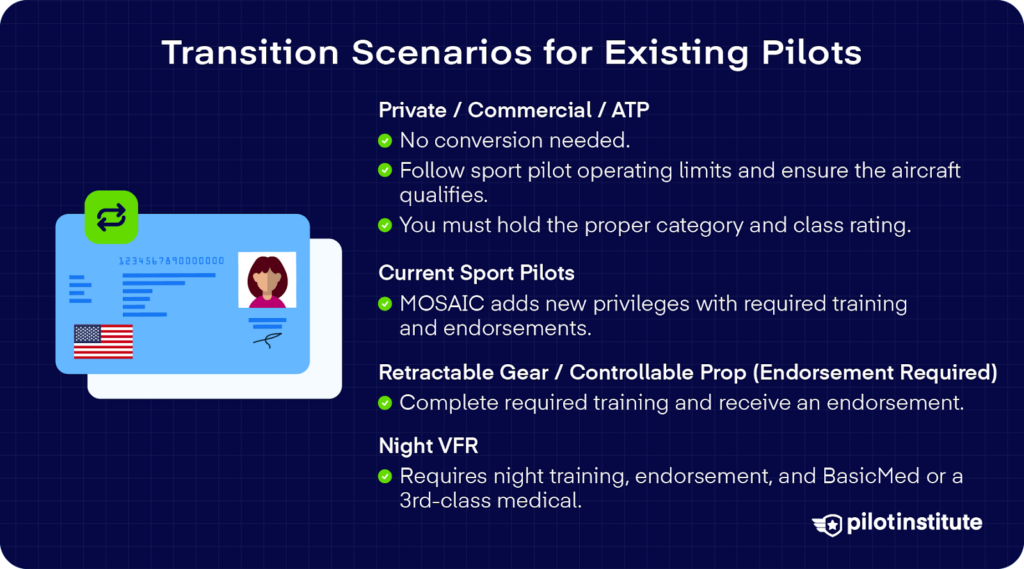
You don’t need to “convert” anything to start using MOSAIC sport pilot privileges. You already have a higher certificate, so the transition is mostly about choosing to operate under sport pilot limitations for a given flight.
Just follow the sport pilot operating rules in 14 CFR 61.303 and 14 CFR 61.315. Make sure the aircraft you’re flying fits the sport-pilot-eligible criteria that apply to the operation.
You also need the right category and class rating. That doesn’t change just because you’re choosing to fly as a sport pilot for the day.
Current Sport Pilots
What if you already hold a sport pilot certificate? What changes? Well, MOSAIC only gives you more optional add-ons.
Each one comes with its own training and endorsement path. The FAA still treats these as privileges you earn through proficiency.
Do you want to fly a complex airplane or one with a controllable pitch propeller? Then you have to meet one of two requirements.
You can take the standard route. Complete the training and get the endorsement required by 14 CFR 61.31(e).
Or, you can take a more direct option. Get ground and flight training from an authorized instructor in an airplane with a retractable landing gear or that type of propeller. Then, log that training and receive an endorsement.
MOSAIC also makes night VFR possible under sport pilot privileges, but you’ll also need dual training and an endorsement.
The training requirement is three hours of night flight training from an authorized instructor. It must include at least one cross-country flight at night over a total distance of at least 25 nautical miles, as well as 10 takeoffs and 10 landings to a full stop.
You also need to meet the medical requirements for night operations, which is not the driver’s license pathway.
Training & Flight-School Opportunities
Flight schools feel the difference most in budget and time.
How come? Sport pilot aeronautical experience requirements are structured to be achievable with a much lower total time requirement than the private pilot certificate.
You just need at least 20 hours of flight time to become a sport pilot. But to become a private pilot, you’ll need twice that time.
That’s why you’ll often see sport pilot programs budgeted for less time than private pilot training.
CFI-Sport (CFI-S) Pathway
| Requirement | CFI | CFI-Sport |
| Certificate | Commercial + Instrument | Sport/Private |
| Total Time | 250 hr | 150 hr |
| FOI / Knowledge tests | Yes | Yes |
You also get a new opportunity on the instructor side.
A flight instructor certificate with a sport pilot rating (CFI-S) lets you teach and endorse sport pilot applicants and sport pilots, as long as you stay within the limits of your privileges.
Find out more about these privileges in 14 CFR 61.413. It gives you the authority to provide training and issue endorsements tied to sport pilot certification.
This is where flight schools can grow capacity. A CFI-S pipeline can help schools scale sport pilot training without requiring every instructor to operate only through the traditional CFI track, especially for sport-focused programs.
Maintenance, Insurance, and Legal Fine Print
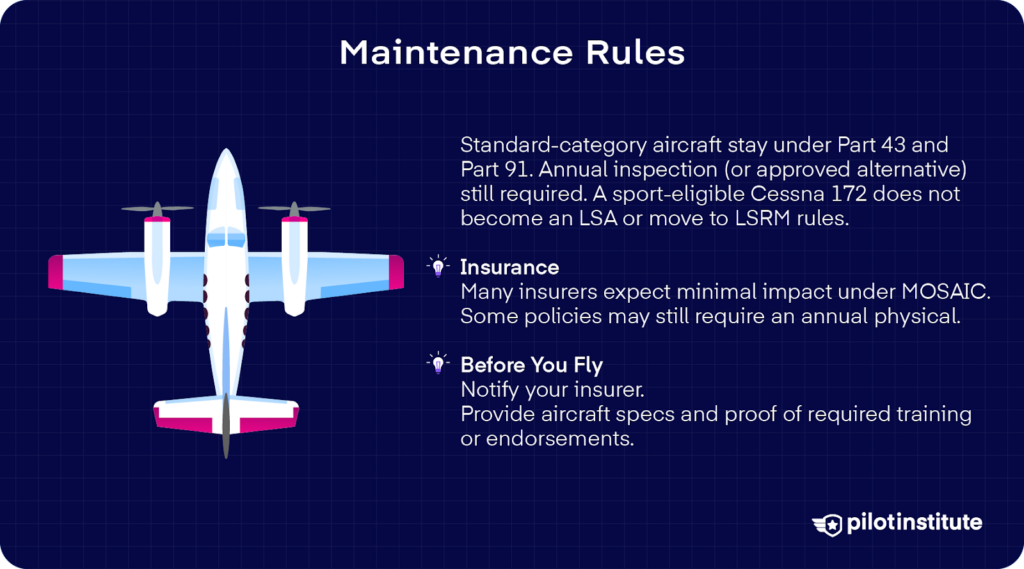
A standard-category aircraft (even if sport-pilot eligible) stays under the normal maintenance system. That means you’re still in the Part 43 world for maintenance, and the inspection requirements in Part 91 still apply.
You also still need a proper annual inspection sign-off. It’s pretty much the same legal baseline you’ve always had for standard-category aircraft.
Now, LSRM privileges are a different bucket. A Light-Sport Repairman (LSRM) certificate ties to aircraft that are actually certificated in the light-sport category.
That’s why it’s worth saying plainly: a Cessna 172 that becomes eligible for sport pilot operations does not become an LSA, and it does not suddenly move into an LSRM maintenance lane.
It stays where it is, legally, under the same inspection and return-to-service rules.
Insurance Market Snapshot
Early messaging from the insurance world has been pretty calm, and that’s good news for you!
Insurers have already weighed in on MOSAIC, and the general message is reassuring.
Most expect it won’t blow up coverage for pilots who start flying under sport pilot privileges. You still want to watch for a few caveats, though, because insurance doesn’t always move in lockstep with FAA rules.
Avemco has also addressed MOSAIC directly. They point out that some policies require an annual physical, and that can be an insurance requirement even if the FAA doesn’t require it for sport pilot operations.
So what should you do before you fly?
You should tell your insurer you’re transitioning into MOSAIC sport pilot operations.
You should bring proof that the aircraft qualifies. A clean way to do that is to present a copy of the specs and performance data from the AFM/POH. On top of that, a logbook entry showing transition training or the endorsement path you completed for any new privileges.
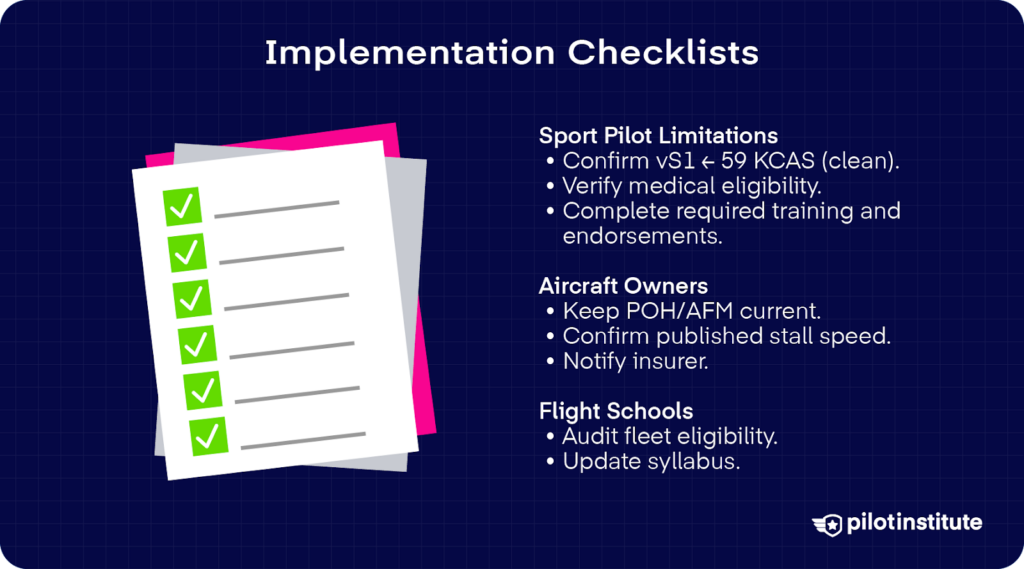
Implementation Checklists
Sport Pilots Limits
So, how can you start flying in this new world of sport pilots?
Start with the aircraft eligibility basics. If you’re planning to fly under sport pilot privileges, confirm the aircraft meets MOSAIC’s performance/design limits (including clean stall speed Vₛ₁ ≤ 59 KCAS) using approved aircraft data, not aftermarket stall-speed mods.
You also need to be careful about how that stall speed is achieved. Some aftermarket changes can lower the stall speed you see in real life, even if they don’t automatically disqualify the aircraft for sport pilot operations.
The FAA specifically warns against relying on modifications like vortex generators or STOL kits to meet the stall-speed limitation.
Next, check your medical pathway. You can still use the driver’s license option in the right situation, but you can’t use it as a workaround if you have a disqualifying history.
Last, book the training that matches the aircraft you actually plan to fly. You don’t want to learn it later if you’re moving into constant-speed or other advanced prop systems.
You want dual first, then a clean logbook trail that proves proficiency. It’ll also protect you with insurance conversations later.
Aircraft Owners
For aircraft owners, you’re in the proof and paperwork category under MOSAIC. You might be flying the same aircraft you’ve always owned, but you may now be renting it out to sport pilots.
You should start by keeping your POH/AFM current, including all required supplements.
A lot of common upgrades (especially STCs) can change performance data, which can affect published stall speed numbers.
Always comply with the operating limitations in the approved AFM/POH, markings, and placards.
What about insurance? You should notify your insurer early and ask for a mid-term change if needed. Some policies include medical requirements that are stricter than FAA rules.
You should also stock copies of the POH/AFM stall-speed data for renter pilots. This makes eligibility easy to prove.
Flight Schools
Flight schools get a real opportunity here. You can expand your sport pilot training fleet. Audit each aircraft’s published vS1 and tag aircraft that qualify as sport-pilot-eligible.
You should also add a dedicated Sport Pilot track inside your syllabus and order the right training materials.
You’ll want to coordinate locally, too. You can brief your area DPEs early, so checkride expectations stay aligned with MOSAIC.
Marketing changes the game. Remember that MOSAIC is built around lowering barriers while keeping training safe. Discovery-flight packages aimed at driver’s license pilots can convert well into new leads and students.
FAQs & Common Misconceptions
“Does a C-172 become an LSA?”
Nope. A Cessna 172 that qualifies as Sport-Pilot-Eligible under MOSAIC does not turn into a Light-Sport Aircraft (LSA) overnight.
The certification basis stays exactly what it has always been, usually a standard category under a type certificate. MOSAIC changes what you can operate under sport pilot privileges. It doesn’t relabel the aircraft’s certification category.
“Can I fly IFR on a driver’s license?”
No. Sport pilot privileges are still built around VFR operations, and IFR is still outside the sport pilot lane.
The FAA keeps sport pilot privileges in 14 CFR 61.315, and IFR is not one of those. So even if you’re using a driver’s license, IFR isn’t suddenly allowed just because of MOSAIC.
“My medical was denied in 2018; can I use MOSAIC?”
Not yet.
If your most recent FAA medical was denied, revoked, or suspended, you can’t use the driver’s license pathway to fly under sport pilot privileges.
The fix is getting another FAA medical certificate. You may need special issuance depending on your situation.
“Will insurers accept driver’s-license pilots?”
Early signals look positive, but insurance is still insurance.
At the same time, policies can still have their own medical or pilot-warranty requirements that go beyond FAA minimums.
Some policies require a current medical or annual physical as an insurance condition. They also warn that open pilot warranty clauses can be affected if a pilot lets their medical expire.
So yes, insurers may accept driver’s license pilots, but you should still call your underwriter before assuming your coverage won’t change.
Conclusion
MOSAIC is a big step forward for sport pilots, and it’s coming fast.
The rule opens the door to more capable aircraft and a smoother path into aviation. All of this, without losing the safety foundation that makes sport flying work.
You still have clear limits, and that’s a good thing. Limits make decisions simple and training more focused. Now it’s your move.
Check your aircraft’s specs in the POH, confirm your medical pathway, and book smart transition training with an instructor you trust.
You’re closer to the sky than you think.