
-
Key Takeaways
-
How Much Does a Glider Cost?
- How Much Does a Two-Seat Glider Cost?
- How Much Does a Motor Glider Cost?
- What Is the Cheapest Glider You Can Buy?
-
How Much Does It Cost to Own a Glider?
- How Much Does It Cost to Store a Glider?
- How Much Does Glider Maintenance Cost?
- How Much Does Glider Insurance Cost?
- Do You Need to Wear a Parachute in a Glider?
-
How Much Does It Cost to Rent a Glider?
- Soaring Club
- Commercial Gliderport
-
How Much Does Glider Pilot Training Cost?
- Private Pilot Certificate With a Glider Category Rating
- Is 20 Flights Realistic?
- Glider Rental Cost During Training
- Glider Instructor Cost During Training
- Glider Towing Cost During Training
- Glider Exam Costs
-
How Much Does a Glider Rating Cost If You Already Have a Pilot Certificate?
-
How Long Does It Take to Obtain a Glider Rating?
-
Frequently Asked Questions
- Is Gliding Cheaper Than Flying Airplanes?
- Do Gliders Hold Their Value?
- Do You Need a Medical Certificate to Fly a Glider?
- How Old Do You Have to Be to Fly a Glider?
- How Much Does a Hang Glider Cost?
-
Conclusion
A glider can cost about $5,000 to $6,000 at the low end of the used market, while new high-performance or self-launching models may exceed $300,000.
In 2026, club rentals may start around $22 to $43 per hour plus the aerotow, and initial glider training often costs $3,500 to $10,000.
Pilots who already hold an airplane certificate still need to add a glider category rating and pass a practical test.
It’s Saturday morning, and you’re standing by the airport fence with a coffee going cold in your hand.
A sailplane releases from its towline and circles into rising air. It keeps climbing with no engine running.
What would it cost to be up there? Gliding can be one of the lower-cost ways to fly, but the final price depends on the aircraft, launch method, storage, and training path.
Key Takeaways
- Used gliders can start around $5,000 to $6,000, while modern models may exceed $300,000.
- Club rentals may start at around $22 to $43 per hour, plus the aerotow.
- Initial glider training often costs about $3,500 to $10,000.
- Airplane pilots still need a glider add-on and a practical test.
How Much Does a Glider Cost?
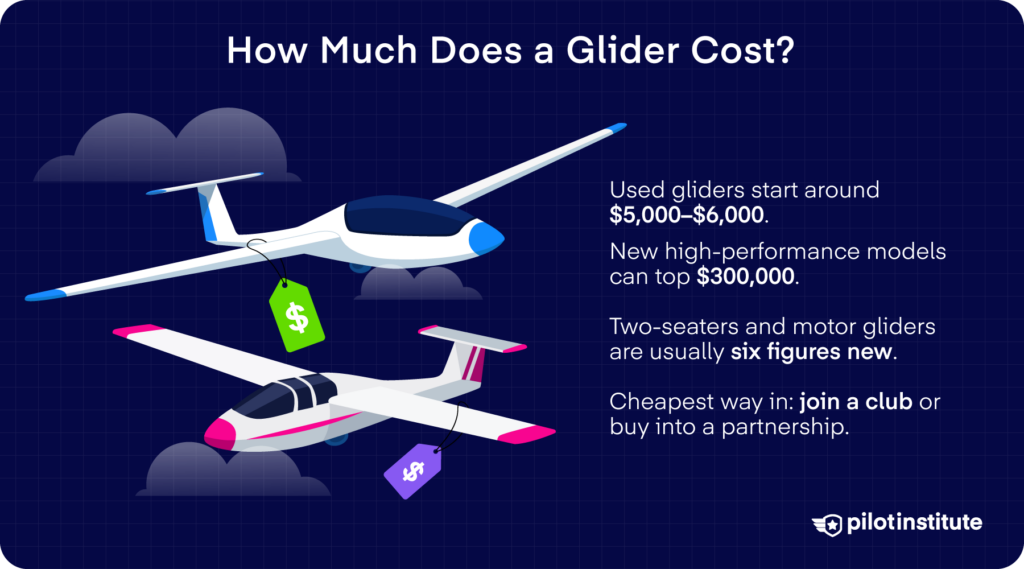
Current used-aircraft listings cover a wide range. Older gliders may appear for under $10,000, while newer racing and self-launch models can reach deep into six figures. Wings & Wheels’ current glider listings show how much the price changes with age, condition, equipment, and trailer quality.
New gliders are often priced by dealer quote. A modern composite trainer or high-performance sailplane can easily carry a six-figure price once the panel, trailer, engine system, and other options are added.
| Cost Item | Typical 2026 Range or Example |
| Club glider rental | Included in dues at some clubs; $21.60–$43.30 per hour at one current club |
| Aerotow | Often priced by height or tow time; one club charges a $12.40 hookup fee plus $1.80 per 100 feet |
| Private Pilot – Glider (initial) | About $3,500–$10,000 |
| Private Pilot – Glider (add-on) | About $2,500–$5,000; extra training or examiner fees may raise the total |
| Used glider purchase | Roughly $5,000 to well over $300,000 |
| New glider purchase | Often six figures; dealer quotes are common |
Pricing checked July 2026. Aircraft listings and operator fees can change.
How Much Does a Two-Seat Glider Cost?
An older metal trainer and a modern composite two-seater sit in very different price brackets. Older two-seat aircraft can appear near the bottom of the used market, but condition and required repairs can quickly erase the savings.
Modern two-seat gliders are commonly six-figure aircraft. Optional avionics, a trailer, oxygen equipment, or a self-launch system can push the total much higher.
How Much Does a Motor Glider Cost?
A motor glider adds an engine or electric propulsion system, which raises the purchase and maintenance cost.
A self-launching motor glider can take off under its own power. A sustainer cannot normally launch the aircraft, but it can help the pilot stay airborne or return toward the airport.
A front electric sustainer, often called FES, uses a folding propeller in the nose. Some newer electric systems can also support self-launching on aircraft approved for that use.
New motor gliders are often priced in the six figures, and top-end models can cost several hundred thousand dollars. Ask for a current quote because batteries, engine choice, avionics, and trailer equipment can change the final price by a large amount.
What Is the Cheapest Glider You Can Buy?
The low end of the current used market is around $5,000 to $6,000. A low asking price does not guarantee a low ownership cost.
Before buying, review the logbooks, inspection status, airworthiness directives, finish condition, trailer, and parts support. A pre-buy inspection by someone familiar with that glider model is worth the cost.
For many pilots, the lowest-cost path is joining a soaring club or buying through a partnership. Shared aircraft and fixed costs can make better equipment available for less money per pilot.
How Much Does It Cost to Own a Glider?
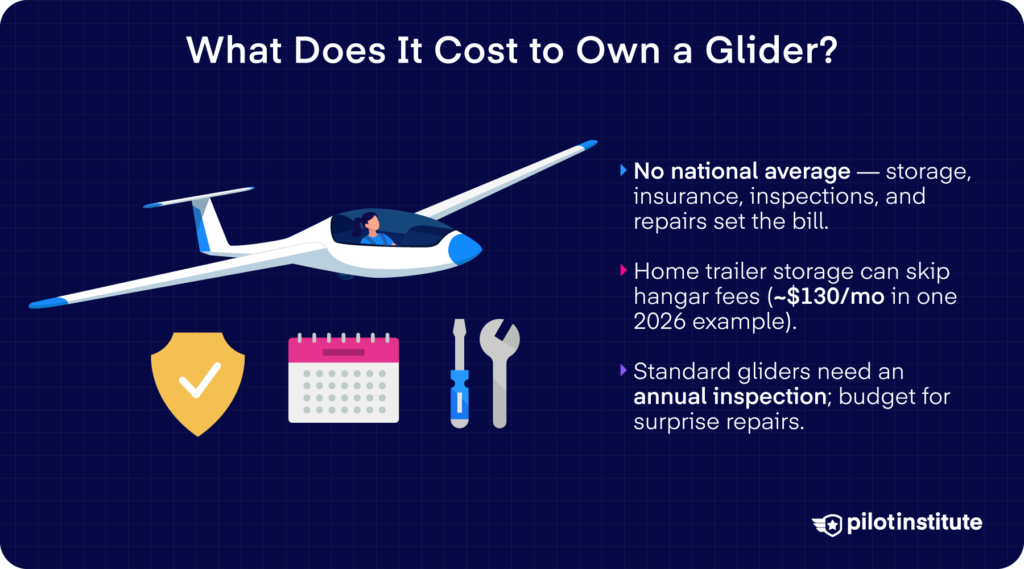
There is no reliable national average for annual glider ownership. Storage, insurance, inspection type, repairs, trailer upkeep, and the aircraft’s value drive the total.
A simple glider kept in its trailer at home may cost far less each year than a high-value motor glider stored in a hangar. Budget for unexpected repairs instead of relying only on the fixed annual bills.
How Much Does It Cost to Store a Glider?
Keeping a de-rigged glider in its trailer at home may remove the monthly storage bill, provided local rules allow it and the aircraft stays protected.
Airport and club prices vary. As one 2026 example, Windy City Soaring Association lists private-glider field use at $345.10 per year and full-time hangar storage at $128.80 per month.
Those figures are for one location, not a national average. Hangar availability can also be limited.
How Much Does Glider Maintenance Cost?
Standard-category gliders generally fall under the annual inspection requirement in 14 CFR 91.409. Experimental gliders are excluded from paragraphs 91.409(a) and (b) and usually follow the condition-inspection requirement in their operating limitations.
The 100-hour rule applies when an aircraft carries a person for hire or when an instructor provides paid flight instruction in an aircraft that the instructor provides. It does not automatically apply to every privately owned glider used during paid instruction.
Pure gliders have fewer engine-related parts, but inspection and repair costs still vary. Gelcoat work, control-system repairs, canopy damage, corrosion, and life-limited components can become expensive.
How Much Does Glider Insurance Cost?
Insurance is quote-based. Hull value, pilot experience, aircraft type, liability limits, and where the glider is operated all affect the premium.
Ask for separate liability-only and hull-coverage quotes. A low-value glider may be inexpensive to insure, while a high-performance or motor glider can cost much more.
Do You Need to Wear a Parachute in a Glider?
The FAA does not require a parachute for ordinary glider flight.
Under 14 CFR 91.307, every occupant must wear an approved parachute before the pilot intentionally exceeds 60 degrees of bank or a 30-degree nose-up or nose-down attitude while carrying a person other than a crewmember.
The rule exempts flight tests for a certificate or rating and required spins or maneuvers when they are given by an authorized instructor. An ordinary training flight is not automatically exempt.
A parachute made from qualifying synthetic materials must have been packed by an appropriately rated rigger within the preceding 180 days. A parachute containing natural-fiber materials has a 60-day limit. Competition and club rules may add stricter requirements.
How Much Does It Cost to Rent a Glider?
Soaring Club
Club rental rates are often low because members share the aircraft and overhead. Some clubs include the glider in monthly dues, while others bill by the minute or hour.
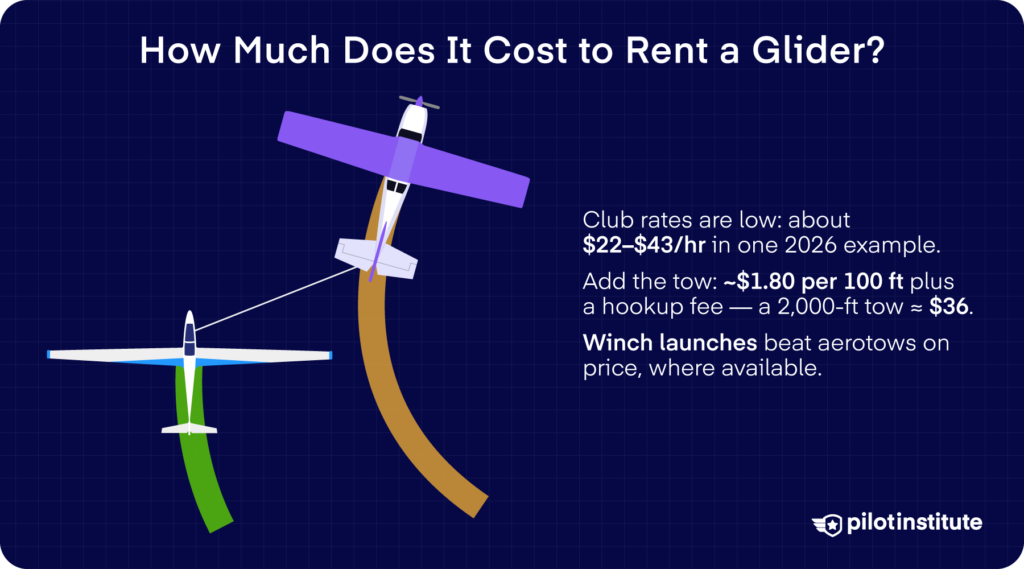
At one current club, aircraft rental runs from $21.60 per hour for a PW-5 to $43.30 per hour for an ASK 21. Current club rates also show a $12.40 hookup fee and $1.80 per 100 feet of aerotow.
At those rates, a 2,000-foot tow would cost $36, or $48.40 after the hookup fee. The glider rental is added separately based on the flight time.
Membership dues, initiation fees, instruction charges, and field-use fees vary by club. Compare the full fee sheet rather than the hourly rental price alone.
Commercial Gliderport
Commercial operators may sell training by the lesson, day, or package. Their rates are usually higher, but concentrated scheduling can help students avoid long gaps between flights.
Launch methods also change the cost. Aerotows are usually more expensive than winch launches, but a winch is not available at every field.
How Much Does Glider Pilot Training Cost?
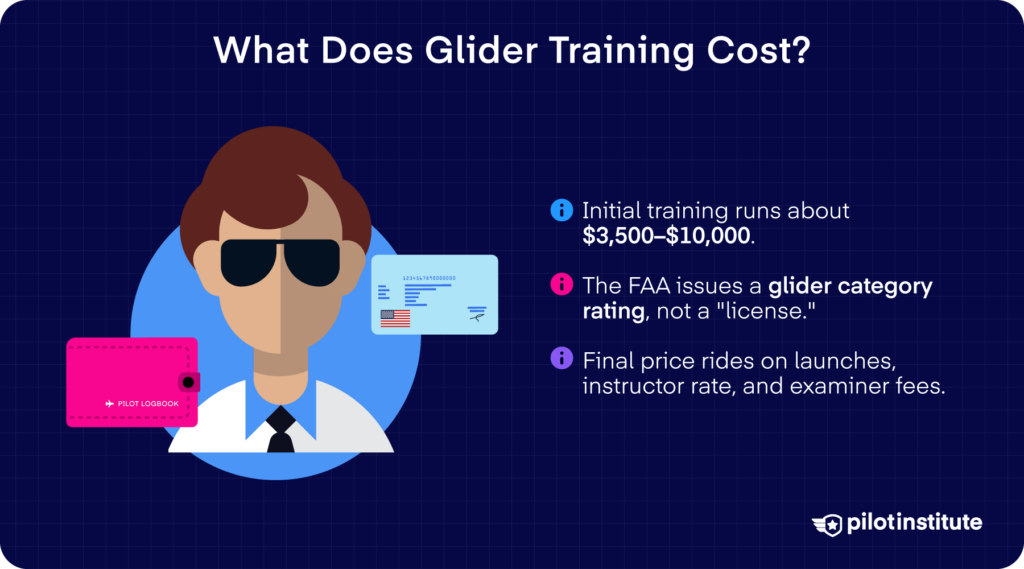
People often search for a “glider pilot license,” but the FAA issues a pilot certificate with a glider category rating. A first-time applicant earns an initial private pilot certificate in the glider category.
A pilot who already holds an airplane private pilot certificate must add the glider category rating before acting as pilot in command of a glider.
Current school examples place initial training from about $3,500 to $10,000. Right Rudder Aviation advertises a $3,499 motor-glider package, while SoaringNV estimates $7,000 to $10,000 for an initial glider certificate.
The final price depends on the aircraft, launches, instructor rate, training frequency, written test, and examiner fee. Any training beyond a package’s included amount raises the bill.
Private Pilot Certificate With a Glider Category Rating
The aeronautical experience requirements are found in 14 CFR 61.109(f). If you have not logged at least 40 hours as a pilot in heavier-than-air aircraft, the FAA minimum is 10 hours in a glider.
That time must include:
- At least 20 glider flights, including three training flights with an authorized instructor in preparation for the practical test within the preceding two calendar months.
- At least two hours of solo glider time, including no fewer than 10 launches and landings.
These are certification minimums, not a promise that every student will be ready in 20 flights. Your instructor must find you proficient and endorse you for the practical test.
Free Private Pilot Study Sheet
Grab a printable PDF that highlights must-know PPL topics for the written test and checkride.
- Airspace at-a-glance.
- Key regs & V-speeds.
- Weather quick cues.
- Pattern and radio calls.
Is 20 Flights Realistic?
Twenty flights are possible for a student who reaches the required skill level within the FAA minimums. Many students need more launches, especially when training is spread across weekends or interrupted by the weather.
Frequent lessons can reduce the amount of time spent relearning skills. Aircraft availability and the examiner’s schedule can also affect the finish date.
| Item | How It Is Charged | What Raises the Total |
| Glider rental | By minute, hour, flight, or included in club dues | More flight time and higher-performance aircraft |
| Instruction | Volunteer, hourly, or included in a package | Ground instruction and extra proficiency flights |
| Launches | By tow height, tow time, or a flat winch fee | More flights and higher release altitudes |
| Other fees | Membership, hookup, written test, and practical test fees | Local pricing and examiner fees |
Glider Rental Cost During Training
Do not calculate the minimum rental bill by multiplying 20 flights by a one-hour minimum. The regulation requires 10 total glider hours across at least 20 flights for the initial path, and many clubs bill by the minute.
Ask how the operator records rental time and whether a daily or one-hour minimum applies. The billing method can change the estimate by hundreds of dollars.
Glider Instructor Cost During Training
Some nonprofit clubs use volunteer instructors. Other clubs charge an instruction surcharge, and commercial schools usually charge by the hour or include instruction in a package.
Confirm whether the quoted rate covers flight instruction, ground instruction, preflight briefings, and checkride preparation.
Glider Towing Cost During Training
Every unpowered training flight needs a launch. Aerotow charges are commonly based on release height or towplane time.
Using the current example of $1.80 per 100 feet, twenty 2,000-foot tows would cost $720 before hookup fees. A $12.40 hookup fee on each flight would add $248.
Those numbers are an example from one club. Your total may be lower with winch launches or higher with longer tows.
Glider Exam Costs
An initial private pilot applicant in the glider category must pass the required knowledge test. PSI’s FAA voucher price is $175 in 2026, plus any applicable tax.
A Designated Pilot Examiner sets the practical-test fee. The FAA does not publish one nationwide price, so confirm the examiner’s fee and retest policy before scheduling.
How Much Does a Glider Rating Cost If You Already Have a Pilot Certificate?
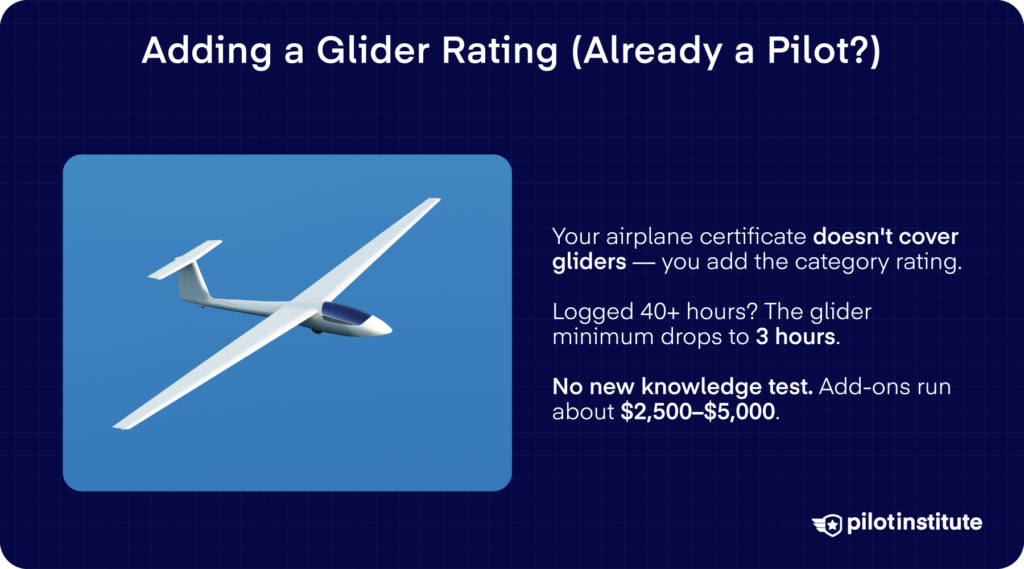
An airplane private pilot certificate does not automatically authorize you to fly gliders as pilot in command. Glider is a separate aircraft category, so you must add the glider category rating.
Under 14 CFR 61.63(b), you must complete the applicable training and experience, receive an instructor endorsement, and pass a glider practical test.
You do not need another knowledge test when you already hold a qualifying airplane, rotorcraft, powered-lift, weight-shift-control, powered-parachute, or airship rating at the same pilot-certificate level.
If you have logged at least 40 hours in heavier-than-air aircraft, 14 CFR 61.109(f)(2) reduces the glider minimum to three hours. Those three hours must include:
- At least 10 solo glider flights.
- Three training flights with an authorized instructor in preparation for the practical test within the preceding two calendar months.
Current add-on estimates run from about $2,500 to $5,000. SoaringNV lists $2,500 to $3,500, Arizona Soaring lists about $4,000 to $5,000, and Seminole Lake Gliderport lists an approximate $4,500 private add-on.
How Long Does It Take to Obtain a Glider Rating?
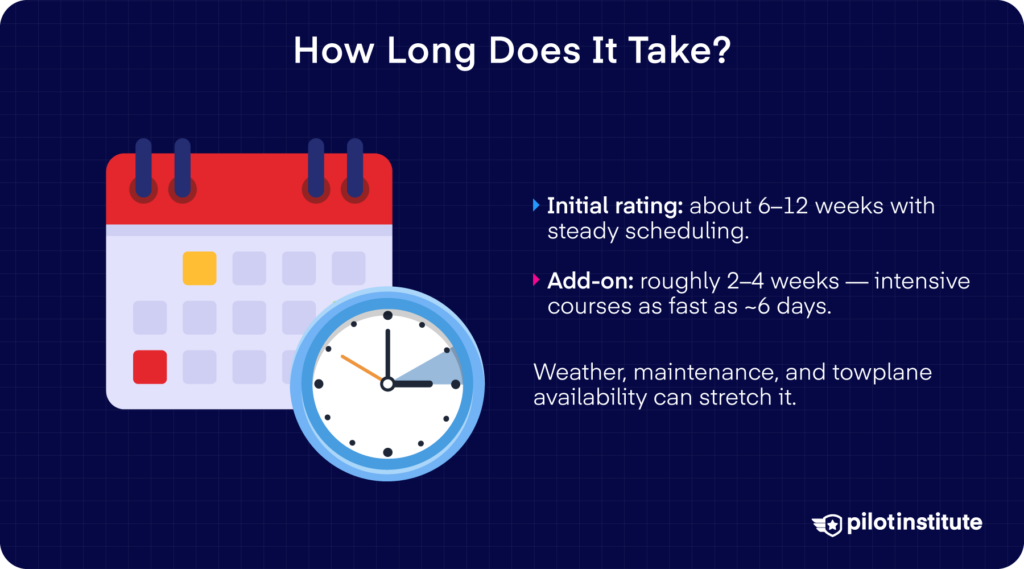
A first-time student may finish in several weeks at a commercial school with steady scheduling. SoaringNV gives a broad estimate of six to 12 weeks for an initial certificate and two to four weeks for an add-on.
An intensive add-on course can be faster. Arizona Soaring estimates about six days for many private add-on applicants, but actual readiness varies by pilot.
Low clouds, rain, strong winds, aircraft maintenance, and towplane availability can delay training. Calm air may limit soaring time, but it can still support launches, landings, and other useful training.
Frequently Asked Questions
Is Gliding Cheaper Than Flying Airplanes?
It often is. Initial glider training can cost a few thousand dollars, while powered-airplane private pilot training commonly costs much more.
Operating costs can also be lower because a pure glider has no engine or fuel burn. High-end gliders, hangars, aerotows, and repairs can still make the hobby expensive.
Do Gliders Hold Their Value?
A well-maintained glider can retain value for a long time, but appreciation is never guaranteed. Finish condition, accident history, trailer quality, avionics, inspections, and demand for the model all affect resale value.
Do You Need a Medical Certificate to Fly a Glider?
No. 14 CFR 61.23(b) says a medical certificate is not required when exercising the privileges of a pilot certificate with a glider category rating in a glider.
You still may not fly when you know or have reason to know of a medical condition that would make the operation unsafe. That rule appears in 14 CFR 61.53(b).
How Old Do You Have to Be to Fly a Glider?
You may be eligible for a student pilot certificate for glider operations at age 14 under 14 CFR 61.83(b).
You may earn a private pilot certificate with a glider rating at age 16 under 14 CFR 61.103(b). Most other private pilot ratings require the applicant to be at least 17.
How Much Does a Hang Glider Cost?
A hang glider is a foot-launched aircraft, so its prices and training rules are separate from the sailplanes covered in this article.
Current North Wing prices show several new hang gliders around $4,775 to $5,100. Harnesses, helmets, instruments, training, and inspection of used equipment add to the total.
Conclusion
Glider prices cover a huge range. An older used aircraft may cost only a few thousand dollars, while a new high-performance sailplane or motor glider can reach several hundred thousand.
Training also has two distinct paths. A first-time applicant can earn an initial private pilot certificate in the glider category, while a powered-aircraft pilot must complete a glider category add-on and practical test.
Before buying, book an introductory flight and visit a local soaring club. You will get a better sense of the aircraft, training pace, launch costs, and ownership options before making a large purchase.