
Flying a helicopter is one of the coolest things you can learn to do. It’s also one of the most expensive types of pilot training out there.
If you’re serious about it, you need real numbers before you commit. The total cost to go from zero experience to a commercial helicopter pilot certificate typically runs between $70,000 and $90,000. A private license alone will cost you somewhere around $30,000.
We know that those numbers can feel pretty overwhelming. But when you break them down step by step, it gets a lot easier to plan for.
Let’s walk through every cost you’ll face on the way to becoming a helicopter pilot.
Key Takeaways
- A private helicopter certificate costs $24,000 to $30,000.
- Going from zero to commercial pilot runs $70,000 to $90,000 total.
- Helicopter flight time runs $350-700 per hour.
- The FAA requires 150 minimum flight hours for a commercial certificate.
Cost Breakdown by Certificate
Here’s a general breakdown of what each level of training costs. Keep in mind that these numbers are based on averages. Your actual total depends on the helicopter you train in, where you train, and how quickly you learn.
| Certificate / Rating | FAA Minimum Hours | Typical Hours Needed | Estimated Cost |
| Private Pilot (Helicopter) | 40 hours | 50–60 hours | $24,000–$30,000 |
| Instrument Rating | 40 hours | 45–55 hours | $18,000–$22,000 |
| Commercial Pilot (Helicopter) | 150 hours total | 150–200 hours total | $25,000–$35,000 |
| Certified Flight Instructor (CFI) | 25 hours (flight) | 25–40 hours | $12,000–$15,000 |
| Total (Zero to CFI) | — | — | $70,000–$95,000 |
These figures include flight time, ground school, and instructor fees but typically exclude checkride fees, books, headsets, and your medical exam.
Private Helicopter Pilot Certificate
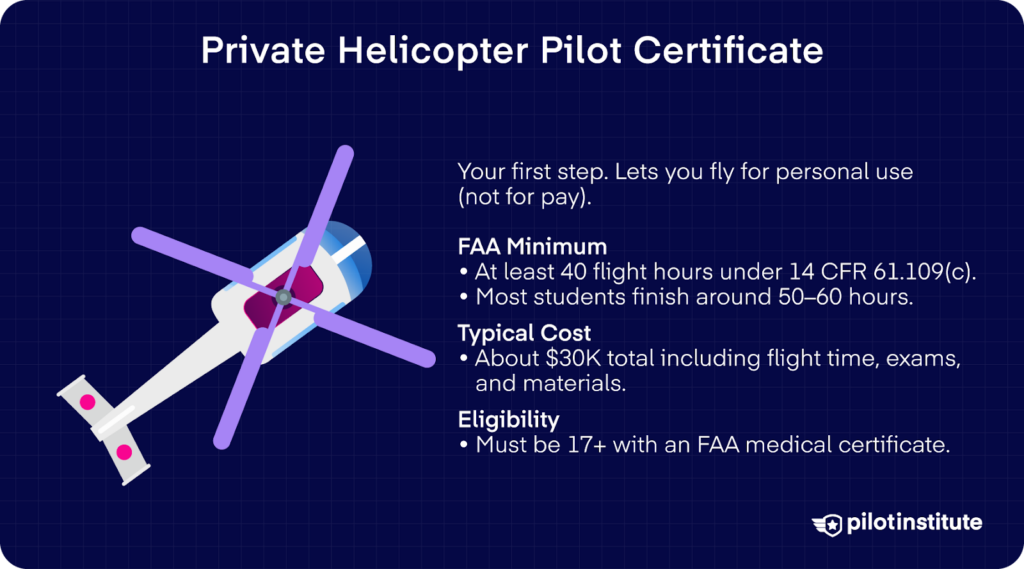
The private pilot certificate is your first step. It lets you fly a helicopter for personal use, but you can’t get paid for it.
Under 14 CFR 61.109(c), the FAA requires a minimum of 40 hours of flight time. That includes at least 20 hours of flight training with an instructor and 10 hours of solo flight.
The national average to complete your private certificate is closer to 50 to 60 hours. Very few people finish at the 40-hour minimum. The FAA sets a floor, not a target. You fly until you’re ready for the checkride, and that takes as long as it takes.
At roughly $400-500 per hour for dual instruction in a Robinson R22 (the most common training helicopter), 50 hours puts you at about $20,000-25,000 in flight costs alone. Add ground school, books, and exam fees, and you’re in the $30,000 range.
You also need to be at least 17 years old and hold an FAA medical certificate. That medical exam costs about $100 to $200 out of pocket. The FAA does not set exam fees, so your price depends on the Aviation Medical Examiner (AME) you visit.
Commercial Helicopter Pilot Certificate
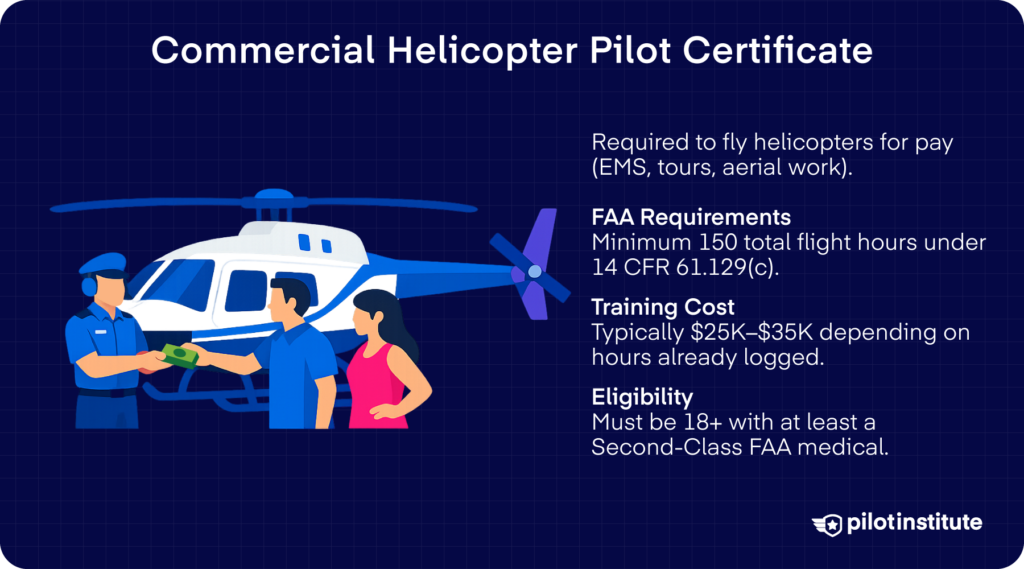
If you want to fly helicopters for a living, you need a commercial certificate. This is what opens the door to jobs in EMS, tours, aerial work, law enforcement, and fire.
Under 14 CFR 61.129(c), the FAA requires at least 150 hours of total flight time. Of that, 100 hours must be in powered aircraft (with 50 in helicopters), and 100 hours must be as pilot in command. You also need 20 hours of training that includes instrument work, cross-country flights, and night flying.
Most students accumulate their 150 hours through the combined training from their private certificate, instrument rating, and commercial course.
The commercial course itself adds roughly $25,000 to $35,000 to your total, depending on how many hours you’ve already logged. This is in addition to the instrument rating, assuming you accomplish that immediately after private.
You must be at least 18 years old and hold at least a second-class FAA medical certificate for commercial privileges.
Instrument Rating and CFI
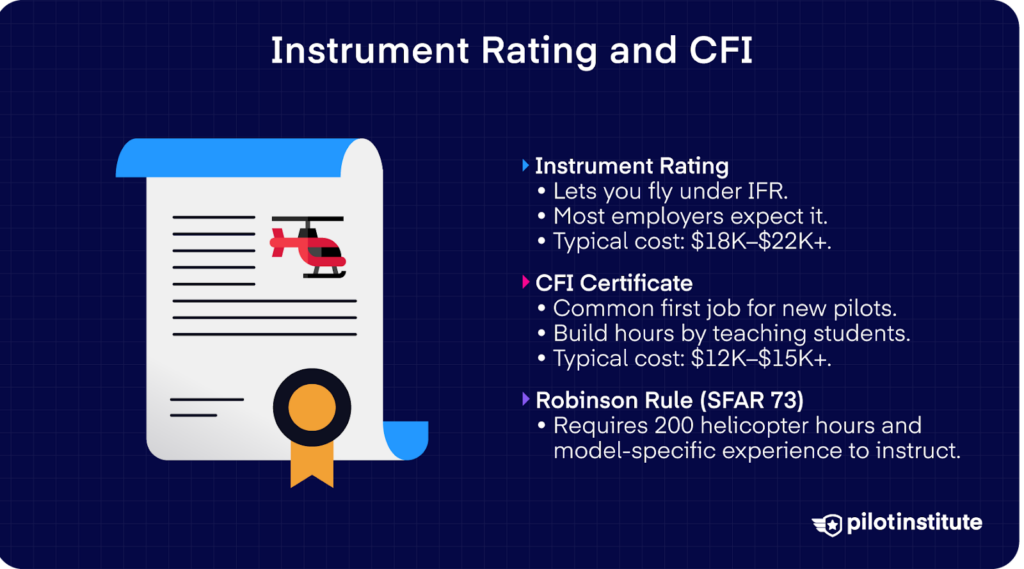
An instrument rating lets you fly in bad weather under Instrument Flight Rules (IFR). It’s not technically required for a commercial helicopter certificate, but most employers expect you to have one.
Budget around $18,000 to $22,000 for this. Many flight schools conduct in the instrument rating in the R44 helicopter, which is about $700 per hour for dual instruction. If that is the case for you, anticipate the elevated cost for those flight hours.
The Certified Flight Instructor (CFI) certificate is how most new commercial pilots build their hours. Teaching other students to fly gives you the flight time you need to qualify for higher-paying jobs later. The CFI program typically costs $12,000 to $15,000.
If you have an instrument rating, finish your CFII as well- it’s not much extra effort for a large gain in marketability as a flight instructor.
If you train in Robinson helicopters (the R22 or R44), the FAA has a special rule. Under SFAR 73, anyone who teaches in a Robinson must have at least200 hours of helicopter flight time. So you’ll need to build those hours before you can instruct in one.
In addition, SFAR73 requires any flight instructor teaching in Robinson helicopters to log 50 hours as PIC in the R22 to teach in the R22, and 50 hours in the R44 to teach in the R44. 25 hours of your R22 time can count toward the 50 required R44 time.
You also need a special endorsement from an examiner for each model in order to legally teach. This usually happens during your CFI checkride.
Hidden Costs You Should Plan For
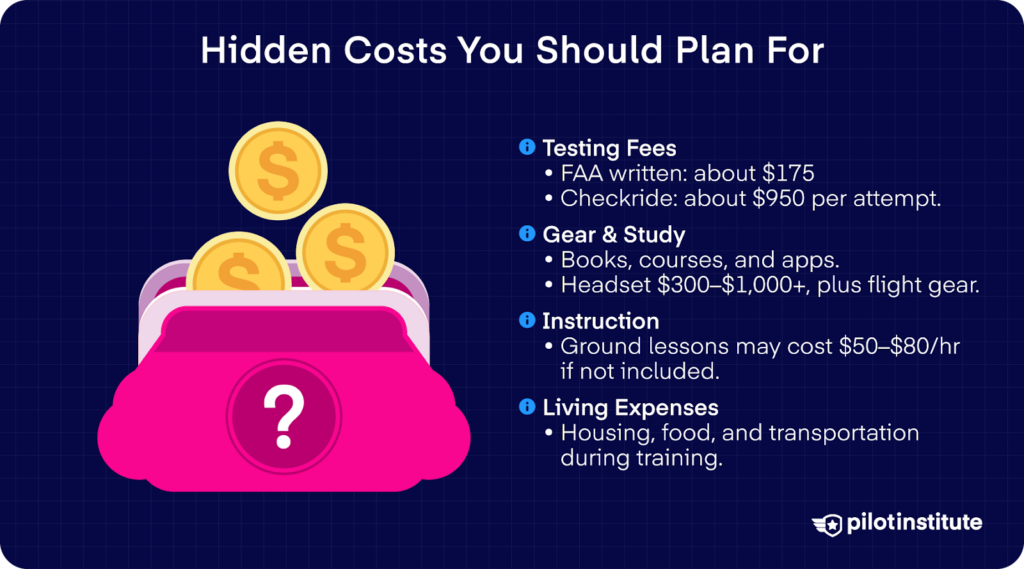
The big hourly rate grabs all the attention. But smaller costs add up fast too.
Your FAA written exam (the Airman Knowledge Test) costs about $175. The practical test, or checkride, runs around $950 per attempt. You’ll pay a checkride fee for each certificate and rating you earn, in addition to the helicopter flight time which is usually about 1.5 hours.
Factor in the cost for books, study materials, and apps like our Pilot Institute courses. A decent aviation headset costs $300 to $1,000+. And you’ll need a kneeboard, flight bag, iPad, and other gear.
If your flight school doesn’t include ground instruction in the hourly rate, that’s extra too. Some schools charge $50 to $80 per hour for ground time with an instructor.
If you are good at self-study, an online ground school program like the ones that Pilot Institute offers can make a huge difference in preparing you for your lessons, and minimize the costs of ground training with a flight instructor.
Don’t forget about living expenses. If you move to a training location or attend a full-time program, factor in housing, food, and transportation for several months to a couple of years, depending on your pace.
What Helicopter Pilots Earn
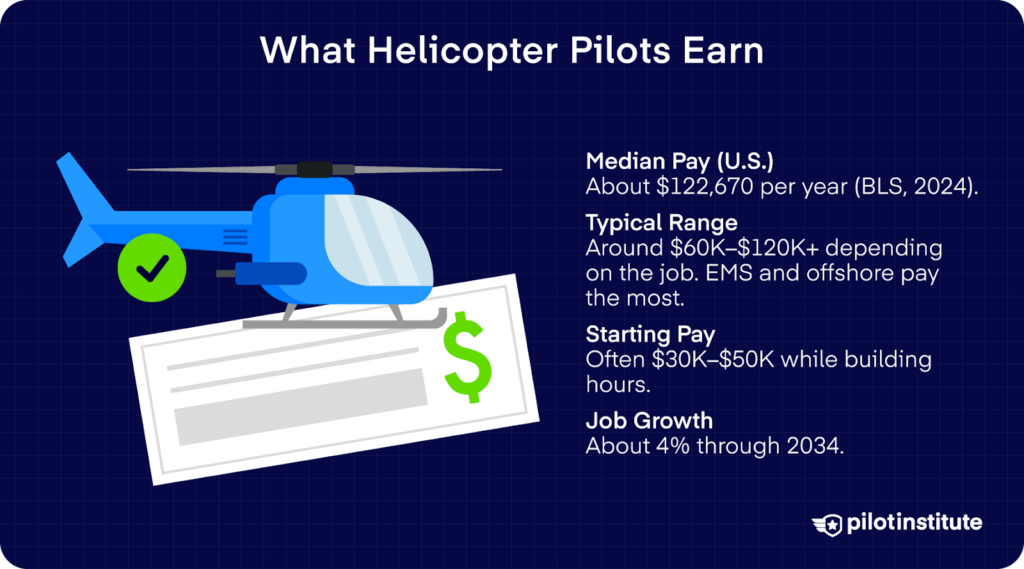
After all that investment, you’ll want to know what the payoff looks like.
According to the U.S. Bureau of Labor Statistics, the median annual wage for commercial pilots was $122,670 in May 2024. That category includes helicopter pilots who fly charters, tours, EMS, and other commercial operations.
Helicopter pilots specifically tend to earn between $60,000 and $120,000+ per year, depending on the sector. EMS and offshore oil transport jobs generally pay the most. Tour pilots and entry-level CFI positions pay the least.
Most new helicopter pilots start out earning between $ 30,000 and $ 50,000 while building hours in their first job. The pay gets better as you gain experience and flight time. After 1,000+ hours, you start qualifying for the higher-paying positions, and 2,000+ hours is the gateway to the upper-level paying jobs like EMS
The BLS projects about 4% job growth for pilots from 2024 to 2034, which is about average for all occupations.
Frequently Asked Questions and Common Myths
- Can I get a private helicopter license for under $15,000?
Some sources quote $10,000 to $15,000, but those numbers are often based on absolute minimum hours and don’t include all the extras.
The $24,000 to $30,000 range is a more realistic estimate for most people. Going in with a too-low budget will likely lead to frustration when you run out of money before you finish.
- Is helicopter training more expensive than airplane training?
Yes, definitely. Helicopters cost a lot more per hour to operate, maintain, and insure. A typical airplane training hour might run $150 to $200.
A helicopter hour in a Robinson R22 is usually $350-450. The mechanical complexity of rotor systems drives those costs up.
- Do I need a college degree to become a helicopter pilot?
The FAA does not require a college degree for any helicopter pilot certificate. Some employers prefer it, especially in the corporate sector, but it’s not a legal requirement. Many successful helicopter pilots started with just their flight training.
- Can I use the GI Bill for helicopter training?
You can, but only at schools approved by the VA under FAA Part 141 rules. Not all helicopter flight schools qualify. If you’re a veteran, check whether your school holds VA approval before enrolling.
- Is 30 too late to become a helicopter pilot?
Not at all. The FAA has no upper age limit for earning a helicopter pilot certificate. You need to be 17 for a private and 18 for a commercial, but there’s no cap on the other end.
Plenty of people start helicopter training in their 30s, 40s, and even 50s. As long as you can pass the FAA medical exam and commit to the training, your age won’t hold you back. You’ll still have decades of flying career ahead of you at 30, and the helicopter industry does not have a mandatory retirement age as the airlines do.
- Are helicopter pilots in high demand?
Yes. The helicopter industry is dealing with a real pilot shortage. Boeing has projected a global shortage of roughly 61,000 helicopter pilots by 2038, driven by retirements from the Vietnam War era and growing demand in sectors like EMS, construction, and offshore energy.
The BLS projects about 4% job growth for pilots through 2034. For helicopter pilots specifically, the outlook is strong. There are more positions opening up than there are qualified pilots to fill them.
- Will drones replace helicopter pilots?
Not anytime soon for most civilian jobs. Drones have definitely taken over some tasks that helicopters used to handle, like aerial photography, surveying, and certain types of inspections. Those jobs are cheaper and safer to do with a drone. But drones can’t carry passengers, fly EMS missions, transport heavy loads, or perform the kind of complex operations that helicopter pilots do every day.
On the military side, the picture is a bit different. The U.S. Army is actively shifting toward unmanned systems and cutting some manned helicopter positions. But in civilian aviation, the pilot shortage is still the bigger issue.
Drones are creating new jobs in aviation, not eliminating helicopter careers.
- Myth: The FAA minimum hours are all you’ll need.
This trips up a lot of people. The FAA minimum of 40 hours for a private certificate is a legal requirement, not a training target. The national average sits between 50 and 60 hours. Some students take 70 or more. Plan your budget for the average, not the minimum.
- Myth: You can become a working helicopter pilot for under $50,000.
Technically possible if everything goes perfectly and you skip the instrument and CFI ratings. The primary issue is, there are very few, if any, employers out there who will hire you without that experience. Even working for yourself with limited experience and your own helicopter is incredibly risky. Realistically, most students spend $70,000 to $90,000 to get through all the ratings they need for employment. Budget for reality.
Conclusion
Becoming a helicopter pilot is a serious financial commitment. You’re looking at $70,000 to $90,000 or more to go from zero experience to an employable commercial pilot.
That cost covers your private certificate, instrument rating, commercial certificate, and CFI. Each step has its own FAA requirements, its own training hours, and its own price tag.
The good news is that the career pays well once you build experience. Commercial pilots earned a median of $122,670 in 2024, and specialized helicopter jobs in EMS and offshore work push that number higher.
Plan your budget carefully, pick a reputable school, and know what the FAA actually requires before you sign up.