
-
Key Takeaways
-
1. The True Cost of Learning to Fly
- Factor Burnout Inflation
-
2. Build Your Flight-Training Savings Before You Start
- Savings
- Loans
- GI Bill and 529 Plan
- Scholarship & Grant Playbook
-
3. Choose the Right Training Path for Wallet & Lifestyle
- Part 61 vs. Part 141 vs. Accelerated Academies
- College Programs vs. Local Flight School
-
4. Schedule Like a Pro: Time Management That Saves Money
- Use Three-Hour Blocks
- Build Weather & Maintenance Plans
- Online Ground School
-
5. Spend Smarter in the Airplane
- Hobbs Rate
- Block Rates
- Flying Clubs
- Share Costs Legally
-
6. Prevent Burnout Before It Starts
- Build a Support Crew
- Know When to Tap the Brakes
-
7. Lifestyle Cuts That Add Flight Hours
- Housing & Transportation
- Aviation Side Hustles
-
8. The 6-Month Sample Plan
-
Conclusion
There once was a student pilot who had $10,000 saved and a dream. By hour 45, both were gone: the money and the motivation.
A scheduling conflict at work cost them two weeks. Then, the weather grounded them for another three. By the time they got back in the airplane, they needed four review flights just to get back to where they’d been.
Sound familiar? Flight training has a way of attacking on two fronts at once. Airplanes burn avgas while pilots burn brainpower, and running low on either one will stall your progress.
How do you avoid having the same ending to your story? Let’s have an honest talk about both problems, and how you can balance your expenses and endurance.
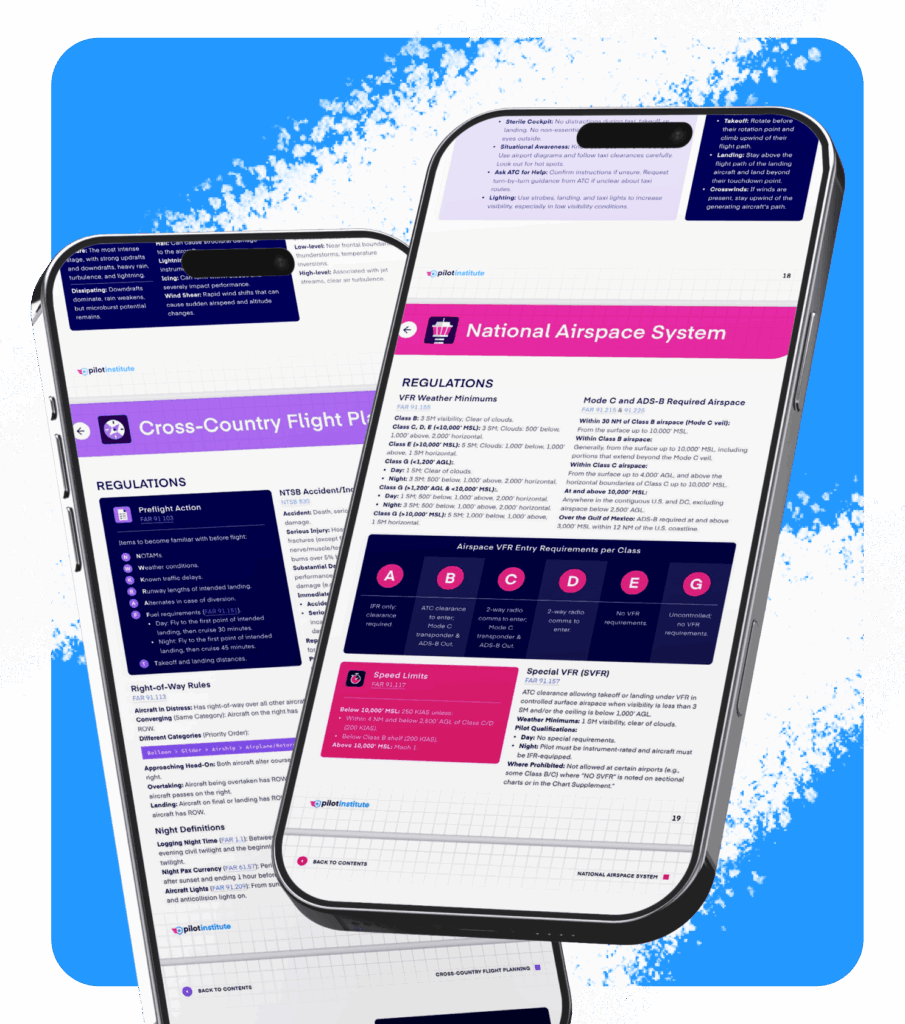
Keep It on
Your Phone

Study anywhere with easy-to-skim pages and exam-style reminders.
- Bite-sized sections.
- Simple mnemonics.
- Add your notes.
- Clickable FAR links.
Key Takeaways
- Flight training costs more than just hourly rental, so budget for every foreseeable expense.
- Frequent flying reduces retraining costs and shortens your overall timeline.
- Build a savings buffer and explore loans, GI Bill, or scholarships.
- Choose the right training path to match your finances and lifestyle.
1. The True Cost of Learning to Fly
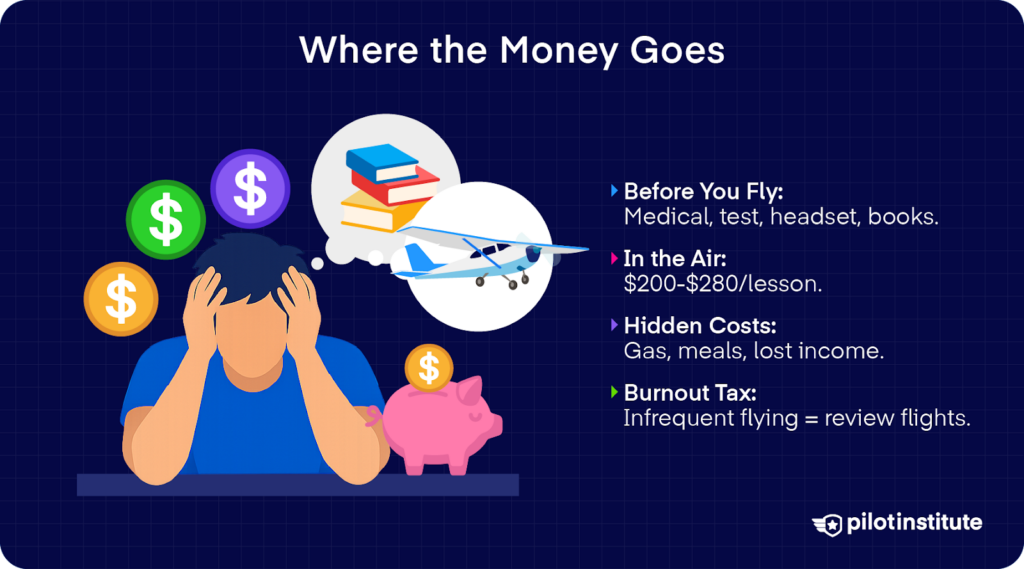
You will spend money long before your first solo. You need a medical certificate, a written test, and a practical test. Each one comes with a fee.
You also need gear. A headset alone can cost as much as a short vacation. Add books and supplies, and you have already invested a serious amount before logging a single hour.
That brings us to the big-ticket item: hourly flight costs.
A typical trainer rents for around $150 to $200 per hour wet. On top of the aircraft cost, your certified flight instructor charges their own hourly rate, usually somewhere around $50 to $80 per hour.
When you combine the two, a single one-hour lesson can easily run $200 to $280.
Is that all? Not quite.
You also pay to get to the airport. You buy meals there. You may lose income if you leave work early.
All these costs together rarely ever show up on a flight school brochure, but they absolutely show up in your bank account.
Factor Burnout Inflation
So, how should you pace your training? Spread things out over several months, and the financial burden could be more manageable.
That sounds promising, but what’s the catch? Well, stretch things out too far, and you might also stretch yourself too thin.
You could lose your muscle memory and momentum, and your instructor ends up reteaching concepts you already covered.
Remember, those review flights are going to cost the same as the original ones.
Training more frequently keeps your skills fresh and lets you finish sooner. Most full-time students complete their private pilot training in about three to six months when they fly multiple times per week.
If you fly less than once a week, you might prolong that timeline into six or twelve months or even longer.
2. Build Your Flight-Training Savings Before You Start
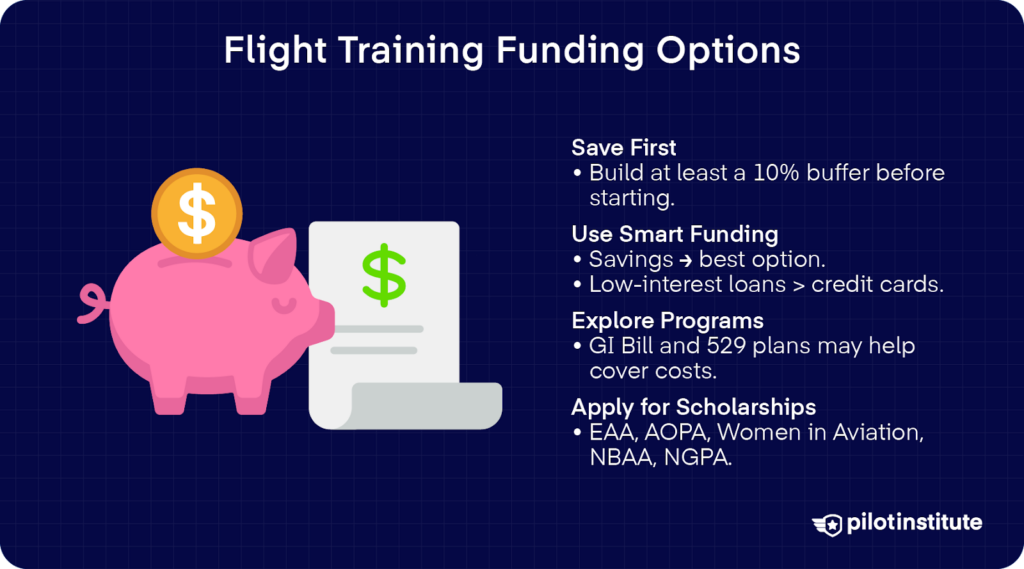
If you’re smart about your budget, you should save a contingency of at least 10 percent before you start lessons. When life throws you a surprise, that buffer keeps you flying without stress.
Savings
But where could the money come from? Cash savings is the cleanest path.
If you can afford to set aside a part of each paycheck for six months to a year before starting, go for it. You’ll enter training with complete financial freedom.
That could mean a delay in the start date. But for some of us, it’s the cost of being able to train full-time.
Loans
A zero-interest family loan can be the next best thing if savings alone won’t cover it. You’ll want to treat it like a real financial agreement. That’s to keep the relationship healthy and the accountability clear.
Credit unions often offer low-APR personal loans. They’re also usually a lot cheaper than credit cards.
A personal loan at 7 or 8 percent is far less painful than putting lesson after lesson on a card charging 22 percent.
There are also private student loans made specifically for flight training. They’re designed with the unique costs in mind.
GI Bill and 529 Plan
Are you a military veteran? Then you should seriously consider the GI Bill. The education benefits can help pay for flight training at VA-approved pilot schools. You’ll need your PPL first, or enroll in a college aviation degree program that includes private pilot training.
Then there’s the 529 plan, which until recently was largely off-limits for standalone flight training until last year.
You can now, potentially, use 529 funds for your expenses at qualifying flight schools.
Scholarship & Grant Playbook
If loans and personal savings aren’t enough, or if you’d rather not pay full price, you should check out scholarships and grants. Unlike loans, this is money you don’t pay back.
But what if you’re not a straight-A honors student or a military vet? You don’t need to be any of those to qualify!
Give these scholarship programs a look:
- EAA Ray Aviation Scholarship
- AOPA Flight Training Scholarships
- Women in Aviation International Scholarships
- NBAA Scholarships
- NGPA Scholarships
3. Choose the Right Training Path for Wallet & Lifestyle
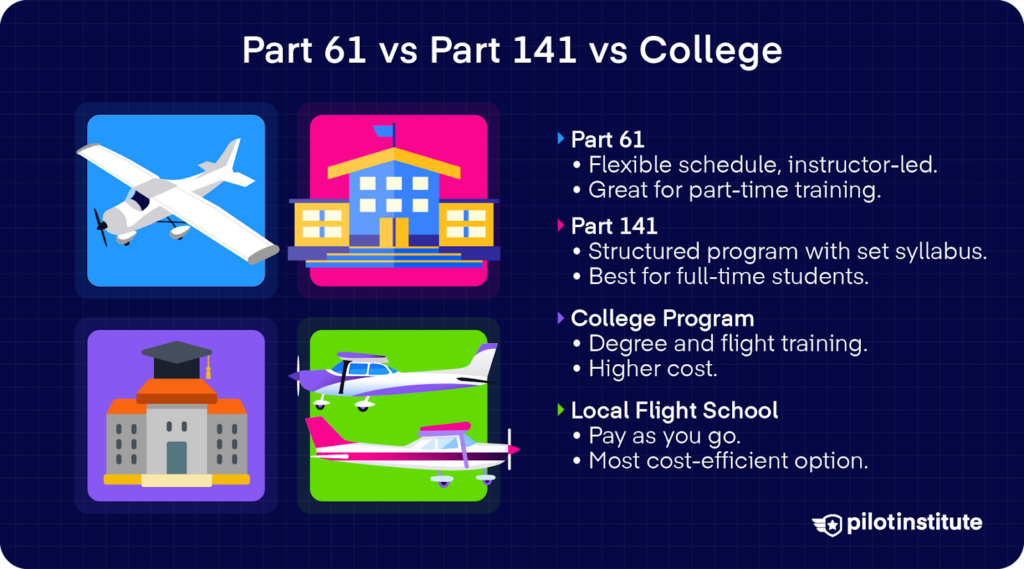
Not all roads to a private pilot certificate look the same. The one you pick will shape everything from your weekly schedule to your bank account balance.
Part 61 vs. Part 141 vs. Accelerated Academies
Flight schools operate under different regulatory frameworks. You’ll find most of them are under either Part 61 or Part 141 of 14 CFR.
What’s the difference? Part 61 is the more flexible option. Your instructor tailors the training to you, and you can schedule lessons whenever it works for both of you.
Part 61 could be a terrific choice if you’re training on weekends or otherwise juggling flying with other life stuff.
If you thrive under structure and you can fully commit to training, Part 141 may be the track for you. These schools operate under an FAA-approved training course outline, with a set syllabus and stage checks.
College Programs vs. Local Flight School
Aside from the regulatory framework, there’s another fork in the road: do you train at a university aviation program or at a local fixed-base operator?
College aviation programs bundle flight training with a traditional degree. You get to kill two birds with one stone: a bachelor’s degree and your pilot certificates.
But university programs come with extra costs. After all, you’re not just paying for flight training. There’s also tuition for non-aviation courses, campus housing, meal plans, and whatever else the bursar’s office charges.
Training at a local flight school, on the other hand, strips things down to the essentials. You pay for the aircraft, and you pay your instructor.
If you already have a college degree or simply don’t want the four-year commitment, a local flight school is usually the most cost-efficient path.
4. Schedule Like a Pro: Time Management That Saves Money
You’ve figured out what training costs and how to pay for it. Now, how will you structure your training days?
Use Three-Hour Blocks
You might assume that a one-hour block booking for the day equals one hour of flying.
Nope. Not even close.
How come? Well, think about everything that happens around the actual flight. The clock runs even on your pre-flight, while you’re in line for take-off, or as you taxi back to the ramp.
That’s easily 20 to 25 minutes at least before your wheels even leave the ground.
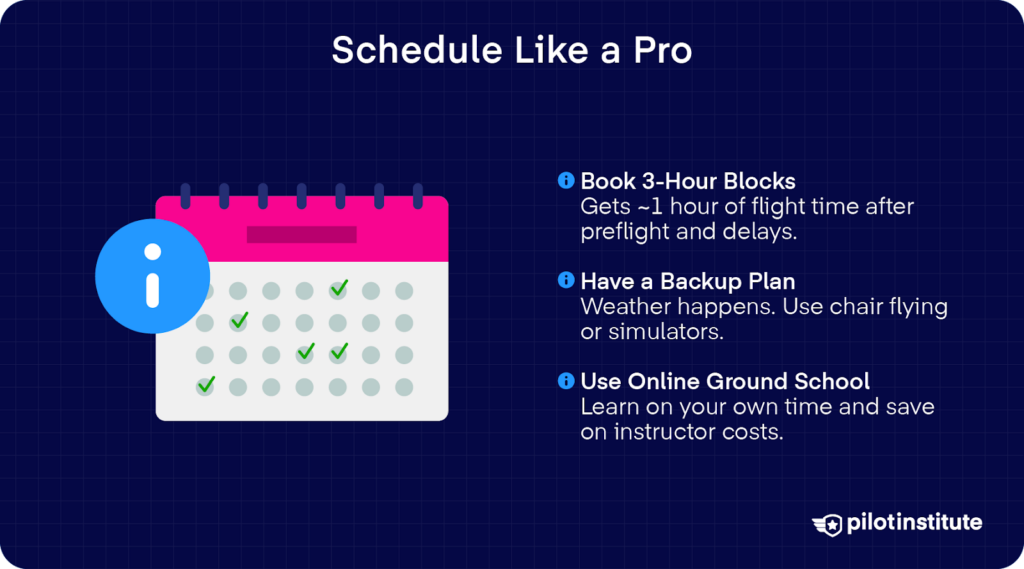
So, what’s the sweet spot? About one hour of airborne time is ideal, especially if you’re pre-solo. And to get that, you should be booking roughly three-hour blocks with your instructor.
It should give you about 20 to 30 minutes for the pre-flight briefing and setup. Run-up and holding could easily eat another 20 to 30 minutes, especially during peak season.
You have 20 to 30 minutes to fly to your area assignment and back, an hour for actual practice (give or take), and another 20 to 30 minutes for the debrief afterward. You also have an extra margin for any possible delays.
Much longer than that, though, and fatigue starts working against you.
Build Weather & Maintenance Plans
Here’s something that will definitely happen during your training. You’re going to show up at the airport ready to fly, and you won’t be able to.
The ceiling may have dropped to 800 feet. The aircraft may be down for an unscheduled magneto check. Welcome to aviation.
What’s your backup? You’ve got plenty of options, and chair flying is near the top.
If you haven’t heard of it, it’s exactly what it sounds like. You sit in a chair and close your eyes or tape a cockpit poster to the wall. Then, physically walk through your procedures step by step.
Hands moving to where the controls would be, mouth calling out the checklist items, feet pressing imaginary rudder pedals.
It sounds silly until you realize that students who practice chair flying finish in fewer hours.
If your school has a Redbird or other AATD (advanced aviation training device), a down-weather day is perfect for simulator time.
Sim rates run way less per hour than aircraft rental, and the FAA allows you to log a portion of those hours toward your requirements.
Online Ground School
Online ground school is worth mentioning because it’s one of the easiest ways to save both time and money.
Instead of paying your CFI’s hourly rate to sit in a classroom and cover theory, you can knock out the aeronautical knowledge requirements on your own schedule for a fraction of the cost.
Study at midnight in your pajamas if that’s when your brain works best. The flexibility alone means fewer scheduling conflicts.
5. Spend Smarter in the Airplane
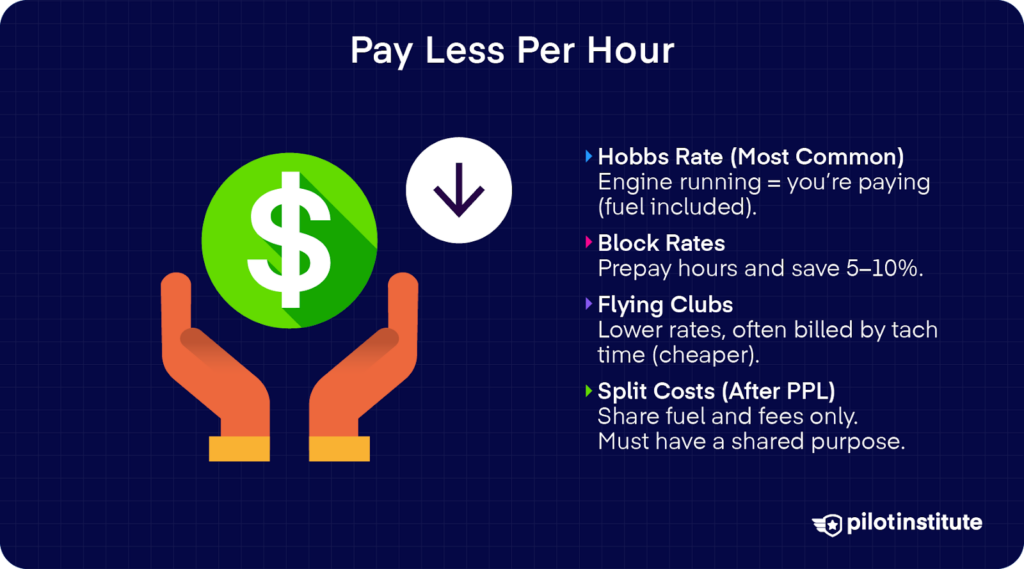
By the way, remember that not all rental rates are created equal. The sticker price posted on a flight school’s wall is rarely the only option.
Hobbs Rate
The most common arrangement at a standard FBO or flight school is the wet Hobbs rate. It’s also the basis of pilot logbook flight hours for most general aviation operations.
“Wet” means fuel is included in the hourly price.
Most rental operations are billed by the Hobbs meter, which in most rental aircraft, is activated by an oil pressure switch.
That means you’re paying for every second the engine is running. Yes, even on the ground.
Block Rates
Are your logbook hours always the same as the hours you’ll pay for? Good news: you can pay less. Block rates are the first lever you can pull.
How does it work? You pay upfront for a chunk of hours (usually 10 or 20), and the school gives you a per-hour discount in return. It’s not unusual to see 5 to 10 percent off the standard rate when you buy in bulk.
On a $180-per-hour airplane, a 20-hour block at 5 percent off saves you $180. That’s basically a free hour of flight time!
Flying Clubs
Flying clubs are a different animal entirely. A club is typically a member-owned organization where a group of pilots shares access to one or more aircraft.
You pay a one-time buy-in, monthly dues, and then an hourly rate that’s usually well below what an FBO charges.
But what does that get you? Well, one of the biggest flight club perks is reduced rates.
Most clubs bill by tach time rather than Hobbs time. The tach meter runs slower than real time whenever the engine is below its calibration RPM.
On a typical training flight, tach time runs roughly 75-85% of Hobbs time.
So a flight that reads 1.0 on the Hobbs might only register 0.8 on the tach. Combined with the lower base rate, the effective cost per hour of actual flying can be dramatically less than an FBO rental.
Share Costs Legally
Once you have your private pilot certificate in hand, the question of sharing flight costs with friends and family will come up almost immediately.
Can your buddy chip in for fuel when you fly somewhere together? Well, yes, but with important limits.
If you fly two other passengers somewhere, you split the allowable costs three ways, and you must pay at least your one-third share.
And the shareable expenses are limited to the direct operating costs: fuel, oil, airport fees, and rental charges.
You can’t split maintenance, insurance, or hangar costs with passengers on a particular flight, even if you own the airplane.
Another important rule: the FAA requires you and your passengers to share a ‘common purpose’ for the flight. You can’t advertise rides to strangers or fly people somewhere only they need to go.
6. Prevent Burnout Before It Starts
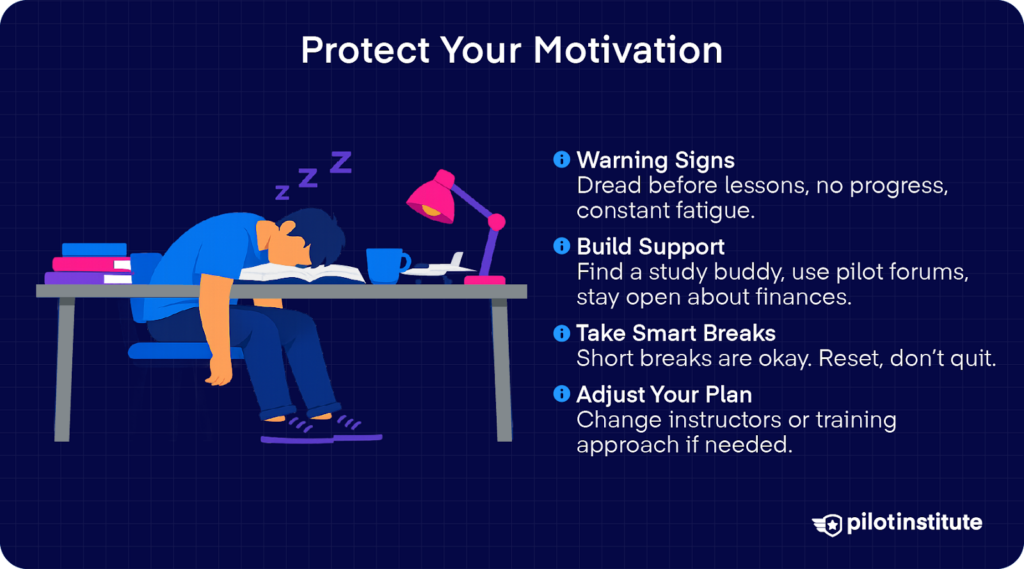
Flight training is a marathon disguised as a series of sprints, and burnout can sneak up on you if you’re not watching for it.
What does it look like? A creeping sense of dread before lessons, where you used to feel excited. Hitting a plateau that stretches beyond three consecutive flights with no visible progress.
But even worse, there’s chronic fatigue that doesn’t go away with a good night’s sleep. Oftentimes, it ties into stress outside the cockpit.
Financial pressure. Work demands. Problems at home. These are entirely different issues, and they’re going to need a deliberate and prolonged solution.
Build a Support Crew
Flying can feel isolating, especially when you’re the only person in your social circle doing it.
How can you fix that? A pilot forum is a great place to ask for advice. You can vent about a rough lesson or celebrate a milestone with people who actually understand what soloing feels like.
Find a study buddy, ideally someone at a similar stage in training.
You should have a conversation with your family about finances, too. That’s because financial stress is one of the biggest silent killers of flight training momentum.
Keeping your spouse in the dark about how much you’re spending is a recipe for conflict at the worst possible time.
Also, try to schedule a regular progress check with a senior instructor or the school’s chief pilot. A fresh set of eyes will help you catch habits your regular instructor has gotten used to.
Know When to Tap the Brakes
If burnout does start creeping in, the worst thing you can do is just keep grinding. But the answer isn’t always “quit.”
A short pause of a week or two is fine. You’ll need a review flight when you come back, but the skills won’t evaporate.
What if it’s something deeper? Perhaps it’s time to talk to your CFI about a syllabus revamp.
You may need to change the order of lessons or even a different instructor. It’s an awkward conversation, but it’s worth the savings you’ll make in the end.
And if you find yourself questioning whether flying is something you even want anymore, sit with that question honestly. There’s no shame in stepping back.
Whatever you decide, document where you left off. Write down what you’ve completed, what needs work, and what your CFI recommended next.
If you do come back, whether it’s two weeks or two years later, those notes will save you from hours of retracing your steps.
7. Lifestyle Cuts That Add Flight Hours
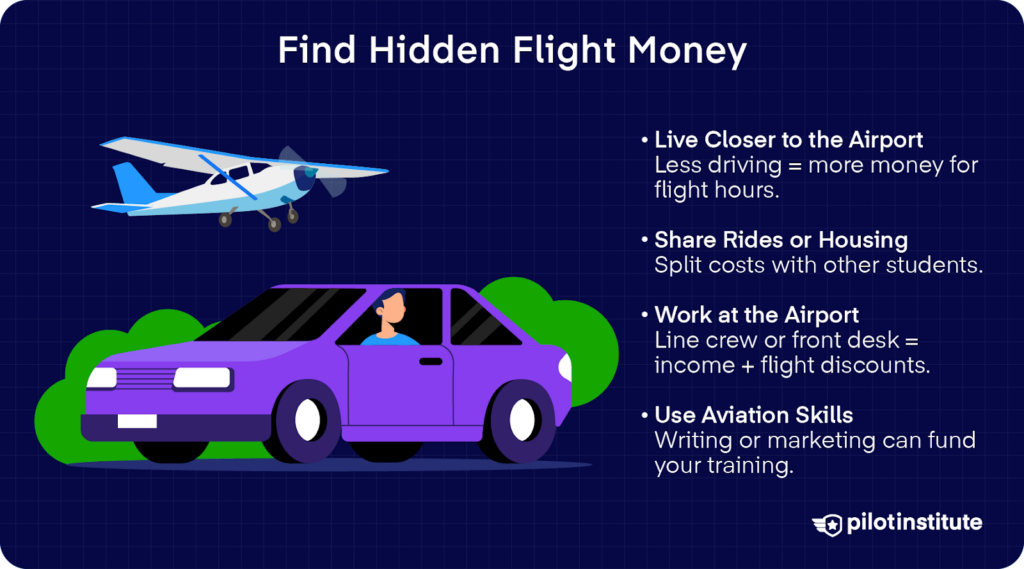
Now, let’s look at the rest of your life, because there’s flight money hiding in your everyday spending if you know where to find it.
Housing & Transportation
This one is worth running the actual numbers. Say you currently live 25 miles from the airport and drive a car that gets 25 miles per gallon. That’s two gallons round-trip, three or four times a week during active training.
Now, imagine you move five miles from the field. Your round-trip drops to two-fifths of a gallon, and your commutes cost a fifth of what they used to.
Not everyone can relocate, obviously. But if your lease is coming up anyway, consider moving somewhere closer.
If you want to take it a step further, you can rent a crash pad near the airport with other students. It’s not glamorous, but neither is running out of money at hour 45.
Ride-sharing with fellow students is another easy win. If two of you train at the same school and live in the same direction, swapping driving days easily cuts your fuel bill in half. It even gives you someone to debrief with on the way home.
Aviation Side Hustles
Want a side hustle that keeps you close to flying? Working at or near the airport puts money in your pocket while you learn by osmosis.
A line-service technician is the most usual entry point. You’re fueling aircraft and marshaling on the ramp.
You could get a 10% to 25% discount if you work at your flight school. Plus, you can have access to training resources and opportunities to build your network.
Dispatch and front-desk roles at flight schools are another option, and they come with the added benefit of learning how the scheduling and operations side works.
If you have writing or marketing skills, aviation copywriting pays surprisingly well.
Flight schools and aviation startups all need content, and your pilot knowledge makes you more credible for the role.
8. The 6-Month Sample Plan
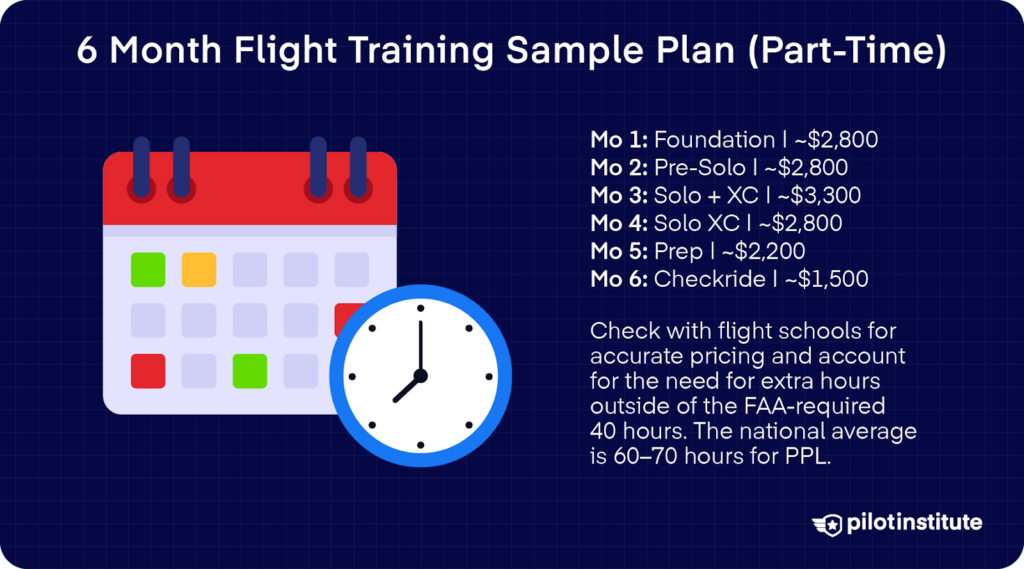
Now, let’s say you’re training part-time at about two to three lessons per week. You’ve got $3,000 per month available for training. How can you arrange your training month by month?
- Month one is for building your foundation. You’re logging roughly 10 to 12 hours, which adds up to around $2,800. Since everything is new and exciting, your burnout risk is low, maybe a 1 out of 5.
- Month two picks up the pace toward solo. That could be another 10 to 12 hours, another $2,800 or so.
- Month three is where you solo and start dual cross-country work. Hours climb to 12 to 15, and spending hits about $3,300 (those longer flights cost more). The risk of burnout at this stage creeps to a 3 as the novelty fades.
- Month four is the solo cross-country building phase. You’re logging 10 to 12 hours and spending roughly $2,800. Burnout risk holds at a 3.
- Month five is maneuver polishing and checkride prep, around 8 to 10 hours. $2,200 spent, burnout risk at a 2 because you can see the finish line.
- Month six is the mock checkride and the real thing. Maybe 4 to 6 hours of flying plus the examiner fee, totaling about $1,500.
- Grand total: roughly 54 to 67 hours and $15,000 to $17,000.
Keep a running spreadsheet and follow a simple rule. If your remaining balance drops below the estimated cost of the next milestone plus a 10 percent buffer, flag it.
What does that tell you? You should either pause or adjust the timeline.
Conclusion
Learning to fly costs real money and genuine commitment. But you now have something most student pilots don’t have when they start: a plan.
You know what the expenses actually look like, where the funding comes from, how to structure your schedule, and where the hidden savings are. The only thing left is to start.
Book that discovery flight. The certificate won’t earn itself, but thousands of people earn one every year, and not a single one of them regrets it. Now, it’s your turn.